aspeca

Forum Replies Created
-
AuthorPosts
-
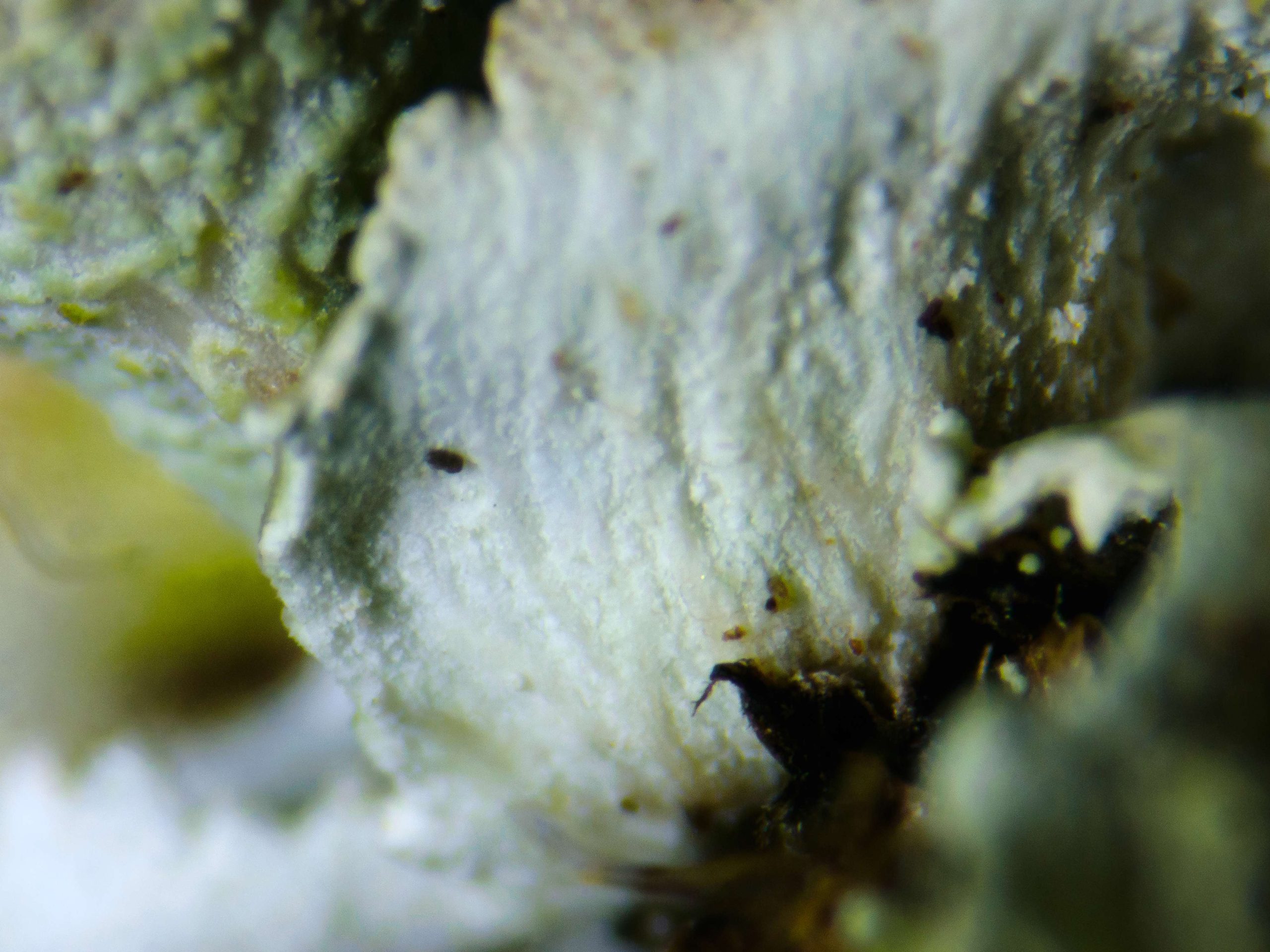
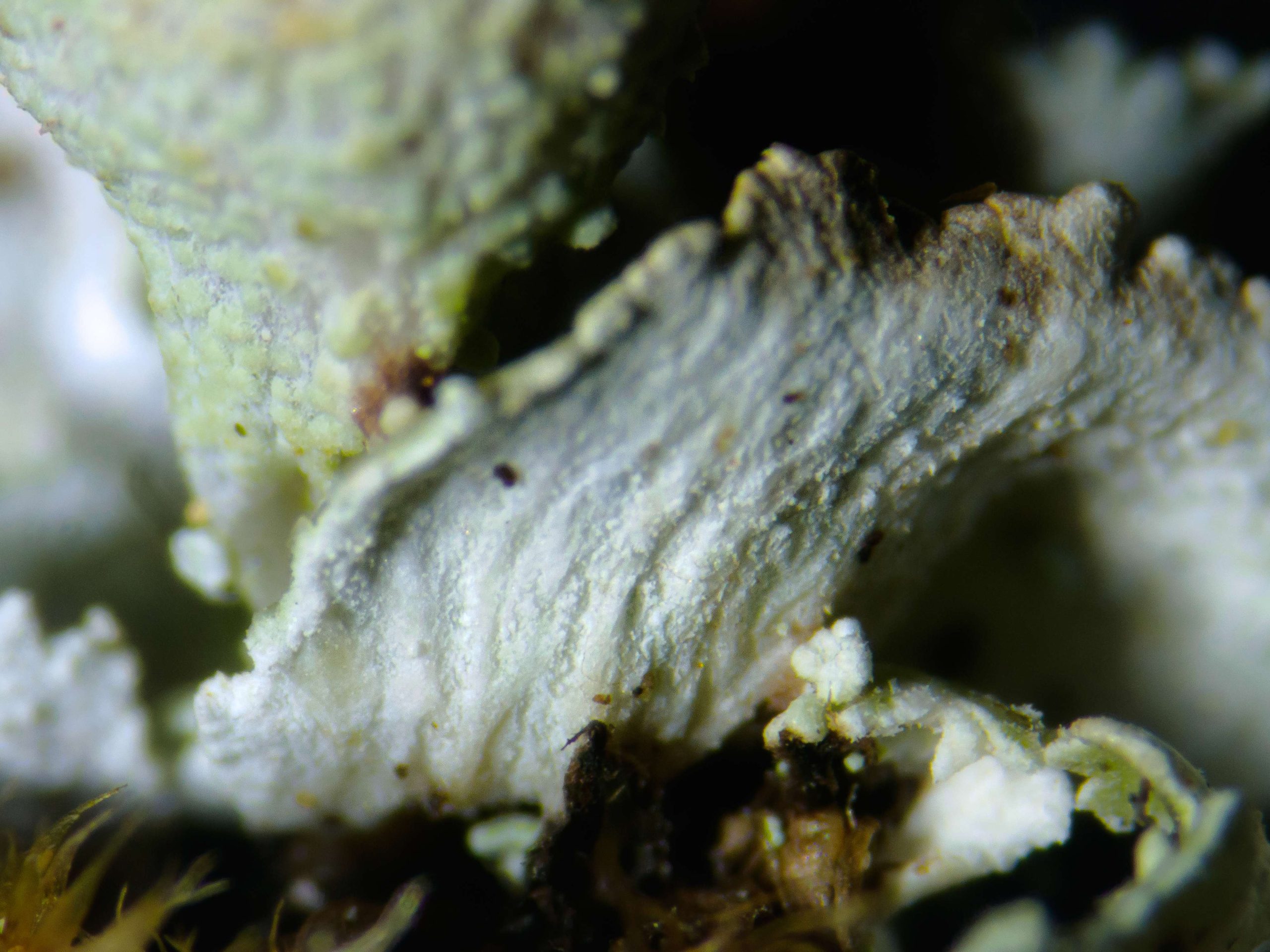
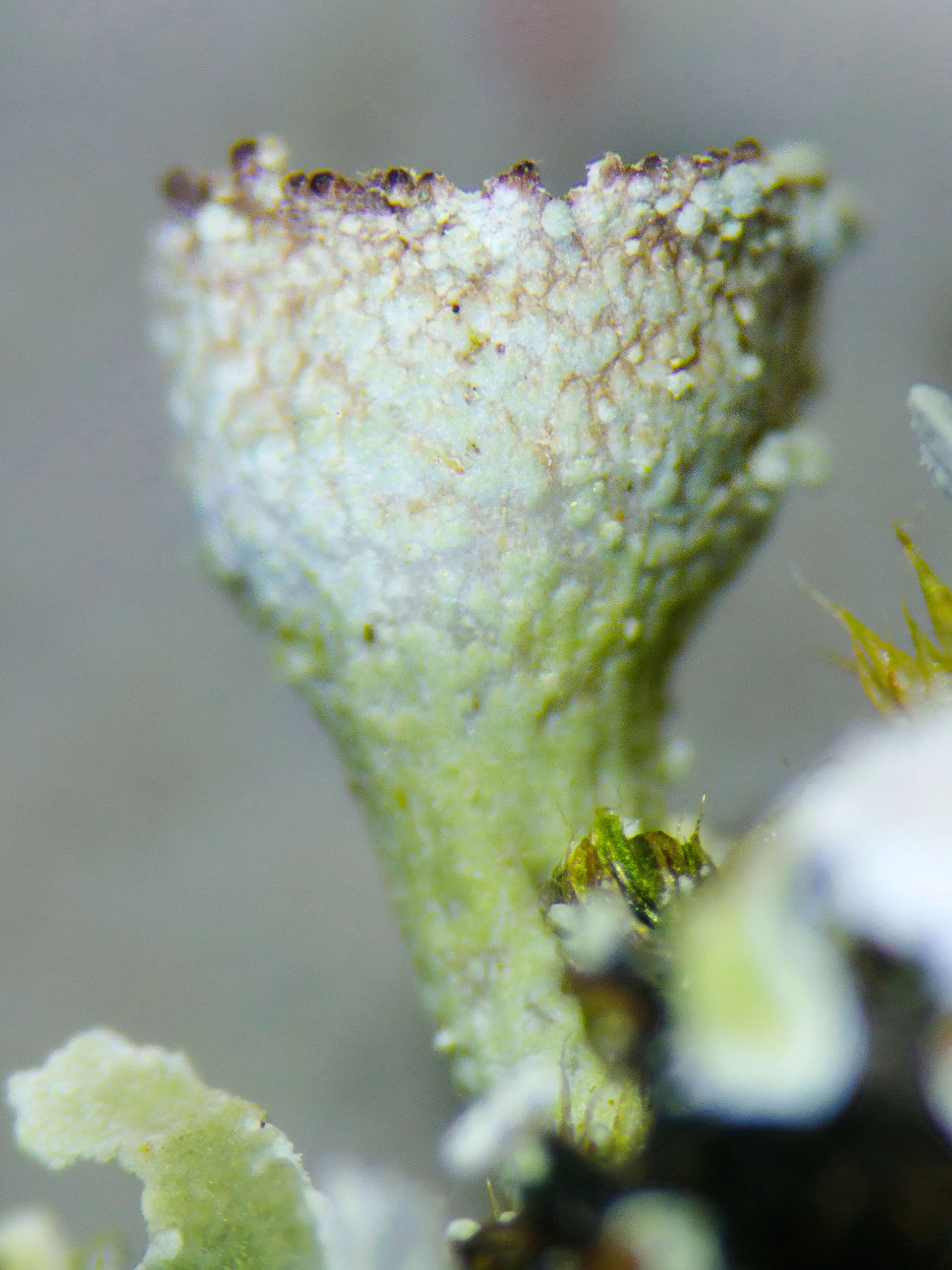
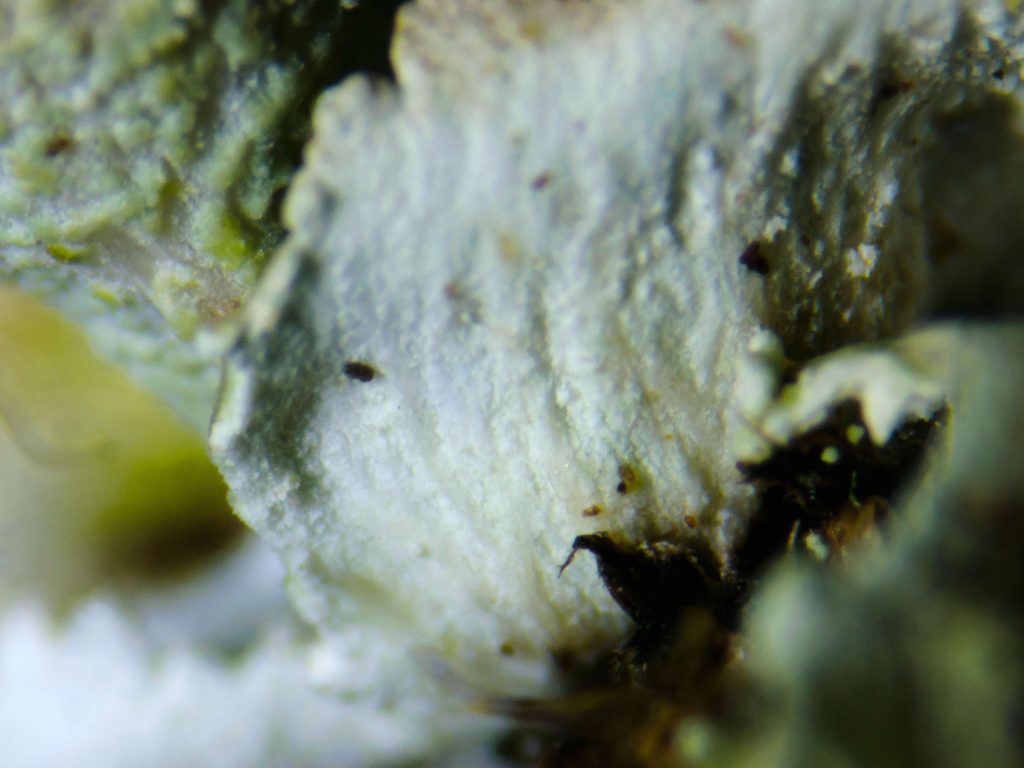
Dear Neil — Just following up on the above — I’ve examined the squamules in my collected material and I believe I’ve found the tell-tale veining you descibed. But as this would be the first record of
C. cyathomorphafor VC101 Kintyre, I’d be grateful to have your confirmation. Photos below. The veining was visible on the largest squamule in my material. I’ve tried to provide photographs with both direct and oblique lighting to help the slightly raised veining stand out from the otherwise ‘mealy’ underside (described on the ITALIC 8.0 website as ‘floccose’). I’ve also provided a better photograph of a podetium, to show the verrucose but generally egranulose and esorediate texture that you said also helped to separate
C. cyathomorphafrom C. pyxidataand C. chlorophaeasens. lat. Many thanks again,
Anthony
[attachment=3]Cladonia cyathomorpha 20240813-A11 Kilmichael of Inverlussa.jpg[/attachment] 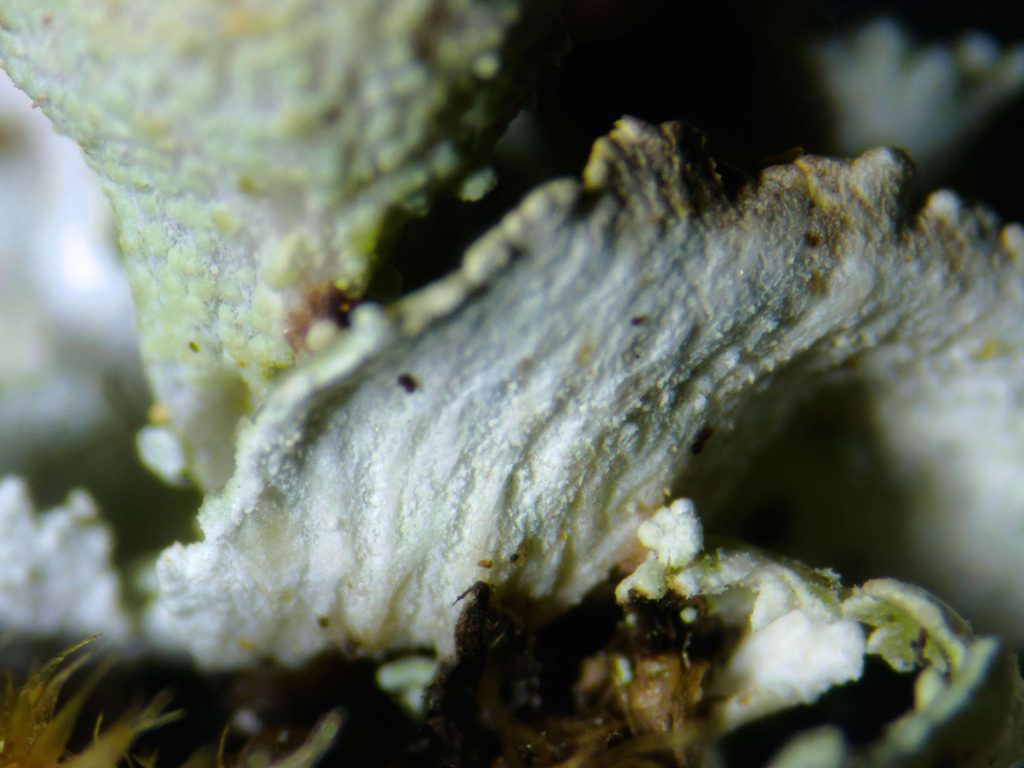
[attachment=2]Cladonia cyathomorpha 20240813-A12 Kilmichael of Inverlussa.jpg[/attachment] 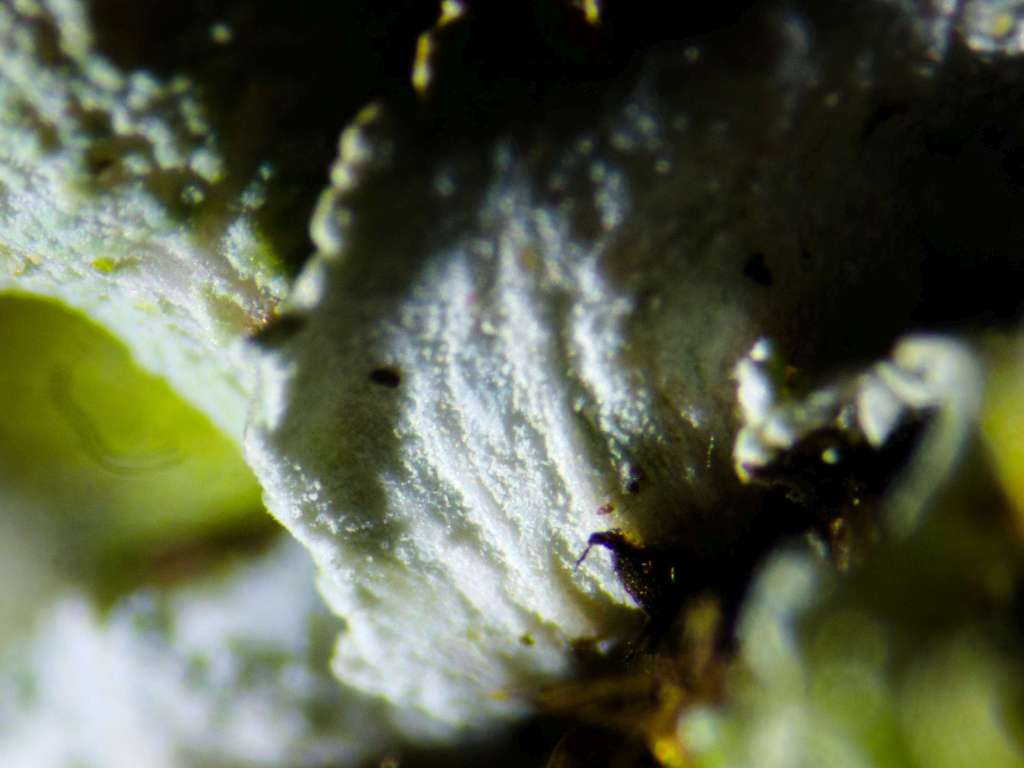
[attachment=1]Cladonia cyathomorpha 20240813-A13 Kilmichael of Inverlussa.jpg[/attachment] 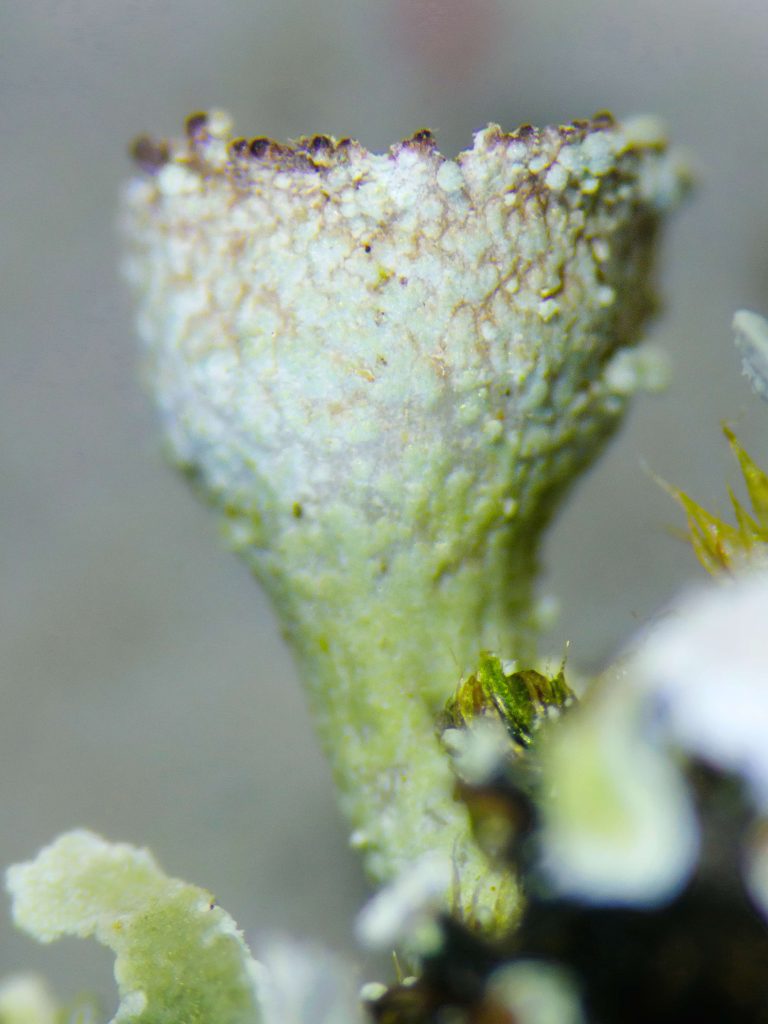
[attachment=0]Cladonia cyathomorpha 20240813-A04 Kilmichael of Inverlussa.jpg[/attachment] Dear Neil — Very many thanks for this advice. It really clarifies matters for me. I was looking for K+ yellow turning red because LGBI3 glosses the ‘K+ yellow-red’ in LBGI2 as ‘presumably yellow -> red’. It’s helpful to know that you yourself haven’t ever seen that reaction with
C. cryptochlorophaea, and I’m pleased that my suspicions weren’t misplaced that I was perhaps just looking at a typical brownish K-reaction to fumarprotocetraric acid. Your pointer on the KC-test is especially useful. I was a bit excited about the possibility of having witnessed this ‘KC+ wine-red’. I thought the phrase meant perhaps more a light beaujolais than a deep cabernet — but from your description it sounds more the other way round. Perhaps I should just stick with the catch-all
C. chlorophaeasens. lat. going forward! Thanks for the steer to
C. cyathomorpha, which I’d discounted because I thought the veining would be more obvious than you’ve explained. Another bit of fieldcraft that’s good to know. I’ll examine the larger squamules on my specimen for any evidence. Enjoy your Cornish fieldwork — glad the goats are cooperating with rare lichen conservation!
Thanks again,
Anthony
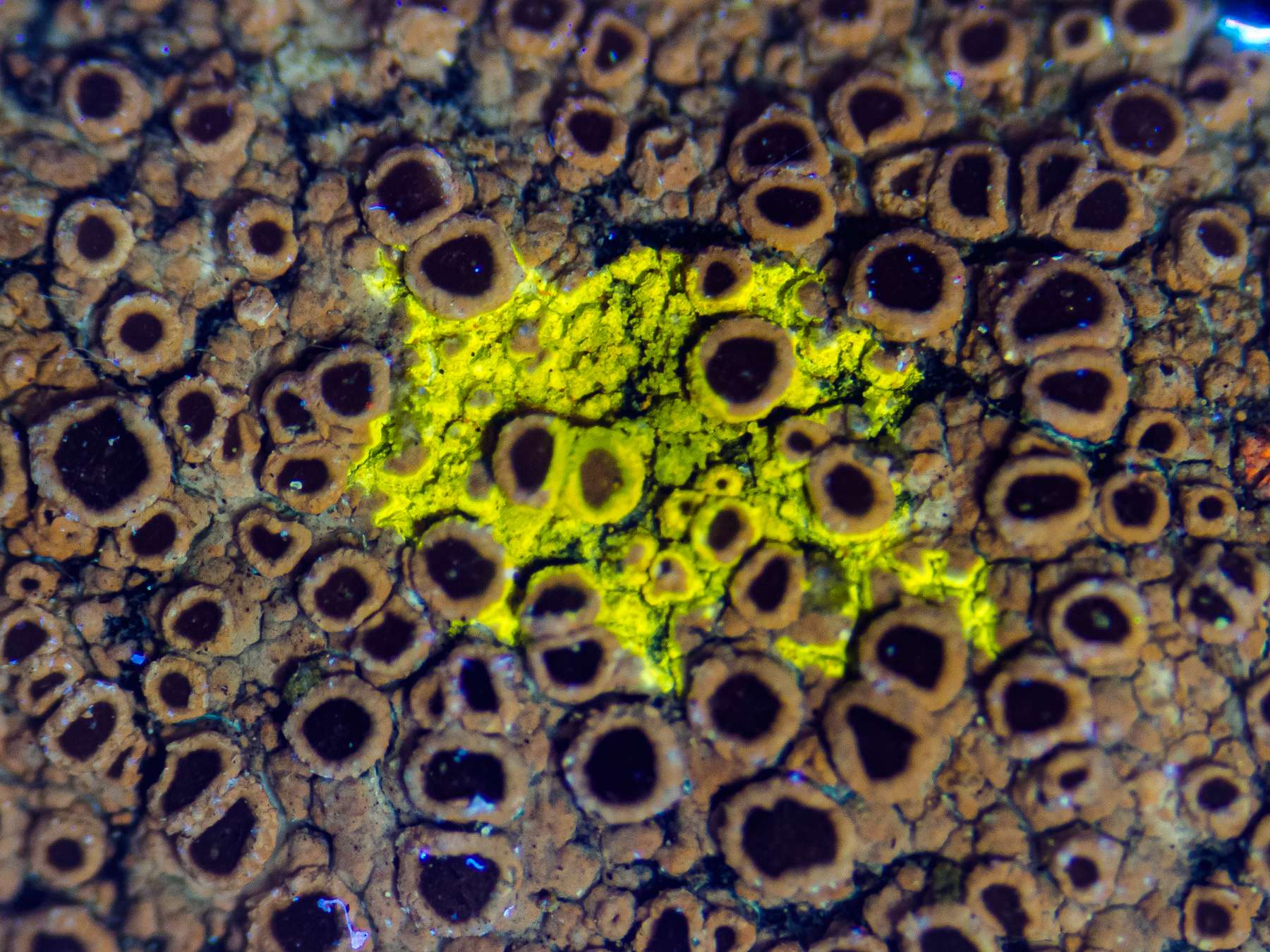
Many thanks for this, Neil. I also find that a visible-light filter makes quite a difference. For those thinking about upgrading, it’s possible to obtain a UV torch with a filter fairly inexpensively: the Alonefire SV16 retails for £16.00. I’ve been happy with mine, though more recently I purchased a more powerful Alonefire SV18 for greater ease of use outdoors during the day. It retails for £34.00, and it also has two settings.
I’m not sure how Alonefire compares with Weltool, though with UV torches I think you probably get what you pay for. But even if you’re on a budget, a torch with a filter is better than one without.
Some photos of results with the Alonefires below. The final two were taken in situ outdoors during the day, rather than indoors with a collected specimen.
Best,
Anthony

[attachment=5]Cladonia rangiformis 20240524A-06 Dunwich.jpg[/attachment] 
[attachment=4]Lecanora expallens 20240524A-02 Dunwich.jpg[/attachment] 
[attachment=0]Lecanora expallens 20240721B-07 Southwold.jpg[/attachment] 
[attachment=3]Lecanora hybocarpa auct br 20240524A-03 Dunwich.jpg[/attachment] 
[attachment=1]Usnea flammea 20230811B-10 Kilmichael of Inverlussa.jpg[/attachment] 
[attachment=6]Cladonia portentosa 20240812A-02 Kilmory.jpg[/attachment] 
[attachment=2]Lecidella elaeochroma f elaeochroma 20240411A-04 Bungay.jpg[/attachment] Pier-Luigi did reply to the specific question about the value of differentiating between the two varieties of P. furfuracea. He agrees that they’re just chemical strains, and he suggests that the rank of forma(lower in the taxonomic tree than varietas, and indicating more minor differences) might be better in this case. At the same time, he favours retaining the two varieties because he thinks that evidence suggests that there are important ecological/distributional differences between them. As you pointed out, Di, LGBI3 also agrees that
P. furfuraceavar. cerateaappears more common in the UK, and particularly more abundant in the north. Not sure if there’s an explanation why, but without recording varieties, the data wouldn’t exist to support one. And more generally, Pier-Luigi takes the view that ‘taxonomists should provide names not only for taxonomists’, and that infraspecific epithets such as
varietasand formaare a good way to capture information such as ecology, distribution, etc. I take it that he’s reminding us that taxonomy isn’t wholly the same as phylogeny, at least below the level of species. Screenshots of his thread:

[attachment=3]Screenshot 2024-09-07 at 19.24.04.png[/attachment] 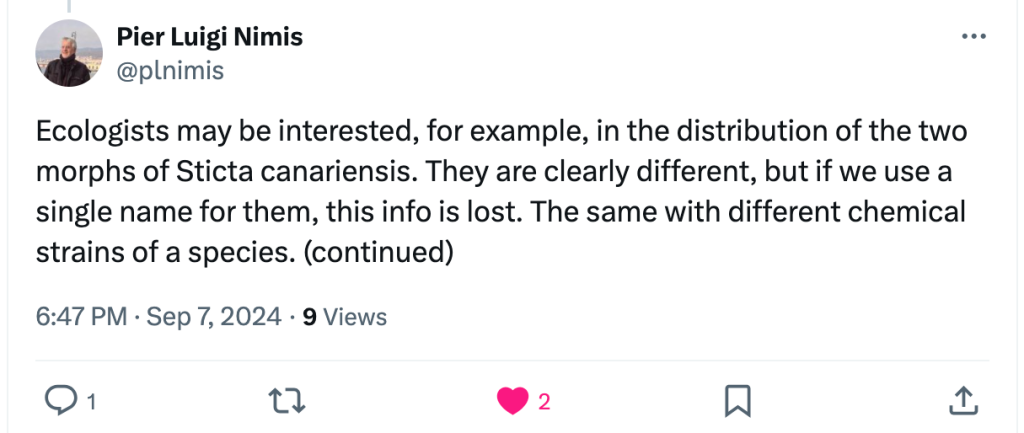
[attachment=2]Screenshot 2024-09-07 at 19.24.16.png[/attachment] 
[attachment=1]Screenshot 2024-09-07 at 19.24.30.png[/attachment] 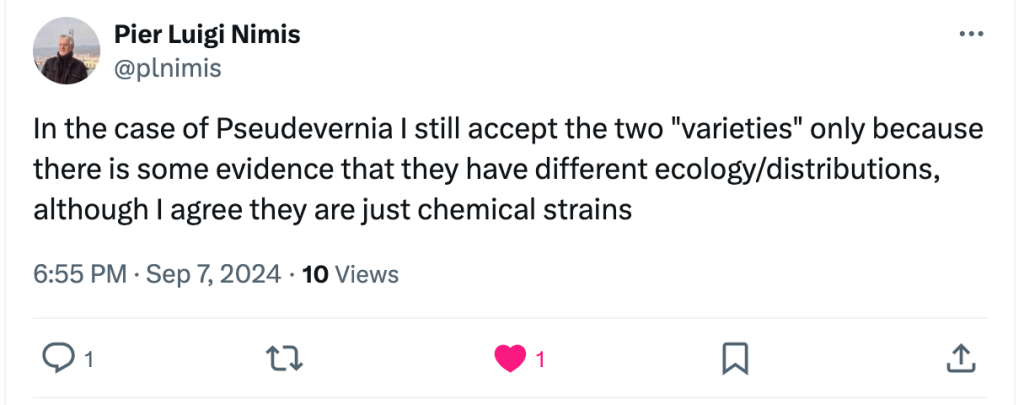
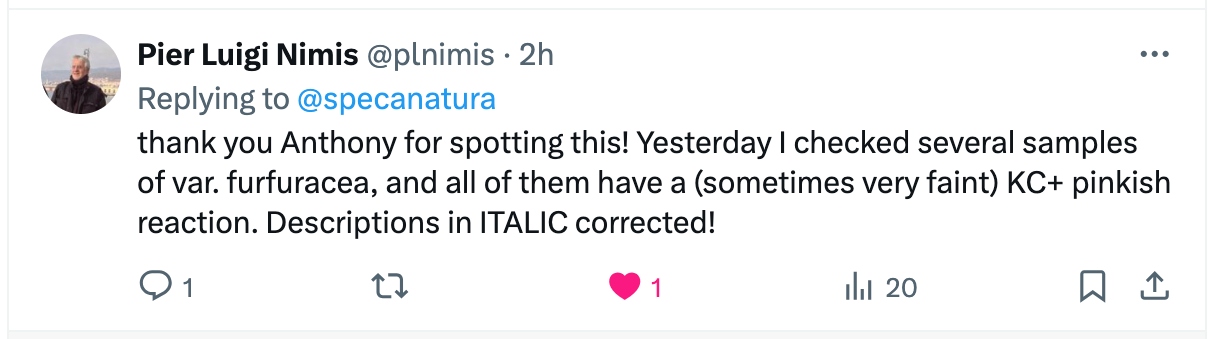
[attachment=0]Screenshot 2024-09-07 at 19.25.01.png[/attachment] As promised above, I was in touch with Pier-Luigi for his views. He tested some samples of P. furfuraceavar. furfuracea, and he also found a (sometimes very faint) KC+ pinkish reaction in the medulla. He’s now updated the species description in ITALIC 7.0 to reflect our shared observations — https://italic.units.it/index.php?procedure=taxonpage&num=1907 ” class=”bbcode_url”> https://italic.units.it/index.php?procedure=taxonpage&num=1907 
[attachment=0]Screenshot 2024-09-07 at 17.10.59.png[/attachment] Pier-Luigi hasn’t yet expressed a view on the phylogenetic validity of these varieties, in light of Paul’s comments above. I’ve asked him directly, and if he responds, I’ll report back.
Excellent stuff, Di! I’d seen that Hawksworth and Chapman paper on P. furfuraceabefore, but I’d completely forgotten it. The further references that you’ve dug up on a KC+ reaction to physodic acid makes me more confident to leave my record as P. furfuraceavar. furfuracea. It also adds to the question of whether it’s valuable to revisit the species description for
P. furfuraceain LGBI3, if not to correct then perhaps at least to qualify the spot-test results listed there. Also the description in ITALIC 7.0 — perhaps I’ll send a message to Pier-Luigi to ask for his views. Of course, this is all compatible with Paul’s point that the production of physodic or olivetoric acid in
P. furfuraceaisn’t phylogenetically significant. So his implied question remains over whether we should be recording these varieties separately in the first place. That said, insofar as the various BLS numbers are all there to use, your finds certainly help to clarify the way forward for us in the field!
Many thanks, Paul — that’s really helpful to know. I’ve wondered about the status of varieties before — e.g. the
ciliataand tenuisvarieties of Cladonia ciliata, which also seem to have to do with chemistry, or the the furcataand subrangiformisvarieties of C. furcata, which seem to have to do with morphology. Are these (and perhaps others) also similarly epigenetic distinctions, or ‘environmental morphs’ as I’ve sometimes seen them called? I’ve wondered about this because so many other lichens are highly variable both chemically and morphologically — some of the Ramalina species come to mind — yet we don’t record separate varieties of them.
Are varieties a bit of a holdover from pre-molecular days, when lichenologists were making fine distinctions according to morphology, and (somewhat later) according to chemistry? Can we ‘field lichenologists’ assume that, if varietal names still remain current in the BLS Taxon Dictionary, that there’s some real phylogenetic distinction to be made, or at least that the jury is still out?
Coming back to
P. furfuracea— thanks for the advice to use BLS 1192 when in doubt about variety. I’ll need to contact Janet to update my past record to that number, and to ensure that both the C- and KC+ red results are recorded in the notes. Many thanks for that very helpful reply, Di. It’s good to know that others have shared my experience with C- but KC+ red P. furfuracea, and what’s more that I didn’t simply mistake a fleeting or weak C-reaction for a negative! I collected my specimen while on holiday in the North Pennines, and as it’s pretty uncommon in East Anglia, it would be difficult for me to investigate further. It does seem to make sense to consider such specimens as
P. furfuraceavar. furfuracea, because as you say the C-test is decidely negative. As mentioned, I recorded my specimen back in December as P. furfuraceavar. furfuraceafollowing Dobson, and I’m happy to leave it there for now for the same reason. But that’s to say that the KC-test isn’t diagnostic, but the C-test is. I’m wary of completely committing to this Dobson/Lichens Marins/Wirth position without understanding why the LGBI/ITALIC 7.0 (and as you found also AFL Lichenologie) species descriptions differ!
I’m also wary of using the BLS number for
P. furfuraceasens. lat. to record these specimens, unless e.g.Paul Cannon specifically directs it. My worry is that it’s possible that number was used at a time when P. furfuraceahadn’t yet been distinguished from other species, and the data tagged with it is classed as unreliable. But maybe not — I don’t know myself what the history of that BLS number might be. If you find more of this C- but KC+ red
P. furfuraceain Warwickshire, I’d be keen to hear about it! Dear Jenny — In his monograph on pyrenocarps, Alan Orange wrote that the clearest character distinguishing between
Anisomeridium viridescensand Arthopyrenia carneobrunneolais that the involucrellum of the former is K+ green, whereas that of the latter remains brown. Not sure what mount you used for your slides, but perhaps mounting in K might help if you haven’t yet tried it? I think the thallus of
A. carneobrunneolashould also be browner — yours seems to be white in places, which suggests A. viridescensas you’ve already suspected. Best regards,
Anthony
Thanks, Di. It’s great to see that you’ve observed Acremonium-type conidia once again in the same sort of reddened L. hybocarpa auct. br.apothecia. My own observations were in October last year, and I was waiting until the autumn to resume investigations in case the sporulation was seasonal. Even so, I’ve seen the reddened apothecia numerous times so far this year — though I suppose the same discolouration can be caused by other LFs as well. Like you, I’ve observed partial degradation of infected apothecia, with POL+ granules remaining in the healthy tissue. (See my post of 23/11/23 above for a photo.)
But I’ve never seen the windmill-shaped conidia that you’ve observed. Could they be the asteroconidia of
Tremella macrobasidiatathat Mark Powell cited Brian Coppins as having mentioned, in his post of 12/01/2024 above? Or of a related Tremellaspecies? It seems that Tremellaalso causes discolouration of the apothecial disc. I believe T. macrobastidiataasteroconidia might have four arms rather than three, but perhaps there’s some variation. The protologue for
T. macrobastidiatais here: https://www.cambridge.org/core/journals/lichenologist/article/abs/tremella-macrobasidiata-basidiomycota-tremellales-a-new-lichenicolous-fungus-from-the-iberian-peninsula/D1F9462B30AAB676E913E82B70415AF4 ” class=”bbcode_url”> https://www.cambridge.org/core/journals/lichenologist/article/abs/tremella-macrobasidiata-basidiomycota-tremellales-a-new-lichenicolous-fungus-from-the-iberian-peninsula/D1F9462B30AAB676E913E82B70415AF4 Although I’ve never seen asteroconidia of any sort, I happen to have seen ‘dumbell-shaped’ conidia in reddened
L. hybocarpa auct. br.apothecia. Perhaps they come from yet another LF in addition to the putative Acremoniumand the T. macrobastidiata. Some micrographs below (ignore any ‘ Acremonium‘ label on the image files if you can see it, as for now I keep the images in the same photo folder as micrographs of our putative Acremonium). 
[attachment=2]Acremonium sp 20231027B-14 Glandford.jpg[/attachment] 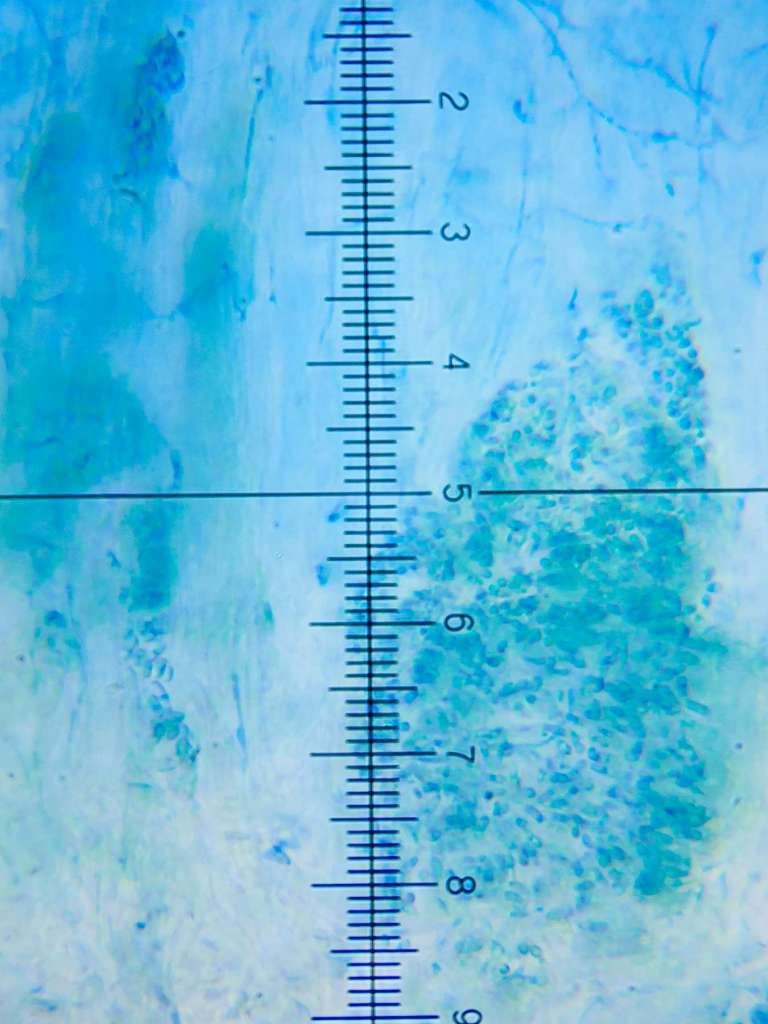
[attachment=1]Acremonium sp 20231027B-15 Glandford.jpg[/attachment] 
[attachment=0]Acremonium sp 20231027B-16 Glandford.jpg[/attachment] Best,
Anthony
Hi Juliet — For what it’s worth, that looks like
C. foliaceato me. I think the little marginal ‘tufts’ of black cilia or hairs, as well as the laminal, globose pycnidia, might be diagnostic. I recently found a specimen that looks very much similar to yours, and which I also concluded to be C. foliacea: white underside (hence the Dutch name ‘Zomersneeuw’); numerous podetia; though no apothecia. For photos and discussion, see https://x.com/specanatura/status/1797978605076828624https://x.com/specanatura/status/1797978605076828624” class=”bbcode_url”> Best regards,
Anthony
Thanks, Peter. They look very much like it. My own micropgraphs of O. niveoatraconidia, for comparison: 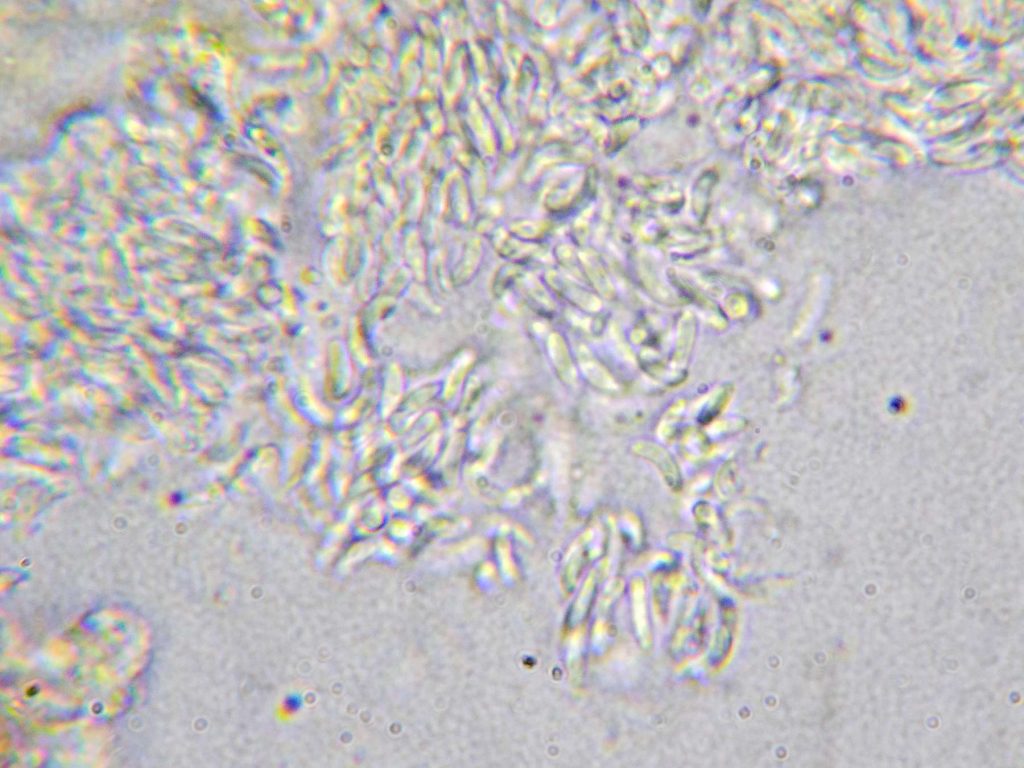
[attachment=1]Opegrapha niveoatra 20230408A-12 Bungay.jpg[/attachment] 
[attachment=0]Opegrapha niveoatra 20230408A-13 Bungay.jpg[/attachment] Many thanks, Neil — that’s very helpful. I’ll check reactions again and post anything I find, but if they continue to come up negative, I’ll record it as C. chlorophaea sens. lat.Congratulations on the
C. peziziformisand other finds! Best,
Anthony
Thanks, Neil. I was originally thinking
Pertusaria hymeneaas well. But I discounted it not only because the thallus wasn’t C+ yellow and because there were only four spores per ascus, but also because the epihymenium didn’t appear to be K+ violet. (I should have mentioned that the unstained micrographs were mounted in K.) On an unrelated note — if you have the chance, I’d be glad of your opinion on a previous post about Cladonia chlorophaea (7th June).
Thanks again,
Anthony
Thanks for asking this question, Jenny. I’ve also been unable to access it. -
AuthorPosts