Forum Replies Created
-
AuthorPosts
-
Hi Chris, That’s a really kind offer. You wouldn’t necessarily need to send the whole pebble. You could just scrape a bit of the ‘infected’ Caloplaca off into a packet if that makes it easier/cheaper for you. It would interest me to compare the Monodictys microscopically with cyanobacterial cells from similar black gunge.
If you don’t have my address, one way of contacting me is via the Garden Survey section of the BLS website:
http://www.britishlichensociety.org.uk/activities/garden-survey Many thanks,
Mark
The recommended way to submit records of unknowns or tentative identifications to the BLS database is to put just the genus in the ‘Species’ column (column J) and then to put a short description in the ‘Record Notes’ column (column R). For a lichenicolous fungus the host can be put in the small scale habitat column (e.g. Z1530 means lichenicolous on Xanthoria parietina). The host can also be stated in the Record Notes column if desired, or if the identity of the host is uncertain too. If a specimen is retained then there are columns to record the record the herbarium and species number. It is incredibly useful if people do this. Brian and I are going to work on Pronectria later in the year, including describing some of the undescribed ones. We will interrogate the database for all the Pronectria records. Fortunately Brian has been submitting records of unknowns in this way for years so we have a quick way of finding details of all the ‘unknown’ Pronectria records.
This has been a fascinating subject for me so I am glad that you posted about your ‘last pebble’. I don’t know any lichenologists who do spore drops but we might get better results if we did… I have ever known lichenologists to measure spores in squash preparations, measuring the ones released from the ascus. This of course does introduce a variable because some people might be more aggressive in their squashing than others and so end up with a greater proportion of immature spores from asci that weren’t really ‘ready’ to give up their contents.
The Monodictys is interesting too. I might have overlooked it as cyanobacterial. One would think that separating eukaryote cells from prokaryote ones ought to be easy since they are so distantly related but I suspect that it is not easy to distinguish them using ordinary light microscopy?
I often find what I take to be cyanobacteria on Xanthoria parietina:
I think those ascospores are fine for Caloplaca. They are septate, with a broad septum. If you are looking at images in books, bear in mind that the published images will be of ‘cleared’ spores. Your micrograph shows spores that appear to be fresh and mounted in water and hence the cell contents partially obscure what we consider to be the ‘proper’ cleared structure. Mounting in K or N should make the spores look like those in the books. If you don’t like using reagents on microscope slides, you can try heating the slide until nearly boiling. Otherwise you will have to wait a few weeks or months for the cell contents to dry up in storage (in herbarium material the spores are always ‘cleared’ by this drying out. I think your orange-yellow lichen could be
Caloplaca marina. Unfortunately that is not confirmed determination (I am a land-lubber and don’t pretend to do maritime lichens on sight). The
Monodictysis still the most interesting thing to me – I have never found it. Mark
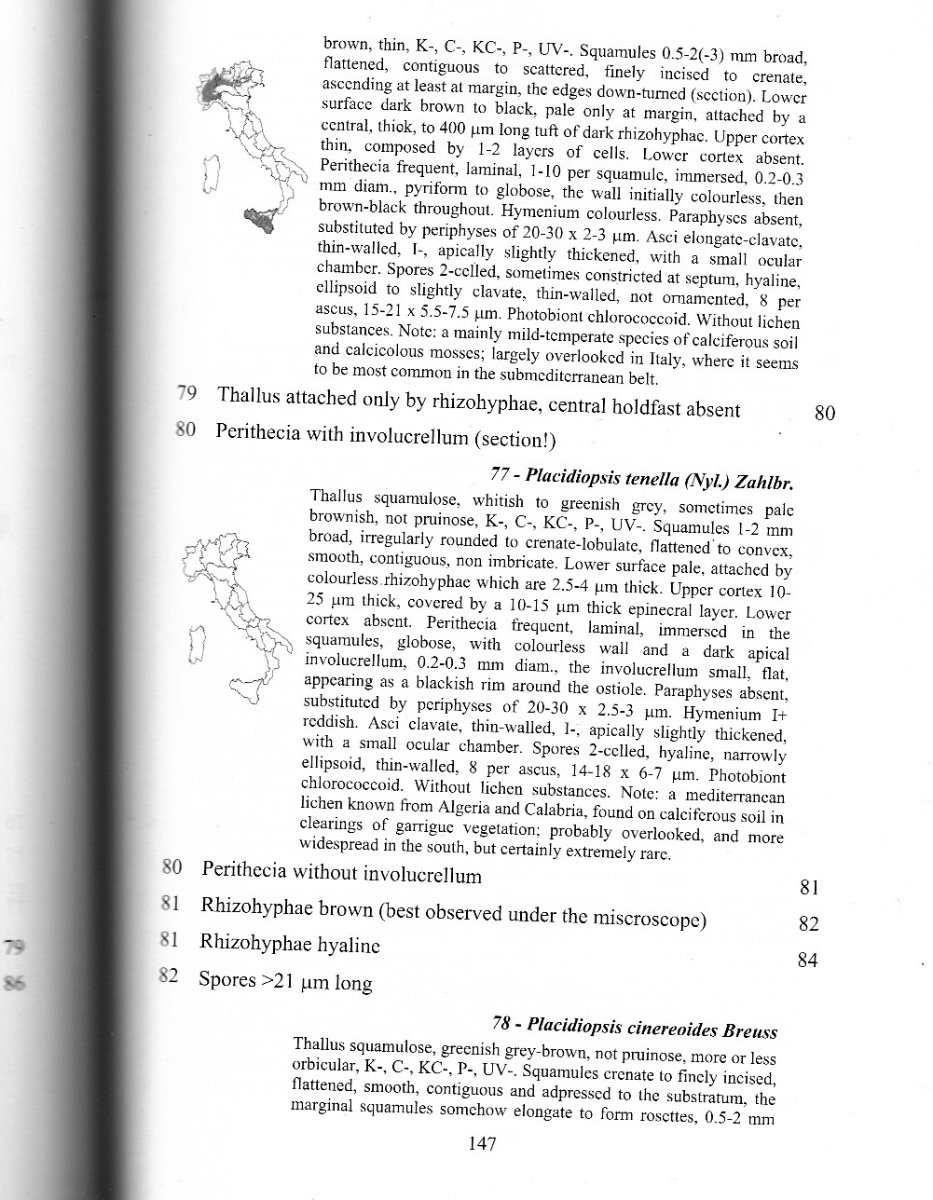
Chris, I don’t know how easy it is to acquire Nimis & Martello but it is all in English. I have only seen the terricolous version which I rate highly. The introductory sections are good, starting with three pages of discussion about what ‘terricolous’ really means (which I found fascinating). This work is structured as a key but with useful descriptions of each species at the point where they key out. I will attach some scans, including some relevant to Paul’s Placidiopsis, which will give you a feel for the book. No illustrations of the lichens – that was probably a good idea in this case because it allowed adequate space to treat all Italy’s terricolous lichens in some depth in one volume.
[attachment=4]Nimis 4.jpg[/attachment] 
[attachment=3]Nimis 5.jpg[/attachment] 
[attachment=2]Nimis1.jpg[/attachment] 
[attachment=1]Nimis2.jpg[/attachment] 
[attachment=0]Nimis3.jpg[/attachment] Hi Paul, This reply is mainly to say that I too am following with interest. It is also a first attempt at posting (and in relative ignorance of squamulose terrestrial things).
The spores in your putative Placidiopsis cinereoides look as though they are truly septate (even if they are late forming their septum). This would seem to rule out one of your initial tentative suggestions (Catapyrenium cinereum) because the literature tells us that the ascospores are simple in Catapyrenium.
I should think that you are in the right genus with Placidiopsis. The only specimen I have of this genus is of P. custnani from limestone grassland in Somerset. I have now gone on a personal diversion being rather confused about whether the rhizohyphae in this species are pigmented or not (most sources seem to agree that in P. custnani they are restricted to a central holdfast). Investigation of my specimen shows no pigmented hyphae and an obscure central holdfast. The paper that Neil linked to seems undecided stating first that the rhizohyphae are dark and later that they are colourless in P. custnani.
Using Nimis & Martello (2004) Keys to the lichens of Italy: I Terricolous species, your suggestion of P. cinereoides seems rather hopeful. I eagerly await further information/opinions.
Best wishes,
Mark
-
AuthorPosts