- This topic is empty.
-
AuthorPosts
-
January 7, 2019 at 6:10 pm #31171
I am an eternal optimist when it comes to lichen identification, so this may turn out to be less exciting… I’ve been going through some samples from a soil pocket in siliceous maritime rocks near Stranraer (VC74) and have come up with what seems to be
Placidiopsis cinereoides. This was described by Breuss (1996) from montane rocks in northern Spain so the ecology isn’t spot-on, but the spore size is just right – (20.5-) 22-26.5 x 6.5-8.5 (-9.5) µm for the Stranraer collection versus (20-) 22-28 (-30) x (6,5-)7-8 (-8,5) according to Breuss. In addition, the thallus squamules do not have dark edges and there is a dense dark mat of hyphae underneath, and the spores become septate very late in development so many are aseptate. All these are apparently diagnostic features. Alternative IDs are
Placidiopsis custnanii(which looks very similar macroscopically but has distinctly smaller ascospores and rhizoidal hyphae in tufts) and Catapyrenium cinereumwhich has greyish thalli and aseptate, slightly smaller spores. Both occur in similar habitats to the Stranraer collection. A little esoteric for some, but any opinions would be gratefully received.
January 8, 2019 at 8:00 am #41642Hello Paul As you are one of the leading lights in all things lichen, you may struggle to get much knowledgeable input into your exciting find. I personally appreciate you sharing this with us and showing your outstanding photomicrographs.
I’m sure Rebecca Yahr would be interested in hearing about it.
All the best, Chris
January 9, 2019 at 8:51 pm #41643Paul I am mostly confused by these
Placidiumet al crusts, so am not much help, however, I am hoping the new Nordic Lichen Flora Vol 6 will help me get up to speed with them eventually. Have you seen https://www.researchgate.net/publication/233610024_The_genus_Placidiopsis_in_the_Iberian_Peninsula_and_the_Balearic_Islands ” class=”bbcode_url”> https://www.researchgate.net/publication/233610024_The_genus_Placidiopsis_in_the_Iberian_Peninsula_and_the_Balearic_Islands Placidiopsis cinereoides? This shows the thallus they describe as Quote:squamulose, composed of contiguous to slightly overlapping squamules, forming a compact rosette
Your pictures are not quite the same, less overlapping perhaps? Not sure, yours could just be younger given the spores etc fit. Anyway this does not help say what this actually is!
Eternal optimist is the best, sometime one is right
All the best
January 10, 2019 at 12:07 pm #41644Thank you for the info, Neil – I hadn’t seen that paper. The picture looks not entirely different from my specimen, so cineroides still seems to be an option. Othmar Breuss has offered to look at it, so we may know more in time. Best wishes
Paul
January 11, 2019 at 8:23 pm #41645Following with interest! January 19, 2019 at 7:05 pm #41646Hi Paul, This reply is mainly to say that I too am following with interest. It is also a first attempt at posting (and in relative ignorance of squamulose terrestrial things).
The spores in your putative Placidiopsis cinereoides look as though they are truly septate (even if they are late forming their septum). This would seem to rule out one of your initial tentative suggestions (Catapyrenium cinereum) because the literature tells us that the ascospores are simple in Catapyrenium.
I should think that you are in the right genus with Placidiopsis. The only specimen I have of this genus is of P. custnani from limestone grassland in Somerset. I have now gone on a personal diversion being rather confused about whether the rhizohyphae in this species are pigmented or not (most sources seem to agree that in P. custnani they are restricted to a central holdfast). Investigation of my specimen shows no pigmented hyphae and an obscure central holdfast. The paper that Neil linked to seems undecided stating first that the rhizohyphae are dark and later that they are colourless in P. custnani.
Using Nimis & Martello (2004) Keys to the lichens of Italy: I Terricolous species, your suggestion of P. cinereoides seems rather hopeful. I eagerly await further information/opinions.
Best wishes,
Mark
January 20, 2019 at 8:43 am #41647Mark Watching with interest even though the debate is well above my pay scale.
However, I am interested in
Nimis & Martello (2004) Keys to the lichens of Italy: is this available in the UK and is it in English? Many thanks, Chris
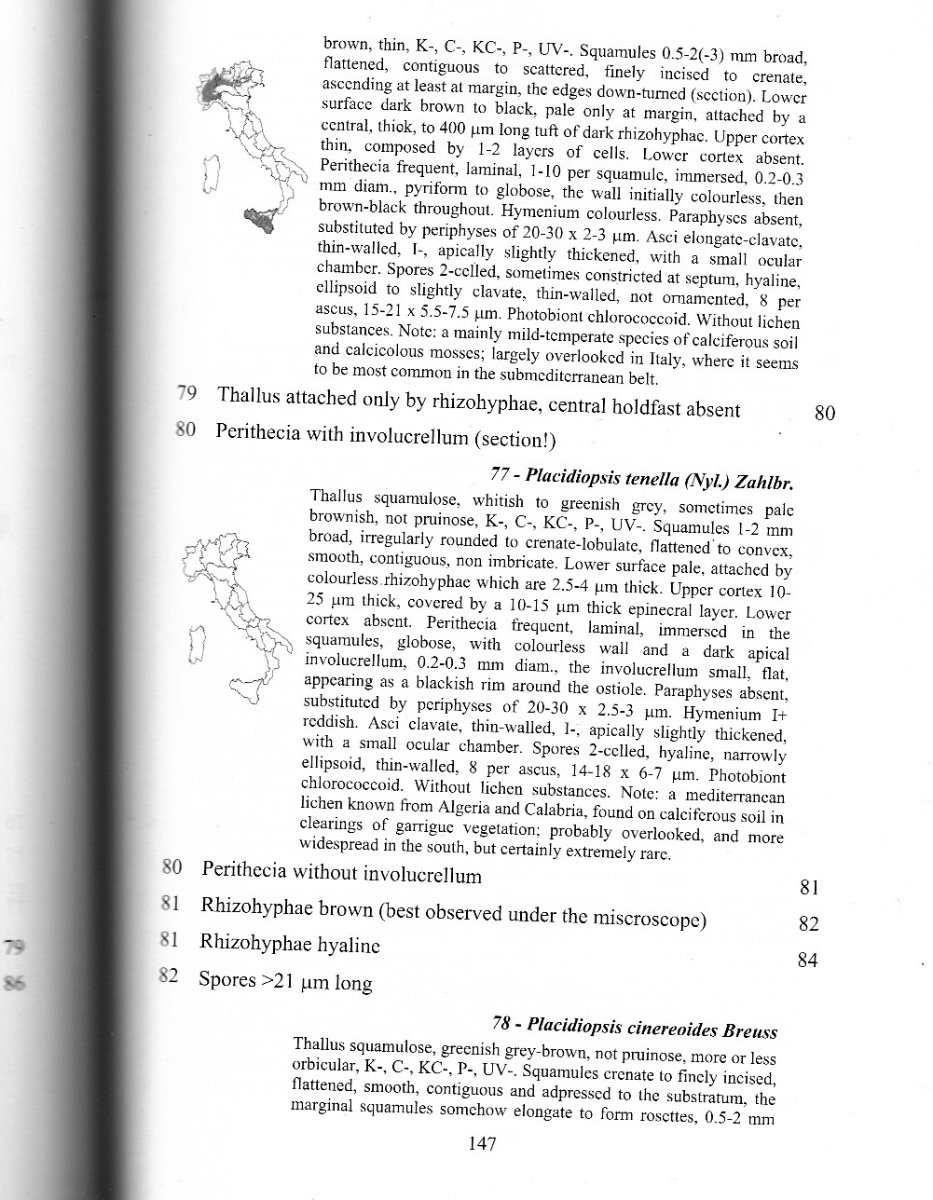
January 20, 2019 at 9:27 am #41648Chris, I don’t know how easy it is to acquire Nimis & Martello but it is all in English. I have only seen the terricolous version which I rate highly. The introductory sections are good, starting with three pages of discussion about what ‘terricolous’ really means (which I found fascinating). This work is structured as a key but with useful descriptions of each species at the point where they key out. I will attach some scans, including some relevant to Paul’s Placidiopsis, which will give you a feel for the book. No illustrations of the lichens – that was probably a good idea in this case because it allowed adequate space to treat all Italy’s terricolous lichens in some depth in one volume.
[attachment=4]Nimis 4.jpg[/attachment] 
[attachment=3]Nimis 5.jpg[/attachment] 
[attachment=2]Nimis1.jpg[/attachment] 
[attachment=1]Nimis2.jpg[/attachment] 
[attachment=0]Nimis3.jpg[/attachment] January 20, 2019 at 1:19 pm #41649Thank you to Mark for his opinion on the species (welcome to the forum!), and to everyone else who has commented. Othmar Breuss has offered to take a look at the specimen, and once I’ve got around to posting it and getting a response, I’ll make another update. The Nimis & Martello book is available free online (see
https://moodle2.units.it/pluginfile.php/229093/mod_resource/content/1/totale1.pdf January 20, 2019 at 3:28 pm #41650Thank you Mark for taking that much trouble, and to Paul for the download. I tried ordering a copy from Italy but the e-mail is suspect.
Best wishes,
Chris
January 20, 2019 at 7:57 pm #41651I am pleased to find a user-friendly forum and fascinated by the Placidiopsis you have been looking into. It made me think about the one we discovered in Galloway in April 2018. Sending this post to introduce myself to the forum. Maxine. January 21, 2019 at 8:32 am #41652Welcome to the forum, Maxine. Look forward to your posts. Regards, Chris
January 21, 2019 at 12:44 pm #41653Hello Maxine I think this was the one we found in Galloway in April 2018!
January 26, 2019 at 12:02 am #41654Welcome Maxine and welcome to all the lichenologists!  March 26, 2019 at 11:02 am #41655
After a long delay (caused mainly by me forgetting to post off the specimen) I have had an identification from Othmar Breuss (the world expert in such species). His response is given below…. The “
Placidiopsis cinereoides” specimen is Catapyrenium cinereum. I found only simple spores (but they may be pseudoseptate in that species), mostly slightly clavate, but also narrowly ellipsoidal; the exciple is brown-black in mature perithecia. The squamules show the typical anatomy and morphology of C. cinereum, but the upper surface is non-pruinose (rather rare in this species) and thus appears uniformly brown with no dark rims. So, no new species for GBI, but we now know more about
Catapyrenium cinereum. I’m happy to settle for that outcome. Best wishes, and thanks to Othmar.
-
AuthorPosts




- You must be logged in to reply to this topic.