
Forum Replies Created
-
AuthorPosts
-
February 24, 2021 at 12:02 pm in reply to: Scarlet Elf Cup – Orange Variant Sarcoscypha austriaca var. lutea #44035
Thanks Simon, interesting stuff. A similar question to mine arose on Ascofrance a few years ago I now find, with a response from expert, Zotto – ”undoubtedly you have S. austriaca, considering spore shape and guttulation, and undulating hairs. The colour variants do not deserve any taxonomic value, in my opinion. They appear within a population and might originate from genetic defects.” So I now think that mine isnt var lutea, but a simple colour variant. Strange as there were two separate twigs with the same colour, I wonder what you say is thus partly responsible.
Thread as here:-
cheers Adam, good to see your site still working, nice one, hope you are well too…… Hi Mike, great to talk again, hope all is good with you. Jelly Rot was my first thought, but it doesnt seem right – maybe I am over thinking it. Maybe as its such a pristine specimen, I’ll do some more research and thinking. It doesnt fit anything else in Laessoe and Petersen. We cant both have that initial thought and be wrong can we? Oh yes…….thanks a lot my friend.
I’ve never seen it on Xanthoria either Chris…….(err, Yeates that is…..) Hi Chris! Thanks Jenny – Lichens approved already – this simple guide to Earthtongues from NWFG may be helpful: http://fungus.org.uk/nwfg/earth-tongues.htm Cheers
Ken
Interesting Jenny – I had a late Geoglossum too on a neighbours lawn only two weeks ago -I knocked at the door and got a sample, haven’t had chance for microscopy yet though…………. PS -whats the UK lichens site?
Cheers
Ken
February 6, 2016 at 8:20 am in reply to: Fungus Of The Day (One identified fungus only please, with species name in attachment comment and in post) #33743It was slightly tongue in cheek……… 🙄 I understand very well the need for accuracy and specific language and also realise the impossibility of writing such papers in a simple way – they are not intended for joe public to necessarily understand and follow, but fellow scientists and researchers who require precision in meaning.
In that respect it was unfair, but surely would have been read with a wry smile if taken in the way intended?
I still think it flowery though.
👿 Cheers
Ken
February 5, 2016 at 10:44 pm in reply to: Fungus Of The Day (One identified fungus only please, with species name in attachment comment and in post) #33741Mossy based then. That paper clearly wasn’t cleared by the plain English society, or American equivalent – you really need to read it carefully to follow it………………I like ”Deep nodes were not well supported by bootstrap analysis”, which is quite clear of course………..
Marvellous stuff, Trying hard to impress.
😥 Cheers
Ken
February 5, 2016 at 8:37 am in reply to: Fungus Of The Day (One identified fungus only please, with species name in attachment comment and in post) #33739Indeed, I nearly mentioned that my woodland Waxcaps have been with mosses of various genera. Right too to remind us all of our past Chris – certainly round here, the early reasons to harvest trees (often Oak) was primarily for building and heating, besides farming. I had a huge Oak trunk, complete with some bark, holding up roof trusses in one house I lived in, built around 1720.
In the light of current worries about flood plains and ground not being absorbent and retaining water, this tree loss hasn’t helped.
😯 Cheers
Ken
February 4, 2016 at 7:58 pm in reply to: Fungus Of The Day (One identified fungus only please, with species name in attachment comment and in post) #33737I always thought Waxcaps weren’t Mycorrhizal, so no association………….? I could, of course, be wrong!
Cheers
Ken
February 4, 2016 at 5:35 pm in reply to: Fungus Of The Day (One identified fungus only please, with species name in attachment comment and in post) #33735Nice find John – I had some waxcaps until late December, but this is unusual. Waxcaps are often thought to be grassland species, but in America they seem to be considered more woodland – and I have seen them so around me, increasingly , this year.
Cheers
Ken
February 4, 2016 at 9:26 am in reply to: Fungus Of The Day (One identified fungus only please, with species name in attachment comment and in post) #33733Mal and Andreas, post corrected – this is NOT ciliatus, but brumalis, many thanks indeed. 😳 😳 I found a reliable set of pics and text to compare – simply not fine enough pores and the edging is also finely hairy in brumalis as Mal says……………
Cheers
Ken
February 3, 2016 at 11:11 pm in reply to: Fungus Of The Day (One identified fungus only please, with species name in attachment comment and in post) #33730Hi Andreas, oh no, not more uncertainty! 
The cap has lots of fine hairs on the edge though – I cant find whether brumalis does? Any further thoughts anyone?
Edit – brumalis has a smooth cap , so this does appear right for ciliatus from that perspective. I will do some macro shots of the dried specimen cap edge tomorrow and post them, see what we all think………..
Cheers
Ken
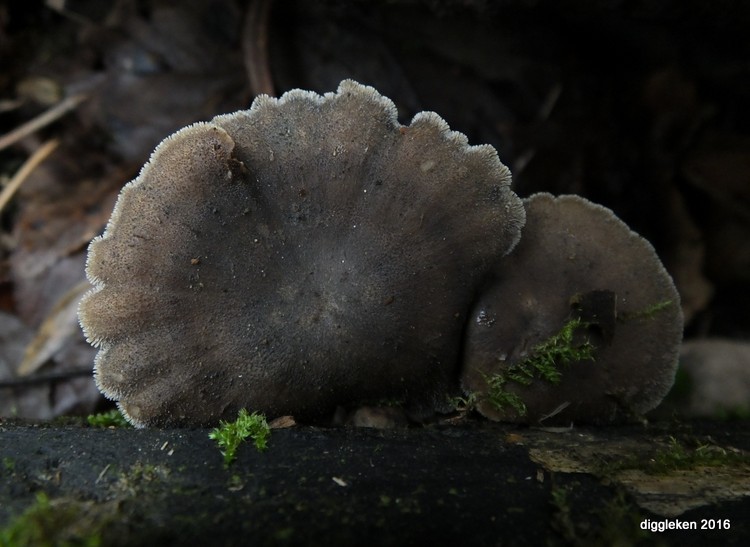
February 3, 2016 at 4:44 pm in reply to: Fungus Of The Day (One identified fungus only please, with species name in attachment comment and in post) #33728I had this as Winter Polypore, P brumalis, but after a posting on Facebook BMS, realised its been Fringed Polypore – Polyporus ciliatus that’s been on that log for 3 or 4 years now…………I live and learn! Finer pores becoming browny and fine hairs fringing the cap. Not that many on NBN either – quite possibly many do the same as me…….. 😳 EDIT – ALL WRONG, this is P brumalis – thanks for help from Mal and Andreas………..oops indeed!
😳 😳 😳 
[attachment=1]Fringed Polypore – Polyporus ciliatus.JPG[/attachment] 
[attachment=0]Fringed Polypore – Polyporus ciliatus-001.JPG[/attachment]
CheersKen
Hi Steve, you might find this useful too for many microscopic protozoans in Sphagnum – I use it to help with bog surveys – not in depth but good info and illustrations:
http://www.amazon.co.uk/Microscopic-Life-Sphagnum-Naturalists-Handbook/dp/0855462914 Cheers
Ken
-
AuthorPosts
