Forums › Forums › General fungi discussion › Fungus Of The Day (One identified fungus only please, with species name in attachment comment and in post)
- This topic has 953 replies, 55 voices, and was last updated 3 weeks, 4 days ago by
admin.
-
AuthorPosts
-
February 4, 2016 at 4:33 am #33732
Re. Exidia thuretiana Very nice Chris!
That is a work of art

Here is what I have called Hebeloma mesophaeum, found last week, but it’s not 100% as in FOS.
It was in willow herb scrub by an old beech stump. It fits Hebeloma mesophaeum as described in FOS Vol. 5 with some slight differences. The cheilocystidia are a bit more polymorphic than in FOS, and the spores are no longer than 8 microns, but are described as up to 10(11) in FOS, and up to 13 by other authors. Simple biological variation?
Steve

[attachment=5]1 Field photo.JPG[/attachment] 
[attachment=4]2 Stereo images.jpg[/attachment] 
[attachment=3]3 Spores x1000.jpg[/attachment] 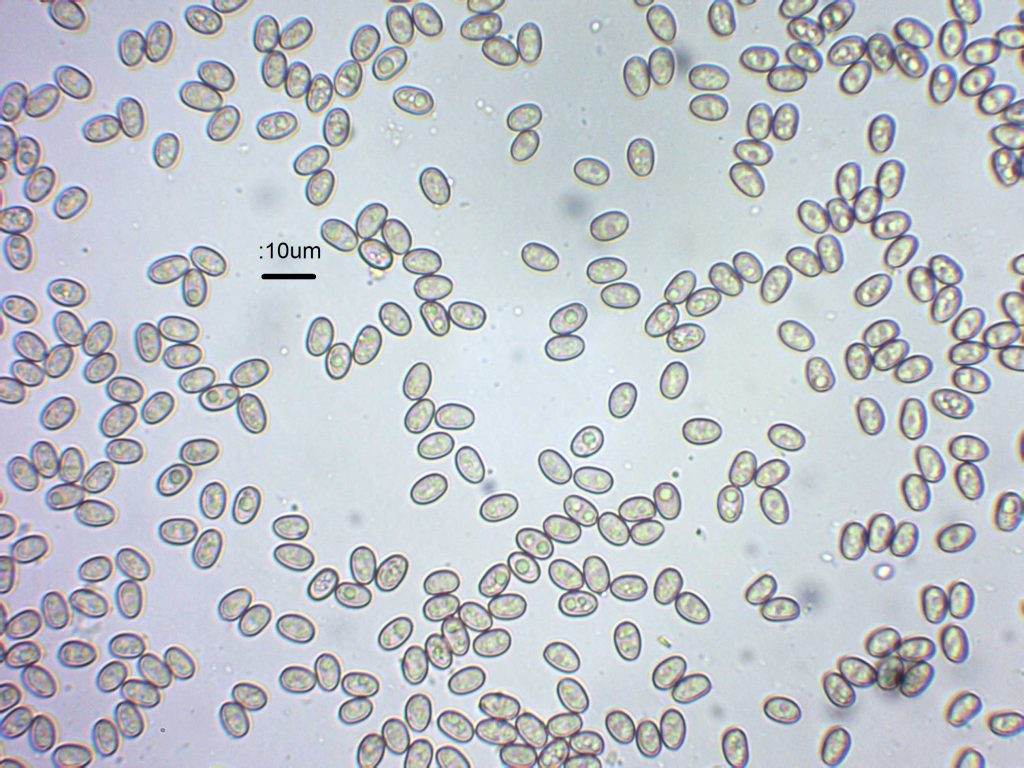
[attachment=2]4 Spores x 600.jpg[/attachment] 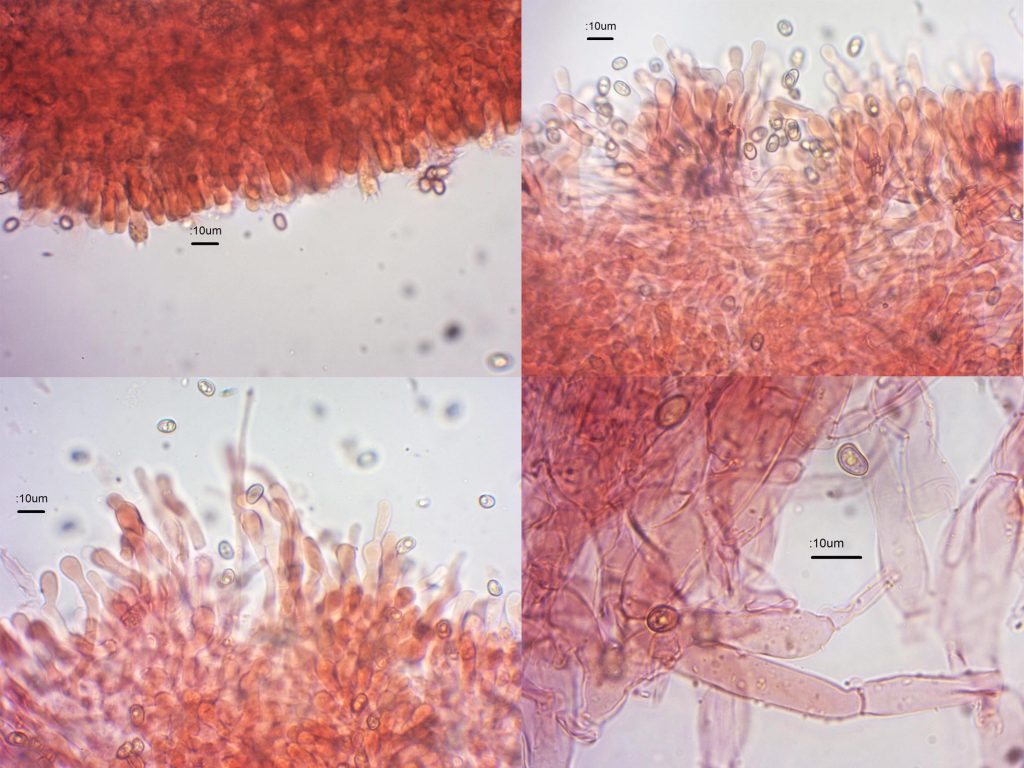
[attachment=1]5 Microscopy.jpg[/attachment] 
[attachment=0]6 Cap cuticle.jpg[/attachment] February 4, 2016 at 9:26 am #33733Mal and Andreas, post corrected – this is NOT ciliatus, but brumalis, many thanks indeed. 😳 😳 I found a reliable set of pics and text to compare – simply not fine enough pores and the edging is also finely hairy in brumalis as Mal says……………
Cheers
Ken
February 4, 2016 at 4:23 pm #33734Hello folks, A nice idea, fungus for the day.
Well, I was ‘gobsmacked’ when I stumbled across this Hygrocybe chlorophana in my deciduous woodlands this week, though not far from a field.
I was working in the wood, but carried it carefully on glove to car then realised I ought to photo on site so tried to relocate spot before dark,
at the same time as watching and awaiting for barn owl to emerge.
I initially thought of H. ceracea, which is also occasionally in woodland, but this one had constricted spores and though I hardly got any spores on two slides overnight, there were ample enough to align it with H chlorophana. There were also the ultralong fusiform cells in gill trama as per the Boertmann laminated key I possess, though I don’t have his Fungi of Northern Europe volume.
Only Bon and Buczacki out of the other 5 sources mention that it is occasionally found in BL woodland.
Though it is common overall, for me it was a great record for the site.
John W
February 4, 2016 at 5:35 pm #33735Nice find John – I had some waxcaps until late December, but this is unusual. Waxcaps are often thought to be grassland species, but in America they seem to be considered more woodland – and I have seen them so around me, increasingly , this year.
Cheers
Ken
February 4, 2016 at 7:00 pm #33736Thanks for this information Ken, a reassurance in some ways. I was wondering what the plant associate might be; there are bluebells, bryophytes ferns; Pinus, Quercus, Carpinus and Acer in vicinity.
John
February 4, 2016 at 7:58 pm #33737I always thought Waxcaps weren’t Mycorrhizal, so no association………….? I could, of course, be wrong!
Cheers
Ken
February 4, 2016 at 10:22 pm #33738diggleken wrote:I always thought Waxcaps weren’t Mycorrhizal, so no association………….?
I could, of course, be wrong!
Cheers
Ken
There are associations other than mycorrhizae of course. I think the consensus is that whileHygrophorusspecies are clearly ectomycorrhizal, other genera within the Hygrophoraceae do form associations including with bryophytes: http://www.mycologia.org/content/103/2/280.fullhttp://www.mycologia.org/content/103/2/280.full” class=”bbcode_url”> With regard to the occurrence of
Hygrocybes.l. in woods, it is worth remembering that relatively recently (in evolutionary terms) these islands were largely covered with some sort of woodland: https://texthistory.wordpress.com/2013/08/19/british-deforestation/ ” class=”bbcode_url”> https://texthistory.wordpress.com/2013/08/19/british-deforestation/ Chris
February 5, 2016 at 8:37 am #33739Indeed, I nearly mentioned that my woodland Waxcaps have been with mosses of various genera. Right too to remind us all of our past Chris – certainly round here, the early reasons to harvest trees (often Oak) was primarily for building and heating, besides farming. I had a huge Oak trunk, complete with some bark, holding up roof trusses in one house I lived in, built around 1720.
In the light of current worries about flood plains and ground not being absorbent and retaining water, this tree loss hasn’t helped.
😯 Cheers
Ken
February 5, 2016 at 7:36 pm #33740Hi, Interesting to read your replies here. I had heard from somewhere that Hygrocybe DNA had been isolated within Plantago species, even to the extent of appearing in the plant’s seed endosperm. I don’t know the source of this information, but that indeed would not support an ectomycorrhizal association , so I was being a bit loose with my terminology and the Seitzman paper(link for which, thanks – I found it interesting – uses the term biotrophic rather than saprophytic.
Cheers,
John W
Ormskirk
February 5, 2016 at 10:44 pm #33741Mossy based then. That paper clearly wasn’t cleared by the plain English society, or American equivalent – you really need to read it carefully to follow it………………I like ”Deep nodes were not well supported by bootstrap analysis”, which is quite clear of course………..
Marvellous stuff, Trying hard to impress.
😥 Cheers
Ken
February 6, 2016 at 1:50 am #33742diggleken wrote:Mossy based then.
That paper clearly wasn’t cleared by the plain English society, or American equivalent – you really need to read it carefully to follow it………………I like ”Deep nodes were not well supported by bootstrap analysis”, which is quite clear of course………..
Marvellous stuff, Trying hard to impress.
😥 Cheers
Ken
Actually Ken that’s a little unfair. It’s not aimed at the likes of us and uses a lot of (necessary) technical terms – bioinformatics is a highly complex area.I know a very good mycologist who was a physicist in a previous life (not literally); show him
https://en.wikipedia.org/wiki/Callan%E2%80%93Symanzik_equation ” class=”bbcode_url”> https://en.wikipedia.org/wiki/Callan%E2%80%93Symanzik_equation *Chris
*he would also understand “that paper” as bioinformatics is his thing now (as well as being a fine field mycologist/taxonomist) – not fair . . . February 6, 2016 at 8:20 am #33743It was slightly tongue in cheek……… 🙄 I understand very well the need for accuracy and specific language and also realise the impossibility of writing such papers in a simple way – they are not intended for joe public to necessarily understand and follow, but fellow scientists and researchers who require precision in meaning.
In that respect it was unfair, but surely would have been read with a wry smile if taken in the way intended?
I still think it flowery though.
👿 Cheers
Ken
February 6, 2016 at 2:14 pm #33744diggleken wrote:It was slightly tongue in cheek………
🙄
of course . . . . .
diggleken wrote:. . . .
I still think it flowery though.
👿 Cheers
Ken
Even a tiny bit fungussy (I think), now I’ve re-read it:ugeek: February 6, 2016 at 4:17 pm #33745The problem with research papers is that unless you are a specialist in the field, you cannot really make sense of it. Even when the abstract states that “We have shown blah blah wibble wibble”, the truth is that the blah blah wibble wibble is usually subject to various assumptions, and simplifications, which the non specialist will struggle to interpret. A good example is a paper I came across concluding that various Peziza species are con-specific. It was based on DNA analysis, which I did not understand, having no training in biological sciences (I was a quantum physicist by training) so I had no idea whether or not the conclusions were cast iron. In a recent post Andreas indicated that they had drawn conclusions based on limited DNA analysis, and in fact it was not as clear cut as the abstract suggested. Anyway, we seem to be going somewhat off topic …
February 10, 2016 at 11:52 am #33746Episphaeria fraxinicola. This species looks like an Ascomycete and lives under logs and branches. Only when you look at it under a microscope do you realise it is a Basidiomycete. It is very small. The photograph is taken at x 40.
I found this on 3rd February at Speke Hall, Liverpool where they have conveniently stacked all the prunings and fallen wood into neat piles for me to rummage through. I have no idea what the wood is.
Only 28 records on FRDBI but due to size it is probably overlooked or ignored. I have found it before in another Liverpool park in May 2014. Perhaps Liverpool is an Episphaeria hotspot.
MykoGolfer
-
AuthorPosts




- You must be logged in to reply to this topic.