Forums › Forums › General fungi discussion › Fungus Of The Day (One identified fungus only please, with species name in attachment comment and in post)
- This topic has 953 replies, 55 voices, and was last updated 3 weeks, 4 days ago by
admin.
-
AuthorPosts
-
October 20, 2016 at 8:15 pm #33867
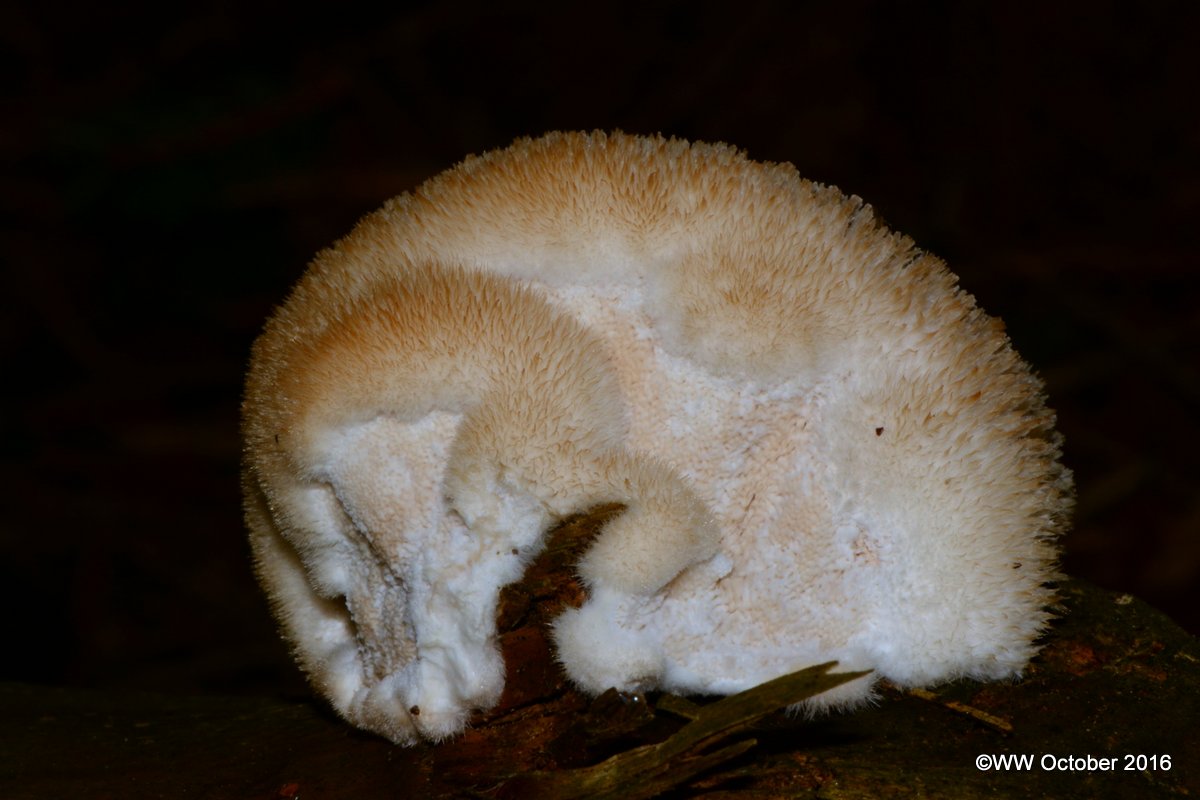
Love this one, Postia ptychogaster Tell us more where found please. Alison
October 20, 2016 at 9:39 pm #33868alindsay wrote:Love this one, Postia ptychogaster Tell us more where found please.
Alison
It was on an old Pine stump in a New Forest enclosure. I’ve seen it a handful of times around here. This is the anamorphic stage of the fungus.
October 22, 2016 at 1:50 pm #33869Waxcap wrote:alindsay wrote:Love this one, Postia ptychogaster Tell us more where found please.
Alison
It was on an old Pine stump in a New Forest enclosure. I’ve seen it a handful of times around here. This is the anamorphic stage of the fungus.
Almost common around here this year whereas previously very hard to find, invariably on old cut conifer logs in my experience.
Found this one earlier this week

[attachment=0]DSC_0103.JPG[/attachment] John
October 22, 2016 at 3:16 pm #33870Two weeks ago, I came across this example of Perenniporia fraxineaon an oak ( Quercus robur) at Wimpole, which is near Cambridge. It is the first time I have seen the association – excluding seeing photos others have taken. October 22, 2016 at 3:19 pm #33871Wood Wanderer wrote:Waxcap wrote:alindsay wrote:Love this one, Postia ptychogaster Tell us more where found please.
Alison
It was on an old Pine stump in a New Forest enclosure. I’ve seen it a handful of times around here. This is the anamorphic stage of the fungus.
Almost common around here this year whereas previously very hard to find, invariably on old cut conifer logs in my experience.
Found this one earlier this week
DSC_0103.JPG
John
Interesting fungus. The times I have come across any
Postia spp. can be counted on one hand, unfortunately. I am down in the New Forest next Sunday so will keep my eye out for it if venturing into some of the pine plantations. October 23, 2016 at 4:48 pm #33872Having been bemoaning the lack of fungi here this lone fungus appeared on the edge of steep slope amid the beech. Never had these growing here before – one Shaggy Ink Cap – 
[attachment=0]Shaggy Ink Cap Coprinus comatus.JPG[/attachment] Coprinus comatusOctober 23, 2016 at 5:41 pm #33873Pluteus plautus in situ: 
[attachment=3]_DSC1940 Pluteus plautus.jpg[/attachment] Spores in Melzer’s:

[attachment=2]_DSC1965 Pluteus plautus spores x100 Melzers – composite.jpg[/attachment] GEC in Congo Red:

[attachment=1]_DSC1972 Pluteus plautus GEC x40 Congo Red.jpg[/attachment] Pyriform-clavate cuticle cells:
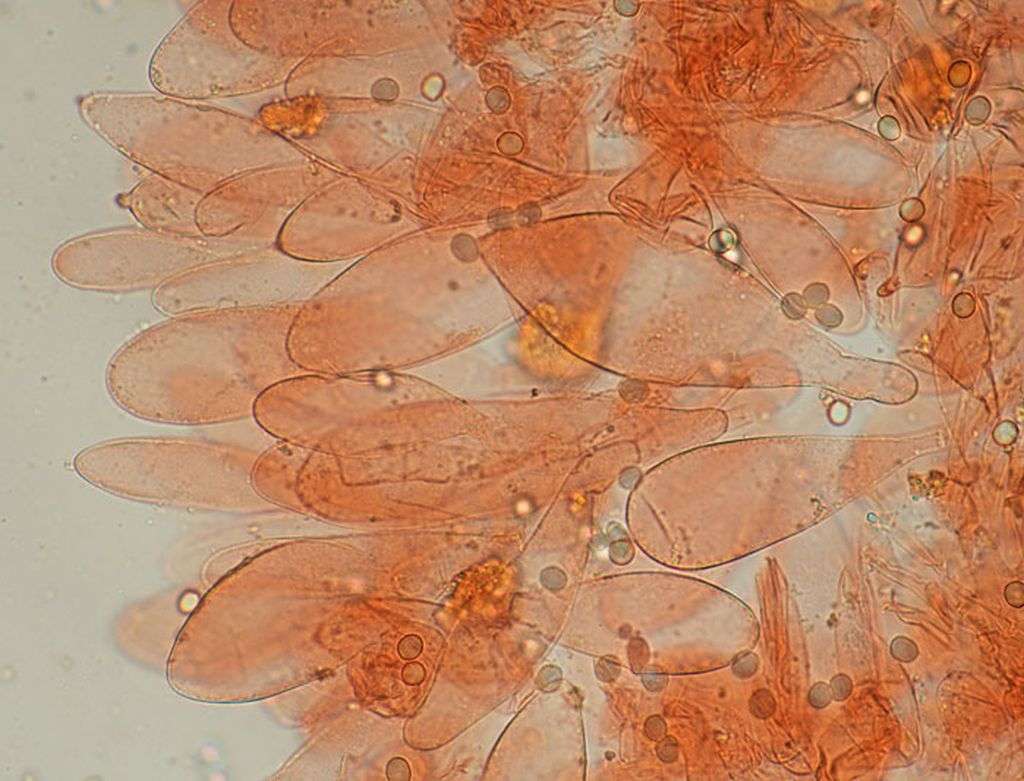
[attachment=0]_DSC1969 Pluteus plautus Cuticle hyphae x40 Congo Red.jpg[/attachment] This is a species I see fairly often on beech, and is quite variable. According to the literature it might be a species complex.
October 24, 2016 at 4:44 pm #33874Cyathus olla– Field Bird’s Nest. 
[attachment=0]Cyathus Olla – Field Bird’s Nest.jpg[/attachment] Regards,
Mike.
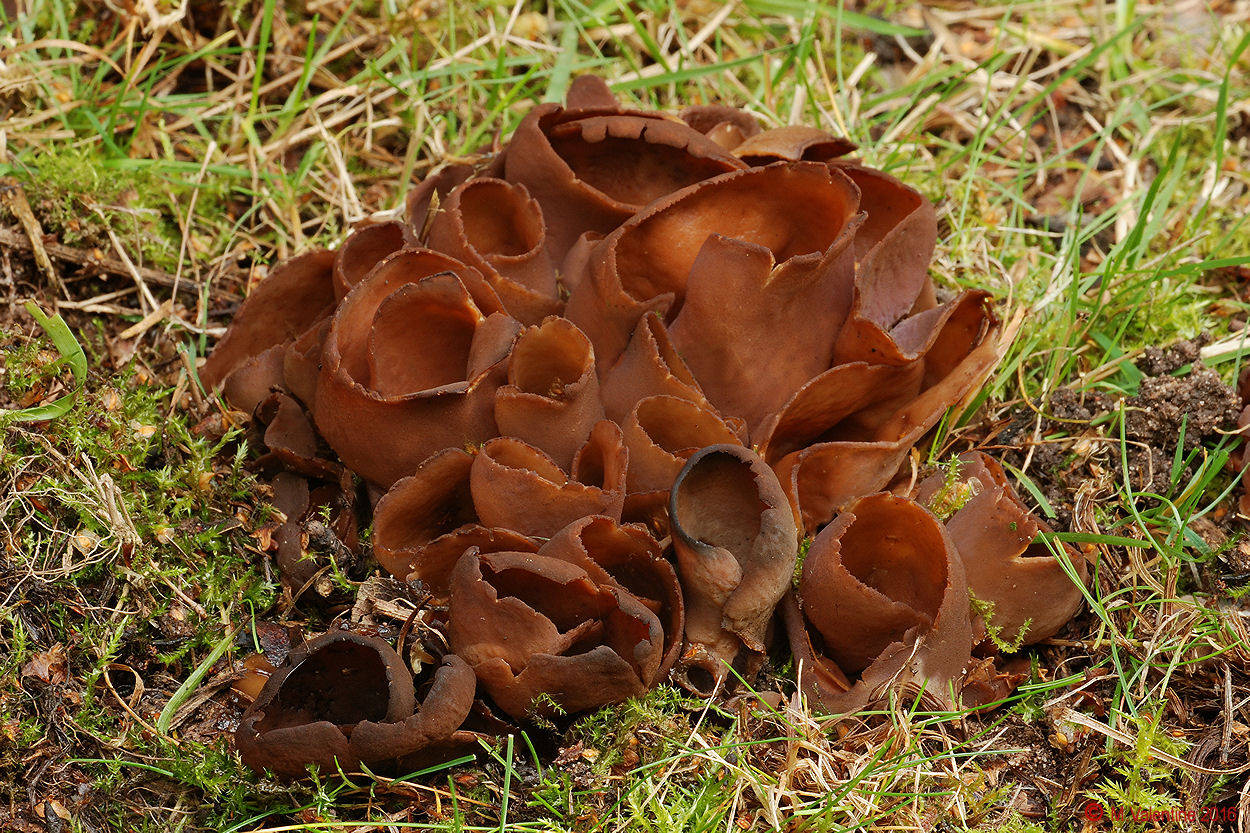
October 25, 2016 at 1:51 pm #33875Peziza badia– Bay Cup: – (See EDIT)
[attachment=0]Peziza badia – Bay Cup 1.jpg[/attachment] SUBSEQUENT EDIT (by Lancashire Lad). – More than likely wrongly ID’d – Should beOtidea bufonia– Toad’s Ear See: –
http://www.fungi.org.uk/viewtopic.php?f=3&t=14&p=6853#p6853 Regards,
Mike.
October 25, 2016 at 3:08 pm #33876Lancashire Lad wrote:Peziza badia– Bay Cup: – Peziza badia – Bay Cup 1.jpg
Regards,
Mike.
Nice shot Mike, not one I see that often and certainly not as a cluster ..
Regards
John
October 25, 2016 at 6:31 pm #33877Lancashire Lad wrote:Peziza badia– Bay Cup: – Peziza badia – Bay Cup 1.jpg
Regards,
Mike.
Mike, nice photo, but did you do microscopy on that one? Otidea bufonia is similar, and I note many of the cups in the photo have a split along one side. In my experience O. bufonia is quite common, albeit in the areas I visit which are in the south.
October 25, 2016 at 7:06 pm #33878Plums and Custard – Tricholomopsis rutilans Seem to be everywhere this year, normally only find a few and then only if I go searching especially …

[attachment=0]DSC_0091.JPG[/attachment] October 25, 2016 at 7:26 pm #33879Leif wrote:Lancashire Lad wrote:Peziza badia– Bay Cup: – Peziza badia – Bay Cup 1.jpg
Regards,
Mike.
Mike, nice photo, but did you do microscopy on that one? Otidea bufonia is similar, and I note many of the cups in the photo have a split along one side. In my experience O. bufonia is quite common, albeit in the areas I visit which are in the south.
Hi Leif,No, I didn’t do microscopy – but these were named and pointed out to me by FungiJohn on an informal foray at one of his local sites, (and in the presence of BMS’s Peter Smith, amongst others).
I too noted the “split along one side”, which is characteristic of
Otideaand not Peziza– but on close inspection, in these, the splits are actually folds (most of which have split), caused by them growing in tight groups – without those folds, each individual fruitbody would be properly cup shaped. On this occasion, I’m happy to go with John’s identification. – He knows the site like the back of his hand, and I’m sure he would have had them under the microscope at some stage in the past.

http://www.fungi.org.uk/viewtopic.php?f=3&t=14&p=6853#p6853 Regards,
Mike.
October 26, 2016 at 11:05 am #33880Pholiota squarrosa– Shaggy Scalycap. The ones previously photographed, (16th Oct.), have been left alone – by both slugs and humans! – and have matured into quite a nice group: –

[attachment=0]Pholiota squarrosa – Shaggy Scalycap 2.jpg[/attachment] Regards,
Mike.
October 26, 2016 at 1:23 pm #33881Lancashire Lad wrote:Leif wrote:Lancashire Lad wrote:Peziza badia– Bay Cup: – Peziza badia – Bay Cup 1.jpg
Regards,
Mike.
Mike, nice photo, but did you do microscopy on that one? Otidea bufonia is similar, and I note many of the cups in the photo have a split along one side. In my experience O. bufonia is quite common, albeit in the areas I visit which are in the south.
Hi Leif,No, I didn’t do microscopy – but these were named and pointed out to me by FungiJohn on an informal foray at one of his local sites, (and in the presence of BMS’s Peter Smith, amongst others).
I too noted the “split along one side”, which is characteristic of
Otideaand not Peziza– but on close inspection, in these, the splits are actually folds (most of which have split), caused by them growing in tight groups – without those folds, each individual fruitbody would be properly cup shaped. On this occasion, I’m happy to go with John’s identification. – He knows the site like the back of his hand, and I’m sure he would have had them under the microscope at some stage in the past.
Regards,
Mike.
Hi Again Leif / All,I hold my hand up to posting wrong ID.
😳 
[attachment=0]Otidea bufonia- Toad’s Ear.jpg[/attachment] I’ve just contacted FungiJohn, and concensus from him, having now seen my photo, is that yes, this probably is
O.bufonia! A senior moment on John’s part when he named them at the time as
P.badia, and not a close enough examination of the “macro” characteristics on my part when taking the photo! In order to avoid possible confusion to people looking at the original photo, I’ve edited the original post, and have cross referenced each of the related posts back to this one.Regards,
Mike.
-
AuthorPosts






- You must be logged in to reply to this topic.