Forums › Forums › General fungi discussion › Entoloma – biting the bullet
- This topic is empty.
-
AuthorPosts
-
November 14, 2015 at 9:47 pm #29970
Hi, Is anyone interested in joining me on looking at the genus Entoloma? We are going to hold a free “Entoloma and other grassland fungi” workshop over the weekend September 10-11 next year at Longshaw Estate in the Peak District, which has been claimed by some to be the no.1 site for grassland fungi in the UK. Or is that Hadrian’s Wall? Or somewhere in Pembroke? That all depends on identifying Entolomas accurately as they form the big E in CHEG (Clavaria etc, Hygrocybe, Entoloma and Geoglossum). Rob Foster, a National Trust (Peak District) Volunteer Fungi Surveyor will be leading us on an investigation of these charismatic but difficult fungi.
Here are a few Entolomas we found on a grasssland survey, not easy if you are happier hunting fungi in the woods. Out of approx 170 Entolomas which we counted, the vast majority (102) were identified in the field as Entoloma conferendum. 8 specimens of E. conferendum were checked and all produced star-shaped or concave cubic spores. Others which we named were Entoloma porphyrophaeum and E. rhodopolium (edge of a wood). E. sericeum, E. incanum and E. sericellum are ones we are fairly happy with in the field. On this last survey we found a number with delicate blueish tints which are hard to capture, and some which gave E. conferendum-like spores but looked quite unlike this species macroscopically. This is just about the worst time of the year to be spending hours on a couple of mushrooms when you have about 50 others to check – eventually I gave up on the heavy texts and ran through Bon, which has the spore diagrams nicely next to the text. From that I was tempted to identify the brown-capped blue-stalked little Entolomas as E. asprellum. Just out of desparation. If anyone can suggest a pointer or two for our un-named little Pinkgills that would be good. But I would rather leave them as Entoloma sp.1, 2,3 etc than stick on a label that means nothing.
Steve (National Trust Volunteer Fungi Survey, Longshaw Estate)

[attachment=5]1 Entoloma conferendum.jpg[/attachment] 
[attachment=4]2 Small pale Entoloma.jpg[/attachment] 
[attachment=3]3 Blue stemmed Entoloma.jpg[/attachment] 
[attachment=2]4 Blueish Entoloma.jpg[/attachment] 
[attachment=1]5 Tiny Entoloma.jpg[/attachment] 
[attachment=0]6 Small dark Entoloma.jpg[/attachment] November 15, 2015 at 3:13 pm #37404Steve wrote:Longshaw Estate in the Peak District, which has been claimed by some to be the no.1 site for grassland fungi in the UK. Or is that Hadrian’s Wall? Or somewhere in Pembroke? That all depends on identifying Entolomas accurately as they form the big E in CHEG (Clavaria etc, Hygrocybe, Entoloma and Geoglossum). Rob Foster, a National Trust (Peak District) Volunteer Fungi Surveyor will be leading us on an investigation of these charismatic but difficult fungi. . . . . . .
Hi SteveThis raises some interesting issues. The term “claimed by some” is one of those phrases which if you try it in an article on Wikipedia gets flagged as “weasel words”.
While making no such claim I suspect the Hebden Valley area in SW Yorkshire (with its richest areas also National Trust property) could take some beating, and it’s nothing like the size of Longshaw. I’ve just done a “CHEG check” and have come up with a total of 77 species (including 35
Entolomaspecies). The key factor is the quality of the workers who have collected here. This is no degree casting aspersions on you and your Longshaw colleagues – I would readily include myself outside that “quality” when it come to CHEG species. But Prof. Roy Watling grew up in this area for heavens sake, the BMS have visited it. And this leads on to the second issue – if you pour lots of effort into a site you will get some outstanding results. This is a mycological phenomenon – it is much easier to establish a pecking order (pun intended) when assessing the importance of sites for their birds or their flowering plants.
There is a steep narrow clough near Marsden where in recent years I have found a 2nd British record a 4th and one
http://www.indexfungorum.org/names/NamesRecord.asp?RecordID=805098 ” class=”bbcode_url”> http://www.indexfungorum.org/names/NamesRecord.asp?RecordID=805098 because it’s handy for the bus. In a previous life I worked in a Biological Records Centre and from time to time we would be faced with planning applications on valuable sites. We deliberately aimed in our surveys
notto just visit the sites we knew were the richest. This was because if you presented the argument “this site has x number of species – many of them rare” the developers pet ecologist would say “yes but that’s just because you have put so many person/hours of survey into it” we knew we had to prove we had also looked at other areas which had proved to be not as rewarding. Left to myself I could have spent all my time in Anston Stones Wood – but I didn’t 
https://en.wikipedia.org/wiki/Thorne_and_Hatfield_Moorshttps://en.wikipedia.org/wiki/Thorne_and_Hatfield_Moors” class=”bbcode_url”> In conclusion I think that what you and the gang are doing at Longshaw is wonderful, but one just needs to bear some of these things in mind when assessing the quality of sites. After all it may well be that the best site in the country for CHEG species has never seen a mycologist . . . . .
cheers
Chris
November 16, 2015 at 10:19 am #37405Hello Steve, I would be interested in joining a ‘Grassland Fungi Workshop’ next Sept. (I was up in Dovedale in ’06 helping Malcolm Storey with one of his several Grassland Surveys that year). As often is the case, the more you see a species the more familiar you get. Serrulatumshould be an easy one but it seems surprisingly variable (gill edge colour). Bloxamiiwas easy, but now we have madidumas well to consider. Roseum & xanthochroumare ‘easy’ due to their colour (although need checking microscopically to make sure as there are other pink and yellow spp). In addition to your list, I’m pretty confidant in the field with prunuloides, griseocyaneum, exile, ameides (strong smell), longistriatum, infula, papillatum. Also getting to grips with chalybaeum, turci, cetratumand rhombisporum(easy under the microscope). November 16, 2015 at 12:15 pm #37406Hi Chris and Roy, Many thanks for the very interesting comments.
You are quite right Chris – the species list is all about the hours put in by who, and most importantly the hours of microscopy. I’ve started helping out the local Wildlife Trust around Sheffield – Yorkshire VC side – and some of their sites are wonderful for fungi. At one stage I had a list of fungi from Sheffield streets which was far bigger than most local “ancient” woodlands, and almost half as long as Longshaw’s. I had more fungi on my allotment than Lady’s Spring Wood – an SSSI! We really started the Longshaw survey as a great opportunity to learn and share our finds. But when within a month the apocalypse of Network Rail’s plans loomed, the list of species suddenly seemed to matter. It was probably the only site in our region where the fungi might be of some importance in stopping the rail developments.
Roy – it would be brilliant if you could join us. We’re now working with NT fungi surveyors from Ilam in the southern part of the Peak District. We had a very useful waxcap workshop together a couple of weeks ago – here’s a picture by Fungi John of us poring over yellow-orange-red waxcaps amongst others.
December 4, 2015 at 9:30 pm #37407This was present in small numbers at a local Sheffield nature reserve last week. It’s one I’d be happy to name without doing microscopy – or even touching the toadstool. It’s hardly lilac at all in this specimen, but we have found some purplish ones at Longshaw. January 5, 2016 at 5:46 pm #37408Hi, Now the frantic days of autumn recording (and Christmas!) are over, we can relax

We were lucky to find this elusive Pinkgill at Longshaw this autumn. We were actually looking at some large Waxcaps. But where you find one fungus you often find aother, so we drew a 10 metre wide circle around the Hygrocybes, looked very thoroughly and found this. I had never seen it before but the overpowering acetamide smell was key to the ID. I took a single specimen to examine and keep in the herbarium (double-bagged), and noted the lovely colour change in the stem base from green to sky-blue. This is one of Rotheroe’s “Top Twenty” indicators of Waxcap Grasslands of conservation importance. (Thanks to Rob Foster for the info).
Steve
January 8, 2016 at 11:12 pm #37409Hi, Here’s an Entoloma which
hasto be Entoloma vernum, as it was found in spring2015! In a mixed woodland, Longshaw, Peak District, altitude about 1000 ft. Wet and cold. The only fly in the ointment was that descriptions of E. vernum are not very consistent…at all.
No-one seemed to be happy to 100% confirm this find on good old WAB, which I had just started to use and now miss as much as my wee doggie…
😥 . And why should they have put a name to it if it’s not consistently described?Sometimes it’s like we’re playing a game with all kinds of rules! So we put this down as Entoloma cf. vernum.
I suppose that’s the best we can do in the circumstances.
However, we took lots of notes (I think), photos and micrographs and have a herbarium specimen, so theoretically we should be able to get an ID sometime. If we live long enough
😆 Steve
January 9, 2016 at 9:26 pm #37410The first 3 Entolomas we came across during our survey at Longshaw in January and June 2014, were all with 2-spored basidia. I posted this on WAB: Honey Pinkgill – Entoloma cetratum
I presume this Entoloma is easy because it’s (unusually for the genus) a species with 2-spored basidia. We found this 3 times at Longshaw last year, in two different woods. One was a remnant ancient woodland, with a larch plantation in its midst. The other was a woodland pasture heavily underplanted with conifers. We have many previous records of Honey Pinkgill at Longshaw. At first sight it’s just a dull yellow-brown LBM, with not much to say it’s a Pinkgill. The features I used to name it were the obvious angular Entoloma spores, and the basidia which are 2-spored.
I used a well-worn 1960’s Vickers Microscope and a hand-held 2005 Konica Minolta digital camera pointed down the eyepiece.
Steve
January 9, 2016 at 10:06 pm #37411The Entoloma cetratum specimens looked at in June did cause a bit of a headache, as they matched the previous find very closely. However, some of the basidia were 4-spored 😮 . To record this I took multiple shots at different focus levels- which can be stacked (with the freeware Combine ZP I find that it’s best just to stack 2 images). A lot of agarics can have variable basidia -sometimes I find it very hard to decide whether Galerinas are mostly 2 or 4-spored. Having 1, 2 or 4-spored basidia on the same gill means that there can be a big variation in spore size. That means you have to decide whether to ignore the very big ones as “fliers” – or not. Some authors like Bon just give an average, typical spore size. In Field Mycology Magazine there tends to be the opposite – a big statistical analysis of spores to precise decimal fractions of a micron, and with length/width ratios (Q value). Another variable is the medium in which you place the spores – some reagents will affect them more by osmosis and either swell or shrink them. In the medical labs we would always use physiological saline to match the in-vivo osmolarity of tissue fluids.But back to Entoloma cetratum – has this species been found with 4 as well as 2-spored basidia?
Steve
January 10, 2016 at 9:11 pm #37412Here is yet another specimen which we found in mixed woodland and identified as Entoloma cetratum, based on the habitat, macro features and the 2-spored basidia. But it yet again had some 4-spored basidia. Stacked micrographs show that the 2-spored ones are indeed – 2 -spored, and not just visual artefacts of 4-spored basidia due to a narrow depth of focus. Steve
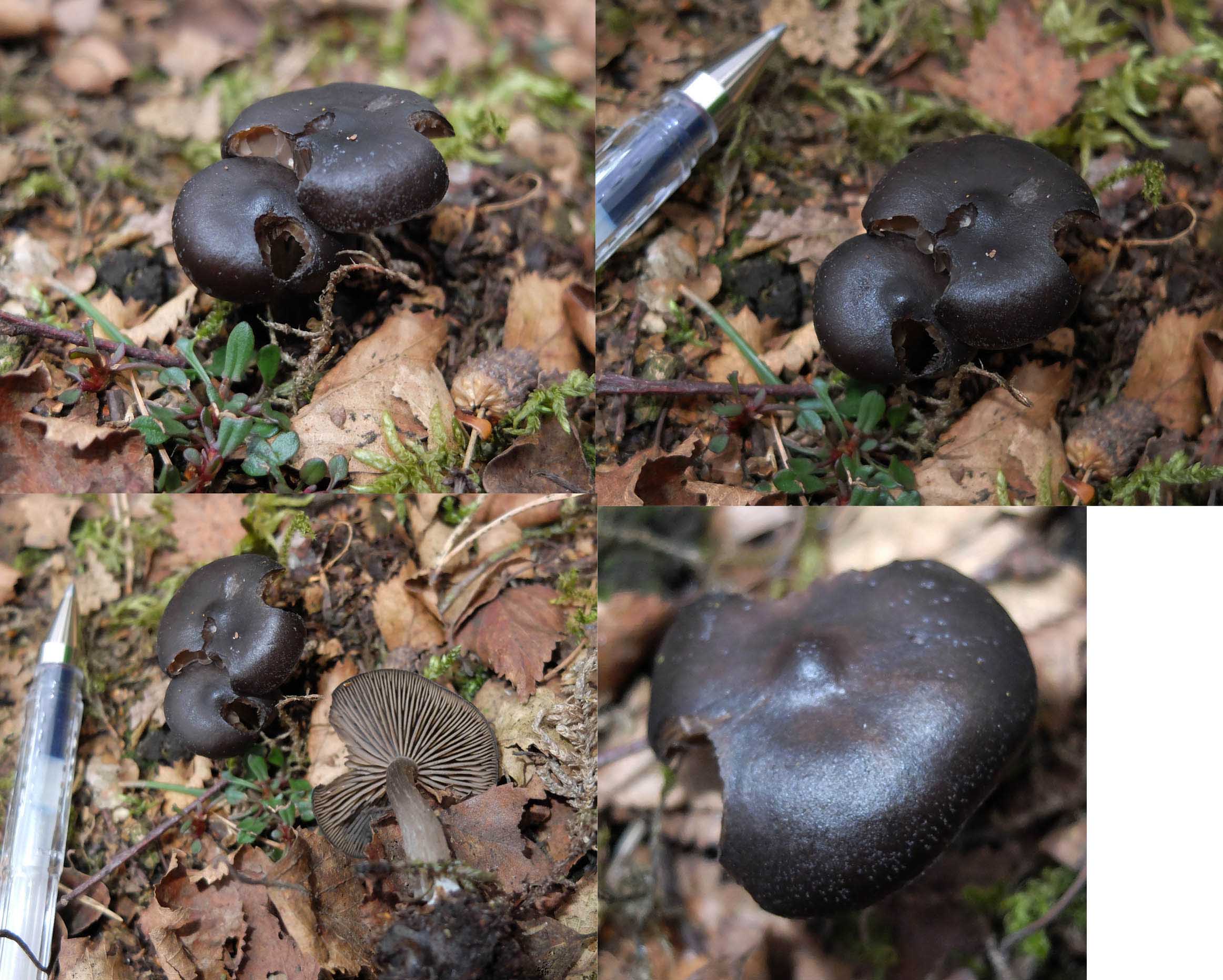
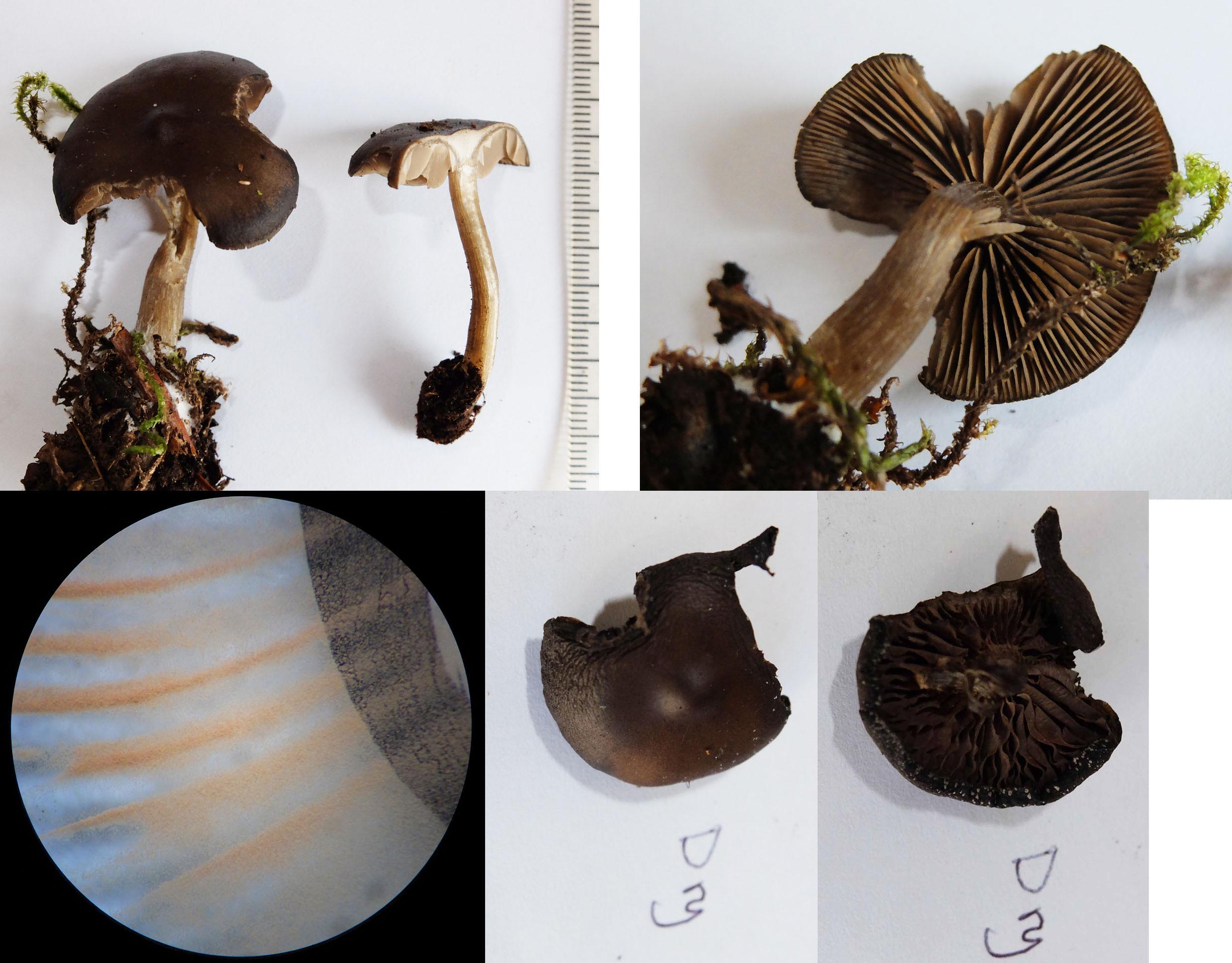
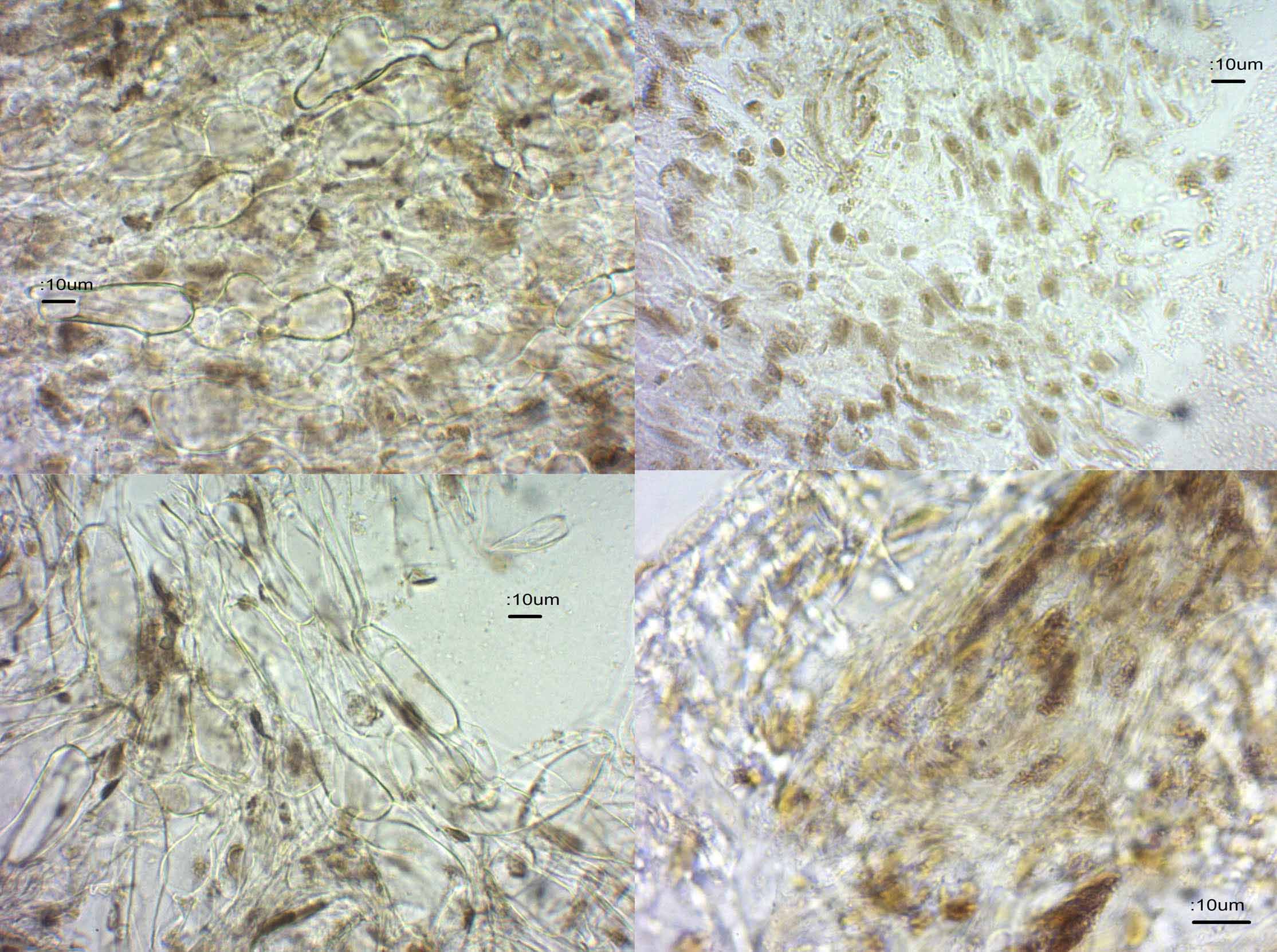
February 12, 2016 at 9:57 pm #37413Here is a spring Entoloma. We were hunting for spring Entolomas on Thursday – but may be a tad early. Last year we found what we eventually decided must be “Entoloma vernum” – though it didn’t fit happily in all details with various descriptions of this species. It’s generally depicted as a very dark Entoloma, which appears in spring. We found this one in wet, undisturbed mixed woodland on acid gritstone, Longshaw, Peak District. The gill edge was uninteresting. Steve

[attachment=5]1 Field pictures – Copy.jpg[/attachment] 
[attachment=4]2 Macro photos1 – Copy.jpg[/attachment] 
[attachment=3]3 Macro photos 2 – Copy.jpg[/attachment] 
[attachment=2]4 Spores – Copy.jpg[/attachment] 
[attachment=1]6 Cap cuticle in water 1 – Copy.jpg[/attachment] 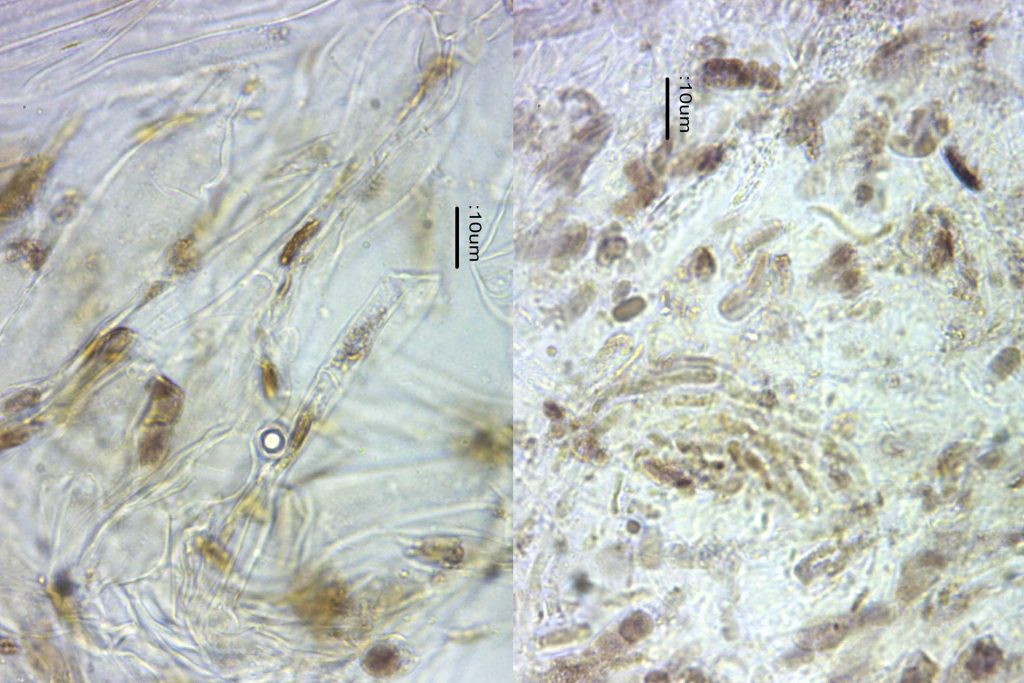
[attachment=0]7 Cap cuticle in water 2 – Copy.jpg[/attachment] April 1, 2016 at 1:47 pm #37414Re Spring Entolomas: Images of
Entoloma vernumdo seem very variable, but I think you have to rely on Noordeloos (FE5/5a) when it comes to descriptions of this Genus. The spores of your collection seem rather small and ‘iso-‘ to be
E. vernum. We have collected a species regularly in Feb. – April growing in old pasture/parkland which we have named vernum(see images taken this week). Spores were up to 11.4 x 8.3µ and there are narrow caulocystidia at the apex of the stipe. NB: images of caulo. taken with a Vivitar compact hand held on the microscope eyepiece! Another Entoloma occurs locally but it’s rather more a winter than a spring species (occurring Dec. – March):
Entoloma hirtipes. It grows amongst herb rich grassland/scrub on limestone. It doesn’t appear every year (these images were taken in 2014). It’s fairly tall with cheilocystidia and large spores (to 14µ). April 2, 2016 at 9:50 am #37415Steve, looking at your collection of E. vernum, I wondered if it might be in Subgenus Entoloma rather than Subgenus Nolanea: specifically Section Tufosa, given it seems to posess more or less iso-diametric spores probably of less than 8µ. Specifically, I was thinking of turbidumor pseudoturbidum. Noordeloos, however, does not recognise them as being Spring fruiting. The only record of pseudoturbidumon FRDBI seems to be my ident. of a collection on 2nd April 2010! (3 images of which I attach courtesy of John Bailey the collector). April 4, 2016 at 9:07 pm #37416Hi Roy, That’s a very interesting suggestion!
It would be a new addition for the Longshaw Entolomas.
I have herbarium specimens for this find, so it can be looked at again – when family affairs permit.
By the way, here is a list of all the Entoloma species recorded for Longshaw, mostly by a single recorder – we have yet to validate a good few of these:
Entoloma ameides
Entoloma asprellum
Entoloma bloxamii
Entoloma caeruleoflocculosum
Entoloma caesiocinctum
Entoloma cetratum
Entoloma cf. juncinum
Entoloma chalybaeum
Entoloma chalybaeum var lazulinum
Entoloma clandestinum
Entoloma conferendum
Entoloma corvinum
Entoloma cyaneoviridescens
Entoloma difforme
Entoloma exile
Entoloma griseocyanaeum
Entoloma hebes
Entoloma hirtipes
Entoloma incanum
Entoloma infula var infula
Entoloma inutile
Entoloma lampropus
Entoloma lividocyanulum
Entoloma longistriatum var longistriatum
Entoloma longistriatum var. sarcitulum
Entoloma ortonii
Entoloma papillatum
Entoloma plebejum
Entoloma poliopus var poliopus
Entoloma porphyrophaeum
Entoloma prunuloides
Entoloma querquedula
Entoloma rhodopolium
Entoloma rhombisporum var. rhombisporum
Entoloma sarcitulum var sarcitulum
Entoloma sericellum
Entoloma sericeum
Entoloma serrulatum
Entoloma sodale
Entoloma turci
Entoloma undatum
Entoloma vernum (sensu latto)
Best regards, and thanks for your interest,
Steve
April 16, 2016 at 1:40 pm #37417Hi, My next “easy”
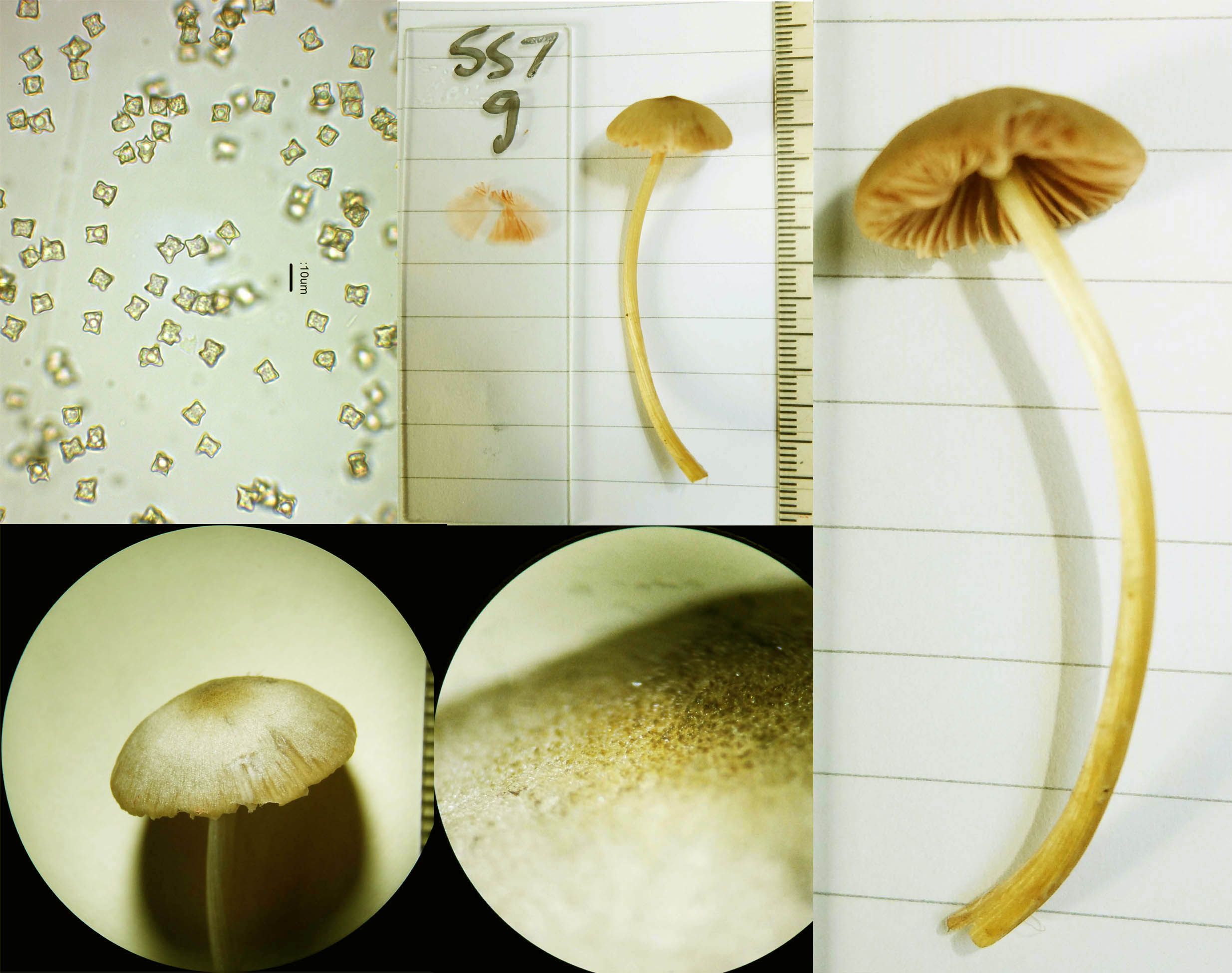
😆 Pinkgill from Longshaw is the Indigo Pinkgill, Entoloma chalybaeum. It’s indigo blue, almost blackish, and covered in fibrils. And the gills don’t have coloured edges. However, there is a variety with a striate cap (var. lazulinum). I identified this one on macro features, but micrographed some features – spores, gill edge and cap cuticle – just in case. (I should have mounted the cap cuticle in water, rather than Congo Red, so the pigment is more easily seen). Plus I kept a herbarium specimen.Steve

[attachment=2]1a Macro.jpg[/attachment] 
[attachment=1]1b Macro.jpg[/attachment] 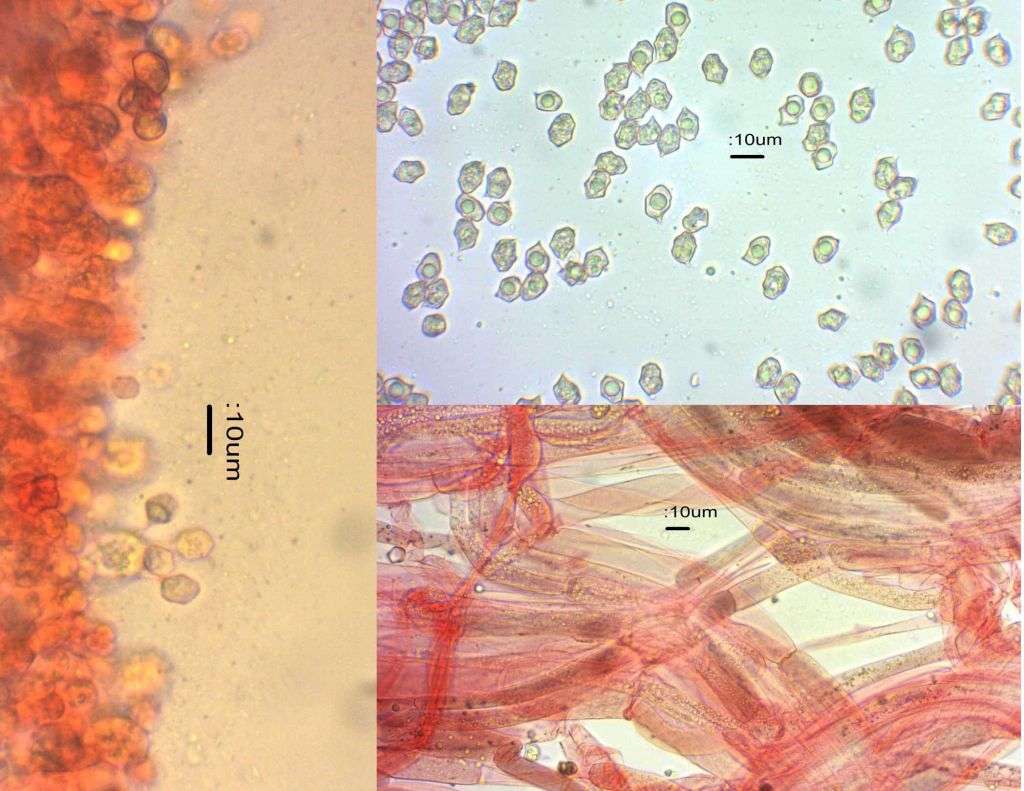
[attachment=0]3 Micro.jpg[/attachment] -
AuthorPosts







- You must be logged in to reply to this topic.