
maxieput901

Forum Replies Created
-
AuthorPosts
-
February 18, 2026 at 9:32 pm in reply to: Lecania (?) in the damp zone on siliceous headstone #46866
Hello Di I hope I have sorted out my problem with attaching images. They were saving as jfif files so I have changed them to jpeg and hope it works. I am glad you were happy with the identification of L. suavis. I have never found this lichen and been shown it only once in Devon on an old wall where it was not very convincing. The literature seems to stress its preference for vertical positions.
Maxine
As a postscript to this lengthy thread I would like to add an observation re Phaeographis species. During a recent survey in South Devon and Dorset I examined every Phaeographis thallus encountered and found a huge predominance of P. smithii over P. dendritica. Looking at our distribution maps P. dendritica has been more widely recorded. Is this due to a decline in P. dendritica now or were few of those records checked microscopically? Luckily the difference between these 2 can be seen using a handlens or dissecting microscope in most cases.
Happy new year everyone!
Maxine
Hello Sylvia I would think you have P. pruinata here despite the most unusual substrate. As you rightly say it’s unlikely to be Sparria endlicheri which is typically found in dry coastal underhangs. I should like to see your find included in NR&I in the next Bulletin to alert people to the possibility of its occurring on rock. I wonder if we have any saxicolous records on the database?
The Lichens marins website has some good images and although it’s late for Christmas now I loved this ‘Christmas decorations’ image …. Thank you Jacques Haine
Best wishes
maxine
You can check out P. dendritica by seeing if it gives a red reaction with KOH. This looks quite a bit like Lecanographa lyncea. Did you find it in Warwickshire? The map shows a couple of old records so a brilliant find if it is this species. It reacts ice blue with the UV torch but negative with all other reagents. Hi Jenny This is certainly Biatoropsis hafellneri as Neil says. It’s quite widespread in the south west of England particularly in Cornwall on Usnea cornuta.
Visualising these LFs is tricky and treatment of horizontal sections with KOH and phloxine is recommended. We managed to get reasonable slides using KOH and ink but only with Biatoropsis usnearum on Usnea subfloridana. We didn’t succeed with B. hafnellneri. We managed to see strings of conidia and basidiomata but it was a laborious business.
Maxine
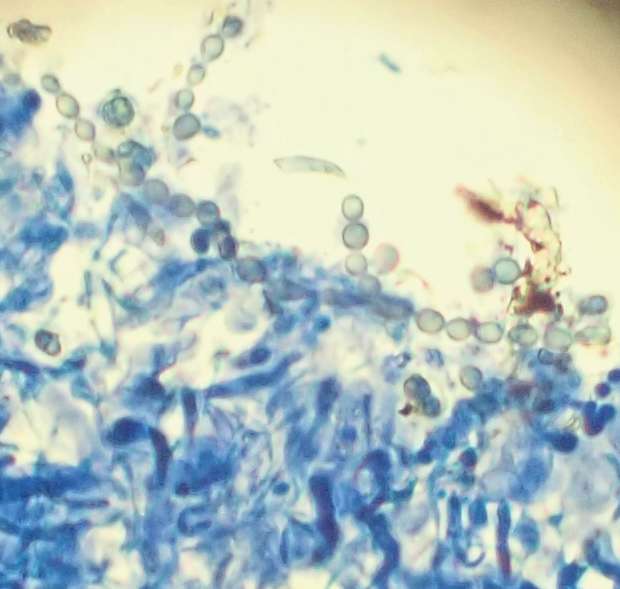
[attachment=0]usnearum c.jpg[/attachment] 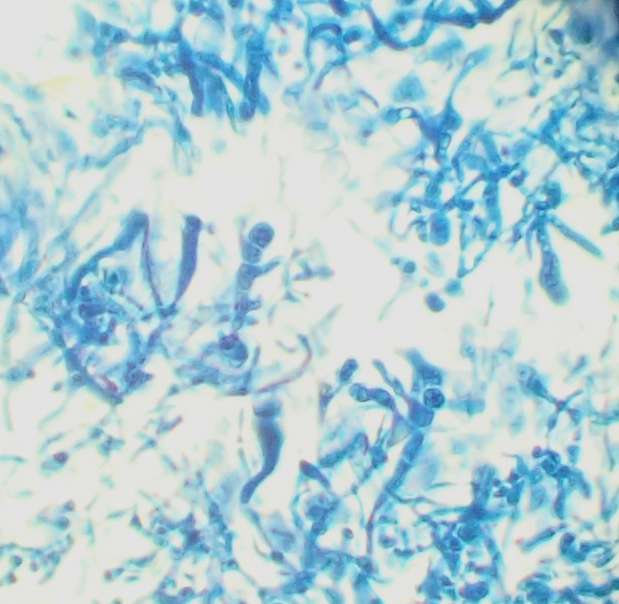
[attachment=1]usnearum b.jpg[/attachment] Hi Juliet This looks a lot like Nectriopsis physciicola although your spores are a little longer than described on fungi.myspecies.The spores and hairs look remarkably similar and it parasitises Xanthoria parietina as well as the usual Physcias.I found it on an ash branch growing across both lichens.
Maxine
Hi Jenny I keep finding these and hunting unsuccessfully in Ellis & Ellis for clues. It does look like a fungus as I find their spores are often thick walled and coloured. I once spoke to a mycologist about it and confirmed that there are likely to be a significant number of bark fungi not yet described or named so not easy.
I had one barcoded recently and the only information I got was that it was a fungus!
Maxine
Hi Sylvia Do you have some measurements for spore length for this Bacidina (?) ? The habitat being elder may suggest Bacidina caerulea of B. friesiana but the colour in K is important for identification and you say yours doesn’t react clearly to K.
Maxine
This looks like Bacidina caerulea by the colour of the exciple. I recorded a similar lichen as B. friesiana back in 2014 which was probably prior to the split and remember the bluish tinge and the piebald apothecia. I imagine it was actually B. caerulea in fact. It was also on elder bark and not in a particularly nutrient-rich community. I notice in LGBI3 that a liking for nutrient-enrichment is noted for B. friesiana and not for B. caerulea but perhaps the latter has not been widely enough recorded to comment yet.
I couldn’t make out any septation so was wondering if you could have Psammina simplex or P. stipitata. There’s a key in the paper in the Lichenologist vol.52(5) pp 337-343 and another paper in the Lichenologist vol. 31(6) pp 579-586 This is exactly like something I found recently as a small thallus on an ash twig in Devon. The spores like yours had few longitudinal septa which were restricted to the middle cells. I was uncertain about the true margin as is was not particularly well developed but I recorded it as D. pharcidium and kept the specimen. It’s not a commonly recorded species. I should be interested in Juliet’s thoughts on this one. This looks very like Hyperphyscia adglutinata as Di suggests. It should have soralia as opposed to isidia and very short rhizines but you have a tiny specimen so difficult to tell. In nutrient-rich sites it often covers the bark extending to many square metres of closely adpressed thalli. It now has a companion, new to Britain, which is identical at first glance. This is H. lucida and you will find an account of it in the Winter Bulletin which should be arriving in a couple of weeks’ time. Thinking this may be a Trapelia too. Alan Orange did some detailed work on new species but haven’t got the reference with me as away at the moment Hi Arno! Would you say the lobes turning up at the ends and the pale prothallus are the characteristic features to look out for? -
AuthorPosts
