- This topic is empty.
-
AuthorPosts
-
February 23, 2020 at 10:46 pm #31602
The lichenicolous Hyphomycetes, are asexual fungi that lack defined structures to produce conidia (pycnidia) so produce conidia from bare hyphae across the host thallus. They include some wonderful looking fungi (look at the conidia of Milospium graphideorumunder high power). As well as common generalists, they also include some specialist parasites of more restricted species and habitats, which are likely to be of conservation significance. They are, however, not at all easy to identify. There are some useful sources like a recent monograph on
Taeniolella: B. Heuchert, U. Braun, P. Diederich, D. Ertz (2018) Taxonomic monograph of the genus Taeniolellas. lat. (Ascomycota), Fungal Systematics and Evolution 2: 69 – 261, Link: https://www.ingentaconnect.com/content/wfbi/fuse/2018/00000002/00000001/art00007;jsessionid=7mu4ghnsldhvl.x-ic-live-02 ” class=”bbcode_url”> https://www.ingentaconnect.com/content/wfbi/fuse/2018/00000002/00000001/art00007;jsessionid=7mu4ghnsldhvl.x-ic-live-02 Taeniolella toruloides, an obligate parasite of Thelotrema. Having identified that species new to Britain recently (I was aware it it for years, it conspicuously turns large patches of Thelotrema lepadinumlead grey in some abundance in parts of the New Forest) I have found another one of that is probably conservation significance. This is Taeniolella arthoniae, which Uwe Braun has kindly confirmed from photographs. This species has been found on
Dendrographa decolorans( Schismatomma decolorans), Lecanactis abietina, Lecanographa lynceaand Pachnolepia pruinata( Arthonia pruinata) in Denmark, France, Luxembourg, the Netherlands, Spain and Sweden, on Oak and rarely Ash. From this it seems to be a species of dry bark on older trees and one to be expected in Britain. My collection of
Taeniolella arthoniaewas from the dry bark of an old Oak growing on the side of a long abandoned and flooded gravel pit in pasture woodland by Ferny Crofts in the New Forest. It had infected the most of the dominant Lecanactis abietinathallus and was suppressing the apothecia, but was avoiding completely the accompanying Sporodophoron cretaceum( Schismatomma cretaceum). [attachment=4]2020-02-17-05.jpg[/attachment]
Thallus ofLecanactis abietinainfected by Taeniolella arthoniae. The “distinctive” feature of
Taeniolella arthoniaeis the frequently branched conidiophores and conidial chains, the generalist Taeniolella delicatacan occur on Lecanactis abietinabut is unbranched. 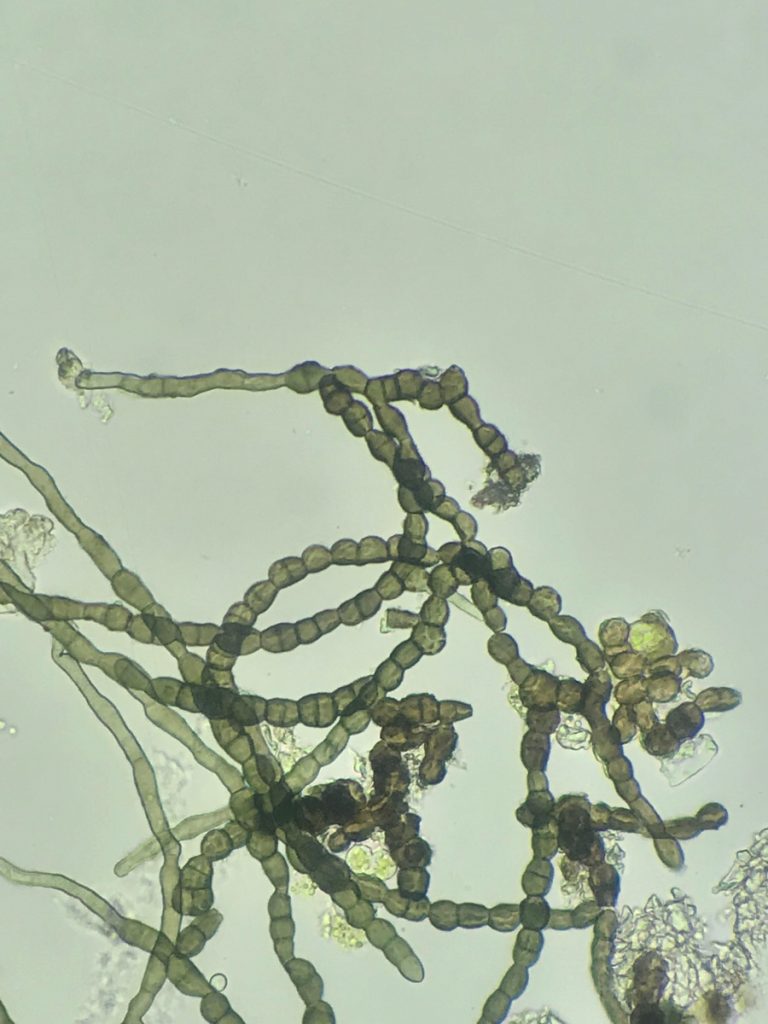
[attachment=3]2020-02-17-04.jpg[/attachment]
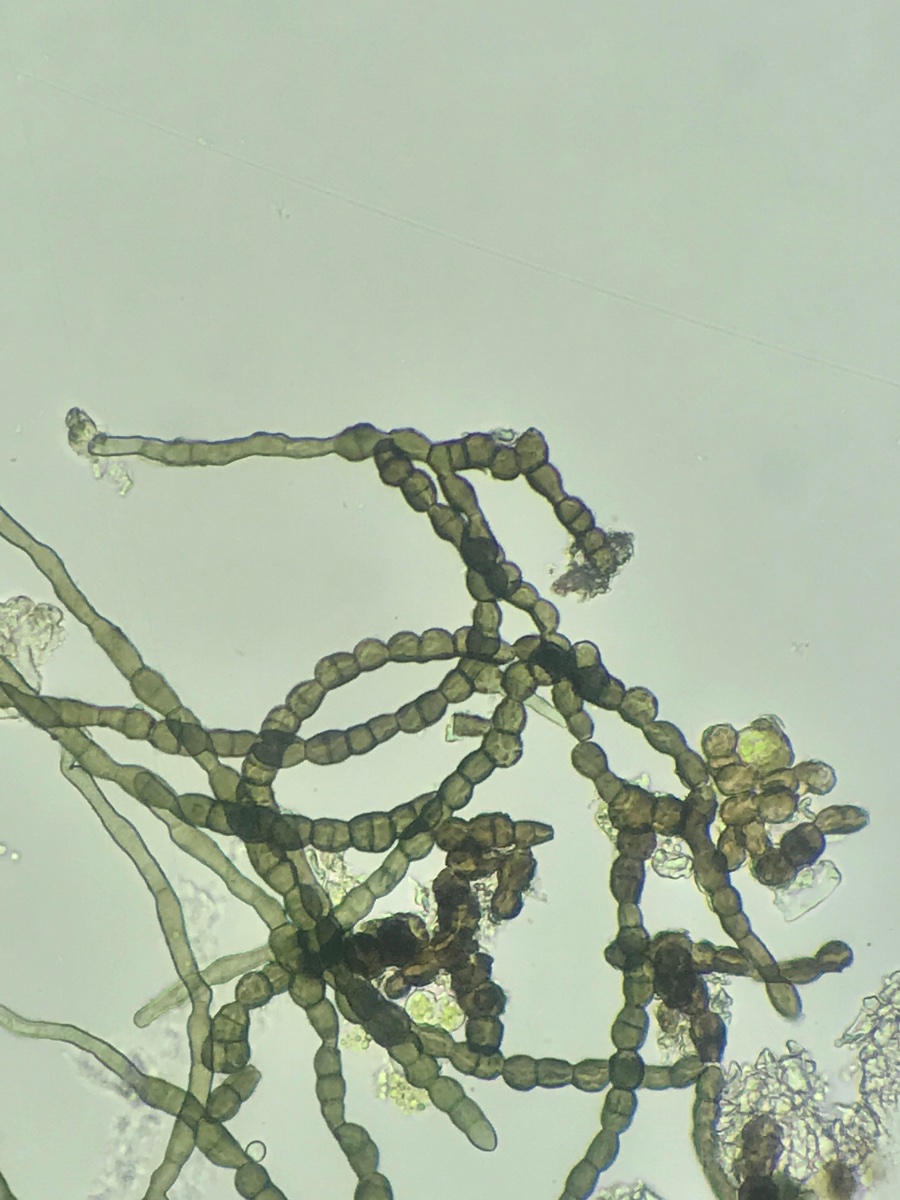
Taeniolella arthoniaeconidiophores showing branching 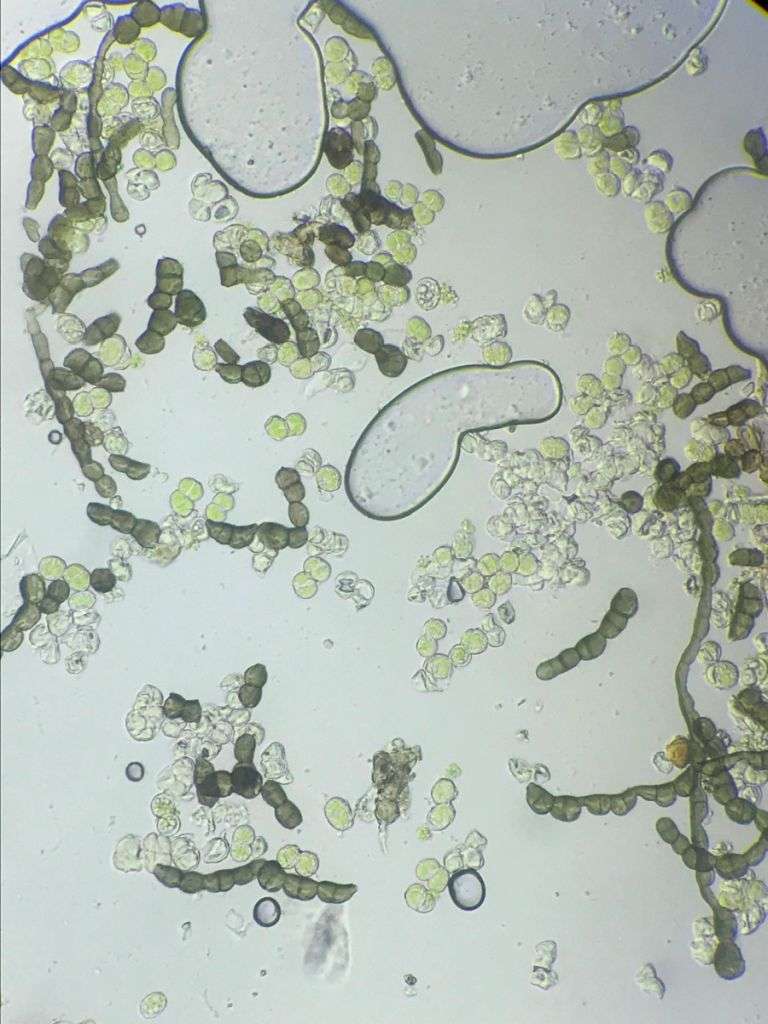
[attachment=2]2020-02-17-02.jpg[/attachment]
Taeniolella arthoniaebroken up material showing the mainly 1 septate conidia [attachment=1]Taeniolella arthoniae Hyphomycetes The lichenicolous.png[/attachment]
Taeniolella arthoniaea drawing in Hawksworth (1979) The lichenicolous Hyphomycetes, Bulletin of the British Museum (Natural History), Vol 6, No 3. Available on the internet, well worth googling I have not found any more yet, but it should turn up on old Oaks elsewhere.
Finally something bigger and really pretty, just because it was snapped on the same day:
[attachment=0]2020-02-17-01.jpg[/attachment]
WetSchismatomma graphidioideson a small suppressed Beech Neil
February 24, 2020 at 8:17 am #42813Another interesting post, Neil – lichenicolous fungi are fascinating. Your link hasn’t worked for me but the monograph can be downloaded from here:
https://www.ingentaconnect.com/content/wfbi/fuse/2018/00000002/00000001/art00007;jsessionid=7mu4ghnsldhvl.x-ic-live-02 Regards, Chris
February 24, 2020 at 9:35 am #42814Chris Thanks, the doi.org link worked on my computer but does seem to have failed in the post, have replace with the direct link in post and it works now
Neil
February 25, 2020 at 9:50 am #42815I had a Taeniolella on apothecia of Lecanactis abietina from Somerset (Horner Wood), which I called T. delicata as that species has also been reported from Lecanactis (see images http://fungi.myspecies.info/taxonomy/term/8745/mediahttp://fungi.myspecies.info/taxonomy/term/8745/media” class=”bbcode_url”> Really nice micro images, by the way – what mounting media did you use?
Best wishes
Paul
February 25, 2020 at 10:34 am #42816Paul Vince has had
T. delicatafrom Lecanactis abietinain the New Forest and this species seems very catholic. Looking at your pictures, however, I would agree that your Horner specimen could very well be Taeniolella arthoniae, but it needs a wider view of the intact conidiophores, or more mature material. Quote:Really nice micro images, by the way – what mounting media did you use?
Thanks, but that’s not due to any skill in my part, in this case possibly just water as
Taeniolellaspecies do not near clearing, at most with K. The set up is a clamp designed for holding smart phones over the eyepiece and an iPhone. This has proved to produce reasonable results, so I have given up the expensive idea of buying a dedicated microscope camera Neil
-
AuthorPosts



- You must be logged in to reply to this topic.