- This topic is empty.
-
AuthorPosts
-
February 1, 2022 at 11:16 am #32300
Pyrrhospora querneais most common on old sandstone gravestones in my parish but recently I have noticed some colonists on ash trees. These colonists lack the dark boundary lines (often inaccurately described as prothalli) which are familiar when older individuals interact with neighbouring thalli. I decided to make a detailed investigation of P. querneaand produced some twitter threads with my findings, e.g.: https://twitter.com/obfuscans3/status/1485438522064474118 In some respects my observations diverge slightly from published accounts.
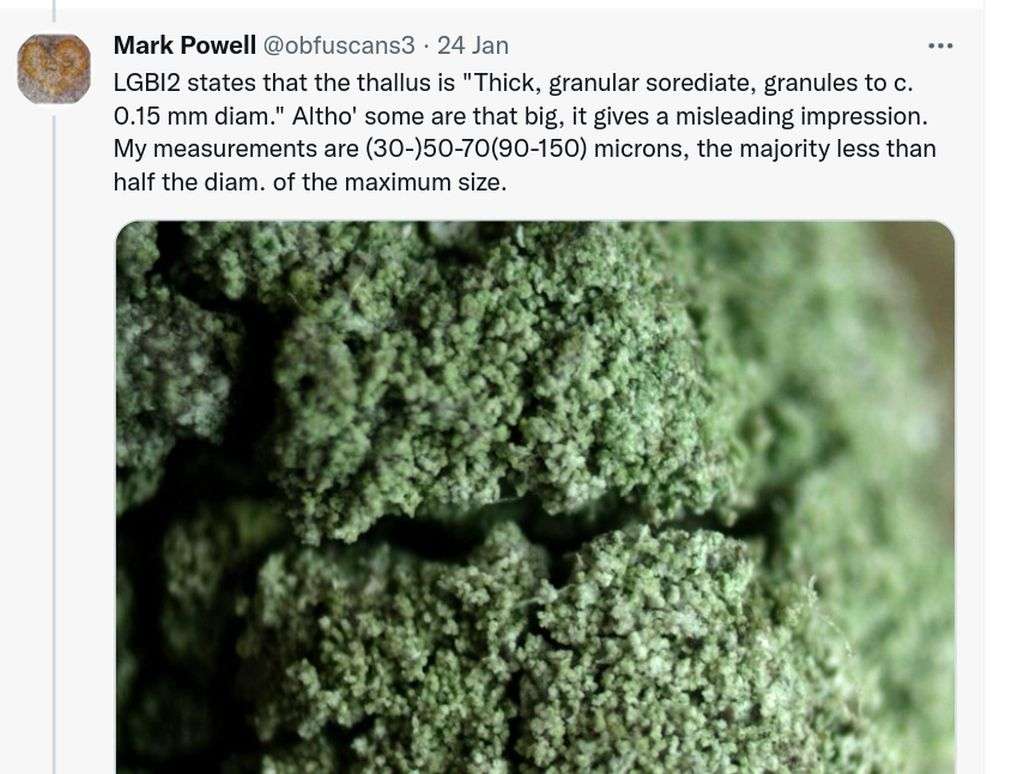
[attachment=4]Screenshot 2022-02-01 at 11.04.03.png[/attachment] I was interested to understand better the nature of the thalline granules and how they are arranged:
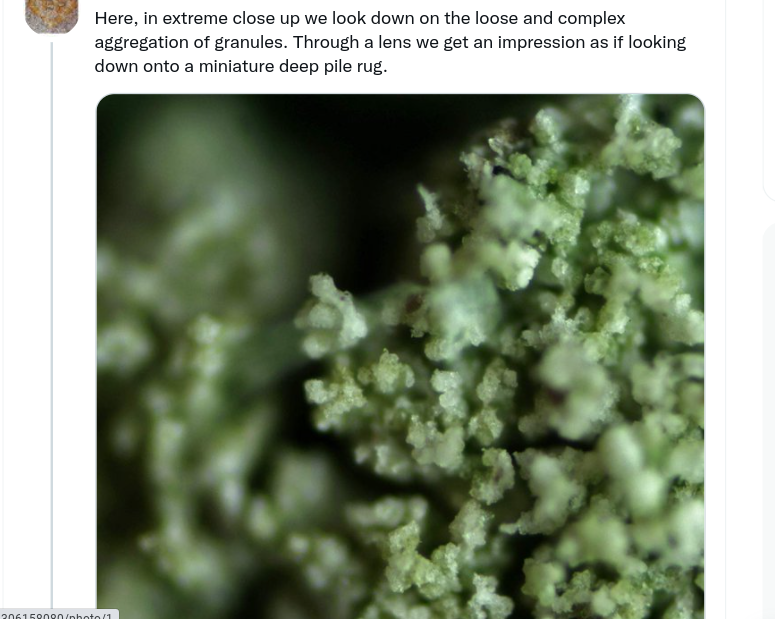
[attachment=3]Screenshot 2022-02-01 at 11.08.18.png[/attachment] 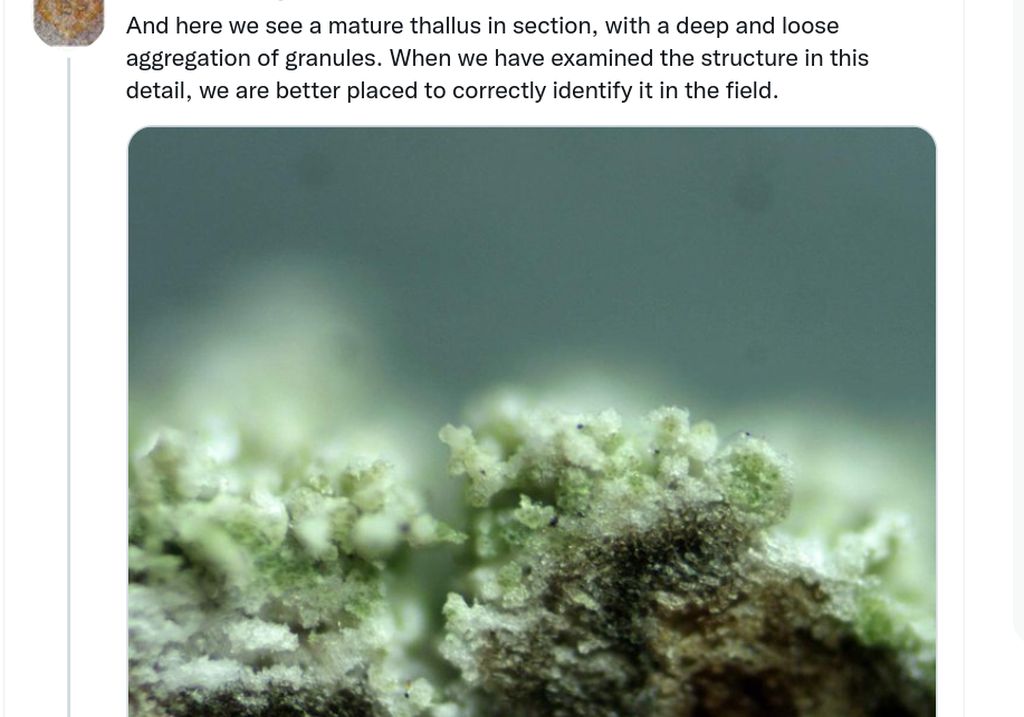
[attachment=2]Screenshot 2022-02-01 at 11.08.41.png[/attachment] I also checked the spot reactions and performed the ‘new’ K/UV test:
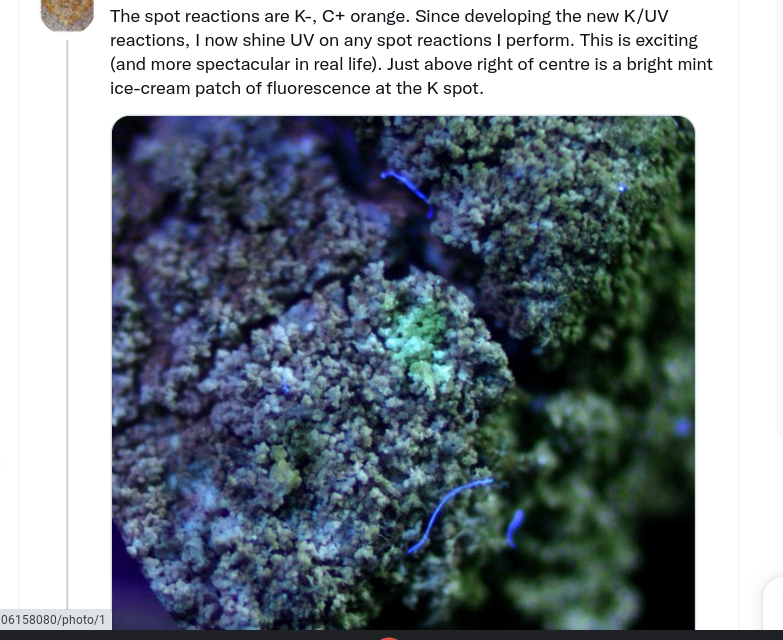
[attachment=1]Screenshot 2022-02-01 at 11.10.40.png[/attachment] I only remember seeing this K/UV+ bright pale green in one other lichen,
Lecidella elaeochroma. A look at the books and both seem to contain arthothelin. Have I discovered a new diagnostic test tonight? Too early to be sure but there is a good hope. As for the true prothallus of
P. quernea, I suspect it is endophloedal. 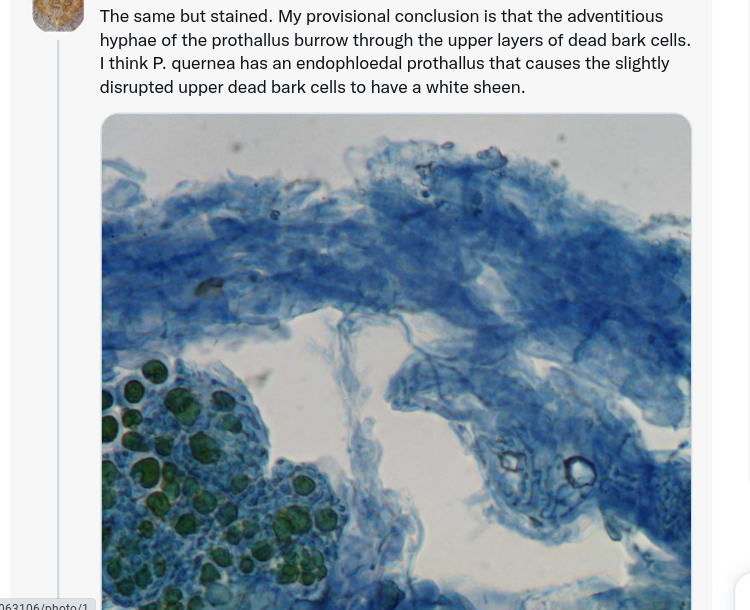
[attachment=0]Screenshot 2022-02-01 at 11.13.34.png[/attachment]
https://twitter.com/obfuscans3/status/1485559581413675014 February 1, 2022 at 8:22 pm #44647Mark Interesting, I have also notice a K/UV+ mint spot tests on yellow sorediate crusts but on C– ones as well (Lecanora compallens?) not entirely sure about these so will do some more testing.
Neil
February 3, 2022 at 2:00 pm #44648Thanks Neil. I have been been doing some testing and I find that specimens which I am convinced are
Lecanora compallensnever give a bright K/UV fluorescence, instead the K spot on L. compallensgives only a dull ochre orange under UV. The couple of specimens of
L. expallensthat I have tested so far give a K/UV+ bright pale green fluorescence, similar to that in Lecidella elaeochromaand Pyrrhospora quernea. This bright mint ice-cream fluorescence is given by fresh wet K spots but the fluorescence changes on drying to a fairly intense golden yellow fluorescence (as noted in
L. elaeochroma, P. querneaand now L. expallens). L. barkmanianagives a K/UV+ intense yellow but this only develops intensity as the spot dries. I guess this is understandable since L. barkmanianais supposed to contain atranorin (and the presumably related compound chloratranorin). In summary (in all cases the reactions reported are when K is applied to the soredia)
L. barkmanianaK/UV+ intense yellow fluorescence developing as the K spot dries (usually weak or inapparent if the spot is still wet with reagent). L. compallensK/UV+ dull ochre orange, slightly intensifying ochre orange on drying, but remaining relatively dull. L. expallensK/UV+ intense ice-cream green fluorescence when the K spot is wet, turning to a fairly intense rich golden yellow fluorescence on drying. I know that these studies are still at an early stage and open to further testing and challenge but I think we already have an additional means of separating out the often mis-identified
L. compallensby its K/UV dull ochre orange rather than any bright fluorescence. Indeed, I think I could distinguish all three using the K/UV reactions but only if I performed the reactions and observed the reactions when wet and then how they changed on drying. Mark
February 3, 2022 at 4:16 pm #44649Mark Yes I was thinking that the K/UV + spot test on C– thalli was probably telling me the C was going off, I suspect they were poorly developed
Lecanora expallens, which would have gone K/C+ orange. I have now seen the spot test from Lecidella elaeochromaand Pyrrhospora quernea. Also tested some specimens of Lecanora compallensand Lecanora strobilina(same chemistry) and also get the UV+ dull ochre orange, so as you say that is very useful. Neil
-
AuthorPosts


- You must be logged in to reply to this topic.