Forums › Forums › Fungi ID requests (post here if you aren’t sure what type of fungus you’ve found) › Pluteus???
- This topic is empty.
-
AuthorPosts
-
October 4, 2015 at 9:44 pm #29823
This yellowis/white specimen was found growing on a fallen log. The gills are pink and the spore print is pink so I was assuming a Pluteus. 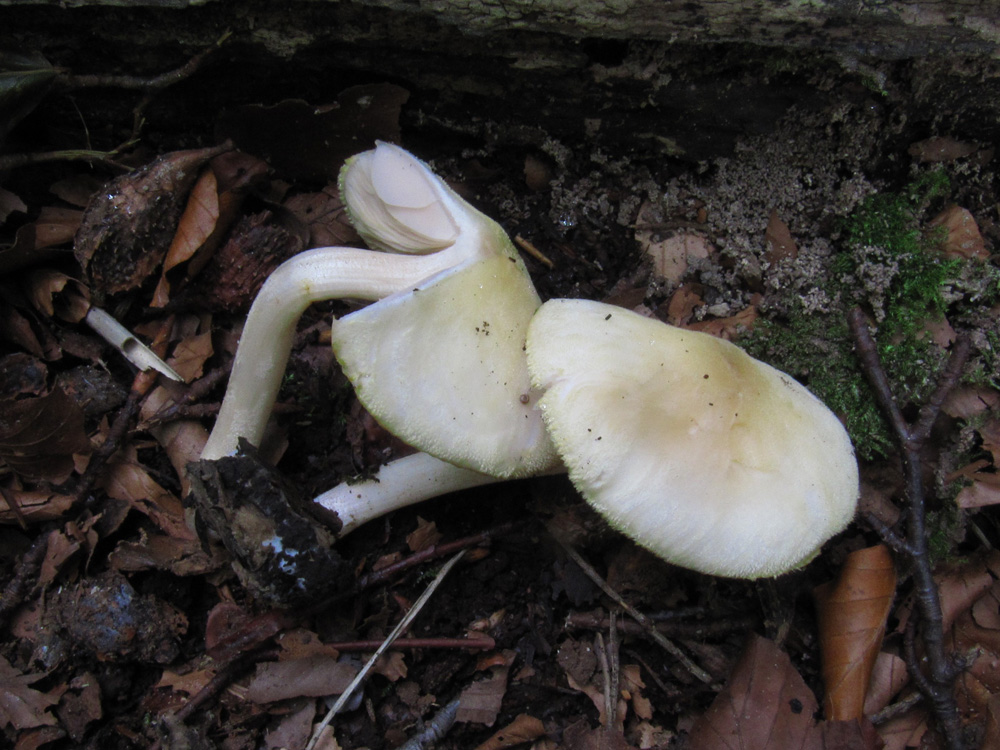
[attachment=2]IMG_8925a (2).jpg[/attachment]
Spores subglobose 5.8-6.2 x 4.8-5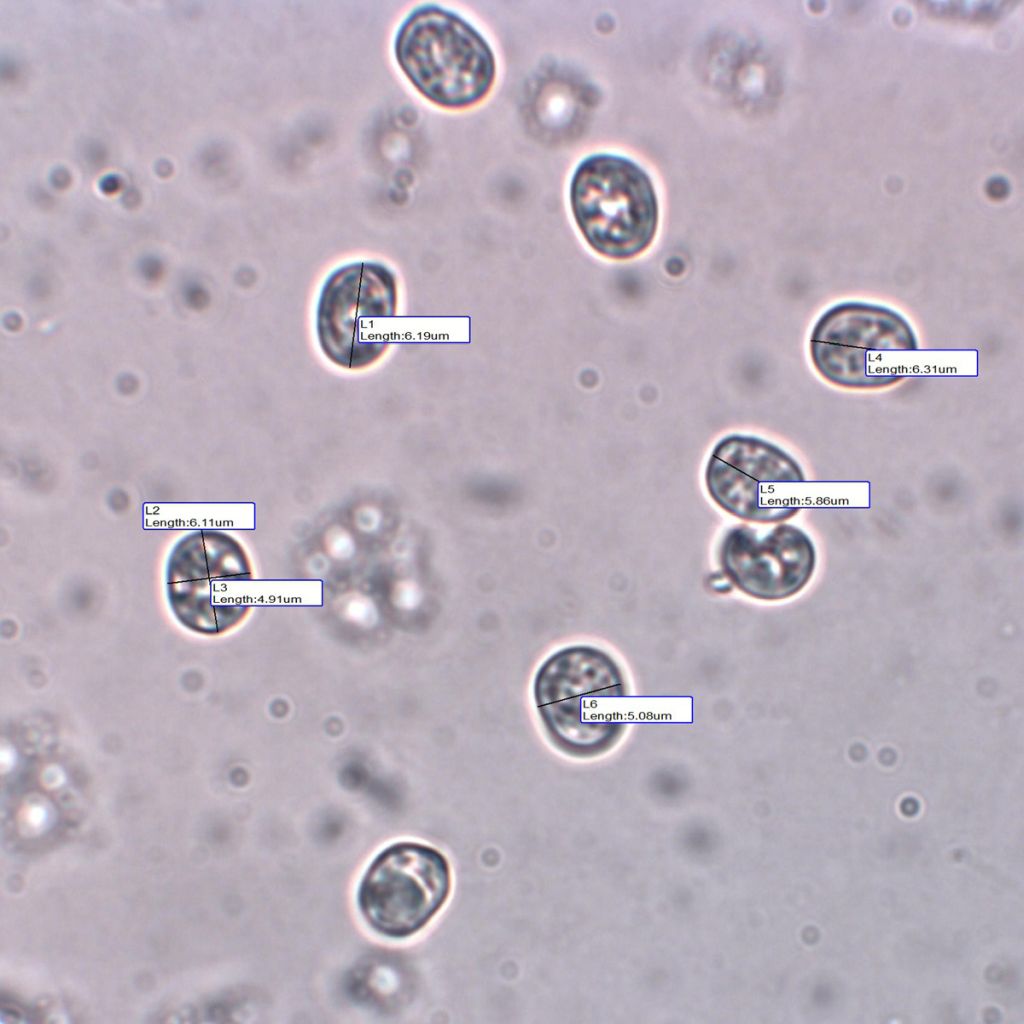
[attachment=0]IS_194_bak.jpg[/attachment]
When I looked closely the edge of the cap yellow hairs
[attachment=1]cap edge.jpg[/attachment]
I cannot come up with any Pluteus with this feature so not quite sure where the (re)start the search.I did think Volvariella but no sign of a Volva

Mal
October 5, 2015 at 7:11 am #36645The cap does looks a lot like Volvariella bombycina, but as you say – the lack of a volva is a problem and the spore size is wrong. A look at the pleurocystidia and cheilocystidia might be useful in determining genus.
Could it be a washed-out yellow Pluteus? The spore size more or less fits for both
Pluteus leoninusand Pluteus chrysophaeus.Cheers,
John
October 5, 2015 at 9:35 am #36646As requested Cheilocystidia

[attachment=2]IS_195a.jpg[/attachment] Pleurocystidia

[attachment=1]IS_198a.jpg[/attachment] and the pileipellis

[attachment=0]IS_196a.jpg[/attachment]
Hope this helps because it still leaves me struggling😳 Mal
October 5, 2015 at 10:05 am #36647Pluteus leoninus seems to fit the microscopy does it not? I have some photos on my web site, and there are others online too. To state the obvious, colour variants are not unknown in fungi. I did wonder about P plautus, which is rather variable, but I don’t think the microscopy fits.
October 5, 2015 at 4:34 pm #36648The microscopy does look like a good match for the photos shown on Leif’s site http://www.leifgoodwin.co.uk/Fungi/Pluteus%20leoninus.html If it is not
leoninusthen it seems likely to be something fairly closely-related. Not sure about that cap though… There seem to be a few macro characters which may help:
– is the stipe longditudinally striate (nicely shown on the link above)?
– is the gill edge colored?
– any smell?
Also, this key may help you if you haven’t seen it already
http://www.britmycolsoc.org.uk/files/9413/3094/7703/Pluteus%20Getting%20to%20grips%20with%20Richard%20Iliffe%20final%20version%20on%2012%20July%202010.pdf Cheers,
John
October 6, 2015 at 3:31 pm #36649John No distinct aroma, the gill edges are concolourous and the stem although showing vague signs of longitudinal ridges I would say is hairy.
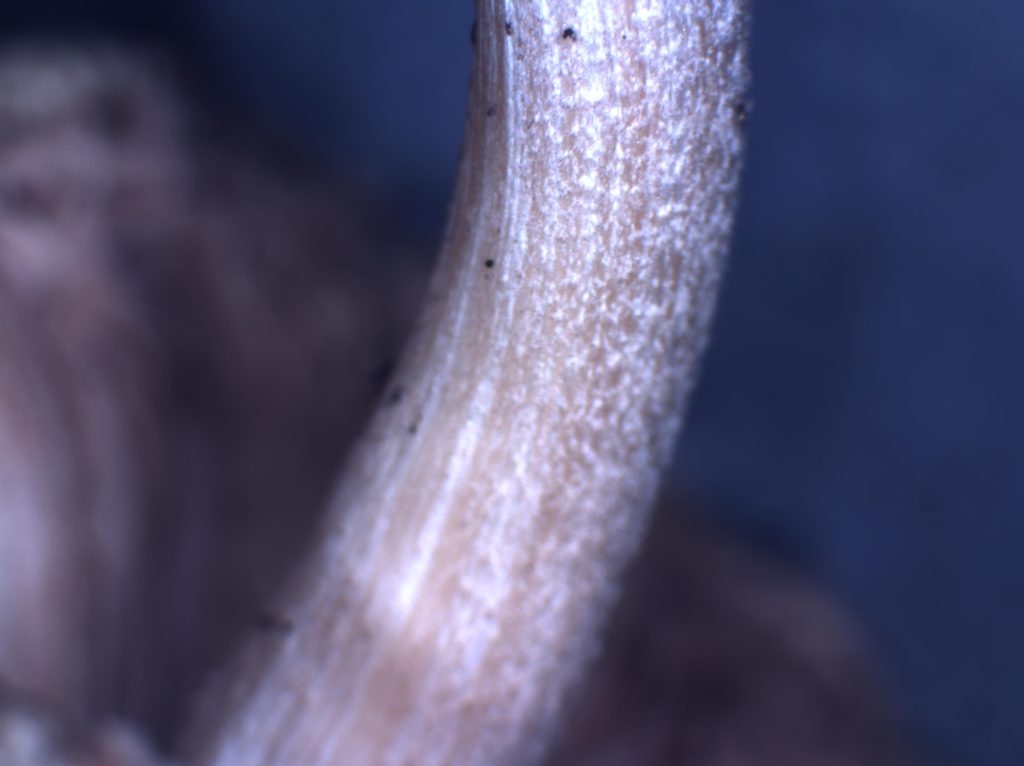
[attachment=0]IS_193.jpg[/attachment]
The species P semibulbosus(inquilinus) seems to be a definite possibility. Has anyone any experience of that species?Mal
October 6, 2015 at 4:13 pm #36650Hi Mal There seems to be a bit of confusion regarding names and the cap structure, but you do seem to have a good fit for the
P.semibulbosusdescribed in FN2.. Does it have a bulbous base? I can’t really tell from the photos. The text seems to suggest it is an optional feature anyway.
Cap translucently striate when moist?
Cheers,
John
October 6, 2015 at 7:48 pm #36651John Yes it has a slightly bulbous base but I am not sure I would say the cap was translucent but definitely striate.
Your mention of FN had me looking through my copy, sadly the first edition which is too big for one volume and is now falling to pieces, and it took me to Pluteus umbrosus var albus which is not or weakly translucently striate.
This is obviously a white variety of P umbrosus (which was also on the same log) and is a really good fit. I was worried that P umbrosus has a dark edge to the gill and this definitely didn’t but a search through Pearsonia includes in the description, white edge to the gills and a flocculose stem.
Unless I get any information to the contrary I think this is what I will record it as.
Thanks for all your input.
Mal
-
AuthorPosts


- You must be logged in to reply to this topic.