- This topic is empty.
-
AuthorPosts
-
January 16, 2021 at 2:33 pm #31979
Continuing my search through oddments collected on Anglesey in 2019, I found this convenient dual specimen. On the left (with pale cream thalline margins) is the reasonably common Myriolecis( Lecanora) fugiens, and on the right (with the yellow thalline margins) is M. massei. Myriolecisis a recently recognized genus set up to contain the Lecanora dispersaaggregate. M. masseiwas described in 2018 from Breton collections, for a species with yellowish thalli (usually extensive like those of M.( Lecanora) actophila), and chemistry C+ orange, Pd- and UV+ bright orange. M. fugiensis contrasted with M. andrewiiin LGBI2 with a yellow-brown thallus rather than white in andrewiibut it seems to be cream at best when compared with M. massei. Apart from thallus colour, M. fugiensdiffers from M. masseiby thalline margins that are Pd+ orange. There was a collection from Jersey cited in the original publication of
M. masseiand it has since been recorded from northern Sutherland and the Outer Hebrides, but this seems to be the first Welsh record. It may well be overlooked for other maritime Lecanora-like species. 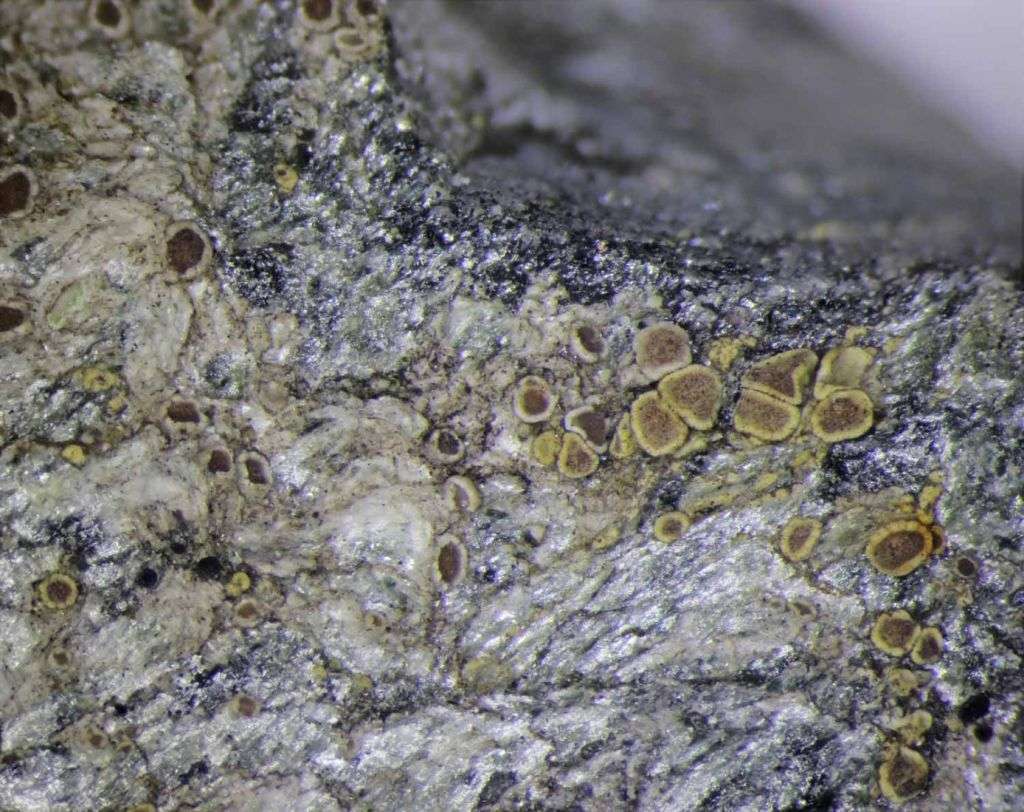
[attachment=0]A31694.jpg[/attachment] January 16, 2021 at 10:35 pm #43835This is exciting and we shall be looking out for a Myriolecis with yellow thalline margins down here on the North Devon coast. January 16, 2021 at 11:09 pm #43836While you’re looking for a yellow Myriolecis, could you keep an eye open for Lecidea phaeophysata, which I recently described with Pieter van den Boom from maritime rocks in western Europe ( Lichenologist51(3). 2019). It is not a true Lecideaand appears to be close to Bryobilimbia/Clauzadea, but all collections are too old for sequencing. We have records from western Ireland (Connemara) and northern France (Bretagne) so surely it must occur in SW England or the Channel Islands. Here is the figure from the paper.

[attachment=0]Fig_1.jpg[/attachment] OK, not as easy to spot in the field as a yellow
Myriolecis, but it would be good to be able to add it to the UK list – and even better to have fresh material so we can sequence it and find out where it fits in the scheme of things. Alan
-
AuthorPosts


- You must be logged in to reply to this topic.