Forums › Forums › Fungi ID requests (post here if you aren’t sure what type of fungus you’ve found) › Hygrophorus
- This topic is empty.
-
AuthorPosts
-
September 27, 2015 at 7:26 am #29778
I believe this is a Hygrophorus, found with beech trees, oak too I think, possibly pine at distance but will check again: 
[attachment=1]_DSC3184 Hygrophorus.jpg[/attachment] 
[attachment=0]_DSC3188 Hygrophorus.jpg[/attachment] No microscopy yet. The cap is about 2 cm wide, very sticky. Faint apical ring zone, stem apex scaly. Gills white, decurrent.
Going by appearance alone –
🙄 – this could be Hygrophorus mesotephrus.September 27, 2015 at 9:14 am #36475Spores (9-11)x(6.5-7)um2 in Melzer’s seen with a x100 immersion objective: 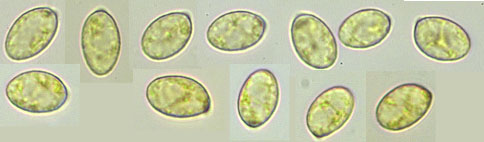
[attachment=0]Hygrophorus mesotephrus spores Melzers x100 Composite.jpg[/attachment] I now think this is Hygrophorus mesotephrus, given the white stem and gill, spore size, cap size and colour and absence of a distinct smell.
September 27, 2015 at 5:31 pm #36476Interesting Leif; when I find specimens like this I usually key them to H. persoonii(syn. dichrous). Looking in FAN2, I see that this and mesotephrusare adjacent in Arnolds key (and both are British). Persooniiis only with Oak and mesotephrusis Beech and Oak. Persooniihe says has an ochraceous to light brown then olivaceous to greyish brown slimy covering whereas he describes mesotephrusas having a white, pale ochre-orange to pale brown glutinous covering. But he describes mesotephruswith a smaller cap and narrower stipe (to 6.5(8)mm) although there is some overlap with persoonii. September 28, 2015 at 8:11 pm #36477Hello Roy, yes there were two or three species I considered. Funga Nordica indicates that H persoonii is more robust, and tends to have distinct stem colouration, although not necessarily when young. It also tend to have some colour at the stem apex and on the gills when older. H. mesotephrus is more graceful, with the cap and stem size range better matching my specimen. I could not see any conclusive evidence for it being H. mesotephrus, but on balance it seemed the more reasonable choice. I will see if I can place a sample of cuticle in KOH and look for incrusting pigment, a feature of H. persoonii. At least I now have a site for this, and can look out for more, the area is in general well worth a visit as it is one of those places that has abundant fungi when other places are barren. October 10, 2015 at 4:50 pm #36478Another collection today which in my mind confirms the ID: 
[attachment=0]_DSC3376 Hygrophorus mesotephrus.jpg[/attachment] October 11, 2015 at 8:58 pm #36479Hello, H. persoonii has olivaceous brownish caps and the veil in gridles on the stem (like H. olivaceoalbus, but with different colouration). H. mesotehprus is pure grey or brownish grey, ususally only in the cap center and not to the margin, and the stipe is white without veil girdles.
H. persoonii is stout and quite big in size, H. mesotheprus is slender and smaller.
best regards,
Andreas
October 11, 2015 at 9:32 pm #36480Yes, these were quite slender, caps 25mm, 30mm and 35mm, stem 8mm by 80mm on the largest. I found another site 100m away. I failed to see blue green incrusting pigment in the pileipellis with KOH. The images are a dead ringer for a MycoKey image (taken by a respected mycologist) confirming that the colouration is a match. http://www.mycokey.com/MycoKeySolidState/species/Hygrophorus_mesotephrus.html -
AuthorPosts


- You must be logged in to reply to this topic.