- This topic is empty.
-
AuthorPosts
-
April 21, 2023 at 1:44 pm #32601
I wondered whether the presence of L. hybocarpain Eastern England is a modern phenomenon, another example of a species that has invaded in recent decades, or whether it has always been part of lichen communities in this area. I can now provide some evidence that L. hybocarpawas already widespread in Suffolk in the first half of the 20th C. I was lent 15 specimens from Norwich Museum. They are all the Suffolk material in their collection in packets labelled ‘
Lecanora chlarotera‘. Many were originally named L. chlarona(an old name for L. pulicaris). Brian Coppins looked at most of these packets in 1973, found they were Pd- and renamed the packets as ‘ Lecanora chlaroteraagg.’. I have redetermined eight of the specimens as L. hybocarpa, a further three as L. cf. hybocarpa, one as L.argentataand three as L. campestris. The
L. campestrisspecimens were on elm and ash bark from Mendlesham, collected in 1914 and 1917, in one case accompanied by Candelariella vitellina. I find corticolous examples of L. campestrisfrom time to time in the modern landscape, and not only on silt-encrusted bark at the bases of trees. The
L. argentatawas on ivy bark, collected by Manning from Aldham in 1936. I find L. argentataboth as a relic on veteran trees in old woodlands and as a colonist in the modern Eastern landscape but it is rather rare. Most of the
L. hybocarpaspecimens are on tree bark but one is on lignum of a gate. They range in date from 1913/14 (Mayfield) to 1936/7 (Burn) with one more recent collection from Staverton in 1978. To confirm
L. hybocarpaI insisted on all the following features: Pd-, clusters of massive crystals in the thalline margin, relatively coarse epithecial granules descending in the hymenium and also that it ‘looked right’. In three specimens which I think are probably L. hybocarpa, I failed to find massive crystals in the margins, or found that the epithecial granules were atypically fine and I tentatively identified these L. hybocarpabut not confirmed. I placed det. slips in each packet, not only with my determination but with notes about my reason for naming, including details of crystals and granules present. I also noted that I was applying the name L. hybocarpausing current/recent British concepts as of 2023. I have more to add to this topic, interesting observations while working on these historic specimens, which I will post in due course. April 21, 2023 at 4:11 pm #45413This is very interesting, L. hybocarpa seems to be very common in north-east England as well so I must take a look at the old specimens in HAMU. Could you send me details of these Suffolk records please, so I can update them in the database.
Janet
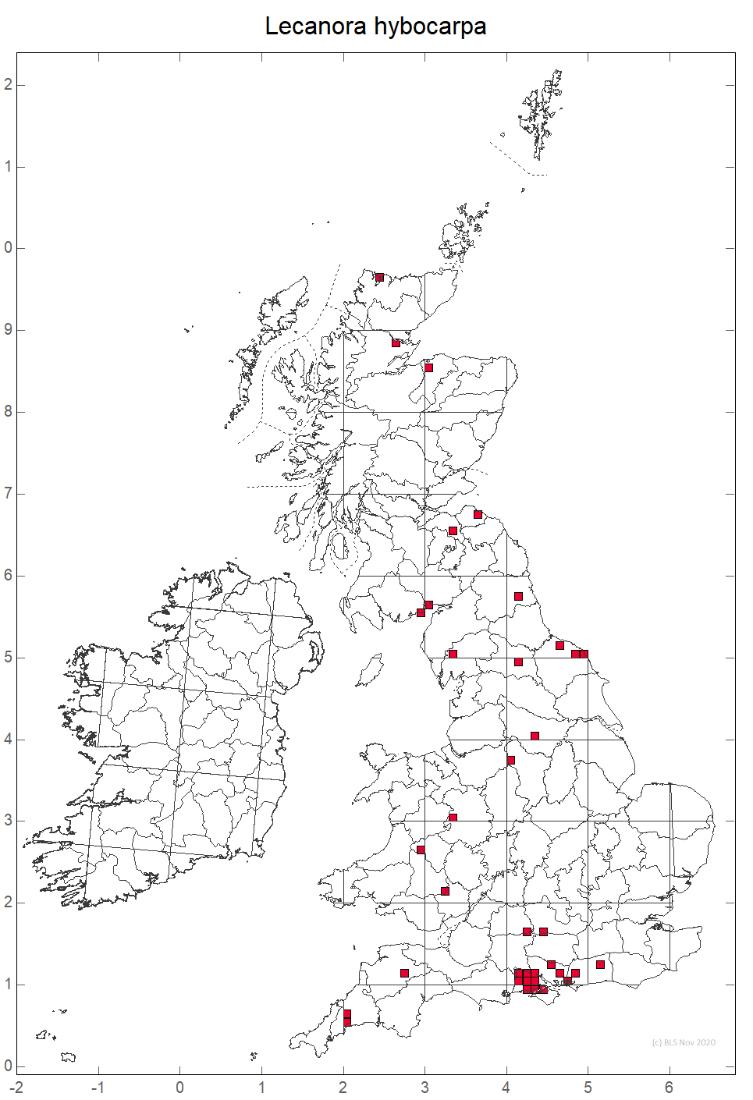
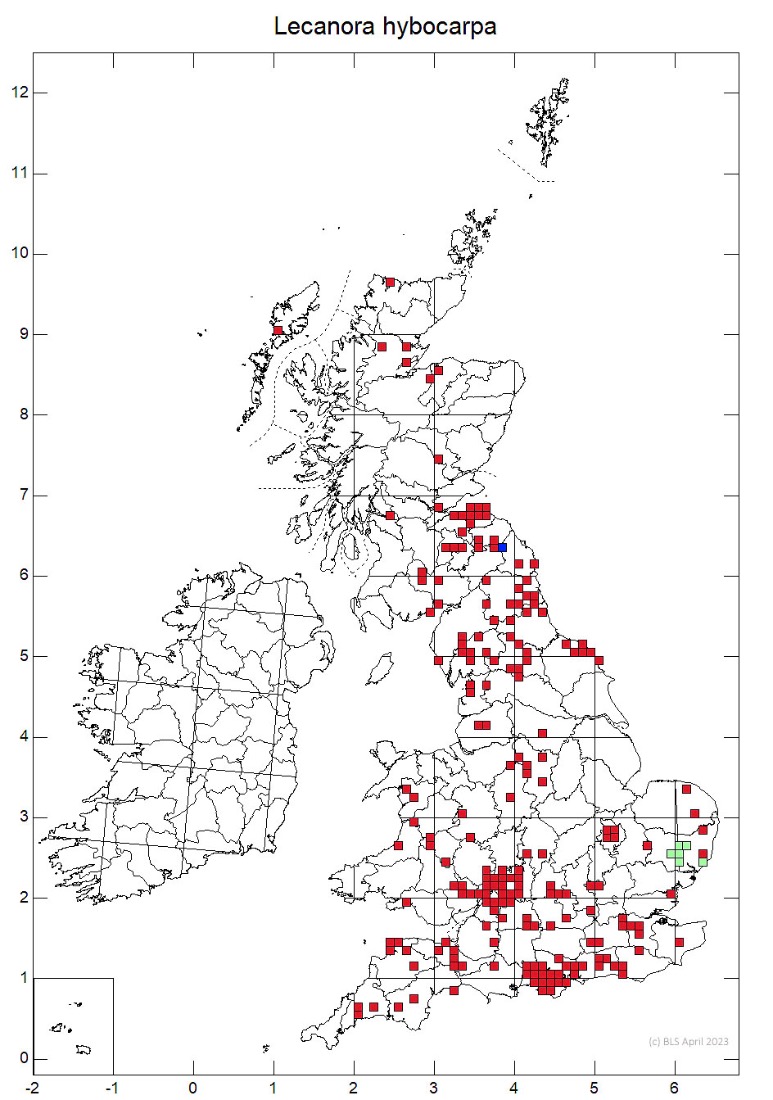
April 21, 2023 at 9:24 pm #45414Hi Janet, I have emailed you a spreadsheet with the details of the historic Suffolk specimens. I downloaded a distribution map from the BLS website in January 2021 and again today (shown below).
L. hybocarpacertainly seems to be very widely distributed and the map is gradually filling with dots. The lack of records from Bedfordshire indicates how negligent I have been in submitting records, something I hope to address in the relatively near future. I believe L. hybocarpato be the ubiquitous member of the subfuscagroup across the whole South Midlands and northern Home Counties region that I have spent most time studying. Distribution in early 2021:

[attachment=1]EscsnKLXAAAIWSB.jpeg[/attachment]
Distribution as of April 2023:
[attachment=0]Lecanora hybocarpa.jpg[/attachment]
I wonder if you have found any specimens ofL. chlaroteras. str. in north-east England? I have failed to find any in my region. April 22, 2023 at 8:35 pm #45415Mark Really fascinating, look forward to more from this work!
Thanks
Neil
April 25, 2023 at 12:18 pm #45416All the new BLS dot maps are now loaded on to the website https://britishlichensociety.org.uk/resources/species-accounts ” class=”bbcode_url”> https://britishlichensociety.org.uk/resources/species-accounts Lecanora hybocarpa: January 2022 (up as April 2023 above) :
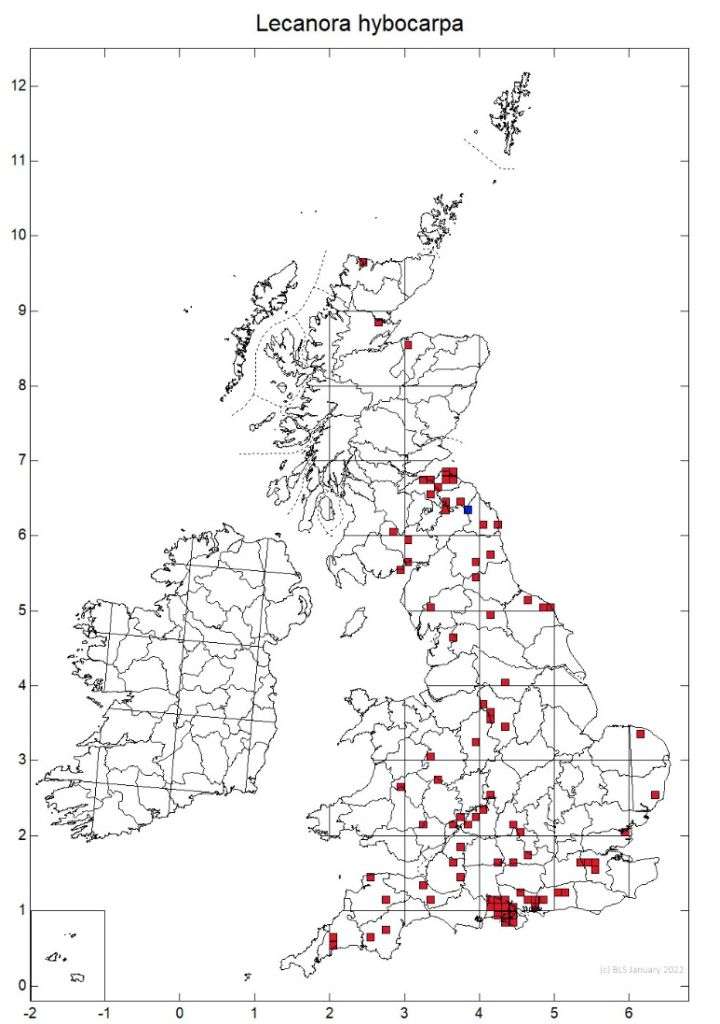
[attachment=1]Lecanora hybocarpa.jpg[/attachment] April 2023 (fully updated version)

[attachment=0]Lecanora hybocarpa 23.jpg[/attachment]
Includes Mark’s Norwich Museum specimens I thinkThere have been a lot of records put in over last year and a bit, well done. Lots of gaps still, however, and I must have a go at North Hampshire this year; colour that map red!
Neil
April 25, 2023 at 7:17 pm #45417Hi Neil – at least a couple of Dorset records are missing from the latest map as I submitted a record from Wool (south Dorset) for 2017 and another from Wimborne Minster (east Dorset) in 2021. Currently going through a box of Irish specimens from 10+ years ago but so far only spotted one that could be worth checking for L. hybocarpa…….
-
AuthorPosts





- You must be logged in to reply to this topic.