Forums › Forums › Fungi on miscellaneous substrates (not soil or wood) › Fungi on dung
- This topic is empty.
-
AuthorPosts
-
March 3, 2020 at 2:20 am #31606
I would recommend the study of coprophilous fungi to anyone with a decent microscope – though a stereo ‘scope is really handy as well. It’s not as weird or unpleasant an area of study as it may appear – I would, however stick to herbivore dung in the first instance. Trust me – rabbit dung is basically just partially digested grass. Also it’s a great way of doing valuable mycological studies at home when the weather conditions preclude productive outdoor work. The disadvantage of only doing the “toadstools” is that long barren season . . .
The literature on coprophiles is extensive and most of it reasonably accessible, and there are plenty of experienced mycologists happy to help. I would be happy to supply people with a useful set of documents – a very useful one is available online –
http://www.gutenberg.org/ebooks/57291http://www.gutenberg.org/ebooks/57291” class=”bbcode_url”> Anyway for starters, a fungus I haven’t seen before –
Podospora appendiculata: 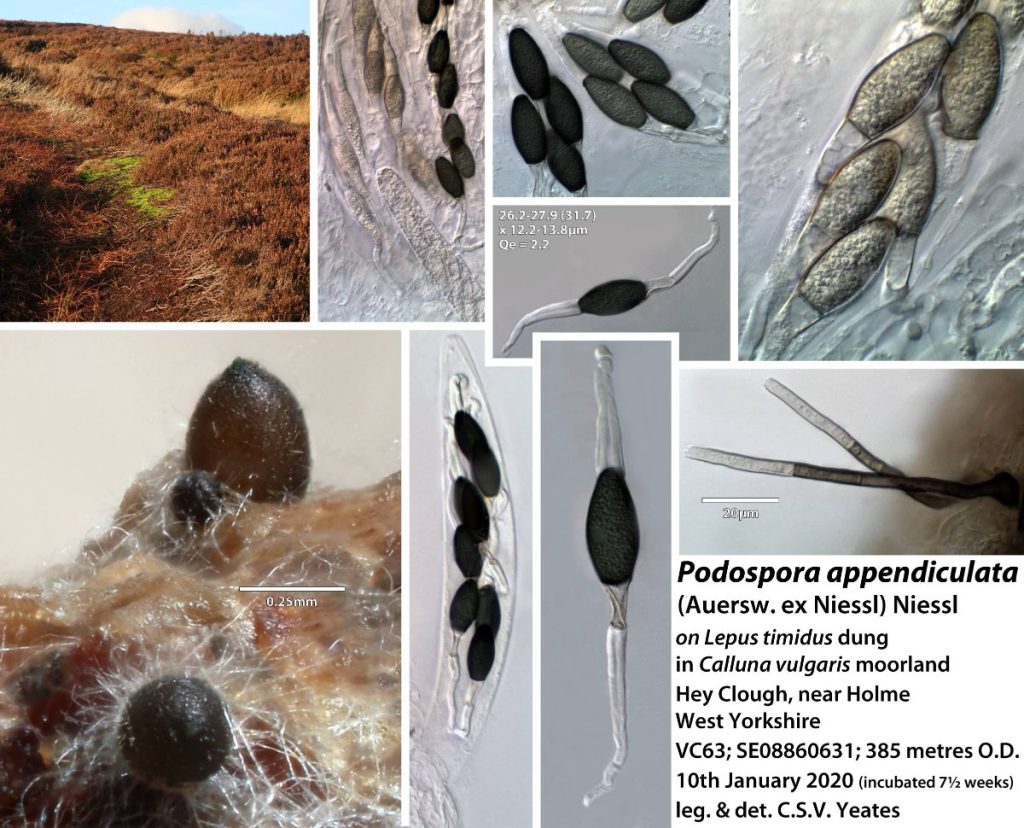
[attachment=0]Podospora appendiculata 0a.jpg[/attachment] March 3, 2020 at 8:22 am #42818I have only found this once, on pony dung, but it’s probably not scarce. I endorse Chris’s comments especially regarding willing helpers. Regards, Chris
April 5, 2020 at 9:17 am #42819With Chris Y’s prompting, you should all have samples of herbivore dung starting to produce fungi. 
One of the first
Ascobolusspecies to appear is Ascobolus equinus. I have two on different substrates: one on the more usual deer dung and the other on an eagle pellet (either golden or white-tailed). April 5, 2020 at 9:03 pm #42820Hi Chris A couple of comments: “Ascobolus equinus” is not an
Ascobolus; the synonymy is a bit of a jungle, but I think it has settled to Lasiobolus papillatushttp://www.speciesfungorum.org/Names/SynSpecies.asp?RecordID=186800 ” class=”bbcode_url”> http://www.speciesfungorum.org/Names/SynSpecies.asp?RecordID=186800 That said
Lasiobolushas hyalinesetae. Do you have BEZERRA, J. L. & J. W. KIMBROUGH. 1975. The genus Lasiobolus (Pezizales, Ascomycetes ) in Can.J.Bot. 53: 1206-1229? If not I’ll let you have it. I’ll also send you my recently done sections of Pezizales for the Yorkshire Mycota I’m writing (these include Ascodesmidaceae, to which Lasiobolusbelongs; and Ascobolaceae). I think you probably have a
Cheilymeniathere. Not always easy, careful microscopy needed, but I know you’ll be doing that anyway. Whatever you definitely have a member of the Pyronemataceae there, it’s a very genus-rich family, which I’m working on at the moment. If you Google “Cheilymenia Moravec” there are links to a number of online papers. The best starting point is his “Taxonomic Revision of the genus Cheilymenia – 3” in Mycotaxon, vol. 38, pp. 459-484 (1990). I can let you have that as well if you don’t have it. Best wishes
Chris
April 6, 2020 at 10:51 am #42821Hi Chris, thanks for your ever-useful comments. Yes, I was aware of the move (back) to
Lasiobolusbut, as you say, FRDBI is behind the curve here . . .This is not an insignificant problem with many recent fungi name-changes, as the recording software and NBN are not up to speed, hence making recording a problem. I had a discussion with Brian Douglas who suggested sticking with existing names for the time being, to make recording easier. It would be desirable to use the latest names but I see no easy solution … I think you are correct in my having a
Cheilymeniaspecies; I overlooked the fact that Lasiobolusare non-septate and mine are. It could well be Cheilymenia pulcherrimabut I have more material so will redo the microscopy. I have BEZERRA, J. L. & J. W. KIMBROUGH. 1975. The genus
Lasiobolus(Pezizales, Ascomycetes) but not the others so would welcome those. Regards, Chris
April 6, 2020 at 12:38 pm #42822Hi This is clearly not aimed at you in the slightest and I understand the general situation. But in this case it’s not a recent name-change. “Ascobolus equinus” is included in Dennis’s “British Ascomycetes” of nearly 40 years ago as a
Lasiobolusthough with a different specific epithet – and that was the standard work for anyone dealing with asco’s in this country for decades. It’s inclusion under Ascobolus in FRDBI is not based on taxonomic opinion – it’s simply a mistake. The problem is that the still very useful
FRDBIis essentially mothballed. I haven’t looked at the new system recently, when I last did it seemed very slow and far too “all bells and whistles” at the entry end. Index Fungorumentries can be updated very quickly – I know because on several occasions I have contacted Paul Kirk pointing out glaring slips (particularly the same fungus in under two names) and they have been promptly corrected. As ever it is worth pointing out that Index Fungorum(grey background) is a nomenclaturaldatabase; Species Fungorum(green background) is the taxonomic one. But such changes are not now possible on FRDBI. In any case it’s very important when dealing with earlier records to include a “paper trail” of original names where these differ from current usage. There’s also the problem of homonyms, and species “sensu X” or “sensu Y”
I know that you are a member of Ascomycete.org. If you go to the digital library page
https://ascomycete.org/Members/Libraryhttps://ascomycete.org/Members/Library” class=”bbcode_url”> HTH
Chris
-
AuthorPosts


- You must be logged in to reply to this topic.