- This topic is empty.
-
AuthorPosts
-
February 26, 2026 at 6:25 pm #33148
A puzzling blue-black sorediate crust (pale green where abraded) with a thin whitish thallus on a churchyard wooden bench in Warwickshire. Growing next to fertile Lecidella scabra, with soredia that fluoresced very strongly orange (unlike this, which only fluoresced very faintly orange). I thought it could be Buellia griseovirens, but despite several attempts (including under the microscope with a small drop of K and lots of soredia, left for several minutes to dry out, as suggested in another post on here) it only gave a yellow K reaction, and no red crystals were seen. The K spot fluoresces yellow in UV.
There was a distinct yellow reaction with C, but I couldn’t detect any Pd reaction in visible light (possibly a faint Pd/UV).
The K, C and Pd tests don’t fit any of the species listed as likely to be confused with Buellia griseovirens on the BLS page
https://britishlichensociety.org.uk/resources/species-accounts/buellia-griseovirens Di
February 26, 2026 at 6:43 pm #46872I don’t think you should give up on the possibility of Buellia griseovirens because in my experience most specimens of this species in the Midlands, East Anglia and Home Counties give a K+ yellow reaction, rather than a K+ yellow turning red. Even when mounted microscopically in strong K solution I have failed to produce any red crystals with these K+ yellow forms of B. griseovirens. The published information suggests that the reaction may be weak but I suspect that some populations, perhaps a lowland race, produce stictic acid rather than norstictic acid. There is a similar phenomenon in an unrelated species, Aspicilia grisea. Although the published information states that this contains norstictic acid, the lowland material, including the rare occurrences on brickwork, and notably the specimens on the sarsen stones such as at Fyfield Down, are consistently K+ yellow. Brian has speculated that, in a similar way to B. griseovirens, these K+ yellow forms of A. grisea contain stictic rather than norstictic acid.
February 26, 2026 at 7:00 pm #46873As for look-alikes of Buellia griseovirens, I could add some others to the short list on the BLS species description page. It is not impossible that Porpidia tuberculosa could turn up on a churchyard bench but yours isn’t that because you would have seen a very distinct K/UV+ blue-mauve due to confluentic acid. Lecanora pannonica is somewhat similar to Buellia griseovirens, especially thin and neat material growing on tops of sandstone headstones; it is not impossible that this would turn up on lignum though admittedly I have never seen it on other than stone. The holy grail of such things on lignum is Thelomma ocellatum which I have found but once, on a very old weathered oak fence post at Toot Baldon churchyard in Oxfordshire. T. ocellatum is perhaps best described as P. tuberculosa on steroids and, despite never having seen it before in the flesh, I was fairly sure I had found it at Toot Baldon at my first glance of it and before it was confirmed. I think the most likely identity of your lichen on the wooden bench is one of the K+ yellow forms of Buellia griseovirens but I thought I would provide my list of somewhat look-alikes for your general interest.
February 26, 2026 at 7:06 pm #46874Thank you. That is very helpful, and all very interesting. Di
February 27, 2026 at 10:20 am #46875That’s all very interesting, thank you to Mark for his helpful comments. Is there a possibility that some of the K+ yellow
griseovirenspopulations are B. arborea? According to the books that has a C– reaction in contrast to the C± yellow of griseovirens, but otherwise looks difficult to distinguish, and perhaps it is not as rare in southern England as it seems. I suppose that is not the case for Di’s collection, as it is definitely C+ yellow… Best wishes
Paul
February 27, 2026 at 8:31 pm #46876I’m grateful to Paul for reintroducing the possibility of B. arborea being much more widespread, a species that I think I convinced myself of once on an Islay fencepost and should still have a specimen to re-examine. Since then I had, in my own mind, run with the idea that the relatively common lignicolous and corticolous lichen with bluish delimited soredia in the Midlands and Home Counties were different from the Islay material and that they seemed like chemotypes of one taxon, B. griseovirens, most K+ yellow and a few identical looking specimens being K+ yellow turning red as they should be according to the literature. I am just stating the way I had thought about the situation up to now, not holding on to any personal cherished hypothesis. I do know that I observed the apparently ‘unexplained’ C+ yellow reaction in some of my K+ yellow ‘Buellia griseovirens’, perhaps in all or most of those that I bothered to test with C. As the C+ yellow reaction is described as ‘unexplained’, including in LGBI3, I am not sure what importance we should attribute to it. I am still erring towards Di recording this as a K+ yellow form of Buellia griseovirens unless or until someone can prove that it is something different. In the meantime I will look back at some of my specimens of B. griseovirens and hopefully find that I also have a snippet of B. arborea and see if any of this changes my opinion.
Mark
March 10, 2026 at 4:13 pm #46877I recently came across some well-developed material of what I would normally record as Buellia griseovirens on a wooden bench seat in Bedford Cemetery. This gives the following reactions, K+ yellow, C+ faint yellow and Pd+ faint yellow. In a previous post I speculated that this sort of material might be a chemotype of B. griseovirens which produces stictic rather than norstictic acid. However, the faint Pd+ yellow reaction seems to suggest otherwise, the presence of stictic acid ought to produce a much more intense Pd+ yellow-orange reaction. When the K spot dried and UV was shone at it, an intense K/UV+ yellow reaction was seen, especially on the thallus. This might indicate the presence of atranorin which would be right for B. arborea. I dug out an old specimen of K+ yellow turning red B. griseovirens from ash bark in Cambridgeshire and that didn’t produce an intense K/UV+ yellow reaction, just a very faint yellowish colour. This perhaps adds weight to Paul”s suggestion to consider B. arborea. If the sort of material that Di and I have recently collected from wooden seats really is B. arborea then we would need to have a complete rethink of the distribution. I suspect that many records of ‘B. griseovirens’ are made on sight, without testing with K. Most specimens I have encountered in the Midlands and Home Counties have been K+ yellow.
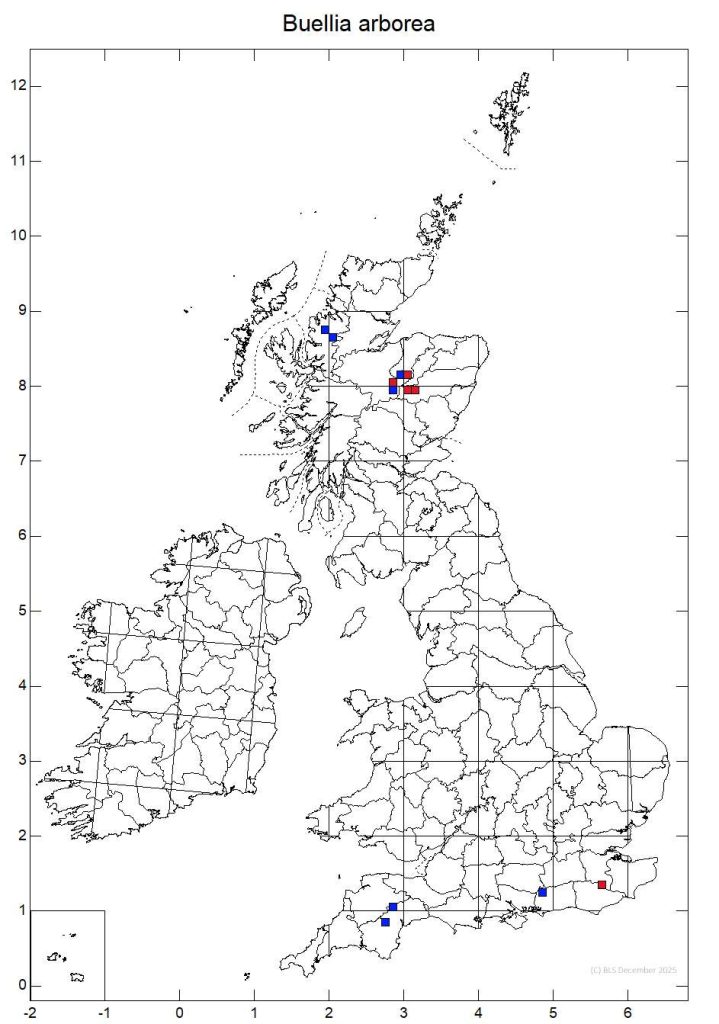
[attachment=0]Buellia arborea.jpg[/attachment] March 10, 2026 at 4:59 pm #46878Mark According to the LGBI
Buellia griseovirensis supposed to have: Quote:atranorin, norstictic acid and traces of other substances of the stictic acid complex
Italic agrees,
https://italic.units.it/index.php?procedure=taxonpage&num=364 ” class=”bbcode_url”> https://italic.units.it/index.php?procedure=taxonpage&num=364 Cladonia symphycarpa, there could be a K/UV(dry)+ bright yellow fringe around the red bit. I am not helping! Probably needs some TLC and sequencing work to sort this out. I was looking at some fertile Buellia griseovirensrecently (so definitely not Buellia arborea) and this appeared to lack norstistic acid too. I will get some more and double check. Buellia arboreais likely overlooked, pictures and comment here https://dalib.cz/en/taxon/info/Buellia%20arboreahttps://dalib.cz/en/taxon/info/Buellia%20arborea” class=”bbcode_url”> Neil
March 11, 2026 at 10:10 pm #46879OK got some more material from the fertile colony of Buellia griseovirens(on an old Beech in pasture woodland in the New Forest, where it is occasionally fertile), In the field I got a nice atranorin spot test (K+ yellow & K/UV(dry)+ bright yellow) but no hint of any K+ yellow to red spot test. Back home, no crystals produced under the microscope. This is interesting
https://dalib.cz/en/taxon/info/Buellia%20griseovirenshttps://dalib.cz/en/taxon/info/Buellia%20griseovirens” class=”bbcode_url”> Quote:It produces norstictic acid, whereas B. arborea contains atranorin and placodiolic acid. Norstictic acid is often present only in low concentrations in B. griseovirens and is barely detectable by the thallus reaction. Even the formation of red crystals after the addition of KOH in a microscopic sample may not always work reliably, so atypical specimens must usually be verified by TLC.
It seems to me that we might have the low norstictic form as the dominant form in Britian. No idea how we detect sterile
Buellia arboreashort of TLC! Any tests for placodiolic acid? Neil
March 12, 2026 at 9:09 am #46880Thanks all for these very interesting follow ups. (The most recent patch that I thought would be B. griseovirens fluoresced bright orange and turned out on testing to be Lecidella scabra. Ugh!)
-
AuthorPosts


- You must be logged in to reply to this topic.