- This topic has 3 replies, 2 voices, and was last updated 2 months, 3 weeks ago by
Neil Sanderson.
-
AuthorPosts
-
August 2, 2026 at 11:32 am #33186
I have been finding some interesting stuff since I started looked at twigs harder in the New Forest and have been meaning to do some posts on the result. This one has just come up and is so surprising that it has prompted me to start with this. I have been aware, sort of in the corner of my eye, of very silvery patches of bark with irregularly rounded
Arthonialike apothecia. It is uncommon and when I collected it earlier the specimen I took had no spores but did have broadly clavate asci, a granular brown-black K+ greener epithecium and no apothecium margin. I found some more recently and this time it had spores, and these were mult-septate and quite large which seemed to instantly rule out any known British Arthoniaceae. The details are:
Fallen twig in by road in Beech – Oak pasture woodland, Nicholas Corner, Bartley, New Forest
Thallus marked by a silvery area of bark, not lichenised; apothecia irregularly rounded 0.25-0.50 mmm across, 100 µm high; ascomatal gel I+ red; epithecium brown-black, with granules, somewhat K+ greener; hymenium colourless; hypothecium thin and pale brown; asci broadly clavate, with a large apical dome, and an ocular chamber, up to 50 x 30 µm; spores (4–) 6 – 8 septate more rounded at one end and more tapered at the other, (20–) 30 – 35 (6–) x 9 – 11 µm () = measurements from immature(?) spores.

[attachment=9]2026-07-15-04.jpg[/attachment]
Thallus & apothecia
[attachment=8]2026-07-15-05.jpg[/attachment] 
[attachment=7]2026-07-15-06.jpg[/attachment] 
[attachment=6]2026-07-15-08.jpg[/attachment]
Apothecia cross sections
[attachment=5]2026-07-15-10.jpg[/attachment] 
[attachment=4]2026-07-15-12.jpg[/attachment] 
[attachment=3]2026-07-15-13.jpg[/attachment] 
[attachment=2]2026-07-15-14.jpg[/attachment]
Spores & acsci
[attachment=1]2026-07-15-15.jpg[/attachment]
Ascus in K/IThis was clearly not in LGBI3, the spores were unlike any British Arthoniaceae, so I ran it through the Arthonioid key in Italic 8
https://italic.units.it/flora/index.php?procedure=ext_key_home&key_id=2731 ” class=”bbcode_url”> https://italic.units.it/flora/index.php?procedure=ext_key_home&key_id=2731 Arthonia hypobelahttps://italic.units.it/index.php?procedure=taxonpage&num=139 ” class=”bbcode_url”> https://italic.units.it/index.php?procedure=taxonpage&num=139 The species is more commonly collected in eastern North America and is also described here
https://lichenportal.org/portal/taxa/index.php?tid=52439 ” class=”bbcode_url”> https://lichenportal.org/portal/taxa/index.php?tid=52439 Arthonia ilicina. However, two at least have sketches of similar spores to my specimen, so some American collections under the name Arthonia hypobelado match my specimen. 
[attachment=0]LSU00058400_1_WR.JPG[/attachment]
One of the specimensAn issue might be that my specimen was producing smaller spores that appeared to be immature spores, that were a better fit with the descriptions. Anyway it looks like
Arthonia hypobelais an OK name until someone does some further work on these. The New Forest taxa seems likely to be closely related to Arthonia hypobelaat the least, even if it is not it. Neil
August 2, 2026 at 2:30 pm #46980Interesting. It might be referable to Naevia, as it’s not lichenized, I have what might be several species masquerading as N. punctiformisthough none like the one you describe. There’s a useful table of characters of non-lichenized “ Arthonia” species in Thiyagaraja et al. (2020) https://doi.org/10.1007/s13225-020-00451-9 .Best wishes
Paul
August 2, 2026 at 4:08 pm #46981Yes other than the big spores, the apothecia do look similar to those of Naevia, but the ascomatal gel being I+ red would be different from the species that Thiyagaraja et al. (2020) included in Naevia. Nothing with spores as big as my taxa in his table either. I imagine it would need sequencing to place the species. It does seem to match specimens that have been called Arthonia hypobela, but I would not be surprised if it was not that! Will look out for more, I think there is a bit of it about in the New Forest, but it is not frequent.
Neil
August 29, 2026 at 5:29 pm #70577Nice to see the forum is back!
Over the interregnum I have seen this taxa in a few places in the New Forest on Oak, all on Oak twigs and quite easy to spot from the sliver patches of bark and the irregularly rounded Arthonia like apothecia. Mostly rather scrappy specimens but this is a nice specimen from my home wood
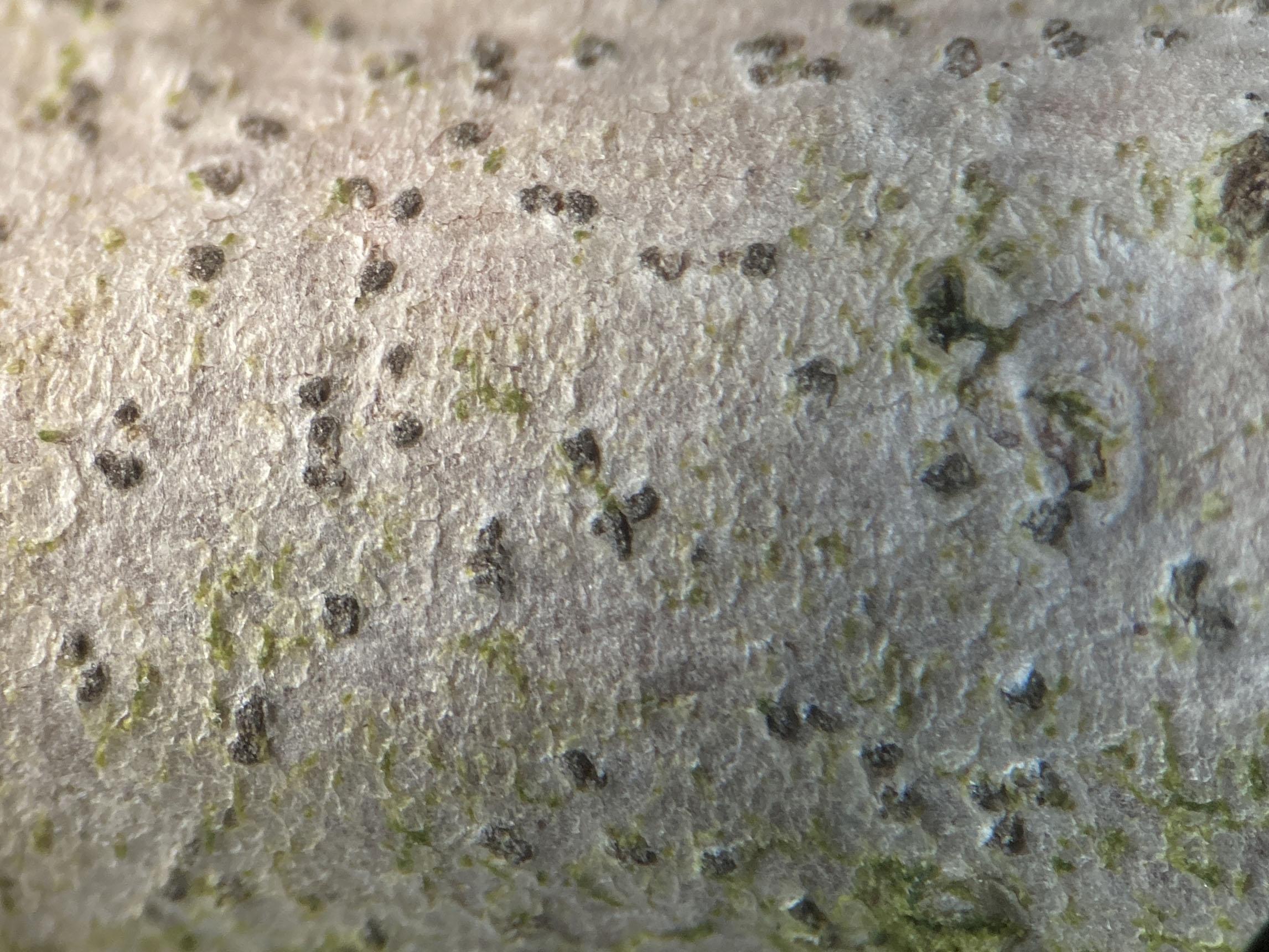
Arthonia cf hypobela on Oak twig in the New Forest
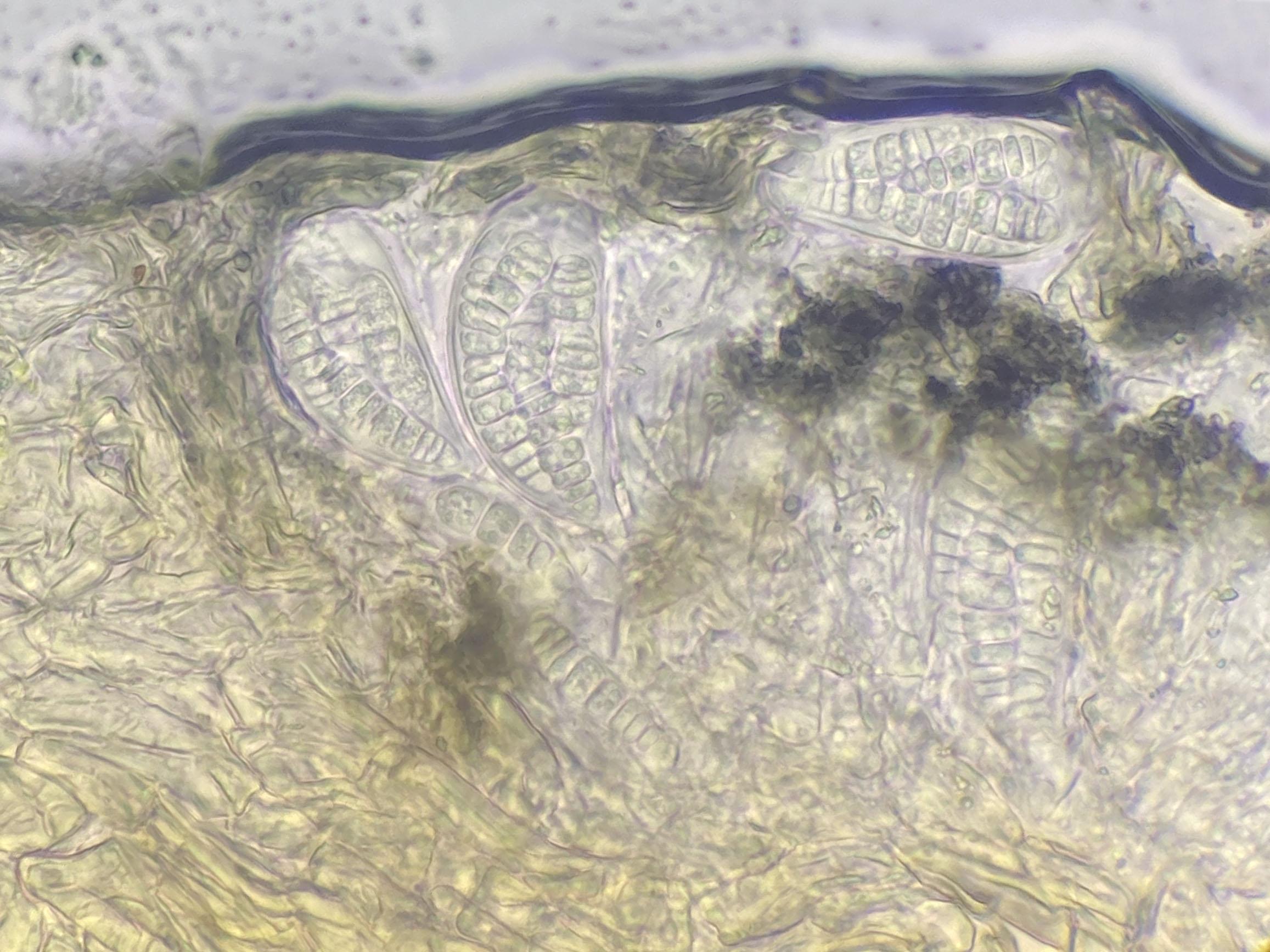
Arthonia cf hypobela apothecium squash in K
The spores were Spores 35 – 38 x 10 – 12 µm 7 – 9 septate.
Putting this up mainly to explore the new forum, have not yet found a preview button yet so no idea what this looks like
Neil
-
AuthorPosts


- You must be logged in to reply to this topic.