
Woodland Mushroom Identification
Forums › Forums › Fungi ID requests (post here if you aren’t sure what type of fungus you’ve found) › Woodland Mushroom Identification
- This topic is empty.
-
AuthorPosts
-
March 28, 2019 at 8:14 pm #31250
Have recently been trying to successfully ID a few more mushrooms and learn the latin names. Really struggling to find reference and ID anything more miscellaneous like these guys.
Anyone have any ideas?
March 30, 2019 at 5:10 pm #41919Hi, and welcome to UK Fungi. It would help to know whether the fallen trunk upon which they are growing is deciduous or conifer.
From the general appearance, they have the looks of one of the
Tubariaspecies – maybe T.confragosa. Regards.
Mike.
March 31, 2019 at 6:45 pm #41920Could it be Honey Fungus? March 31, 2019 at 8:11 pm #41921eltio wrote:
Could it be Honey Fungus?
No, looks quite wrong for honey fungus. What Mike said. Looks like a brown spored species. Was this found recently?
April 2, 2019 at 6:15 pm #41922Hello, I think it could well be Galerina marginata, though Tubaria confragosa is also possible.
best, Andreas
April 8, 2019 at 3:34 pm #41923Lancashire Lad wrote:
Hi, and welcome to UK Fungi.It would help to know whether the fallen trunk upon which they are growing is deciduous or conifer.
From the general appearance, they have the looks of one of the
Tubariaspecies – maybe T.confragosa. Regards.
Mike.
Thanks Mike will check them out. It’s a deciduous log.
April 8, 2019 at 3:35 pm #41924adampembs wrote:
eltio wrote:
Could it be Honey Fungus?
No, looks quite wrong for honey fungus. What Mike said. Looks like a brown spored species. Was this found recently?
Yea found recently.
Norfolk, UK
April 9, 2019 at 11:18 am #41925Mossman wrote:
adampembs wrote:
eltio wrote:
Could it be Honey Fungus?
No, looks quite wrong for honey fungus. What Mike said. Looks like a brown spored species. Was this found recently?
Yea found recently.
Norfolk, UK
A spore print would help. Honey fungus would be white and Tubaria would be a dull brown.
April 9, 2019 at 11:59 am #41926I think that being found recently would completely discount Honey Fungus. – I’m not aware of any Armillariathat fruits (in UK) in spring? (Plus, I completely agree that they don’t look like Honey Fungus). Interesting that they were on deciduous wood.
Tubaria confragosaand Andreas’ suggestion of Galerina marginataboth favour conifer – (but they are sometimes found on deciduous wood too!). However, both species are generally found in summer to late autumn, which would seem to rule them out also. I’m still of the opinion that these do look like
Tubaria– which does have species that might be found fruiting early in the year. Regards,
Mike.
April 9, 2019 at 12:07 pm #41927I think Armillaria is more strict on its timing than the other 2. It appears suddenly everywhere, then its gone. Just my theory, but I put this down to the huge mycelium of Armillaria, while the other two are smaller. Also, the other two are pure saprobes, so their metabolism is more local, being tied to the environment of a smaller host (humidity, temperature) less linked to that of the trees’ timescales which are more seasonal. I have no evidence for this, so I expect to be corrected ! April 9, 2019 at 4:14 pm #41928I’m sort of sorry I ever mentioned Armillaria now, but the scaled surface of the lower fb and the general appearance of the stipe and ring still have a familiar look to me. I’d agree on size and timing of course. However, where is your evidence for this being brown spored? Do these photos really say Galerina or Tubaria to you? I still think it’s a puzzle. April 9, 2019 at 6:16 pm #41929eltio wrote:. . . . Do these photos really say Galerina or Tubaria to you? I still think it’s a puzzle.
I agree that it’s a puzzle – but I remain 100% confident that these aren’t
Armillaria. 
You can see from their general appearance that the fruitbodies in Mossman’s photos are pretty much fully mature, You can also see from the top photo that they aren’t much bigger than his thumbnail.
At that sort of size any of the UK’s
Armillariaspecies would look very different. – In all probability the universal veil would not yet have broken away to form the stem ring, and the heads of the fruitbodies would still be much more spherical in shape, probably well festooned with scaly surface “warts” such as in this photo, (where the fruitbodies, not long emerged, were still considerably larger than Mossman’s): – 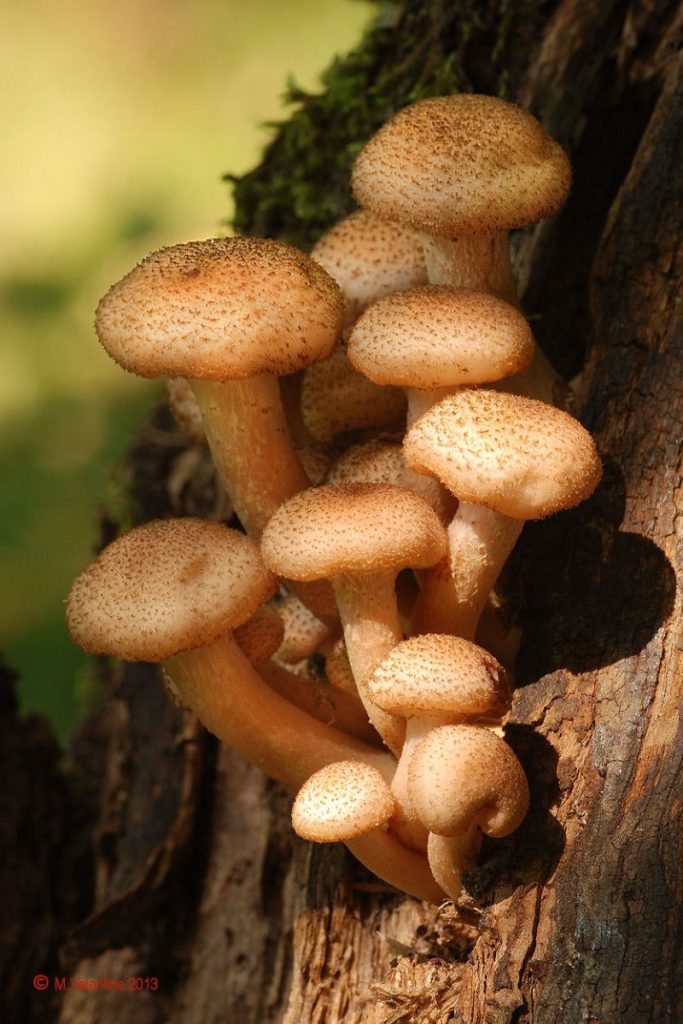
[attachment=0]Honey Fungus – Armillaria mellea.jpg[/attachment] Regards,
Mike.
April 9, 2019 at 6:34 pm #41930Can’t disagree. I’m not trying to push Armillaria as an ID, but neither Galerina nor Tubaria seem right either. April 9, 2019 at 10:36 pm #41931eltio wrote:
Can’t disagree. I’m not trying to push Armillaria as an ID, but neither Galerina nor Tubaria seem right either.
There are around 48 Galerina species, and 5 Tubaria species. The first step in any agaric ID is a spore print.
 April 13, 2019 at 7:13 pm #41932
Hello, I think one can be sure that this is a brown spored fungus. In the middle fruitbody the ring is beset with brown spore powder, at least it seems to me so.
So anyway, there are not many genera which share the following characters:
– cap and gills uniformely brown
– stipe with memranaceous ring zone
– stipe with with silky covering
– growing on wood
Tubaria wouldn’t have such a ring zone, except Tubaria confragosa. But this species doesn’t have a silky white stipe and occurs on coniferous wood or birch.
Pholiotina had come to my mind too, but there the ring is even more stable and moreover these species don’t occure on wood but on soil.
A Galerina from the marginata group is in my opinion the most likely answer, and all feature fit well. G. marginata does occure in Central Europe more often on decidous wood than on coniferous wood, and the fruitbodies on decidous wood always look somewhat stouter t(like yours!) than those from conifers.
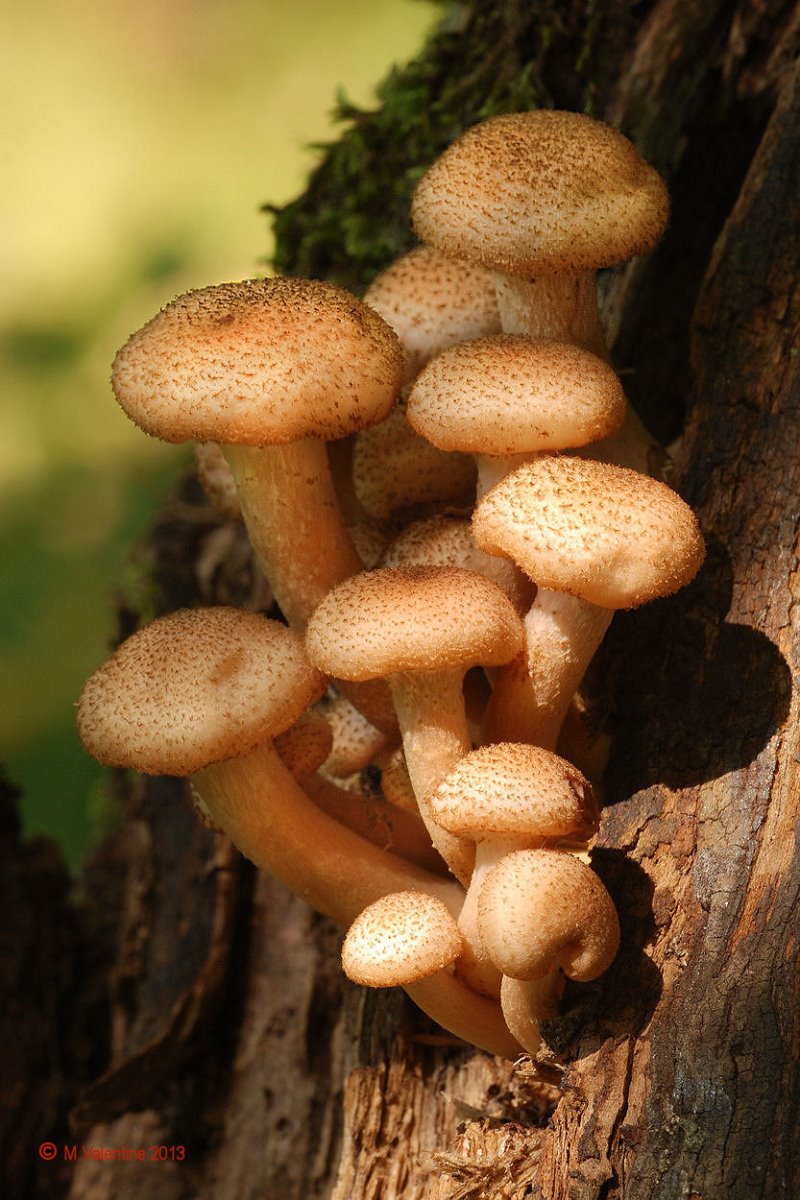
Here a foto of galerina marginata from a pure beech forest, on rotten stem of Fagus – b.t.w. on the same stem also Kuehneromyces mutabilis occured at the same time …..
best regards,
Andreas
-
AuthorPosts


- You must be logged in to reply to this topic.