
Taeniolella delicata LF on Lecanora hybocarpa?
- This topic is empty.
-
AuthorPosts
-
November 24, 2023 at 9:47 pm #32728
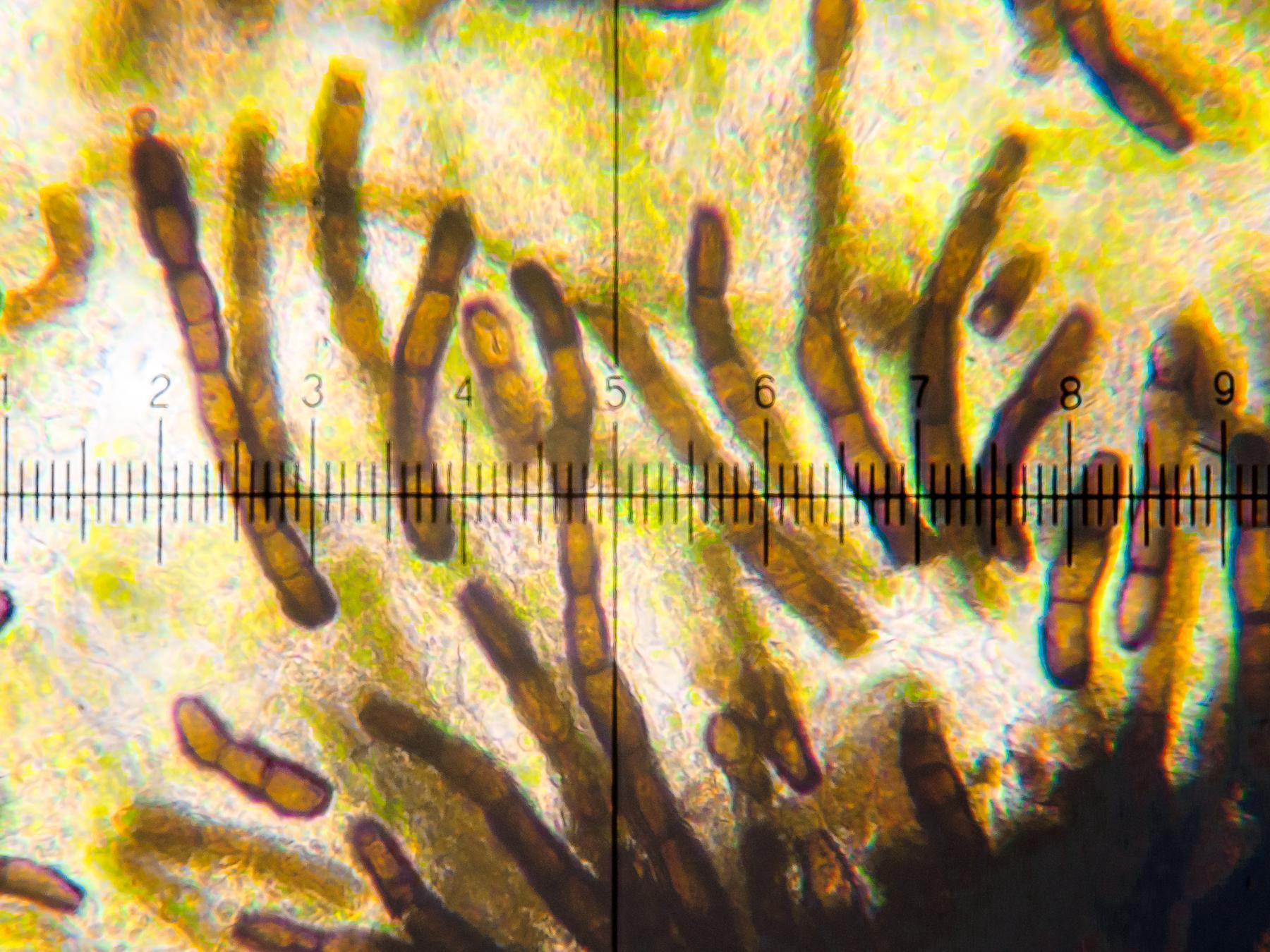
Last month I took a necrotic Lecanora hybocarpaspecimen from an unhealthy rowan ( Sorbus acuparia) in Glandford, Norfolk (TG04/VC27). The thallus is infected with various lichenicolous fungi, including Unguiculariopsis thallophilaand perhaps an as-yet undetermined mould-like hyphomycete. There are also brown-black caespitose growths on the thallus, which appear to be an anamorphic dematiaceous hyphomycete — potentially
Taeniolella delicata. I’ve included photographs and micrographs below, as well as a bit of explanation about this tentative identification. However, if correct, this record would be the first not only for VC27 East Norfolk, but also for Norfolk as a whole. It would also be one of only a small handful of records for the UK — see
https://britishlichensociety.org.uk/resources/species-accounts/taeniolella-delicata ” class=”bbcode_url”> https://britishlichensociety.org.uk/resources/species-accounts/taeniolella-delicata In their monograph on
Taeniolella(open access at http://dx.doi.org/10.3114/fuse.2018.02.06http://dx.doi.org/10.3114/fuse.2018.02.06” class=”bbcode_url”> et alsay that T. delicata‘is able to infect numerous lichen species of various unrelated genera and is one of the most common Taeniolellaspecies’ (2018, p 113). There are records from many countries. The few UK records are fairly distantly scattered, suggesting that it’s widespread. It’s also been found on many Lecanoraspecies, including in the UK, including species of the subfuscagroup, and including L. chlarotera s. lat.— according to Heuchert et al, the FGBI website, and the older Hawksworth LF keys (1983). Considering also that a significant number of the UK records for
T. delicatacome from Suffolk, it would be no great surprise if my Norfolk specimen were indeed the same LF. The FGBI website calls T. delicata‘almost certainly overlooked’ despite being listed as nationally rare. Following the generic key in Heuchert
et al, my specimen seems morphologically to be Taeniolellarather than another similar genus — brown colouration, mostly if not wholly immersed hyphae with superficial conidiophores (I think), not much branching, transverse septae only, and narrow conidiogenous loci (again, I think — it’s hard to tell the conidial cells from conidiogenous cells, which is apparently also characteristic of Taeniolella). Following the tabular key to lichenicolous
Taeniolellaspecies in the same monograph, the three possibilities for Taeniolellaon Lecanoraceaeare T. delicata, T. lecanoricola, and T. pertusariicola. The latter two appear to be ruled out as follows: [list]- The cell walls of
T. lecanoricolaconidiophores and conidia are rarely smooth, as in my specimen and as in T. delicata. They also seem to be a bit wider on average, from 7-10 µm (though my specimen admittedly seems on the broad end for T. delicata). Individual cells are wider than they are long (following the direction of the chain of cells), the opposite of my specimen and of T. delicata. Finally, T. lecanoricolais known from only one record in Germany, on L. rupicola, so it would be a highly unusual (though presumably not impossible) find in Norfolk. [/list] T. pertusariicolais more widespread in Europe, but again unknown from the UK. The cell walls of its conidiophores and conidia are described by Heuchert et alas distinctly ‘rugose, verrucose to rimulose, later squamulose’ — again in contradistinction to my specimen and to T. delicata. And it also seems to have many cells wider than they are long (following the direction of the cell chain).
[list][/list] There are also some features of my specimen positively suggesting
T. delicata. Not only the smooth cell walls of the conidiophores and conidia, but also the regular constriction at the septae, and the multiplicity of shapes of the conidia. These shapes include the limoniform and pyriform shapes mentioned only for T. delicataby Heuchert et al, and the ’rounded-one-end-truncated-other-end’ shape mentioned on the FGBI website. So I tentatively conclude
T. delicata— but as mentioned, I’d be most grateful for additional views, given the rarity of the potential record. Photographs and micrographs below. For more information on the necrotic L. hybocarpathallus itself, see the Twitter threads at https://twitter.com/specanatura/status/1726318374651924693 ” class=”bbcode_url”> https://twitter.com/specanatura/status/1726318374651924693 https://twitter.com/specanatura/status/1727336705953513816 ” class=”bbcode_url”> https://twitter.com/specanatura/status/1727336705953513816 Many thanks in advance!

[attachment=9]20231124-PB241012.jpg[/attachment] 
[attachment=3]20231124-PB241029.jpg[/attachment] 
[attachment=2]20231124-PB241031.jpg[/attachment] 
[attachment=8]20231124-PB241019.jpg[/attachment] 
[attachment=7]20231124-PB241022.jpg[/attachment] 
[attachment=6]20231124-PB241023.jpg[/attachment] 
[attachment=5]20231124-PB241025.jpg[/attachment] 
[attachment=4]20231124-PB241026.jpg[/attachment] 
[attachment=1]20231124-PB241033.jpg[/attachment] 
[attachment=0]20231124-PB241035.jpg[/attachment] November 26, 2023 at 3:56 am #45781This looks like a good ID to me and a good find. I suspect that most people who saw this would assume that it was a random overgrowth of something not associated with the lichen and therefore ignore it. Please note that T pertusariicola is present in the UK. Most records on Ophioparma ventosa.
November 26, 2023 at 4:00 am #45782T delicata has been recorded at least once in the UK on Lecanora hybocarpa in vc 11. November 26, 2023 at 8:48 am #45783Many thanks, Fay — it’s fantastic to know that you agree on T. delicata. I’m thrilled to be able to add to the small number British records of this species! It’s also good to know about the record on
L. hybocarpafrom Hampshire. Heuchert et alsay that the 1977 holotype from Buckinghamshire is on ‘ L. cf chlarotera‘, which I assume is most probably L. hybocarpaas well. As for
T. pertusariicola, I went by the lack of a BLS distribution map for the species. But I somehow overlooked the mention on the FGBI website, as well as your own BLS species description for it, both of which I now see! Not sure how I managed that oversight, especially as I saw your BLS species description for T. delicata. Grateful for the correction. November 26, 2023 at 1:43 pm #45784Sadly there were only six records of T pertusariicola on Ophioparma by Aug 2023 (and one on Pertusaria pseudocorallina). I know it’s been seen in Cumbria, Devon and three Scottish counties. But many sightings have not yet made it through to a record in the BLS database. I’ll look forward to seeing your LF records next time I get a download!
- The cell walls of
-
AuthorPosts




- You must be logged in to reply to this topic.