
Snowy Disco (Lachnum virgineum)?
Forums › Forums › Fungi ID requests (post here if you aren’t sure what type of fungus you’ve found) › Snowy Disco (Lachnum virgineum)?
- This topic is empty.
-
AuthorPosts
-
January 8, 2016 at 7:10 pm #30058
I found this on the inside of a rotten Willow which has just fallen in the garden. Attached to the substrate with a distinct stem, hairy on the stem and on the underside, inner surface smooth. White-cream. It would be great to get confirmation on this please.
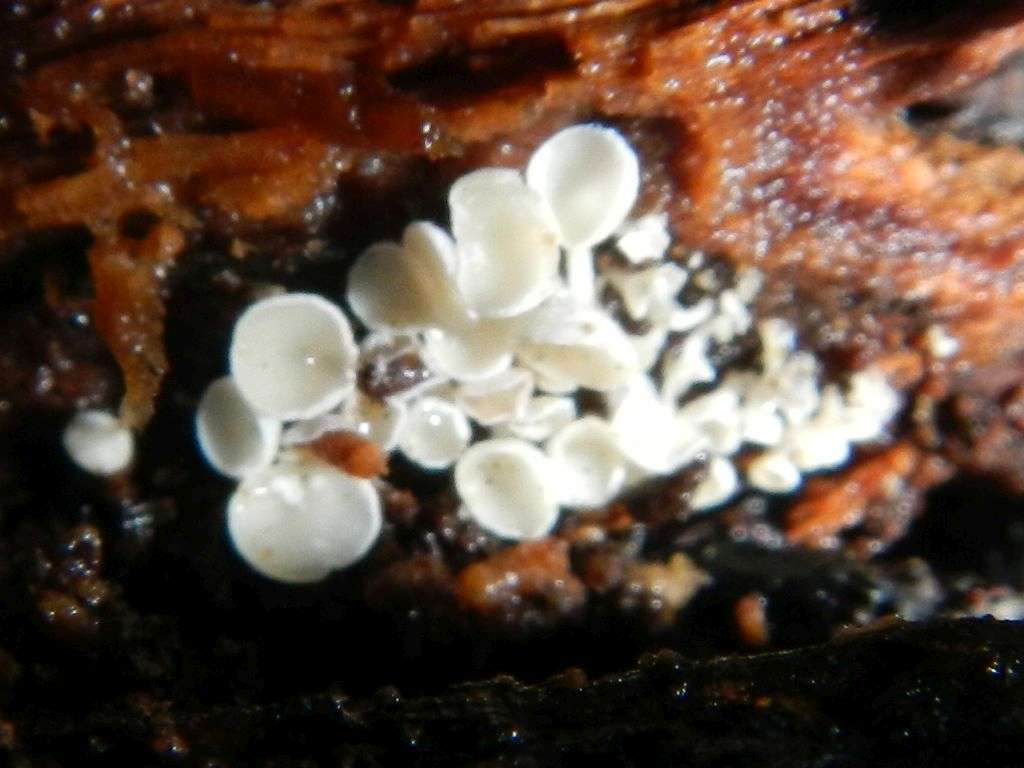
[attachment=1]RSCN1046.JPG[/attachment] 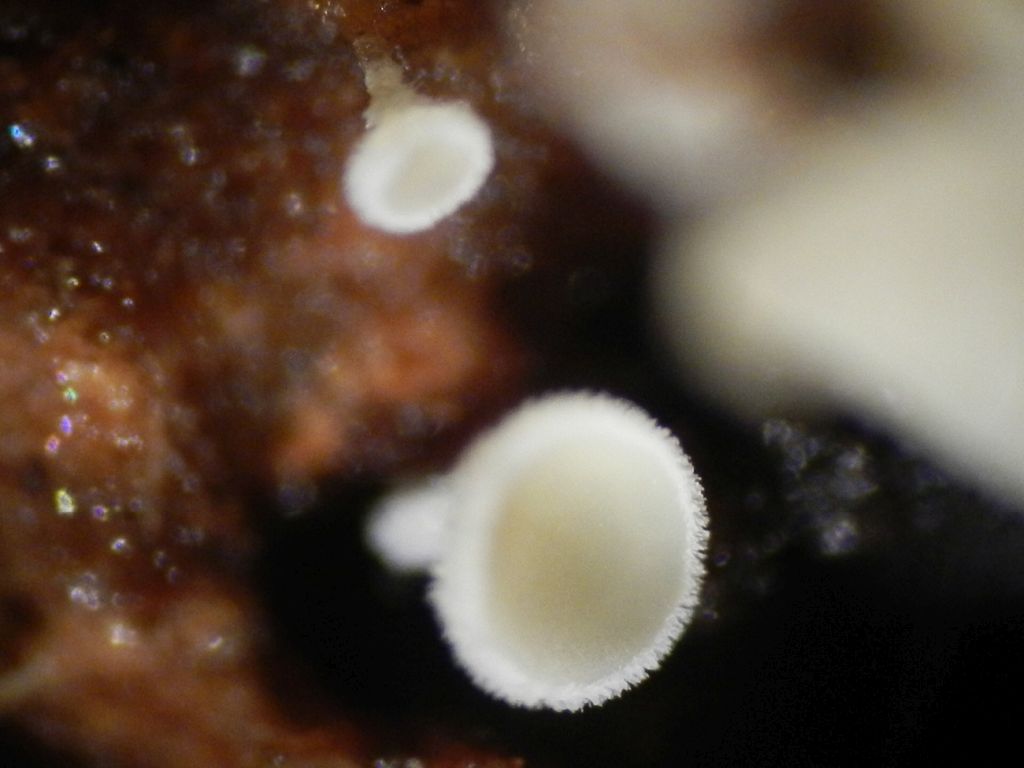
[attachment=0]RSCN1063r.jpg[/attachment] January 8, 2016 at 10:34 pm #37849Hello, never ever can those fungi be determined without a lot of microscoping! There are some dozen of Lachnum species, plus some Dasyscyphella which look alike. Even in winter.
The most likely species of the non-discolouring winter species is probably Lachnum impudicum, for which the host willow would suite wuite good. I don’t believe that you find L. virgineum at this time of year.
best regards,
Andreas
January 9, 2016 at 7:49 am #37850Thanks Andreas, What microscoping do I need to do to confirm? I still have the fungus in the fridge on a slide and hopefully spores will be collected.
Also, it’s quite like autumn now, the temperatures are
VERYmild and we have so much rain that nearly all my garden is flooded. Best wishes,
James
January 9, 2016 at 10:26 am #37851jimmymac2 wrote:Thanks Andreas,
What microscoping do I need to do to confirm? I still have the fungus in the fridge on a slide and hopefully spores will be collected.
Also, it’s quite like autumn now, the temperatures are
VERYmild and we have so much rain that nearly all my garden is flooded. Best wishes,
James
The books suggested in the ascomycetes section
http://fungi.org.uk/viewtopic.php?f=7&t=78 will detail the microscopy needed for ascos. I don’t think it’s something you can learn from a reply in this forum, unless you want someone to write something lengthy when the resources are out there already.You could browse
http://www.ascofrance.com/http://www.ascofrance.com/” class=”bbcode_url”> 
Sorry if this is a bit negative, but this has been suggested many times before. You need to obtain some literature, if you haven’t already done so.
January 9, 2016 at 10:51 am #37852Hi Adam, It is really hard for me to get all of the literature because I’m 12 (see
http://www.brc.ac.uk/psl/users/jimmymac2 ) so I don’t have that much and my parents aren’t prepared to spend so much money especially as I’m interested in so many other fields as well.
I also have exams which I am revising for so I don’t have that much time either.
January 9, 2016 at 11:36 am #37853jimmymac2 wrote:Hi Adam,
It is really hard for me to get all of the literature because I’m 12 (see
http://www.brc.ac.uk/psl/users/jimmymac2 ) so I don’t have that much and my parents aren’t prepared to spend so much money especially as I’m interested in so many other fields as well.I also have exams which I am revising for so I don’t have that much time either.
Wow! I though you were a youngster, but didn’t know you were 12. You are doing really well. In that case, I would suggest sticking to easier fungi or join a local club and see if someone can help. It’s a lot easier if you can watch someone prepare slides etc.
January 9, 2016 at 11:53 am #37854Hello, most books dealing with inoperculate ascomycetes still don’t give the REALLY relevant characters, especially when it concerns the problem with vital taxonomy versus dead material.
For those small discos there is a lot of free material on the website of Zotto
https://www.cubbyusercontent.com/pl/CC%2bAscomycota/_1354d48ffaad4b59bd3ffdbb35915d1f#CC%20Ascomycota Also Zotto has prepared a CD in 2005 with all the stuff from this website (except all what came after 2005), plus keys, papers etc. So if you email me your adress (private) I can send this CD to you if you are interested in those fungi. But it will require a GOOD microscope, means you have necessarily have a 100x objective with an numerical aperture of 1.25 or more. Otherwise it makes no sense.
What you can examine in your fungus is the following:
– Have a look at the hairs, which should be finely warty in their whole length. Have a close look to the last segment (the “top”) wether it is a) smooth in contrast to the rest of the hiar and b) is it capitate or club-shaped or is it cylindrical (= as broad as the rest of the hair)
– Have a look at the paraphyses: They should be more or less fusoid, means tapering from a +/- broad middle to a +/- pointed tip. If you have Lachnum impudicum, what is quite possible, then this species is recognizable by the very narrow paraphyses compared to other Lachnum species. What results in the fact, that you dont see that characteristic fusoid shape, but they look more or less cylindrical. – Also look at the paraphyses wether there are refractive guttules inside or not (most likely there are none in your collection)
– Have a look at the asci, especially at the ascus base: Are there croziers or not? Means is the ascus base connected to the cell below it just straight, or is around the septum a kind of bow.
– Have a look at the spores: You need the measures, the shape (often there are species where one end of the spore is acute and the other is rounded, somewhat “tear-shaped”) and the content (are there oil drops within or not. If so, how many percent of the spore content is filled with those drops –
 %, approx. 10%, approx. 25%, approx. 50%, approx. 80%)
All featrues have to be done in water mounts. Except the croziers may be look at in a very deluted water solution of congo red if you don’t succeed in seeing them in water. But usually if the preparation is good you see them in water as well.
The problem is – as always – to prepare a small enough piece of the fungus and then to squash it enough to separate the tissue but not too strong to squash it “dead”.
Good luck
Andreas
January 9, 2016 at 4:41 pm #37855Thank you. I have taken some microscopic images, I hope they are of some use. They include photographs and measurements of freshly ejected spores (I saw them being ejected)
[ADMIN EDIT: removed inline placement to display better in a grid]
January 9, 2016 at 4:42 pm #37856And some more ~ [ADMIN EDIT: removed inline placement to display better in a grid]
January 10, 2016 at 7:56 pm #37857adampembs wrote:
Wow! I though you were a youngster, but didn’t know you were 12. You are doing really well. In that case, I would suggest sticking to easier fungi or join a local club and see if someone can help. It’s a lot easier if you can watch someone prepare slides etc.Sounds like good advice from Adam. I’m also surprised you are so young. Plenty of time to become a world expert in your chosen genus/genera.
 January 10, 2016 at 10:31 pm #37858
Hello, in my opinion this is Lachnum impudicum.
The paraphyses are narrow and not far protruding the asci, the hairs are not captate, the spores fit well in sgape and size and oil content (which is zero …). I don’t think there is a species with similar features but lacking clamps, so searching for the clamps might be neglected in this case.
best regards,
Andreas
January 11, 2016 at 7:07 am #37859Thanks a lot everyone! 
I should never rush to conclusions from photographs…
Are there any synonyms for Lachnum impudicum? I can’t find it on the NBN.
James
January 11, 2016 at 8:30 am #37860Hi James, it has no other names or synonyms.
IF says:
Current Name:
Lachnum impudicum Baral, in Baral & Krieglsteiner, Beih. Z. Mykol. 6: 77 (1985)
I have found three entries in the FRDBI, see screen shot.

[attachment=0]Lachnum-impudicum.JPG[/attachment] But the species should be common everywhere where dead hard wood is available ….
best regards,
Andreas
January 11, 2016 at 7:44 pm #37861That’s odd! The NBN has a long list of Lachnum species, but Lachnum impudicum isn’t one of them. So it seems quite uncommon? January 11, 2016 at 8:02 pm #37862Hello James, it is one of the most common Lachnum species in winter, and as “no-one” looks out for Lachnum species in Winter AND has the possibilities to determine it there are only very few records.
inoperculate ascomycetes are another world compared to agarics, and there are even more underrepresented groups of fungi. But eben in this quite “big” inoperculates there are a lot of fungi that the scilled mycologist know to be common and can show you on every second excursion, which are only very rarely recorded. I know of Mollisia species which I can show you in every oak dominated forest for which not even one “official” record for Germany exists.
The more complicate the group of fungi is, the less the specialist have fun in recording their finding – this is at list my personal feeling. And I have to be true, that after twenty years of intense recording, I’m now at the point that prefer to invest the time I have in searching Mollisias and examining them, or just search and look for what I’m interested in that very moment, or in just trying to “know” one intersting fungus – rather than recording fungi ….
That’s a pity will some people say. O. k., but training the own skills in taxonomy will lead to a benefit to others too, at least if one is wiling to share his knowledge – what usually is the case within the mycological community. To be somewhat sarcastic: Is it better to add another ten records of Mycena pura to the 2000 existing one, or is it better to use the time to EXAMINE two of these ten collections and get a feeling for the morphology of the species, to REALLY get to know the species, to may be discover yet undescribed characters or even discover that the said species is an aggregate …. A good german amateur mycologist occuping with Psathrfellaceae once git always angry when the discussion come upon mapping of fungi, because he felt it a waste of time that people use their energy to look for Xerocomus badius in the last two unrecorded squares in Germany, rather then use this time and energy to psuh taxonomy further …
And we are now again at the point that everyone is free to have fun with fungi in just that way he/she wants to have fun with
best regards,
Andreas
-
AuthorPosts


- You must be logged in to reply to this topic.