
Small tiered bracket
Forums › Forums › Fungi ID requests (post here if you aren’t sure what type of fungus you’ve found) › Small tiered bracket
- This topic is empty.
-
AuthorPosts
-
December 23, 2016 at 3:21 pm #30530
A group of this small bracket were tiered on a felled log at a local nature reserve. (No photo no camera with me) Covering about 18″ top to bottom and 12″ across. Individual fruit bodies 2″ across.
I first thought of Inonotus but I could find no setae under the scope. Spores subglobose c 5µ
Can anyone help.
Thanks Mal

[attachment=3]PC221481a.jpg[/attachment] 
[attachment=2]PC221480a.jpg[/attachment] 
[attachment=0]PC221482a.jpg[/attachment] 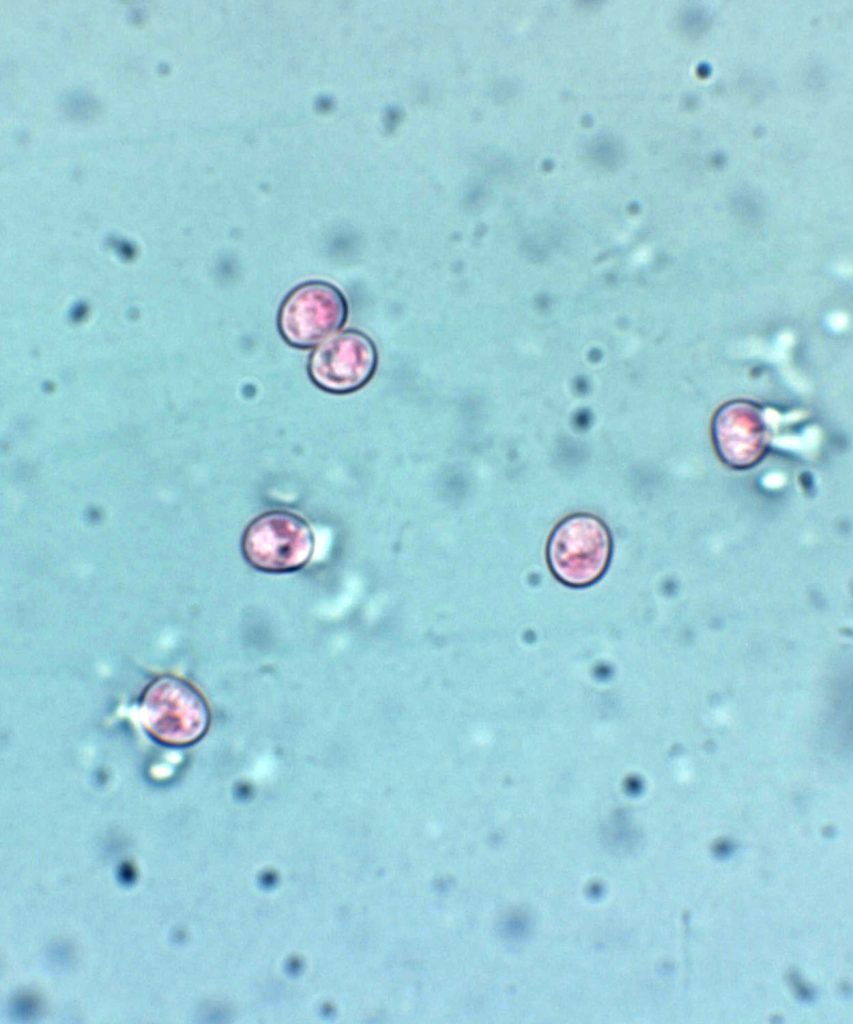
[attachment=1]IS_66a.jpg[/attachment] December 23, 2016 at 3:32 pm #39617Hello, surely a Phellinus s.l. – but don’t know which one. The host tree would be important too. May be it is Phellinus conchatus.
best regards,
Andreas
December 24, 2016 at 8:24 am #39618Received by email “Hi Mal,
This looks like Phellinus conchatus to me too (It is now called
Phellinopsis conchata in the FRDBI)
Was the log lying on damp soil ? This would indicate that the tree could
have been Salix or Populus – the host for P.conchata.
The spores seem to agree, but there should still be setae present in the
hymenium – you probably scratched in the wrong place.
But the reason I am replying to you is the possibility that if this IS
P.conchata, then there is also the very strong possibility that your
sample could be home to maybe 20+ Baranowskiella ehnstromi – Europe’s
smallest beetle !! (Field Mycology Vol.7 (2) page 41-43)
Actually, I enlarged your photo of the hymenium and just to the right of
centre about 15-20 pore mouths seem to have tiny projections sticking out
of them and to me, this is exactly how I found the beetles in the UK’s
first collection in June 2015. The tiny beetles, measuring only 0.5 mm
long, spend their entire lives buried head first in the pore mouths
munching away at the spores within … on the other hand, those blocked
pore mouths may well just be debris, but if they do turn out to be tiny
beetles do be sure to inform your county beetle recorder.
Happy Xmas and all all that,
Neil Mahler.”
December 24, 2016 at 9:26 am #39619re: above See this paper –
http://www.sciencedirect.com/science/article/pii/S1468164116300044 Neil Mahler is actually a co-author!
-
AuthorPosts


- You must be logged in to reply to this topic.