
Ramalina europaea in Britain
- This topic is empty.
-
AuthorPosts
-
September 23, 2019 at 9:51 pm #31383
In 2017 a paper came out in the Lichenologist: Gasparyan et al (2017) “Ramalina europaea and R. labiosorediata, two new species of the R. pollinaria group (Ascomycota: Ramalinaceae), and new typifications for Lichen pollinarius and L. squarrosus” https://www.cambridge.org/core/terms. https://doi.org/10.1017/S0024282917000226 ” class=”bbcode_url”> https://www.cambridge.org/core/terms. https://doi.org/10.1017/S0024282917000226 Ramalina pollinariain Europe in to two species Ramalina pollinarias. str. and the new Ramalina europaea. Ramalina pollinarias. lat. has been recorded widely in Britain, so this raises the question of which segregate we have or do we have both? At the time I put this up on the old UK Lichens site, as I did not know Ramalina pollinariaat all, but from the most recent BSL dot map it does not look like may people have been recording this species recently. 
[attachment=5]Ramalina pollinaria.jpg[/attachment]
BLS dot mapRamalina pollinarias. lat. (Blue = 1999 or earlier & Red = 2000 or latter) Finally I have found some myself and could compare the material to Gasparyan et al (2017). During a weeks holiday in a cottage on the side of The Striperstones, I picked up my first collection of
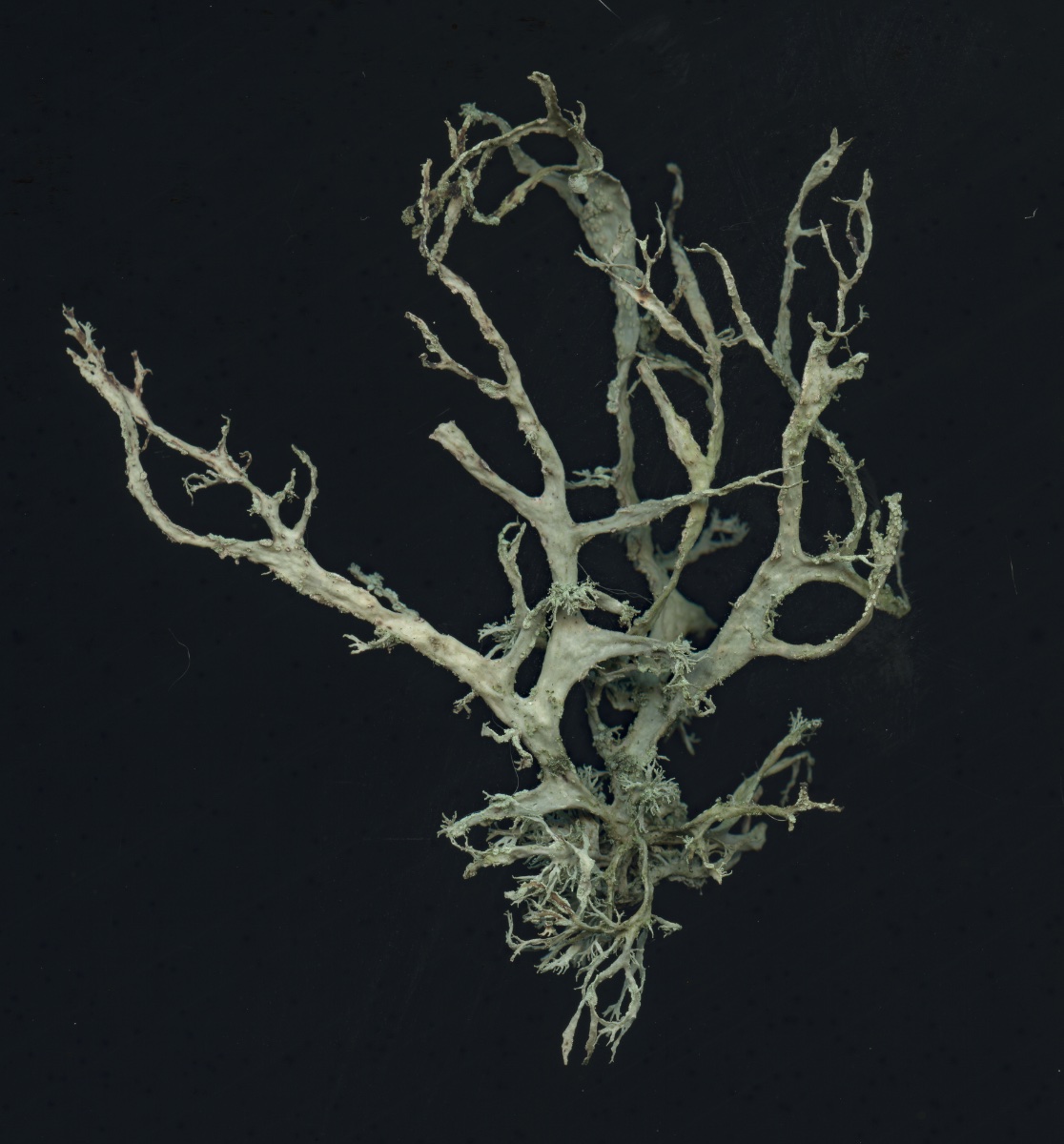
Ramalina pollinarias. lat. from the branch of Holly in moorland near improved fields. This formed a beautiful mat along the branches with the thin branched thallus ending in spine-like branchlets. The latter ended in small nodules, from which the punctiform soralia develop. The soredia were granular 50 – 60 µm diameter. 
[attachment=4]2019-09-15-16.jpg[/attachment] 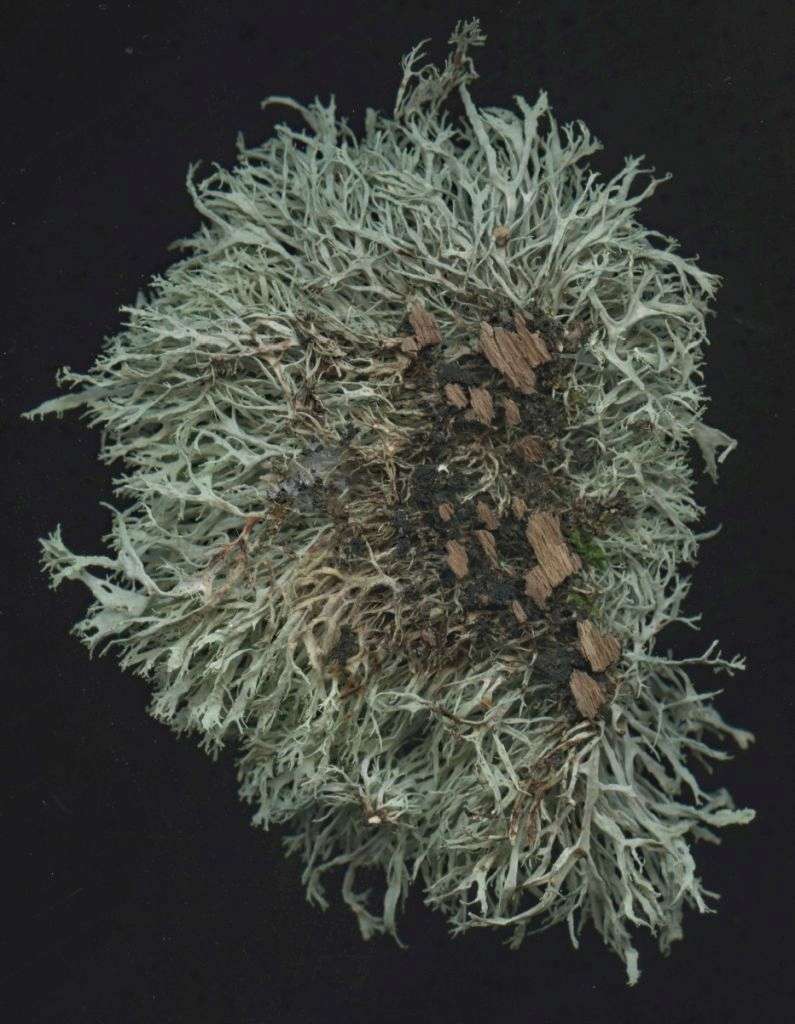
[attachment=3]2019-09-15-17.jpg[/attachment]
Scans of specimenThe species are morphologically distinct, with the soralia formation and distribution the most distinctive features and, as the spine-like branchlets with solaria developing at their tips are the main defining feature of
Ramalina europaea, so this looks very much what I have got Excerpts from paper:
[attachment=2]Screenshot 2019-09-23 at 21.19.45.png[/attachment]
[attachment=1]Screenshot 2019-09-23 at 21.23.16.png[/attachment] 
[attachment=0]Screenshot 2019-09-23 at 21.23.55.png[/attachment] The description on the LGBI includes the following
Quote:the apices dissected with many small, nodulose proliferations, or more flattened branches with wavy or deeply incised or notched margins
The first half is certainly description of
Ramalina europaea, the latter could be of Ramalina pollinarias. str.. We certainly have Ramalina europaeaand it is likely we also have Ramalina pollinarias. str., as Gasparyan et al (2017) record this from The Netherlands. So do keep a look out for Ramalina pollinarias. lat, at the very least the lack of recent records points to a serious decline, either in the species, or in recording it, and that needs sorting out! Gasparyan et al (2017) recorded Ramalina europaeafrom both rock and bark, while they only recorded Ramalina pollinarias. str. from bark. The LGBI implies that Ramalina pollinarias. lat. was mainly recorded on rock, so it may be that most British and Irish records refer to Ramalina europaea. September 29, 2019 at 10:51 pm #42269Ramalina europaealike London buses: you wait ages for one – and then two come along at the same time; well a few days latter. I think I now have more material of Ramalina pollinarias. lat., again appearing to be Ramalina europaea. This time from a Crab Apple branch on the edge of a pasture woodland in the New Forest. Unlikely to Stiperstones material described above, this is mature material and confirms what I thought, that the Shropshire material was a sward of young thalli. This material has wider thalli wider, to a maximum of 3mm wide, but still has the diagnostic spine-like branchlets. These occur thinly on the old thalli but more abundantly on young material at the base. 
[attachment=1]2019-09-29-01 Ramalina europaea Matley 2.jpg[/attachment]
A scan of Ramalina europaea from a Crab Apple branch, Matley Wood, New ForestThis is most like
Ramalina lacera, but Ramalina europaeaand Ramalina pollinarias.str. are much narrower up to 3mm wide, while Ramalina lacerahas thalli over 1cm wide with with reticulate ridges. Ramalina europaeaand Ramalina pollinarias.str. lack these ridges. 
[attachment=0]2017-03-12-16.jpg[/attachment]
Ramalina lacera, Crab Apple twigs, Setley Plain, New Forest Ramalina pollinaria s. lat. is new to the New Forest and this appears to be the first recent record of Ramalina pollinaria s. lat. from Hampshire.
Neil
October 1, 2019 at 8:02 am #42270Thank you for drawing our attention to this new information on Ramalina europaea and R. pollinaria s.lat. A severe shortage of trees makes it unlikely that I will find either, although there is a record of R. pollinaria dating back to 1960 from Stornoway on the island of Lewis. I will look carefully at the trees the next time we go to Stornoway where there is our only sizeable area of broad-leaved, mature trees.
Also thank you for flagging the images of R. pollinaria used on the NBN Atlas as incorrect. Regular users of the Atlas are aware that the images of species used can be incorrect and misleading, and it should encorage more of us to “flag” those which should be removed and replaced.
Christine
December 22, 2019 at 1:46 pm #42271I now have what I think is Ramalina pollinarias. str., as windblown material from the same wood that I got the Ramalina europaeafrom, Matley Wood in the New Forest. This is generally similar but the distinctive spine-like proliferations of
Ramalina europaeaare rare, while it shares the elongated marginal soralia on the thallus. A clincher is that the soredia are finer 30 – 45 µm diameter, while those on my Ramalina europaeaspecimens are more granular and 50–60 μm in diameter. 
[attachment=0]2019-12-19-01.jpg[/attachment]
Ramalina pollinarias. str. spine-like proliferations rare, fine soredia in marginal elongated soralia For comparison:

[attachment=1]2019-09-29-01 Ramalina europaea Matley 2.jpg[/attachment]
Ramalina europaea, spine-like proliferations frequent, granular soredia in marginal elongated soralia I have also recently found some more material of
Ramalina europaeain north Wales. Separating Ramalina pollinarias. lat. from large Ramalina farinaceais not very easy I think, hence the decline in recent records of Ramalina pollinarias. lat. There appears have been a generational loss in confidence in identifying Ramalina pollinarias. lat. in the lichen recording community. Looking at some large Ramalina farinaceamaterial collected this morning, this can have some marginal shortly elongated soralia, but also has wide splayed marginal circular and ulcerose soralia low down on the thallus, which are lacking in Ramalina pollinarias. lat. The critical couplet in the LGBI2 is given below, with 10 leading to
Ramalina farinaceaand 11 to Ramalina pollinarias. lat. 9(
 Soralia oval or round, strictly delimited ………………………………………………………………………………. 10
 Soralia spreading and ± irregular ……………………………………………………………………………………….. 11
Neil
January 2, 2020 at 11:25 pm #42272Probably my last comment on the Ramalina pollinariagroup. One thing I noticed was that the LBGI 2 described the aggregate as Quote:Medulla and soralia C–, K–, KC–, Pd–, UV± blue-white (usnic acid; evernic acid complex sometimes present)
While Gasparyan et al (2017)
https://www.cambridge.org/core/terms.%20https://doi.org/10.1017/S0024282917000226 ” class=”bbcode_url”> https://www.cambridge.org/core/terms.%20https://doi.org/10.1017/S0024282917000226 Ramalina europaeaor Ramalina pollinariadoes have a distinct pale violet-grey UV florescence from the soralia. To check I have had a look at Evernia prunastri, which also has evernic acid. The LBGI 2 gives this as UV -, and the soralia are this, but if you dig through the cortex into the medulla then, yes the medulla is also UV + pale violet-grey but weaker than in the Ramalinaspecies. So I think the LGBI 2 was correct that the Ramalina pollinariagroup can have UV florescence from evernic acid. This UV + florescence is a good field indication to a specimen being potential from the
Ramalina pollinariagroup, but not definitive as Ramalina canariensisand sometimes Ramalina farinaceacan be UV +. In Mark’s UV intensity notation (marks out of 5)
Ramalina europaeaand Ramalina pollinariaare, medulla and soralia UV + pale violet-grey *** Evernia prunastriis medulla UV + pale violet-grey * Neil
January 3, 2020 at 11:06 pm #42273OK not my last post; I could not resist trying to photograph the florescence. 
[attachment=1]2019-12-29-09.jpg[/attachment]
Evernia prunastriwith part of the medulla exposed under UV light, showing the florescence from evernic acid from the medulla 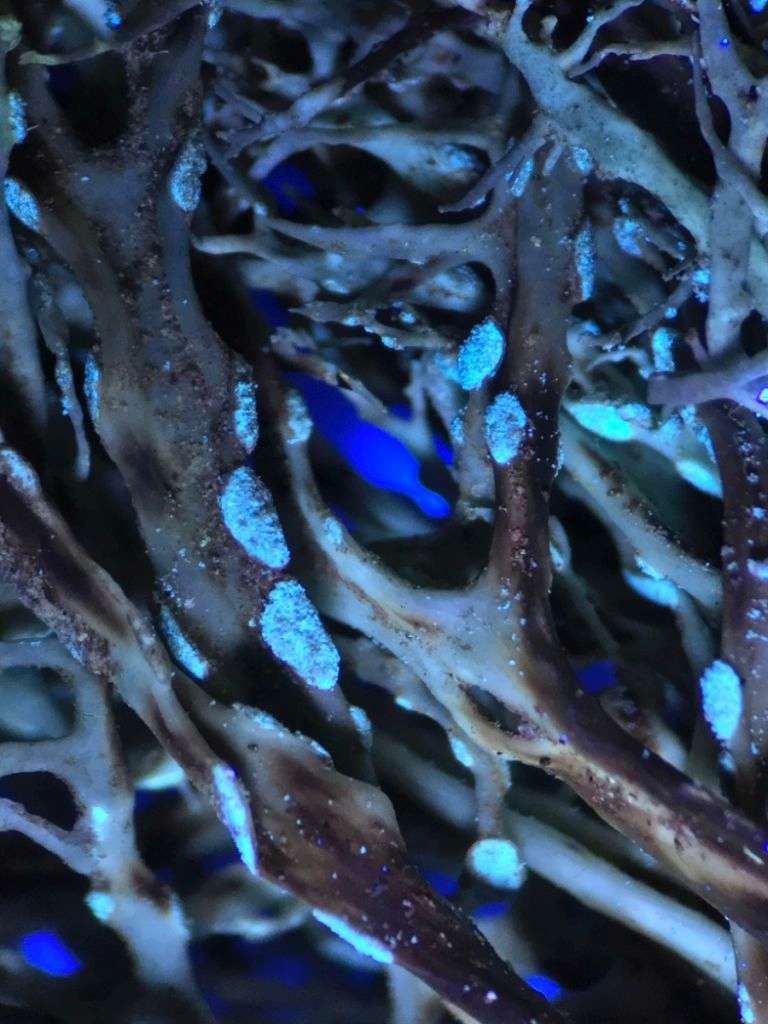
[attachment=0]2019-12-29-10.jpg[/attachment]
Ramalina europaeashowing the florescence from evernic acid from the soralia Neil
January 8, 2020 at 3:50 pm #42274This is all very helpful, Neil. On and close to the coasts here (Ilfracombe, Croyde, Woolacombe, Saunton) we have been recording R. canariensis, R. subfarinacea and R. lacera in addition to great quantities of R. siliquosa and R. farinacea and most certainly have failed to identify R. pollinaria due to the quantities involved. Your findings re UV reactions will be most useful especially being able to use Evernia as a comparison. November 17, 2023 at 11:50 pm #42275Hi Neil, I found this thread this evening when I was trying to sort out my odd Ramalina ?pusilla specimens and their K+ reactions. Haven’t had the confidence to try identifying Ramalina pollinaria s.l before but I tried the three below: Q1. Dorset on Oak branch, possibly Ramalina europaea?
Soralia +/- irregular, some (but not all) spiny branchlets with soredia at the tips, K-, UV-

[attachment=7]w Ramalina Q1 231118 016.jpg[/attachment] 
[attachment=6]w Ramalina Q1 231118 017.jpg[/attachment] 
[attachment=5]w Ramalina Q1 231118 005.jpg[/attachment] Q2. Dorset on Oak twig. Had thought R. europaea but cortex and medulla reacted K+ pink to reddish-brown!
Soralia on branches but not near thallus base, some spreading and irregular and many spiny branchlets from the thallus base with curled, sorediate tips. First UV check gave soredia UV+ pale mauve but when I checked again to photograph there was no UV reaction. Can’t make any sense of the K+ reaction.

[attachment=4]w Ramalina europaea q 231117-2 006 qK+.jpg[/attachment] 
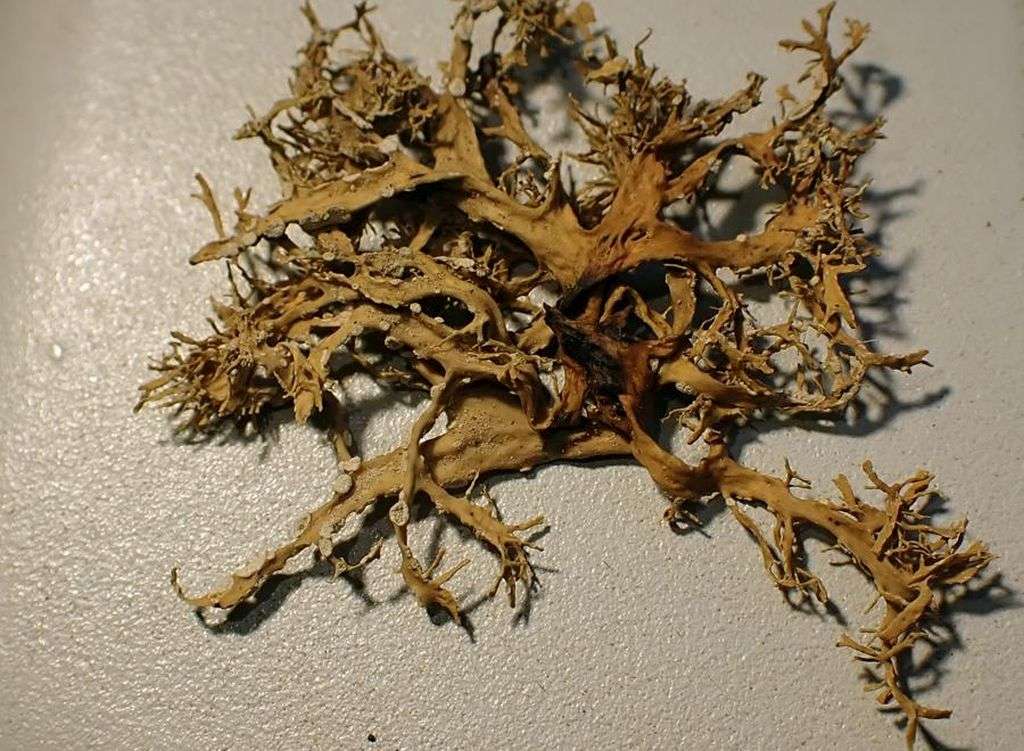
[attachment=3]w Ramalina europaea q 231117 011 K+.jpg[/attachment] Q3. Herbarium specimen from SW Ireland, 2009. Ramalina pollinaria sens lat?
Soredia UV+ mauve, photographing +blue on table but +mauve on white paper.
[attachment=2]w Ramalina pollinaria q 231117 025 IRE.jpg[/attachment] 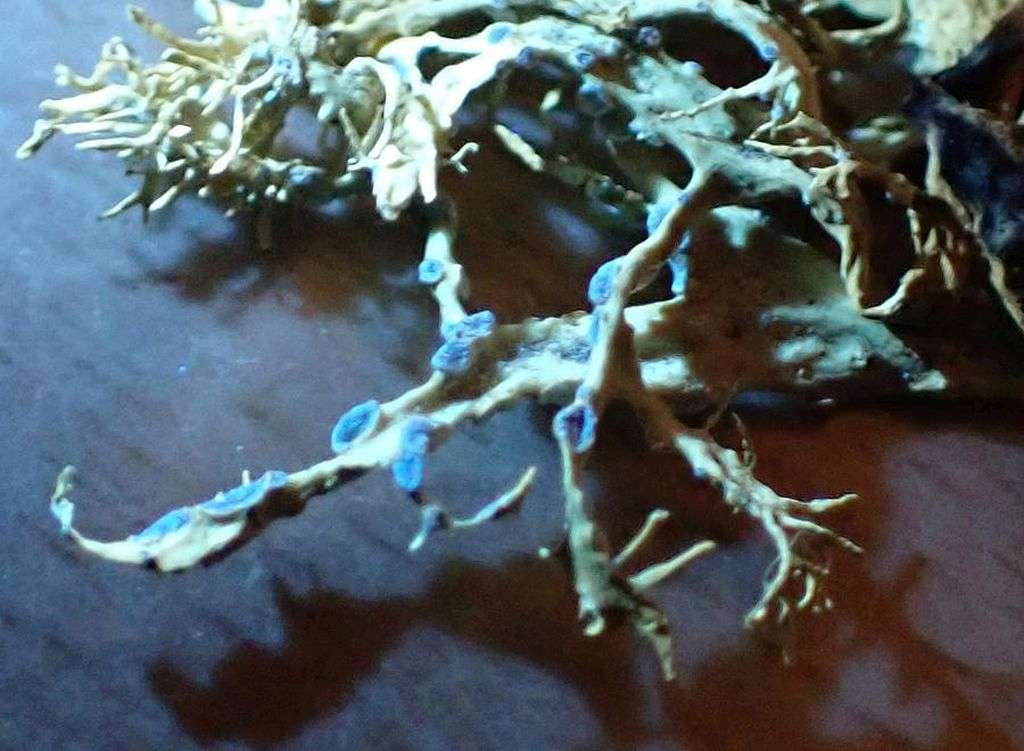
[attachment=1]w Ramalina pollinaria q 231117 029 UV+.jpg[/attachment] 
[attachment=0]w Ramalina pollinaria q 231117 033 UV+.jpg[/attachment] November 18, 2023 at 5:46 pm #42276A morph of Ramalina farinacea? November 18, 2023 at 6:18 pm #42277Yes, that’s very possible – and reminds me of why I’ve always steered clear of trying to identify R. pollinaria sens lat! November 20, 2023 at 1:45 pm #42278It seems to be very difficult to partition between more fine Ramalina farinaceamorphs and R. pollinarias. lat. The best guide that I can make out is the sorlia remain delimited and elliptical in the former and they extend and become irregular in the latter (which is the distinctive character listed in the LGBI key to distinguish them). I avoid recording R. pollinarias. lat. now unless the feature is clear. The spiny branchlets frequently occur on Ramalina farinaceaas well, I think, so are not very helpful. Neil
-
AuthorPosts




- You must be logged in to reply to this topic.