
Punctelia reddenda?
- This topic is empty.
-
AuthorPosts
-
November 20, 2024 at 3:23 pm #32940
This appears to match Punctelia reddenda, but looks to possibly be a new county record for Warwickshire, so we wanted to check. It was in a rather gloomy bit of woodland, an ex sand/gravel quarry, on a horizontal oak branch. It was spotted by Stephanie Gaskin. We both thought it didn’t look quite right for any of the other Punctelias. To our surprise, the medulla was decidedly C- (we checked the C was working, with another C+ species) and also K-. The lower cortex is black (0.5 to 1mm brownish near the edge). Rhizines are fairly sparse, mostly simple with whitish tips (older ones a bit fuzzier at the tip). 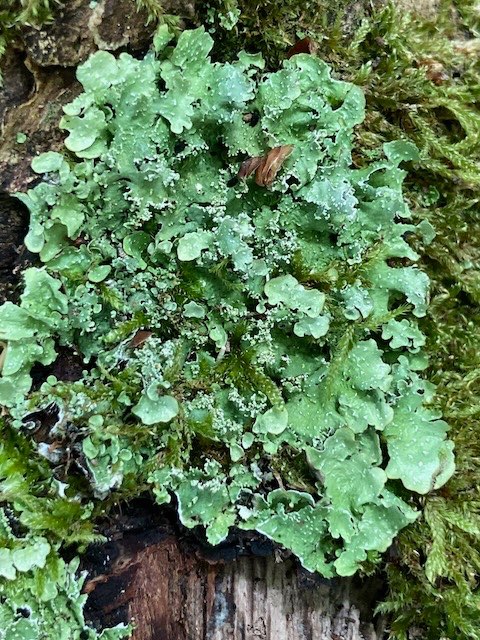
[attachment=5]IMG_4535.jpeg[/attachment] 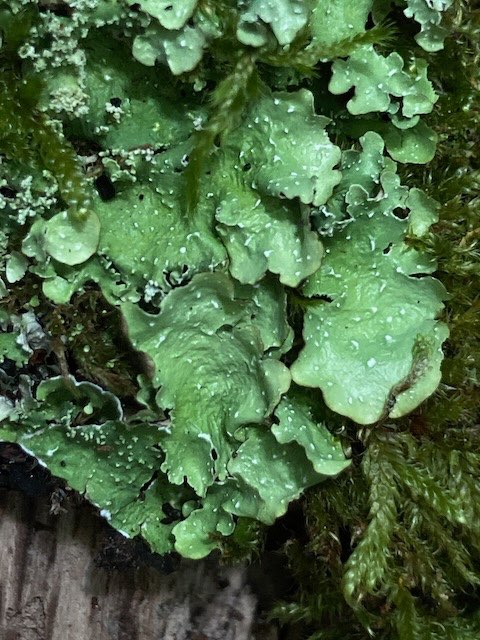
[attachment=4]IMG_4538.jpeg[/attachment] 
[attachment=3]IMG_4539.jpeg[/attachment] 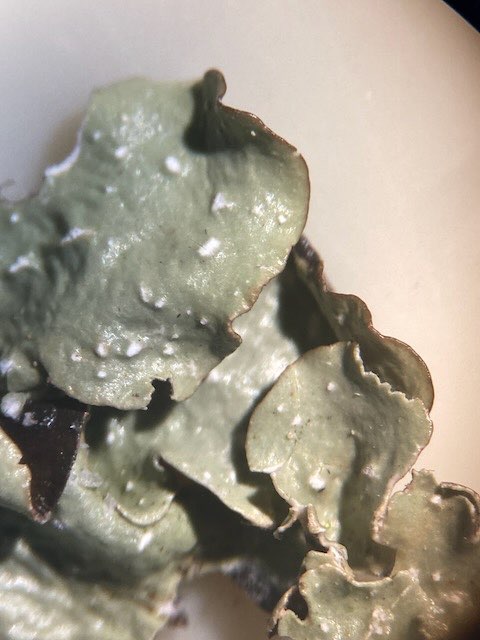
[attachment=2]IMG_7972.jpeg[/attachment] 
[attachment=1]IMG_7975.jpeg[/attachment] 
[attachment=0]IMG_7973.jpeg[/attachment]
Di NNovember 21, 2024 at 1:30 pm #46369I am rather hopeful that you have indeed found Punctelia reddenda. Rather than provide absolute confirmation, I will provide opportunity for others to add weight, or cast doubt. Your lichen seems clearly to be a species of Puncteliabeing a parmelioid with soredia forming from punctiform spots and having the overall Punctelia‘look’. The negative reaction of the medulla with C ought to distinguish P. reddendaby itself and it appears that you have checked the C reaction carefully. However, I like to use several characters if available and it looks as if your lichen is truly black beneath (ignoring the marginal zone which is brown in all British Puncteliaspecies). The black underside adds considerably to our confidence. The third main character of P. reddendais the way that the soredia tend to develop into isidiomorphs (which I think I can see). LGBI2 describes P. reddendaas an old woodland indicator but it appears to be spreading into the wider landscape. I have found it on a shaded fence rail in Bedfordshire and on a willow branch in Sutton Park near Birmingham, so don’t be too disconcerted that your occurrence is in an old gravel quarry. A couple of subsidiary notes.
I am pleased that you checked the C reaction so carefully. So many misidentifications result from using weak or degraded C, and/or testing damp material in the field.
It is not sufficient to see a
Puncteliaspecimen looking a bit isidiate and assuming it to be P. reddenda. I have seen specimens of P. jeckeriwhich looked rather isidiate but that species has a distinctly pale underside and a C+ red medulla. November 21, 2024 at 2:40 pm #46370Very good to hear from you, Mark, thank you. I had seen the photo of the Birmingham outskirts one, but wasn’t sure exactly where it was. I think Sutton Park is VC 38? Our tiny sample from a lobe edge mostly just has punctate pseudocyphellae. I think this shows them beginning to develop, though maybe the lumpier bits are the early stages of isidiomorphs. Unfortunately the light wasn’t too good, and the photos didn’t show the details of the inner lobes very well.

[attachment=0]IMG_7981.jpeg[/attachment] November 21, 2024 at 8:19 pm #46371Chalkie Looks OK, the isidiomorphs are a key feature combined with the others and it looks like these are developing, but are best seen on big old thalli anyway.
Concerning its ecology it was always more of an old tree species than an old woodland species, but did also occur on horizontal branches in humid sheltered places as well as on trunks, especially in Devon. In the last couple of decades it has started doing this is the New Forest too and is certainly building up larger populations in the latter habitat, especially on Beech branches in sheltered glades. Spreading more widely would now not be at all surprising. Confusingly
Punctelia borreriis getting more frequent exposed edge trees in the New Forest, so they are nearly, but not quite, growing together. Neil
November 21, 2024 at 10:45 pm #46372Thank you both. The New Forest information is interesting. -
AuthorPosts


- You must be logged in to reply to this topic.