
Possible Alyxoria viridipruinosa
- This topic is empty.
-
AuthorPosts
-
March 26, 2024 at 5:34 pm #32792
Hi, I collected this sample from the dry side of a veteran Ash on the North slope of the South Downs. At first I thought it was Alyxoria varia, but after doing a section I wondered about A viridipruinosa instead. The lirellate apothecia were quite varied in size and shape – many wide open and green pruinose towards the margin, some branched, many round. Size wise there were a few that were 1-3 mm, but most of the long ones were 1-2mm. The pycnidia were no more than 0.1mm. The thallus colour was quite varied mix of grey/green. When I did a section the hymenium was in the region 60-80um tall, however all the spores were maximum 20um X 5um, couldn’t find any larger and many slightly smaller. Also all the spores were 4-5 septate, with the majority I found being 5 septate. I’ve attached photos. Is this more likely to be Alyxoria viridipruinosa rather than A varia? Or is it a good idea to look at the conidia just to be certain.
Thank you
March 28, 2024 at 12:37 pm #45990I find the distinction between A. varia and A. viridipruinosa a bit disconcerting. As so often in lichenology, I think it is best to consider a range of characters rather than to rely on just one or two. I always check the size of the conidia in making my decision as that seems to provide one of the more reliable distinctions. The pale thallus and robust appearance of your lichen, taken with the length of the lirellae put me in mind of A. varia. On the other hand the tiny pycnidia are more typical of A. viridipruinosa.
From the type description: “Opegrapha varia generally has a whiter thallus, lacking the yellowish colouration present in many collections of the new species, even when the apothecia or pycnidia are greenish pruinose.” I find that some specimens of A. varia *do* have a yellow thallus. However, I don’t recall finding specimens of A. viridipruinosa with a well-developed whitish thallus.
Again from the type description: “The new species is most likely to be confused with O. varia Pers., but is distinguished by smaller and fewer septate ascospores (mostly 5-6-septate in O. varia), generally smaller lirellae and pycnidia, and smaller conidia.” I don’t place too much weight on size and septation of ascospores when making my decision as I find that they vary a lot, and the ascospores of A. varia are often rather small, in the O. viridipruinosa range, and often are only 5-septate. The lirellae are typically significantly smaller in A. viridipruinosa (but they can be small in stunted colonies of A. varia). The length of lirellae of A. viridipruinosa as given in the type description: 0.3-0.6(-1) mm. The pycnidia of A. viridipruinosa are given as 0.07-0.12 mm diameter, while those of A. varia are given as (0.1-)1.2-2(-2.5) mm diameter.
With the information we have so far, I would lean towards A. varia but I would check the size of the conidia to provide perhaps the most unambiguous character. The type description of A. viridipruinosa gives the following: “short bacilliform conidia 2.5-3 x 1-1.3 um.” and “In O. varia… the conidia are either ellipsoid to pyriform, 3.5-4.5 x 1.5-2 um, or bacilliform, 3.8-5.5 x 1-1.5 um.” The only things to note are that the conidia of A. viridipruinosa, in my experience, are often somewhat longer than 3 um, often 3.5 and with some occasionally nearing 4 um long. In A. varia, I rarely encounter the ellipsoid/pyriform conidia and they are usually the bacillifom ones and they are mostly around 5 um long. If you find that the conidia are bacilliform and around 5 um long, I think it would effectively confirm my hunch that you have a specimen of A. varia. If the conidia are bacilliform and around 3(-3.5 or occasionally 4) um long then that will throw my hunch into doubt.
March 28, 2024 at 12:51 pm #45991The type description of Opegrapha viridipruinosa is available at the following link: https://www.mapress.com/phytotaxa/content/2011/f/pt00018p127.pdf Here are screenshots.

[attachment=3]Screenshot 2024-03-28 12.45.21 PM.png[/attachment] 
[attachment=2]Screenshot 2024-03-28 12.45.40 PM.png[/attachment] 
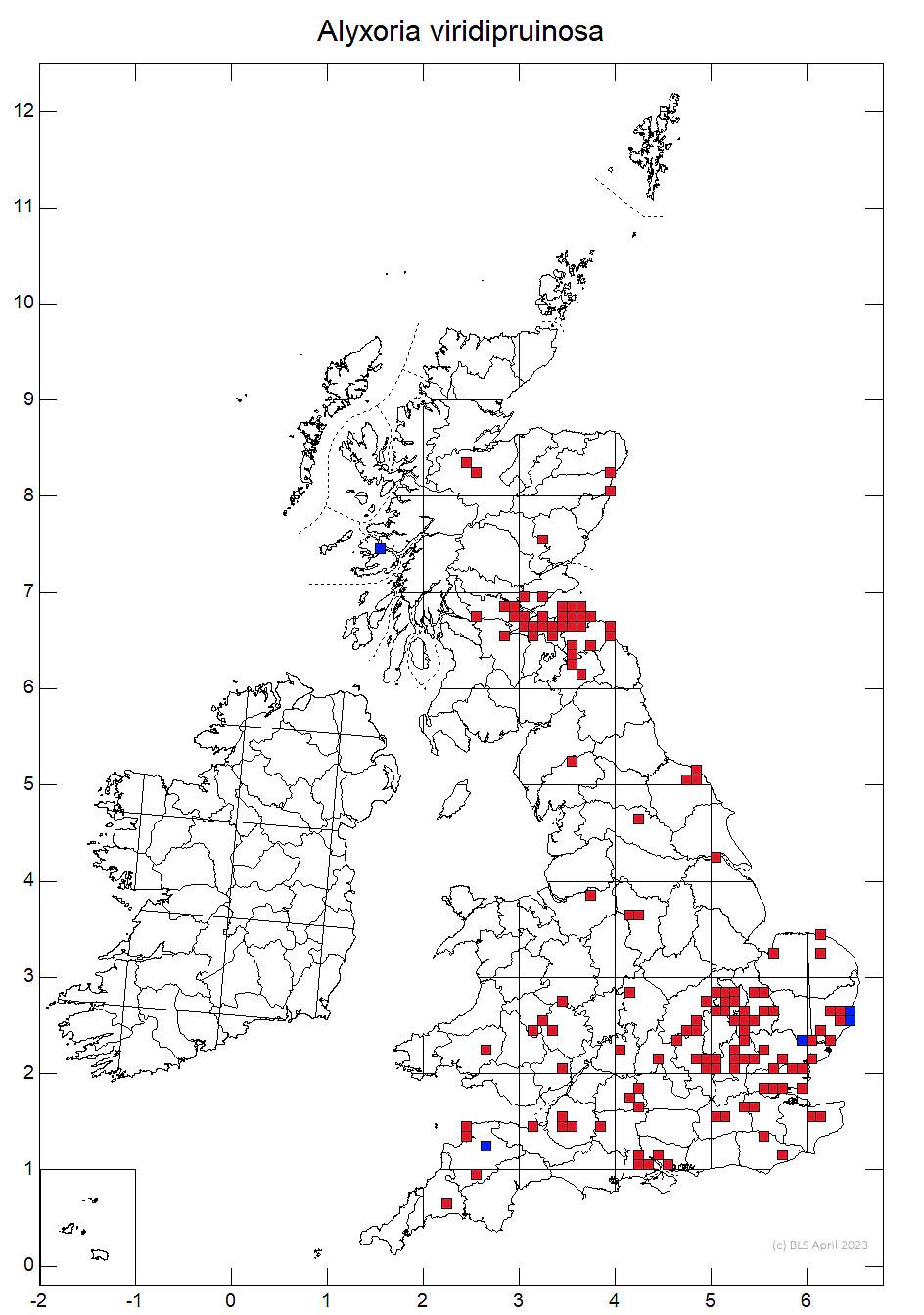
[attachment=1]Screenshot 2024-03-28 12.46.12 PM.png[/attachment] The distribution map gives the distinct impression that a few lichenologists have gained confidence with A. viridipruinosa and that it is almost certainly much overlooked elsewhere.

[attachment=0]Alyxoria viridipruinosa (1).jpg[/attachment] March 31, 2024 at 11:02 am #45992Thanks Mark, great information that has helped a lot. I will attempt to look at the conidia as it’ll be good to have a go at looking at these. Thanks,
Sylvia
-
AuthorPosts


- You must be logged in to reply to this topic.