
Phragmidium tuberculatum or P. mucronatum?
Forums › Forums › Rusts, Smuts, and Mildews › Phragmidium tuberculatum or P. mucronatum?
- This topic is empty.
-
AuthorPosts
-
May 13, 2015 at 6:50 pm #29346

Found on a cultivated Rose but I’m unsure how to distinguish between Phragmidium tuberculatum or P. mucronatum?
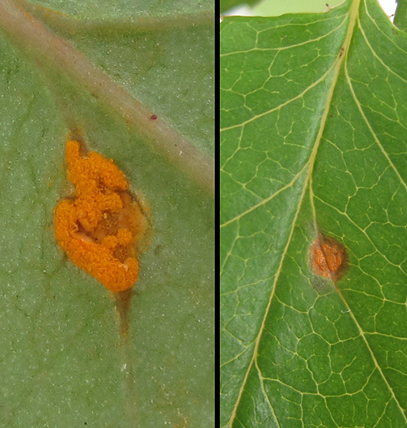
[attachment=1]z Phragmidium Q tuberculatum 150503-2 Rosa.jpg[/attachment] May 14, 2015 at 11:18 am #33274Hi Jenny, As you say, Chris’s opinions would be invaluable.
For what it’s worth, I think you have the aecidial stage – (I), of which Wilson/Henderson say: –
Phragmidium mucronatumAecidia caeomoid, on branches and petioles, hypophyllous on the leaf veins, and on the fruits, often confluent on branches, on the leaves mostly roundish, bright orange, surrounded by a circle of upright clavate or clavate-capitate, hyaline, thin-walled paraphyses up to 80µ long, 8-18µ wide; aecidiospores globoid to ellipsoid, 20-28×17-21µ, wall finely and distantly verruculose-echinulate, pale yellow, 1-2µ thick, pores 2-2.5µ in diameter, the inner surface of the membrane almost flush with the inner surface of the spore wall.
Phragmidium tuberculatumAecidia on branches, petioles and nerves of the leaves in elongate pustules, on the leaves in smaller, rounded pustules, surrounded by clavate, hyaline paraphyses; aecidiospores globoid, subgloboid or ellipsoid, densely verrucose, hyaline, 20-30×18-24µ, wall rather thick with 6-8 scattered pores 4-5µ diam. with membranes apparently hemispheric in optical section.
The main differences between the aecidiospores appearing to be the potential for slightly larger ones in
P. tuberculatum– (30µ as opposed to 28µ in P. mucronatumat top end of size range, spore ornamentation of P. tuberculatumbeing “densely verrucose”, as opposed to “finely and distantly verruculose-echinulate” in P. mucronatum, along with differences in sizes of pores, and the relationship of pore membrane to inner surface of spore wall. It would seem that the uredospore and teleutospore stages, would make life a little easier to distinguish between the two.
Wilson/Henderson say: – “The abrupt contraction of the teleutospore apex into the apiculus and the large uredospores pores in
P. tuberculatumreadily distinguish it from P. mucronatum”. Regards,
Mike.
May 14, 2015 at 2:35 pm #33275You have to be careful with rose rusts as they are difficult. You need to look at the pores to see what size they are and whether the spines are sharp pointed (echinulate) or bluntish (verrucose-echinulate). Best to use a x100 oil objective. May 15, 2015 at 5:51 pm #33276Thanks both – I had a feeling this could be tricky so I’ll keep an eye for the other stages Jenny
-
AuthorPosts


- You must be logged in to reply to this topic.