
Odd mix of fungi
Forums › Forums › Fungi ID requests (post here if you aren’t sure what type of fungus you’ve found) › Odd mix of fungi
- This topic is empty.
-
AuthorPosts
-
December 17, 2016 at 10:47 am #30520
Not really sure what I’m looking at here, but it looked interesting. There is a big black object (originally wood, I assume) that seems to be covered in a poroid fungus which has turned it black. I also see something that looks like Xylaria hypoxylon (but not quite right) and some orange dots that I only noticed from the photos later. Perhaps I’m on a hiding to nothing, but I thought it was interesting. December 17, 2016 at 11:08 am #39570Bracket looks like an old Ganoderma australe. After a few years of senescence or when really close to soil and leaf mould they go really dark like this, from what I see dealing with urban trees and stumps. I remember reading something about a few fungi that degrade
Ganodermafruiting bodies, though I cannot rmember if it was a Xylariaor not. December 18, 2016 at 11:44 am #39571The middle one might be Datriona mollis. THe Xylaria looks ok to me. December 18, 2016 at 12:22 pm #39572At first glance, before I’d read the text, I thought that the first photo showed something like Exidia planathat had fallen to the ground. 😳 However, on reading your description, that it was hard and large, then I’d agree that it looks like a very old
Ganoderma. I don’t think that that the middle one, (upturned), is
Datronia mollis, as the pores aren’t showing any of the angular “mazegill” characteristic typical of that species. Whenever I’ve seen it, it has looked like this: –
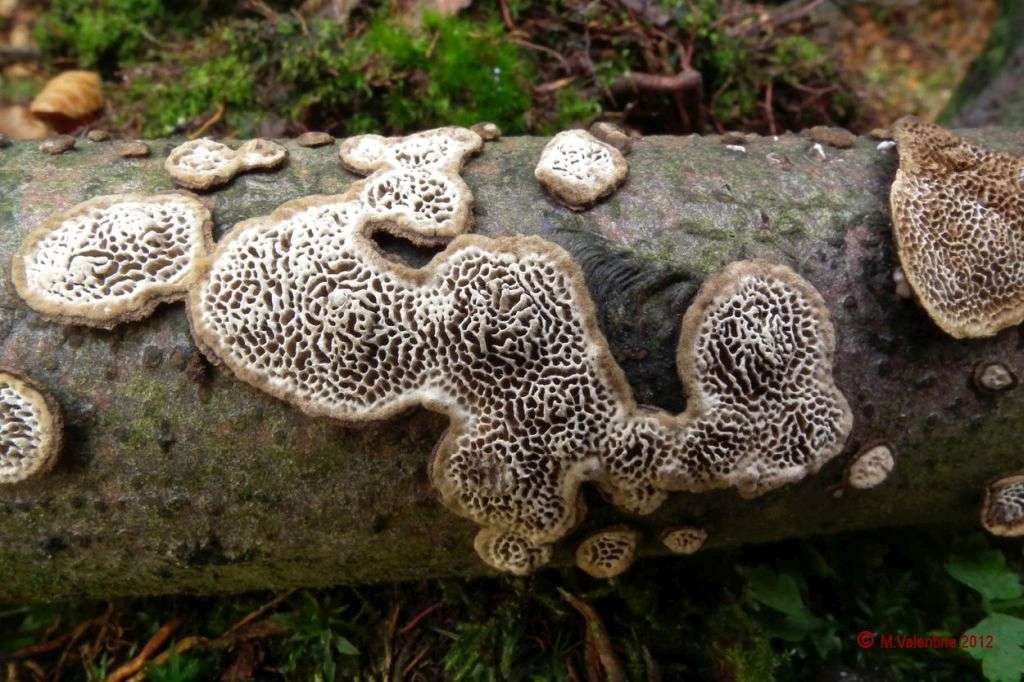
[attachment=0]Common Mazegill – Datronia mollis.jpg[/attachment] I can only think that the tiny orangey-red spheres in that middle photo might be one of the
Nectriaspecies – or one of Nectria’s closely related species. (I.e. no idea whether it could be a possibility here, but
Cosmospora coccineais known to grow on rotting pores of polypores. – Although on checking the FRDBI, C.coccineaisn’t showing any British records). I agree that the third is
Xylaria hypoxylon– I see it at almost every site I visit, and it regularly appears with these flattened “deer antler” type shapes. Regards,
Mike.
December 18, 2016 at 11:09 pm #39573Agree with Mike about it not being Datronia mollis. There is definitely a nectrioid fungus on that black
Diatrype-looking fungus. It’s unlikely to be Cosmospora coccinea– which, incidentally is certainly British, FRDBI just places it in another genus: http://www.fieldmycology.net/GBCHKLST/gbsyns.asp?intGBNum=59892 ” class=”bbcode_url”> http://www.fieldmycology.net/GBCHKLST/gbsyns.asp?intGBNum=59892 This would have been called
Nectria episphaeriain the past, often without microscopy; however the situation is now known to be much more complex. With Nectriaand its allies, one needs a minimum of spore size and ornamentation, but also a section of perithecium wall, and identification of any associated anamorph. Furthermore, in a significant number of cases one also needs to culture the fungus, and even to sequence it, in order to get a reliable name. “ Cosmosporasp.” is a safe bet in this instance. December 18, 2016 at 11:21 pm #39574Chris Yeates wrote:With
Nectriaand its allies, one needs a minimum of spore size and ornamentation, but also a section of perithecium wall, and identification of any associated anamorph. Furthermore, in a significant number of cases one also needs to culture the fungus, and even to sequence it, in order to get a reliable name. “ Cosmosporasp.” is a safe bet in this instance. Yeah…. I think I’ll stick with Cosmospora sp. Awesome name btw!
Thanks all.
-
AuthorPosts


- You must be logged in to reply to this topic.