
Lecanora sambuci
- This topic is empty.
-
AuthorPosts
-
March 22, 2022 at 9:03 pm #32328
Just checking that this is Myriolecis (aka Lecanora) sambuci. LGBI2 says that it is the only one in the Lecanora dispersa group with more than 8 spores per ascus. I checked out one large fruit and then one of the smaller ones, just in case the big one was an interloper, but no. Growing on an elder twig on a very ordinary narrow country lane in Gloucestershire. If this is correct then my guess is that it is a lot more common than the distribution maps suggest. March 23, 2022 at 9:47 am #44709I think it is safe to record your lichen as Lecanora sambuci. Other British lichenologists including myself have recorded such material under the name L. sambuci, based on specimens judged to belong to the L. dispersa group and having more than eight spores per ascus. I checked what Lucyna Sliwa wrote about this species in her ‘Revision of the Lecanora dispersa complex in North America’, Polish Botanical Journal 52: 1-70, 2007. Her discussion is as follows:
“Lecanora sambuci is differentiated by having small apothecia with a thin, regular thalline margin and a brown disc, and by growing predominantly on branches and twigs of deciduous trees, preferring Sambucus. The following anatomical characters distinguish the species: (i) asci more than 8-spored, (ii) an epithecium not at all granular, and (iii) the absence of lichen products. The two most similar species are L. hagenii and L. persimilis. However, the number of spores is diagnostic, since L. sambuci is the only species of the complex having multispored asci. Additionally, L. hagenii has an often pruinose apothecial disc, and L. persimilis usually has a darker apothecial margin (often biatorine), sometimes concolorous with the disc.”
Some doubt is cast on the taxonomic significance of the multispored asci in her ‘Remarks’:
The multispored species of Lecanora s.str. were studied in detail by Guderley and Lumbsch (1999). The authors concluded that the number of ascospores is of minor taxonomic significance in the genus sensu stricto. Assessment of the significance of the character within the L. dispersa complex requires study of more material from Europe.”
Despite the caveat about how significant multispored asci are in Lecanora, for recording purposes we will be consistent if we continue to record material such as yours as L. sambuci. I suspect you are right that it is very overlooked, having a similar ecology to L. hagenii and being very similar in appearance to that species. However, I think it is genuinely rare in Eastern England. There is something about its look that has led me to collect it when I have been in other parts of the country but I don’t seem to find it in my home region.
March 23, 2022 at 9:55 am #44710Just a note to follow up. In her Discussion, Sliwa stated that L. sambuci has “an epithecium not at all granular” as noted in my previous post. However, her description for L. sambuci states: “epithecium in shades of brown, mostly not at all granular or indistinctly granular, granules superficial, coarse (pol +/-, insoluble in K and soluble in N).” I haven’t yet checked my specimens to see whether they have granules in the epithecium but presumably the presence of some granules does not rule out L. sambuci (as might have been implied by Sliwa’s Discussion section).
February 2, 2024 at 12:24 pm #44711Adding to this thread as I’ve just found Lecanora sambuci (Myriolecis sambuci) on several very small Malus twigs collected recently from a Dorset orchard. The apothecia were tiny, 0.1 to 0.4 mm and the asci 16-32 spored. It’s not on my records from when I recorded the orchard in 2015 so presumably a recent arrival.

[attachment=3]z Lecanora sambuci 240201 004.jpg[/attachment] 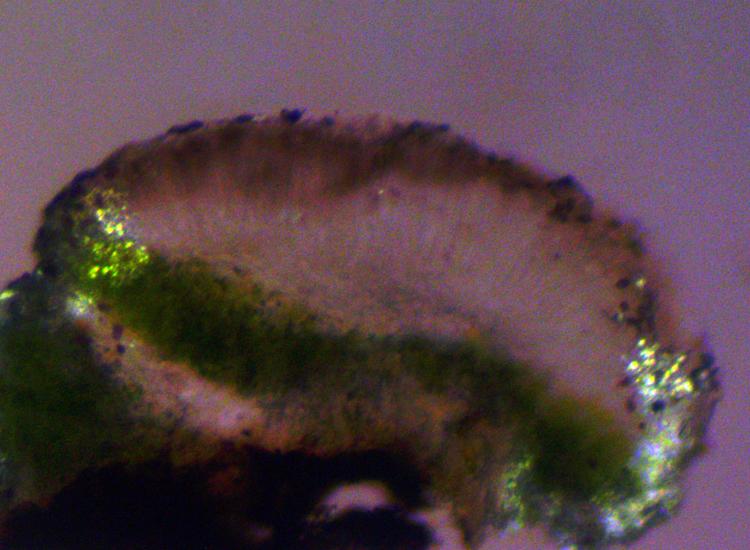
[attachment=2]z Lecanora sambuci 240201-5.jpg[/attachment] 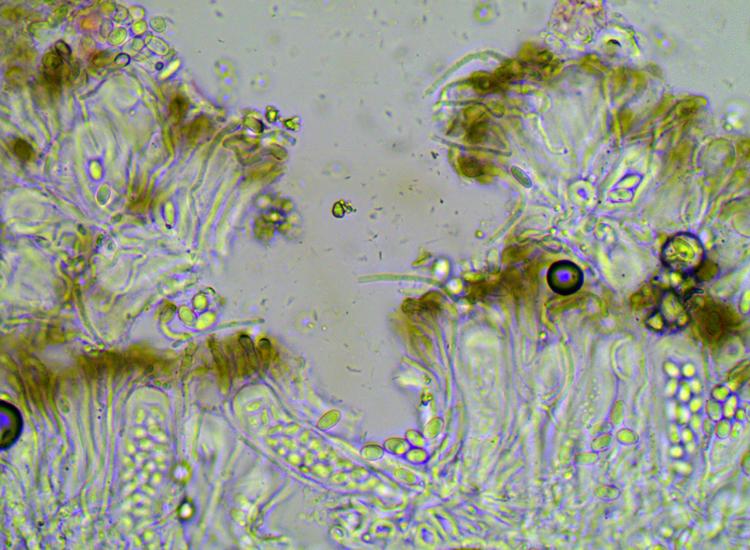
[attachment=1]z Lecanora sambuci 240201-1.jpg[/attachment] 
[attachment=0]z Lecanora sambuci 240201-10.jpg[/attachment] February 4, 2024 at 10:13 am #44712Maybe it’s a recent arrival, but are you certain that you checked the spore count before? In the past, I took it on trust that tiny twig Lecanoras looking like that were hagenii because that is what I had been told were the field recognition characters. It was only when getting desperate with specimens from a poor tetrad that I spared the time to examine the small twig Lecanoras to find they were >8 spored and then I needed the courage of my convictions to do a post on it. Going back to earlier microscope photos of “hagenii” I found – I blush – that at least one specimen was more than 8-spored too. Juliet
February 4, 2024 at 12:17 pm #44713As its so small it is possible I missed it there in 2015 but hagenii is very rare/under-recorded in Dorset and I’ve no records of my own of it so no confusion on that score with this one. (Though now I’m suspicious of one of my persimilis records from another site but micrographs not clear enough!)
-
AuthorPosts


- You must be logged in to reply to this topic.