
Lecanora hybocarpa auct. br. in France in 1956, and some thoughts
- This topic is empty.
-
AuthorPosts
-
February 21, 2024 at 8:53 am #32776
Neil Sanderson’s 2019 discovery of Lecanora hybocarpa auct. br. non(Tuck.) Brodo (1984) in Britain is well known. He separated L. hybocarpa auct. br.from L. chlarotera s. str.by the coarse POL+ epithecial granules descending between the paraphyses, and not only situated in a neat layer above them. See Neil’s original UK Fungi Forum post for more detail: https://www.fungi.org.uk/viewtopic.php?t=2404https://www.fungi.org.uk/viewtopic.php?t=2404” class=”bbcode_url”> Subsequent fieldwork suggests that
L. hybocarpa auct. br.is easily the most common member of the ‘ Lecanora subfuscagroup’ in our region. This group includes not only L. hybocarpa auct. br.and L. chlarotera s. str., but also other familar species such as L. argentata, L. campestris, L. horiza, and L. pulicaris. We also now know from Mark Powell’s herbarium work that L. hybocarpa auct. br.has been present in Suffolk since at least 1913, so it’s not a recent colonist. See Mark’s original UK Fungi Forum post for more detail: https://www.fungi.org.uk/viewtopic.php?p=16657https://www.fungi.org.uk/viewtopic.php?p=16657” class=”bbcode_url”> Why did it take so long to discover
L. hybocarpa auct. br.? Presumably the answer is in large part that L. chlaroterawas taken to be the most common subfusca-group lichen in Britain, and that the placement of the epithecial granules wasn’t taken to be diagnostically significant. In older British flora — Smith (1918), Duncan (1970) and Purvis et al(1992) — the descriptions of L. chlaroteramention epithecial granules without specifying whether they sit atop the paraphyses or also between them. This seems to be something of a lapse in British lichenology. In their seminal work on the
subfusca-group, Magnusson (1932) and Poelt (1952) considered the placement of epithecial granules either atop or between the paraphyses to have diagnostic value for species identification. Did later British lichenologists make a conscious decision to reject their views? If so, were they following a similar rejection by other lichenologists? Rather fascinatingly, I’ve discovered that, as early as 1956, French lichenologist Lucie Kohler was most probably familiar with what we now call
L. hybocarpa auct. br. What’s more, unlike Neil she would have called it L. chlarotera, even despite being aware that some specimens she studied exhibited the characteristic descending epithecial granules. In her view, the placement of the granules wasn’t diagnostic, only their size. This from her 1956 paper, ‘Remarques sur les
Lecanoracorticoles du group subfusca: Leur répartition dans les Alpes du Dauphiné’, Revue bryologique et lichenologique25, pp 167, 173-174 (my translation): Quote:Among crustose corticolous lichens, the
Lecanora subfuscagroup (Acharius, Lichenographia universalis, 1810) is one of the easiest to recognise, and one of the most widespread. On the other hand, it is very difficult to separate from each other the species that comprise it. Acharius had already recognised many varieties and forms within
Lecanora subfusca. For the most part, they were subsequently reclassified as species. Unfortunately, the old lichenologists were thrown into the greatest confusion about this group, thanks to inadequate descriptions, the impossibility of benchmarking against herbarium type-specimens, and the difficulty of the subject-matter. In his long monograph, Hue [1903] recounts the growth of this confusion in detail. However, he doesn’t offer a satisfactory solution to the problem. Hue brings back together, under the name
Lecanora subfusca, the typical form and three varieties: allophana, glabrataand chlarona. In defining them, he gives priority to morphological characteristics, and in particular to the shape of the thalline margin of the apotheicum. Having reclassified a great number of herbarium samples on this basis, he then studies their structure in detail, to show how one and the same variety of Lecanora subfuscavaries in the characteristics of the bark, the medullary crystals and the epithecium. The modern system takes exactly the opposite perspective. It is precisely the latter characteristics that serve as the basis for the descriptions in Magnusson’s [1932] fundamental work, which Poelt [1952] later completed and reorganised.
…
Magnusson [1932] distinguishes between two types of epithecial granules:
[list]rugosella-type (Poelt’s chlarotera-type): with angular, yellowish granules, quite large, situated above the paraphyses, which are themselves colourless and not conjoined [/list] [list]pinastri-type (Poelt’s chlarona-type): with very small granules situtated between the paraphyses, which are themselves conjoined by a gel, and faintly coloured at the tips. The colour becomes visible after dissolving the granules in a dilute solution of potassium hydroxide. [/list] Yet the difference is less marked than this description suggests. In the
pinastri-type, the gel is not always visible, and the colour of the paraphyses is often barely perceptible. As for the granules, if they are abundant, they also form a layer above the paraphyses. In both types, the epithecium is inspersum— that is, the granules penetrate quite deeply (about 15-18 µm) between the paraphyses. The steadiest diagnostic character is the size of the granules. We have not seen intermediates between the two sorts. The granules of the chlarotera-type are of irregular size, angular form, and yellow-brown colour, distinguishable at 300-400x magnification. The granules of the chlarona-type are too small to distinguish their shape and their colour at the same magnification. Kohler’s analysis is interesting for several reasons:
[list]- It appears that Kohler observed, sometime before 1956, and somewhere in the Dauphiné Alps above Grenoble where she lived and worked, what British lichenologists would now call
L. hybocarpa auct. br.— i.e. a subfusca-group lichen with coarse, yellowish, angular epithecial granules forming a layer above, and descending between, the paraphyses. Kohler describes the use of crossed polarisers to examine these POL+ epithecial granules, and indeed I believe she might have been the first to do so. Her report would therefore seem reliable. We have no other evidence of L. hybocarpa auct. br. outside Britain at this early date. [/list] - It’s interesting that Kohler would have identified this lichen as
L. chlaroteraeven despite the descending granules. After Neil’s 2019 discovery of L. hybocarpa auct. br.(BLS# 2506), we British lichenologists have taken care to separate it from L. chlarotera s. str.(BLS# 2870). Yet as we’ve seen, Kohler didn’t consider the placement of the epithecial granules diagnostic, but rather only their size.
[list][/list] - Kohler’s analysis raises the question as to whether our
subfusca-group species-concepts are entirely sound. If you’re familiar with the background to our current British concepts of L. hybocarpa auct. br.and L. chlarotera s. str., you’ll know that the Magnusson/Poelt epithecium scheme, elaborated and extended by Brodo (1984), forms a core part of the taxonomic standard for classifying many species of the subfusca-group around the world. According to it, both epithecial granule size (coarse v fine) and placement (atop or also between the paraphyses) are not only relevant, but correlated. Coarse granules occur only atop the paraphyses, and fine granules atop and between. If Neil’s 2019 discovery of L. hybocarpa auct. br.— which doesn’t fit the Magnusson/Poelt/Brodo scheme — isn’t already enough to call the scheme into question, Kohler’s observations add some weight, at least for Britain, and maybe also mainland Europe.
[list][/list] - Kohler’s analysis raises the further question of whether other properties of the epithecial granules might be diagnostic instead of, or alongside, size and placement. Solubility in K and N might be one of them — and Brodo’s (1984) extension of the Magnusson/Poelt scheme includes it. But recent studies on the solubility of the epithecial granules of
L. chlarotera, for example, have contradicted the existing species-concept, in which the granules are slowly soluble in N ( e.g.Rettig, 2018).
[list][/list] - Kohler’s revision of the
subfusca-group for her region underscores that a similarly focused analytical revision has never been undertaken Great Britain and Ireland. To Kohler’s (1956) work in France could be added Magnusson’s (1932) in Scandinavia, Poelt’s (1952) in south Germany, Brodo’s (1984) in North America, Miyawaki’s (1988) in Japan, Lumbsch’s (1994) in Australasia, Guderley’s (1999) in Central and South America, Malíček’s (2014) in the Czech Republic, and perhaps others.
[list][/list] - Kohler reminds us that the ‘old lichenologists’, such as Acharius and Nylander, were a bit confused about
subfusca-group species. Brodo and Vitikainen (1984) have grappled with this confusion, and they’ve determined the type-specimens for many species in the group. But ‘reading back’ the Magnusson/Poelt/Brodo scheme onto old herbaria specimens establishes nomenclatural stability only to the extent that the Magnusson/Poelt/Brodo scheme is itself stable. It’s good to remember that lichenology progresses, and that our current species-concepts are always open to question, just as we’ve questioned those of the ‘old lichenologists’.
[list][/list] On that last point, it might be instructive to look briefly at Nylander’s own definition of
L. chlarotera, about which he seemed to have changed his mind at least once if not twice. This is his protologue first describing the species, from his January 1872 paper ‘Observata lichenologica in Pyrenæis Orientalibus’, Bulletin de Société Linnéene de Normandie2(6), p 274 (my translation): Quote:L. chlaroteraNyl. is to be distingiushed [from L. chlarona var. pinastriSchær.]: apothecia with thalline margin distinctly crenulate, paraphyses not inspersed, hymenial gel becoming intensely blue (and persistently blue) in iodine; spermatia longer. Common in central Europe and found into Scandinavia. But some months later, in December 1872, Nylander published the following description — logically consistent but less detailed — in his paper ‘Observata lichenologica in Pyrenæis Orientalibus’,
Flora55, p 550 (my translation): Quote:L. chlaroteraNyl. is to be distinguished [from L. chlarona var. pinastriSchær.]: apothecia with thalline margin distinctly crenulate, hymenial gel becoming intensely blue (and persistently blue) in I; spermatia longer. Common in central Europe. Had Nylander, within the space of a year, become unsure about whether his
L. chlaroteralacked epithecial granules? Did he come to doubt whether the Scandinavian specimens he’d seen, or about which he’d heard, matched his description? It’s unclear, but many years later he’d changed his mind entirely about the epithecial granules at least. This from his 1891 monograph Lichenes Pyrenæorum Orientalium: Observatis Novis, p 44 (my translation): Quote:L. chlaroteraNyl. is to be distinguished [from L. chlarona var. pinastriSchær.]: apothecia with thalline margin distinctly crenulate, epithecium inspersed, hymenial gel becoming intensely blue (and persistently blue) in I; spermatia longer. Quite common in central Europe and found into Scandinavia, and in Japan. As we’ve seen, Hue (1903) dismissed Nylander’s microscopic characteristics, and particularly epithecial granules, as diagnostically irrelevant. Indeed, Hue didn’t even recognise
L. chlaroteraNyl. as a species. We also know that Magnusson (1932), Poelt (1952) and Brodo (1984) rehabilitated epithecial granules — including details such as size, placement and solubility — as diagnostically valuable. But we know further that Neil’s 2019 discovery of
L. hybocarpa auct. br.doesn’t fit the Magnusson/Poelt/Brodo scheme as it stands, and that Kohler would have called Neil’s lichen L. chlaroterabecause she rejected granule placement as diagnostically valuable. Perhaps the Magnusson/Poelt/Brodo scheme doesn’t fully correspond to the facts about the subfusca-group in our region (and maybe also in the Dauphiné Alps, too). A detailed revision of the
Lecanora subfuscagroup in Great Britain and Ireland seems long overdue! REFERENCESAcharius E (1810).Lichenographia Universalis. https://www.biodiversitylibrary.org/bibliography/79418https://www.biodiversitylibrary.org/bibliography/79418” class=”bbcode_url”> Brodo IM (1984).The North American species of the Lecanora subfuscagroup. Beihefte zur Nova Hedwigia79: 63–185. Brodo IM & Vitikainen O (1984).The typification of Lecanora subfusca(L.) Ach., its varieties and some of its related taxa published before 1850. Mycotaxon21: 281-298. https://www.researchgate.net/publication/285029816_The_typification_of_Lecanora_subfusca_L_Ach_its_varieties_and_some_of_its_related_taxa_published_before_1850 ” class=”bbcode_url”> https://www.researchgate.net/publication/285029816_The_typification_of_Lecanora_subfusca_L_Ach_its_varieties_and_some_of_its_related_taxa_published_before_1850 Duncan UK (1970).Introduction to British Lichens. Guderley R (1999).Die Lecanora subfusca-gruppe in Süd- und Mittelamerika. The Journal of the Hattori Botanical Laboratory87: 131-257. https://doi.org/10.18968/jhbl.87.0_131https://doi.org/10.18968/jhbl.87.0_131” class=”bbcode_url”> Hue A-M (1903).Causerie sur le Lecanora subfuscaAch. Bulletin de la Société Botanique de France50: 22-86. https://www.biodiversitylibrary.org/item/272970https://www.biodiversitylibrary.org/item/272970” class=”bbcode_url”> Kohler L (1956).Remarques sur les Lecanoracorticoles du group subfusca: Leur répartition dans les Alpes du Dauphiné. Revue bryologique et lichenologique25: 167-182. https://www.biodiversitylibrary.org/bibliography/169357https://www.biodiversitylibrary.org/bibliography/169357” class=”bbcode_url”> Lumbsch HT (1994).Die Lecanora subfusca-gruppe in Australasien. The Journal of the Hattori Botanical Laboratory77: 1-175. https://doi.org/10.18968/jhbl.77.0_1https://doi.org/10.18968/jhbl.77.0_1” class=”bbcode_url”> Magnusson AH (1932).Beiträge zur Systematik der Flechtengruppe Lecanora subfusca. Meddelanden Från Göteborgs Botaniska Trädgård7: 65–87. Malíček J (2014).A revision of the epiphytic species of the Lecanora subfuscagroup (Lecanoraceae, Ascomycota) in the Czech Republic. The Lichenologist46: 489-513. https://doi.org/10.1017/S0024282914000139https://doi.org/10.1017/S0024282914000139” class=”bbcode_url”> Miyawaki H (1988). Studies on the Lecanora subfuscagroup in Japan. The Journal of the Hattori Botanical Laboratory64: 271-326. https://doi.org/10.18968/jhbl.64.0_271https://doi.org/10.18968/jhbl.64.0_271” class=”bbcode_url”> Nylander W (1872a).Observata lichenologica in Pyrenæis Orientalibus. Bulletin de Société Linnéene de Normandie2(6): 256-328 https://www.biodiversitylibrary.org/item/37520https://www.biodiversitylibrary.org/item/37520” class=”bbcode_url”> Nylander W (1872b).Observata lichenologica in Pyrenæis Orientalibus, Flora55: 424-431 & 546-554. https://www.biodiversitylibrary.org/item/971https://www.biodiversitylibrary.org/item/971” class=”bbcode_url”> Nylander W (1891).Lichenes Pyrenæorum Orientalium: Observatis Novis. https://catalog.hathitrust.org/Record/100653227https://catalog.hathitrust.org/Record/100653227” class=”bbcode_url”> Poelt J (1952).Die Lecanora subfusca-gruppe in Süddeutschland. Berichte der Bayerischen Botanischen Gesellschaft29: 58–69. https://www.bbgev.de/_files/ugd/f05de5_d67aa0972cb04a418c12edec88586a2f.pdf ” class=”bbcode_url”> https://www.bbgev.de/_files/ugd/f05de5_d67aa0972cb04a418c12edec88586a2f.pdf Purvis OW, Coppins BJ, Hawksworth DL, James PW & Moore DM (1992).The Lichen Flora of Great Britain and Ireland. Rettig J (2018).Zur Löslichkeit der Kristalle im Epihymenium von Lecanora chlarotera. Haussknechtia14: 77-82. https://www.researchgate.net/publication/331098290https://www.researchgate.net/publication/331098290” class=”bbcode_url”> Smith AL (1918).A Monograph of the British Lichens: A Descriptive Catalogue of the Species in the Department of Botany, British Museum, Part 1, 2nd ed. https://www.biodiversitylibrary.org/bibliography/45990https://www.biodiversitylibrary.org/bibliography/45990” class=”bbcode_url”> March 10, 2024 at 9:15 pm #45944In my previous post above, I suggested that William Nylander had changed his mind at least once about the diagnostic characters of Lecanora chlarotera, a species he described somewhat differently three times (1872a, 1872b, 1891). I pointed to Nylander’s differing descriptions as an example of what Lucie Kohler, following August-Marie Hue, called the ‘greatest confusion’ of the ‘old lichenologists’ about the Lecanora subfusca-group, to which L. chlaroterabelongs (Hue, 1903; Kohler 1956, p 167). However, after further research, I’ve revised my opinion: it was Hue who was confused about Nylander’s descriptions. In this post, I’ll argue not only that Hue was confused about Nylander, but also that Nylander might have anticipated one important element of the
subfusca-group classification scheme in use today: the placement of epithecial granules either in a defined layer above the tips of the paraphyses, or also descending between them. Adolf Hugo Magnusson (1932) was the first to develop the modern scheme, which was extended and elaborated by Josef Poelt (1952) and Irwin Brodo (1984). And though Kohler was wrong to follow Hue in ascribing utter confusion to ‘old lichenologists’ such as Nylander, she was right to criticise Hue for rejecting the diagnostic value of epithecial granules in the subfusca-group. I also intend for this post to serve as background for future posts investigating in detail how the British concept of
L. chlaroteracame to be, and how it obscured the existence of another subfusca-group lichen, which was there all along: L. hybocarpa auct. br.But that’s for later. For now, let’s turn back to Hue’s confusion about Nylander and epithecial granules. Hue certainly knew that epithecial granules could be seen in some
subfusca-group species: Quote:Often, it [the epithecium] is bare. Sometimes it is full of small granules of a dark yellow, and then the epithecium is called ‘granular’ —
epithecium granulosum. This is an inaccurate expression, since the granules are not attached to the paraphyses, and they are easily dissolved in potassium hydroxide. Rarely, the granules cover the paraphyses along their whole length. (Hue, 1903, pp 32-33, my translation). Yet as we’ve said, and as Kolher noted, Hue thought that the epithecial granules were not reliable characters for species identification. What’s more, he specifically criticised Nylander for relying upon them to separate some
subfusca-group lichens: Quote:In 1867, in Triana and Planchon,
Prodr. Flor. Nov. Granat.Lich. Supplem., p 543, Mr Nylander attributed to this chlarona-variety [of L. subfuscaAch.] — which he later made a species in its own right — the following diagnostic characters: a whitish, thin, almost smooth or slightly rough thallus; a finely crenulated margin to the apothecia; a granular epithecium and a hymenial gel turning blue in iodine, with the asci taking a violet or reddish-violet tint. Then, in 1872, in his Observ. lichenol. Pyren.-Orient.in Florap. 550 — published in a volume the following year — he [Nylander] separated L. chlaroteraNyl. from [ L. subfusca var.] chlaronaas a new species, distinguishing it from the latter by the more crenulated margin of the apothecia, the non-granular epithecium, the hymenial gel coloured intensely blue by iodine, and the longer spermatia. At first glance, none of these characters could suffice for describing a new species. A few crenulations more or less indicates nothing; the colour of the hymenial gel, i.e.the paraphyses, is the same in both; and lastly, it is not specified how much longer the spermatia are. The only distinctive character that remains, then, is the epithecium, granular or not. But we will see that there are very regularly furrowed apothecia with a granular epithecium, and very little furrowed apothecia with a non-granular epithecium. … What’s more, apothecia with a granular and a non-granular epithecium can be found in the same individual. Consequently, this character, which Mr Nylander regarded as primary, is inconstant, and only one and the same variety exists [ viz. L. subfusca var. chlarona]. (Hue, 1903, p 74, my translation). But Hue was in error. Nylander did not in fact distinguish between a granular epithecium for
L. subfusca var. chlaronaand a non-granular epithecium for L. chlarotera. Nylander distinguished between them in a rather more subtle way: by the placement of granules between the tips of the paraphyses, or only atop them. Hue, who did not think epithecial granules important, failed to grasp Nylander’s meaning. Remarkably, in according such importance to both the presence and the placement of epithecial granules, Nylander was anticipating today’s Magnusson/Poelt/Brodo scheme. For this reason alone, it’s worth examining in detail what Nylander actually wrote, beginning with the description of
L. subfusca var. chlaronathat Hue cites: Quote:Var.
chlarona(Ach., Lich. U., p 397; Nyl., l. c.[ Lich. Scandinav.], p. 160).—Thallus white, thin, sublaevigate or subrugose, determinate; apothecia pale flesh colour or pale dull red (0.5-0.9 mm diam.), with a crenulated thalline margin, constricted; spores 9-15 µm long, 5-8 µm wide; paraphyses slender, inspersed at the tips (at the epithecium) with yellowish granules. (Nylander, 1867, p 543, my translation). Note that Nylander carefully distinguishes between the paraphyses and the epithecium: he uses the latter term to refer only to the surface of the apothecium, i.e. the surface formed by the tips of the paraphyses. Moreover, Nylander says that it’s the paraphyses themselves that are inspersed with granules, albiet at their tips: ‘
paraphyses graciles apice (epithecio) granulis lutescentibus inspersae’. In fact, this translation of the Latin is conservative: another valid translation is ‘paraphyses slender at the tips (at the epithecium), inspersed with yellowish granules’. But Hue failed either to notice this distinction, or to consider it significant, saying only that Nylander described the chlarona-variety as having a ‘granular epithecium [ épithécium granulé]’. Further evidence that Nylander intended a more subtle distinction between granular epithecium and granular paraphyses comes from his descriptions of
L. chlarotera, which as Hue noted he distinguished from the chlarona-variety. According to Hue, Nylander wrote that the epithecium of L. chlaroterawas non-granular, citing his December 1872 description in the journal Flora. But Hue was incorrect here, and perhaps he was even being a bit disingenuous. He knew that Nylander had described L. chlaroterathree times, having cited all three descriptions in his 1903 paper, and what’s more he knew that: [list]- Nylander had published his protologue for
L. chlaroterain January 1872 in the journal Bullétin de la Société de Normandie, in which he said that the paraphyses, not the epithecium, lacked granules (‘ paraphyses non inspersae’) (1872a, p 274); [/list] [list]- Nylander had offered no information about granules whatsoever in his December 1872 description of
L. chlaroterain the journal Flora(1872b, p 550), the one Hue cited to support his criticisms of Nylander; [/list] [list]- Nylander had asserted that
L. chlaroterahad a granular epithecium (‘ epithecium inspersum’) in his third and last re-description (1891, p 44), while explicitly describing other species in the same publication as having granular paraphyses (e.g. L. chlarodes, of which Nylander wrote ‘paraphyses tapering upwards, finely inspersed [ paraphyses gracilescentes sursum subtiliter inspersae]’). [/list] The only way to make consistent sense of these three descriptions is to understand Nylander to mean that the two lichens differ not in having epithecial granules — since they both do — but in the placement of the granules. Unlike in the
chlarona-variety, the paraphyses of L. chlaroteraare not inspersed with granules (‘ paraphyses non inspersae’), yet its epithecium is still formed of a layer of granules atop the paraphyses (‘ epithecium inspersum’). But doesn’t this conclusion amount to absolving Nylander of an error while simultaneously attributing one to Hue? Even so, they cannot both be correct, especially considering that Hue claimed to have examined two specimens that Nylander determined as
L. chlarotera— including one from the Canary Islands to which Nylander explicitly referred in his 1891 description of L. chlaroterawith epithecium inspersum— and found them both to lack any granules (Hue, 1903, p 77-78)! Ultimately, the balance of evidence appears to me to favour Nylander over Hue — not only the evidence above, but also the following evidence:
[list]- Nylander’s own herbarium specimen for
L. chlarotera— collected in Germany near Jena in 1797 by Christian von Steven — has granules only atop the paraphyses (‘ epithecium inspersum’) and not between them (‘ paraphyses non inspersae’). See Figures 1 and 2 below for photographs of the specimen, now held at the University of Helsinki as H-NYL 27437 and considered to be the L. chlaroteralectotype. Note especially the pencil sketch at the top left of Figure 2, labelled ‘ Epithecium inspersum’ and showing clearly that the granules form a layer atop the paraphyses only. [/list] - Nylander’s distinction between the epithecium, in the sense of the very surface of the apothecium, and what’s sometimes called the epihymenium, in the sense of the topmost part of the hymenium that also includes the epithecium, is often elided in lichenology. The term ‘epithecium’ is often used to mean the epihymenium, and it’s not hard to imagine that Hue, who didn’t consider epitheical granules or their placement diagnostically important, might use the term in that way for simplicity’s sake.
[list][/list] - The
chlarona-variety of L. subfuscahas since been circumscribed as L. pulicaris, the classic subfusca-group species with granules between the paraphyses (Brodo, 1984; Brodo & Vitikainen, 1984).
[list][/list] I’d like to add yet a further piece of evidence, which would conclusively decide the case: an examination of the Canary Islands
L. chlaroteraspecimen, which Nylander described as having an epithecium inspersum, and Hue described as having an épithécium non granulé. The specimen was collected in 1845 or 1846 by Eugène Bourgeaux on behalf of Philip Barker Webb (Nylander, 1891; Raymond, 1972). I believe it can be found today in the Webb collection in the Herbarium Centrale Italicum in Florence, but I don’t have any access to it. Be that as it may, Hue’s own
subfusca-group classification scheme, which prioritised external morphological characters such as the shape of the thalline margin, was superseded by the Magnusson/Poelt/Brodo scheme that I argue Nylander anticipated in a small way. For more, see my previous post above. And as I discussed in that post, Neil Sanderson’s 2019 discovery of
L. hybocarpa auct. br.suggests that the Magnusson/Poelt/Brodo scheme might require further revision, at least for the British Isles. In future posts, I’ll turn back to that point, trying to shed some light on it by investigating how the British concept of
L. chlaroteracame to be. REFERENCESBrodo IM (1984).The North American species of the Lecanora subfuscagroup. Beihefte zur Nova Hedwigia79: 63–185. Brodo IM & Vitikainen O (1984).The typification of Lecanora subfusca(L.) Ach., its varieties and some of its related taxa published before 1850. Mycotaxon21: 281-298. https://www.researchgate.net/publication/285029816_The_typification_of_Lecanora_subfusca_L_Ach_its_varieties_and_some_of_its_related_taxa_published_before_1850. ” class=”bbcode_url”> https://www.researchgate.net/publication/285029816_The_typification_of_Lecanora_subfusca_L_Ach_its_varieties_and_some_of_its_related_taxa_published_before_1850. Hue A-M (1903).Causerie sur le Lecanora subfuscaAch. Bulletin de la Société Botanique de France50: 22-86. https://www.biodiversitylibrary.org/item/272970https://www.biodiversitylibrary.org/item/272970” class=”bbcode_url”> Kohler L (1956).Remarques sur les Lecanoracorticoles du group subfusca: Leur répartition dans les Alpes du Dauphiné. Revue bryologique et lichenologique25: 167-182. https://www.biodiversitylibrary.org/bibliography/169357https://www.biodiversitylibrary.org/bibliography/169357” class=”bbcode_url”> Magnusson AH (1932).Beiträge zur Systematik der Flechtengruppe Lecanora subfusca. Meddelanden Från Göteborgs Botaniska Trädgård7: 65–87. Nylander W (1867).Lichenes. In J Triana & JE Planchon, Prodromus Florae Novo-Granatensis: Cryptogamie. https://bibdigital.rjb.csic.es/records/item/9742-prodromus-florae-novo-granatensis-cryptogamie ” class=”bbcode_url”> https://bibdigital.rjb.csic.es/records/item/9742-prodromus-florae-novo-granatensis-cryptogamie Nylander W (1872a).Observata lichenologica in Pyrenæis Orientalibus. Bulletin de Société Linnéene de Normandie2(6): 256-328 https://www.biodiversitylibrary.org/item/37520https://www.biodiversitylibrary.org/item/37520” class=”bbcode_url”> Nylander W (1872b).Observata lichenologica in Pyrenæis Orientalibus. Flora55: 424-431 & 546-554. https://www.biodiversitylibrary.org/item/971https://www.biodiversitylibrary.org/item/971” class=”bbcode_url”> Nylander W (1891).Lichenes Pyrenæorum Orientalium: Observatis Novis. https://catalog.hathitrust.org/Record/100653227https://catalog.hathitrust.org/Record/100653227” class=”bbcode_url”> Poelt J (1952).Die Lecanora subfusca-gruppe in Süddeutschland. Berichte der Bayerischen Botanischen Gesellschaft29: 58–69. https://www.bbgev.de/_files/ugd/f05de5_d67aa0972cb04a418c12edec88586a2f.pdf ” class=”bbcode_url”> https://www.bbgev.de/_files/ugd/f05de5_d67aa0972cb04a418c12edec88586a2f.pdf Raymond M (1972).Bourgeaux, Eugène. In Dictionary of Canadian Biography, vol 10. http://www.biographi.ca/en/bio/bourgeaux_eugene_10E.html ” class=”bbcode_url”> http://www.biographi.ca/en/bio/bourgeaux_eugene_10E.html 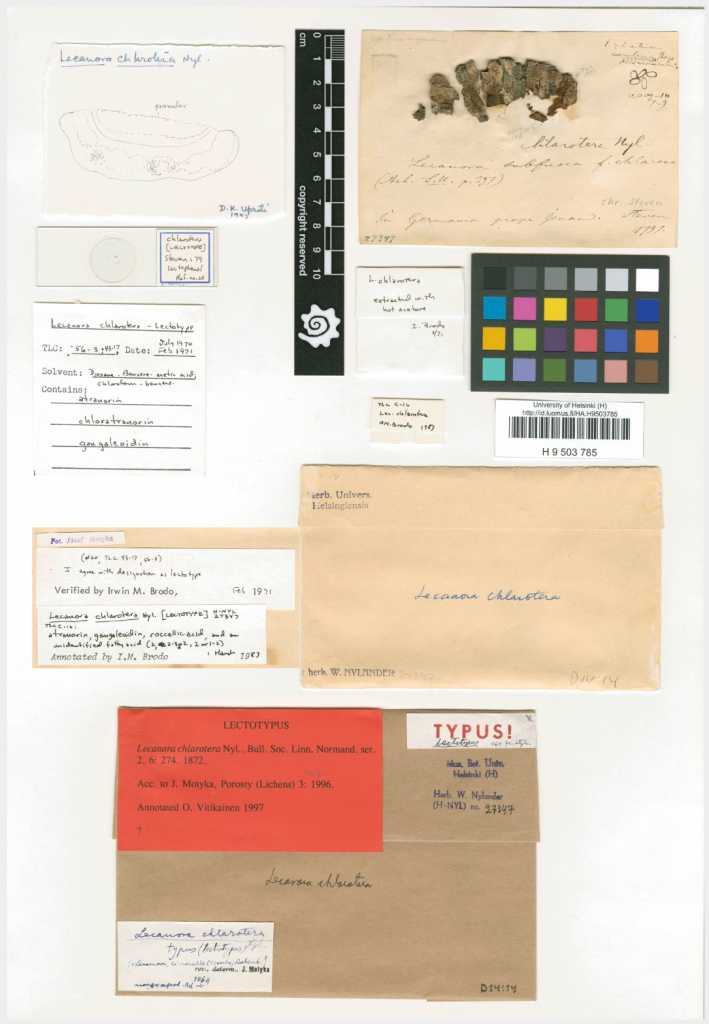
[attachment=1]H-NYL 27347 Lecanora chlarotera lectotype 1.png[/attachment] 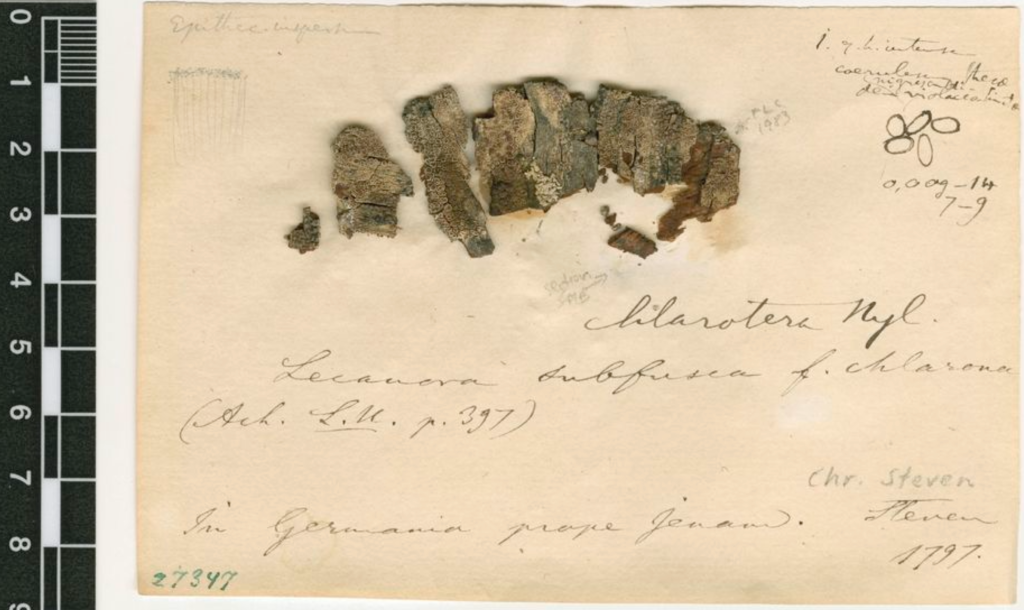
[attachment=0]H-NYL 27347 Lecanora chlarotera lectotype 2.png[/attachment] March 16, 2024 at 1:41 pm #45945Anonymous
I wonder about the reliability of the character of the crystals: small or large, soluble in K and N or not, inspersed or not,… to distinguish species certainly! In fact, the constituent of these crystals (calcium oxalate) is a product of the metabolism of the fungus and the quantity of crystals and their size is therefore proportional to the ageof the apothecia examined. We studied apothecia from the same thallus of Lecanora chlaroteraand we found that the apothecia in the center of the thallus (the oldest) had large crystals and that the apothecia at the margin of the thallus (the youngest) had small crystals… It therefore seems difficult to me to separate species based solely on the criterion of crystals and which must be supplemented by other characteristics. AG
March 16, 2024 at 2:27 pm #45946Many thanks for your reply, Alain. Yes — despite Brodo’s (1984) work, some question does indeed seem to remain as to whether the size and placement of the epithecial granules are completely reliable for separating species. That said, not even for Brodo is the placement of epithecial granules definitive —
i.e.whether only on the epithecial surface, or descending into the hymenium. Granule placement is just one diagnostic character among others, though it’s the main one separating Lecanora chlaroteraand L. hybocarpa auct. br., at least on current British conceptions. Your findings about the calcium oxalate crystals of
L. chlaroteraare fascinating. Presumably you mean the large crystals in the amphithecium? It certainly seems reasonable that the lichen would deposit more calcium oxalate as it ages, in the same way that our kidney stones — also calcium oxalate — grow larger as we ourselves age. But the small granules ‘inspersing’ the epithecium of Lecanora chlarotera aren’t composed of calcium oxalate. They dissolve in K, whereas calcium oxalate doesn’t. The compound is ‘
chlarotera-unknown’, I believe, and the granules seem to serve an anti-herbivory function (on this point see Malíček, 2014, cited above). My posts above refer to the size and placement of these small crystalline granules in the epithecium, not the large calcium oxalate crystals in the amphithecium. Lucie Kohler (1956) concluded that size of epithecial granules, not placement, was diagnostic. But Magnusson (1932), Poelt (1952) and Brodo (1984) concluded otherwise.
March 17, 2024 at 9:21 pm #45947Fascinating stuff and I wait further episodes with interest, but I would say I “elucidated” Lecanora hybocarparather than “discovered” it in Britain, as is was already in LGBI 2, where it was described as Quote:Known from E. Scotland, perhaps elsewhere. Europe, N. America.
I just worked out these was a lot of it about, partly because the lower nitrogen deposition environment of the New Forest means the the taxa we currently call “
Lecanora hybocarpa” and “ Lecanora chlarotera” grow together making it easier to realise there was more than one thing in the expansive field concept of Lecanora chlaroterathat was tending to be used at the time. Yes a review is certainly needed, our
Lecanora hybocarpais potentially not the same as the type described from America and is Lecanora sinuosareally a separate taxa, or just a morph of Lecanora hybocarpa. Also a brief foray in to sequencing suggests the quite distinctive Lecanora chlaroteraon horizontal Oak twigs in the New Forest, with dark brown disks, sometimes with distinctly blueish pruina and a pale grey thallus is not Lecanora chlaroteraat all! Neil
March 17, 2024 at 10:07 pm #45948Many thanks for your reply, Neil. I hope you don’t mind my inadvertent elevation of your work from ‘elucidation’ to ‘discovery’! But considering that Lecanora hybocarpa auct. br.seems unlikely to be the same taxon as the North American L. hybocarpa, perhaps your work does indeed sit somewhere in between the two levels. Grateful for the pointer to the entry in LGBI2 for
L. hybocarpa. I feel fairly keenly the lack of this volume on my shelf. Three times now I’ve thought I had a used copy in my grasp, but it’s eluded me. If you know of anyone looking to sell their copy, I’d be a willing buyer. It’s amazing to learn that our current concept of
L. chlarotera s. str.may still be obscuring other cryptic taxa. Looking forward to hearing more about your investigations as they develop. LGBI3 suggests that, in addition to the potential relationship to L. sinuosa, the same may be true of L. hybocarpa auct. br.Are you able to shed any further light on that? Thanks again for your interest in my posts above. I hope to add soon those promised further posts about the development of what you call the ‘expansive field concept’ of
L. chlaroterain use here in Britain before 2019. March 18, 2024 at 10:57 am #45949I am impatiently (but also worriedly) awaiting a study on the sequencing of these species, if it is possible to find correctly named reference species… In addition, this may be insufficient because it would be necessary to study the different associated algae and also bacterial flora… Good luck. AG
March 18, 2024 at 11:27 am #45950Many thanks, Alain. I’d be very interested to hear what you discover from this study. -
AuthorPosts


- You must be logged in to reply to this topic.