
Inand and upland Cladonia firma
- This topic is empty.
-
AuthorPosts
-
July 24, 2025 at 8:54 pm #33060
My trip up north to see family, included some lichening on the way up and included several new inland and very upland finds of the true Cladonia firma, see https://britishlichensociety.org.uk/resources/species-accounts/cladonia-firma ” class=”bbcode_url”> https://britishlichensociety.org.uk/resources/species-accounts/cladonia-firma Cladonia firmaon coastal habitats, some of which at least appear to be a form of Cladonia symphycarpawith atranorin but lacking norstictic acid. First with the Cumbria Lichen Group, flushed andesite slab at 520m at Kirkstone Pass, Westmorland:

[attachment=6]2025-07-18-06.jpg[/attachment] 
[attachment=5]2025-07-18-08.jpg[/attachment]
Wet thalli brown-green =Cladonia firma& sliver-grey = Cladonia subcervicornisA bit more lowland 70m, Ervie Moor, by Loch Ken, Kirkdbudbrightshire, a wonderful rhos pasture with rocky greywacke outcrops with H10 heath and CG10 grassland

[attachment=4]2025-07-19-05.jpg[/attachment]
Cladonia firmadrying 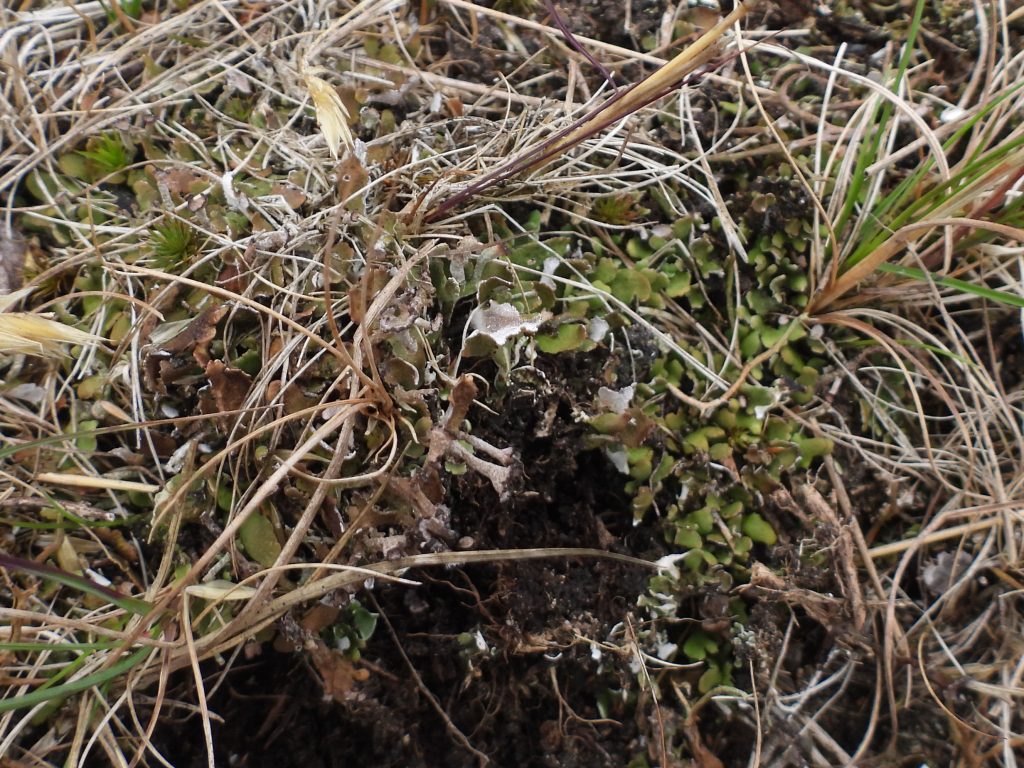
[attachment=3]2025-07-19-04.jpg[/attachment]
Cladonia firmadamp 
[attachment=2]2025-07-19-03.jpg[/attachment]
Habitat, rocks in CG10 grassland, with M25b rhos pasture belowFinally on a hunt for more
Cladonia peziziformison Airie Hill, Kirkdbudbrightshire, wet granite slabs in recently wild fire burned M15 wet heath at 225 – 240m 
[attachment=1]2025-07-20-08.jpg[/attachment]
Cladonia firma, wet on granite slab 
[attachment=0]2025-07-20-07.jpg[/attachment]
Habitat, wet granite slab in M15 wet heathThis suggests the lichen might be widespread in at least parts of the uplands in the west. Look for what is essentially a green-brown
Cladonia subcervicornis, which is easiest to spot when wet. Dry the both turn their undersides up; these are different, Cladonia firmais less white, but the difference is not easy to see except close up. Interested to hear of any other inland finds Neil
-
AuthorPosts


- You must be logged in to reply to this topic.