
Herons Wood – Some sort of fungus!
Forums › Forums › Fungi ID requests (post here if you aren’t sure what type of fungus you’ve found) › Herons Wood – Some sort of fungus!
- This topic is empty.
-
AuthorPosts
-
August 4, 2015 at 5:42 pm #29603
Found by the side of a path through mixed deciduous woodland – but mainly Sweet Chestnut. 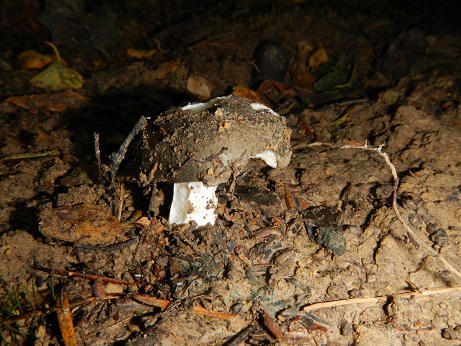
[attachment=1]DSCN5527.jpg[/attachment] 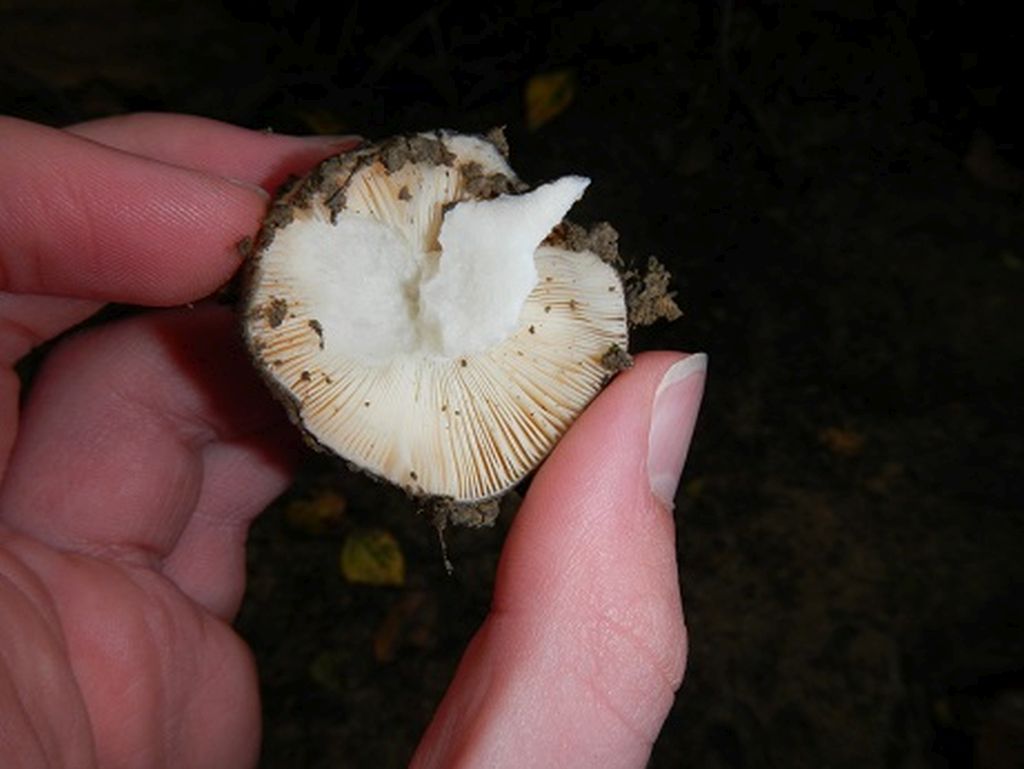
[attachment=0]DSCN5528.jpg[/attachment] 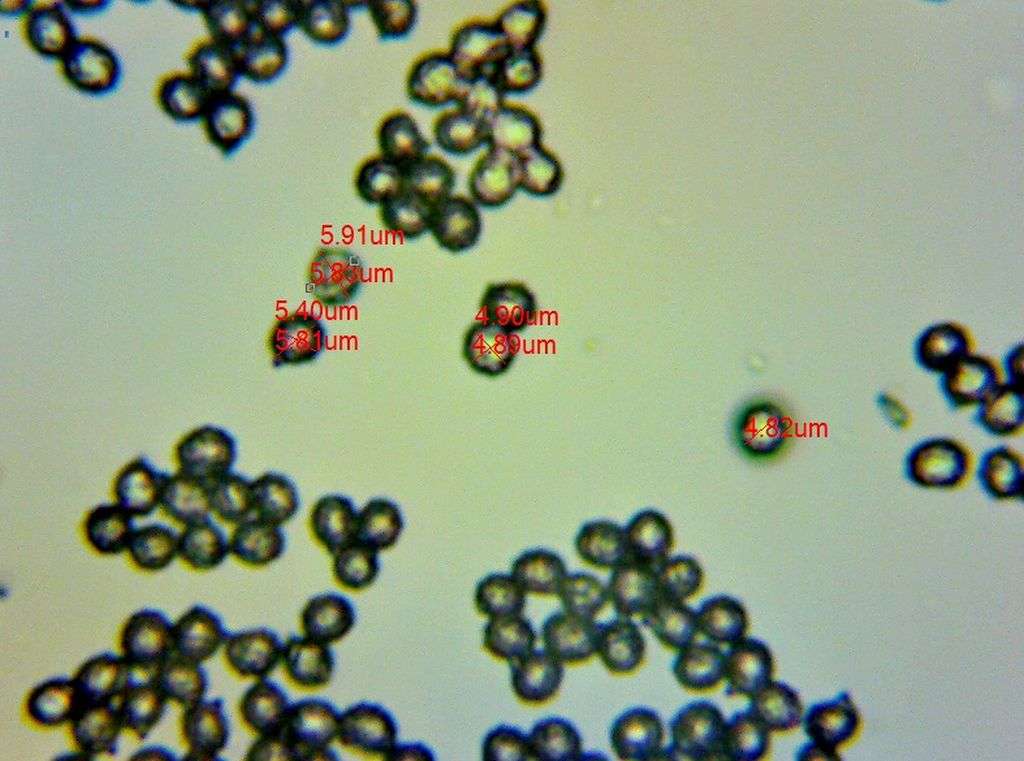
[attachment=2]Site002 – Fungus002 – Spores001 – 28th July 2015.jpg[/attachment] August 4, 2015 at 5:59 pm #35561It’s a Russula. Hard to tell much more with such small images. Try to make them at least 800 x 600. Its hard to see the cap colour. Does it have a hot or mild taste (spit it out after)?
Does the cap cuticle peel to the centre?
Does it discolour on handling?
Does it have a smell?
Spores should be mounted in Melzers, I’m not sure what you have mounted them in but they look out of focus and somehow wrong? Melzers is one of the most important chemical reagents for fungi, along with either 5-10% potassium hydroxide or 10% ammonia (available from Homebase) and congo red.
This page is worth a read as it has some useful background.
Cheers, Adam
August 5, 2015 at 7:14 am #35562These are 800 x 600: 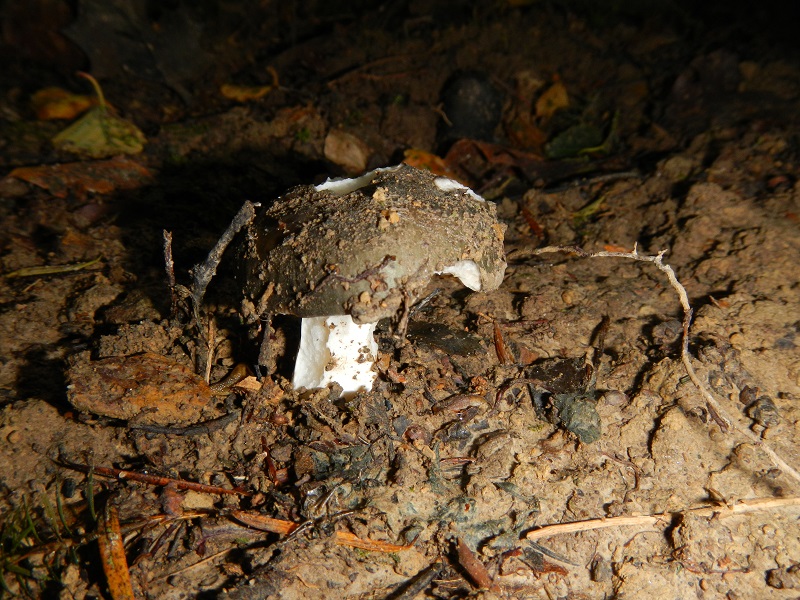
[attachment=1]DSCN5527 r2.jpg[/attachment] 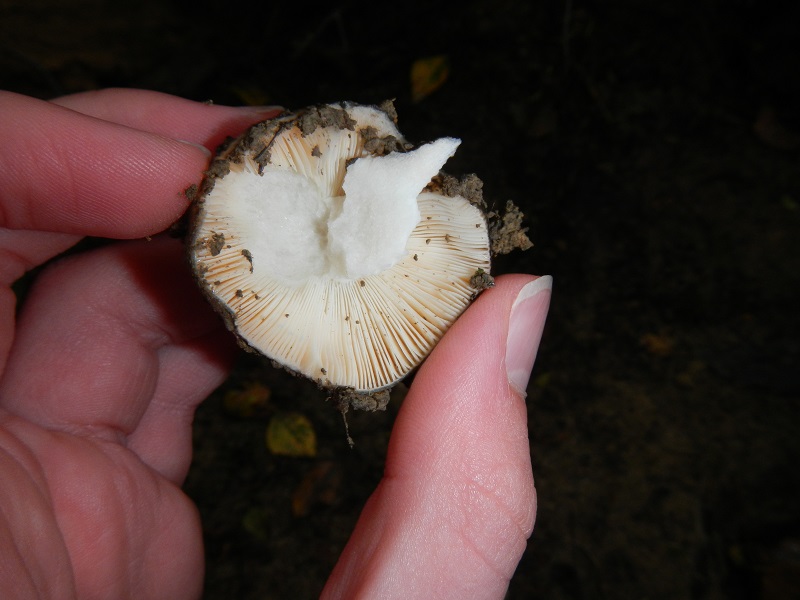
[attachment=0]DSCN5528 r2.jpg[/attachment]
Mild taste I think,Cap cuticle doesn’t peel to the centre but I can’t be certain,
No discolouration,
I didn’t check the smell.
As for the spores, I mount them with water as I think someone told me to (I don’t want to point fingers).
Thanks for your interest.
August 5, 2015 at 8:28 am #35563There are a number of possibilities, was there any colour on the stipe, even just a flush of lavender? The key in Kibby also needs a spore print. The colour can vary from pure white to almost ochre.
The last part of the key needs a look at the dermatocystidia, but this is a bit tricky unless you have a sulphovanillin kit or cresyl blue.
Possibilities are the Charcoal Burner R.cyanoxantha (very common and variable in cap colour) or R.grisea.
I can’t go further than this, I’m afraid, without more details.
I would recommend getting the Kibby book
http://summerfieldbooks.com/the-genus-russula-in-great-britain%3A-with-synoptic-keys-to-species~3221 ” class=”bbcode_url”> http://summerfieldbooks.com/the-genus-russula-in-great-britain%3A-with-synoptic-keys-to-species~3221 As far as spores are concerned, the advice was good, if unsure always mount in water first, but to observe the ornamentation in Russulas/Lactarius, as the warts and spines are amyloid, they will show up better in melzers. From the pattern on the spores, you can see a partial reticulum (net) on a few spores along with some isolated warts (black dots)
eg
August 5, 2015 at 10:31 am #35564What about spore size? My spores seem to be smaller than both the Russula species you mentioned, but R.grisea has smaller spores than Charcoal Burner. No lilac on the stem whatsoever, and the cap was just brown after I cleaned off all the dirt and mud, no green or purple. Does that also make R.grisea more likely? I’m finding fungi identification quite daunting!
😳 August 5, 2015 at 11:04 am #35565Check your email 
There is a lot to learn, you have to put in the effort, and I would never learned as much as I have without the help of the people here (when we were on WAB)
Been doing it for 3 years, 2 with a microscope and I’m getting confident at looking at most parts of the fungus now (agarics anyway)
Have you joined your local group? – perhaps
http://www.westwealdfungi.co.uk/http://www.westwealdfungi.co.uk/” class=”bbcode_url”> I would recommend it, I think maybe somone could take a look a your scope and make sure it’s set up properly etc.
Regarding spore sizes, as your photo is not in sharp focus, I wouldn’t trust the accuracy of the measurements, the spore edge should be a solid line. Also, how many spores did you measure? I do mine by hand (eyepiece graticule) which is a pain, but I measure at least 10 spores (when spore size is a critical feature like with Psathyrella, I would do 20.)
August 5, 2015 at 4:21 pm #35566I’ve been at it a lot longer than Adam and I still find it daunting! I know a good number of species by sight but each year I find a some that I’ve not seen before (and still occasionally find identifying the Genus an issue). Regarding Russula spores: they are generally ellipsoid. Some of those measured appear spherical suggesting that they were end-on to the camera. There’s a nice ellipsoid one on the right of the field which may be longer than those you have measured.
August 5, 2015 at 4:44 pm #35567Thanks Roy and Adam, I will measure much more spores next time. I’m glad I’m not the only one who finds it daunting!
 August 5, 2015 at 5:28 pm #35568
Respect to Roy – Russulais a genus I tend to ignore, my motto being “ Caedite eos. Novit enim Dominus qui sunt eius” (see
https://en.wikipedia.org/wiki/Caedite_eos._Novit_enim_Dominus_qui_sunt_eius. ” class=”bbcode_url”> https://en.wikipedia.org/wiki/Caedite_eos._Novit_enim_Dominus_qui_sunt_eius. Once one gets immersed in this mycology game, it soon becomes clear (once you have the equipment and some decent literature) that the most important commodity is
time; this starts with recognising whether a find will be worth that expenditure. The ability to ignore stuff is an important skill is presented as here with a single(I think?), damaged/eaten/past it fruitbody I would definitely ignore it – throw into that mix the fact it’s a Russula. . . . . . Bearing in mind that last factor I would check out the third paragraph of:
http://www.mushroomexpert.com/russula.htmlhttp://www.mushroomexpert.com/russula.html” class=”bbcode_url”> Do bear in mind I am not trying to put you off mycology – actually the opposite
💡 best wishes
Chris
PSsomething I had banged into my head by Roy Watling (and others) when I was starting out in the 1980s is the notion that “one fungus is not a fungus”; meaning that a solitary fruitbody or scant bit of material will almost invariably prove unsatisfactory for identification (and having sufficient at the end of detailed examination to dry as a voucher specimen, should it be rare, in a critical group, or needed for an expert to check). August 5, 2015 at 9:57 pm #35569I can understand Chris’ view of Russula, but I think they are quite good for beginners to “break their teeth on,” for a number of reasons. They are quite easy to spot as a genus. They are big and solid and survive handling quite well. You don’t have to worry about damaging stem cystidia, or looking for basal disks, rooting or signs of a veil.
There are only two elements of microscopy needed, cap cuticle and spores.
There are some chemical tests that can be useful and are fun.
Taste and smell are factors but none are deadly poisonous.
They are quite commonly encountered, so plenty of practice material.
I don’t find much daunting but that is because I have perseverance in abundance

**edit – none of the above means they are easy, but I think there are worse things, eg Clitocybe, Peziza or Agaricus
**edit again – I have great respect for Chris, Roy and others who have 20-30+ years of experience each.
August 6, 2015 at 2:32 pm #35570Most years I get probably one find that I can’t get even to Genus, and usually have a few I’ve not seen before (so far this year – Conocybe dumetorum). But before people start thinking I’m a Russula expert, I was talking about fungi in general; I can’t do many Russula in the field.
I agree with Chris about time being the main issue. And if you’re the “expert” on a foray, you can get given a large number of things to examine: my problem is I’m not good at ignoring ‘unknowns’ and most get taken back for checking – that is when it really gets daunting (and more like a production line!).
Back to Russula: one good thing is the availability of a good, cheap and up-to-date Guide to British species (Geoff Kibby’s), which makes tackling the Genus a challenge rather than a nightmare. When I started out I identified species using Roger Phillips’ (recently published) book and my Collin’s Guide (Lange & Hora) and was quite confident that I had the right name! It was not until a couple of years later, when I had the BMS Russula Guide (Ronald Rayner’s) and the English translation of Moser that I fully appreciated how many species there were (and more have been added to the list since then).
-
AuthorPosts


- You must be logged in to reply to this topic.