
Hawthorn Leaf Blight – Monilinia johnsonii
Forums › Forums › General fungi discussion › Hawthorn Leaf Blight – Monilinia johnsonii
- This topic is empty.
-
AuthorPosts
-
May 21, 2015 at 8:03 pm #29375
Hi, I was asked by my Longshaw Survey colleague, Les, to check some dead attached Hawthorn leaves for the anamorphic form of the stalked cup which is found on old Hawthorn berries. The strong flowery perfume from the leaves was discussed by Peter at the BMS Spring Foray in South Yorkshire last year. That the scent should be a mimic of the Hawthorn flowers is a very attractive one – Peter’s hypothesis is that insects are attracted to the leaves and carry away conidia to disperse the fungus. Ergot produces a sweet solution which induces insects to carry spores in a similar way. The conidia are illustated in Ellis and Ellis as a tiny string of beads. I found the best way to see these is by scraping the white “mould” off the dead leaves onto a slide, and then avoid putting water on – just look at the conidia in an air mount – it stops the spore chains breaking up. The fungus looks to be a problem in the States. We’ve searched the Longshaw Estate Hawthorns without success, for both the perfect form and the conidial – annoyingly Monilinia johnsonii (the conidial form) is found just up our road in Sheffield. The only records I have for the Sheffield region (70 km square centred on the city) are from 20 May 2011, Worsborough in South Yorkshire, from a BMS visit – it looks as though the 2 records are duplicated, but one indicates the anamorph was found. We found it there again last year. We have plenty of Monilinia fructigena (brown rot of apple) records, including from our allotment. I always check the old apples for the cup fungus – just in case….
Steve
May 21, 2015 at 11:33 pm #34421Excellent post Steve, very interesting. I found a local site earlier this year with literally thousands of
Monilinia johnsonii– “Haw Goblets”: – 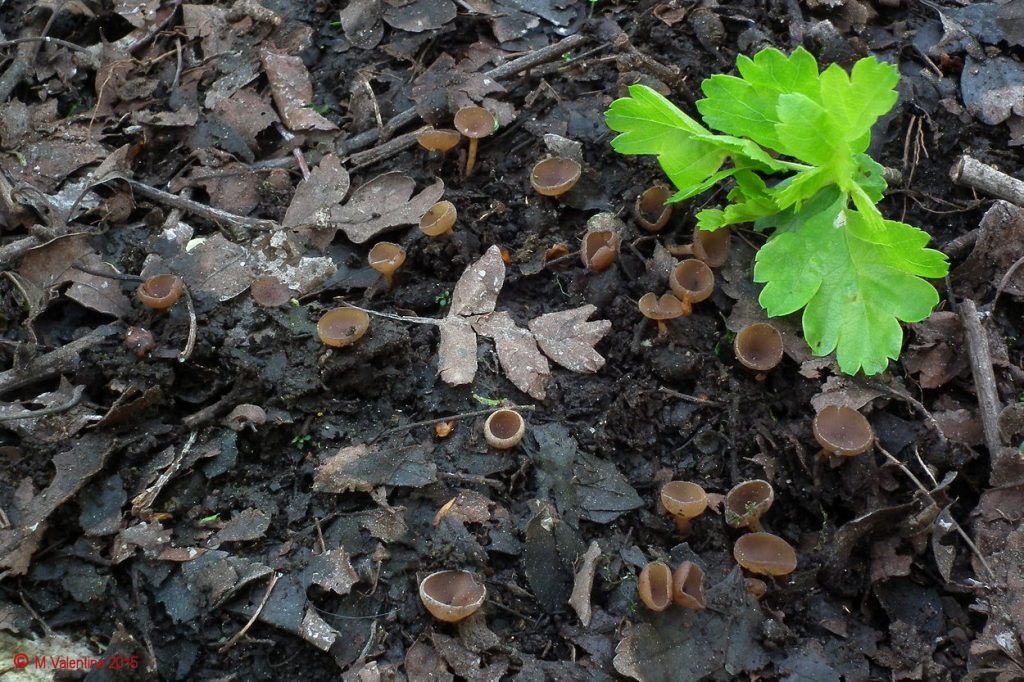
[attachment=0]Haw Goblet (2a).jpg[/attachment] I shall now have to try to find the anamorph stage, and hopefully be able to see some of those conidial chains for myself!
Regards,
Mike.
May 22, 2015 at 9:51 am #34422Interesting thread Steve, I have also found Haw Goblet quite often around here but never noticed the anamorph stage. regards
John
May 23, 2015 at 7:26 am #34423very impressive photographs – never seen the species before. May 23, 2015 at 11:51 am #34424Neither had I till Peter from the BMS pointed it out on the Spring Foray. I’m still looking for my first Hawthorn Cup – a good place to look would be earlier in the year under the bushes/trees where the Hawthorn Blight is noted – a bit difficult for me as this is in someone’s garden. Most of these cups are far smaller than I ever expected. May 24, 2015 at 2:55 pm #34425Well – That was easier than I thought it might be. 
On a short foray with a friend yesterday afternoon, in the perimeter woodlands around a local reservoir.
The very first Hawthorn we examined had a few scattered leaves showing the symptoms: – dry, curled, & brown, with grey furry/powdery coating.
Examined under the scope (dry as per Steve’s suggestion) – the exact same bead-like chains of conidia: –
Click on image to view at full size
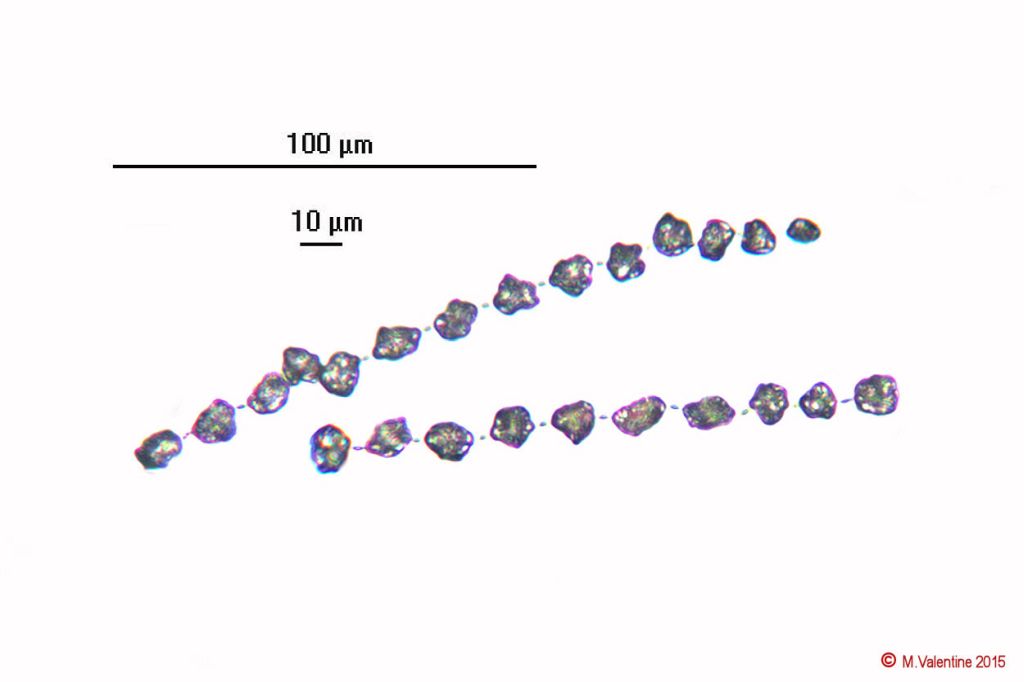
[attachment=0]Monilinia johnsonii Anamorph (Conidial Chains x400 with scale).jpg[/attachment] Regards,
Mike
May 24, 2015 at 3:21 pm #34426Yes, found some just starting to brown last week in Galloway – its quite common once you have seen/smelt it – brilliant to show folk with its smell of incense -but never, in spite of huge looking, found the cups on the floor berries…………must try harder. Cheers
Ken
May 25, 2015 at 7:35 am #34427Doing my BBS Bird survey this morning, takes me past so many Hawthorns – so I had a look at them all as a rough estimate, around 2/3 of mature trees have the leaves browned/furry/rolled up………..so pretty frequent round here! (Saddleworth). 
Cheers
Ken
May 27, 2015 at 5:21 pm #34428Hi Lots of the Anomorph in Southern Derbyshire. I have been noting the trees with the most affected leaves so I can look for the Teliomorph next spring
Peter
May 27, 2015 at 5:31 pm #34429Ditiola wrote:Hi
Lots of the Anomorph in Southern Derbyshire. I have been noting the trees with the most affected leaves so I can look for the Teliomorph next spring
Peter
Hi Peter,Welcome to the forum – good to have you on board.
The strength of knowledge amongst those registering here on UK Fungi is growing by the day.

Regards,
Mike.
May 27, 2015 at 5:44 pm #34430Hi Peter, great to have you aboard. Anamorph close-up shots from today next to the R Wharfe in Ilkley.
May 27, 2015 at 8:49 pm #34431Hi Ken It was Peter who pointed this out to me a couple of years ago – astonishing how one can miss things for decades
😳 . I walked from Ravensthorpe to Huddersfield by the river/canal on Monday and must have seen hundreds of infected leaves along virtually the whole stretch . . .cheers
Chris
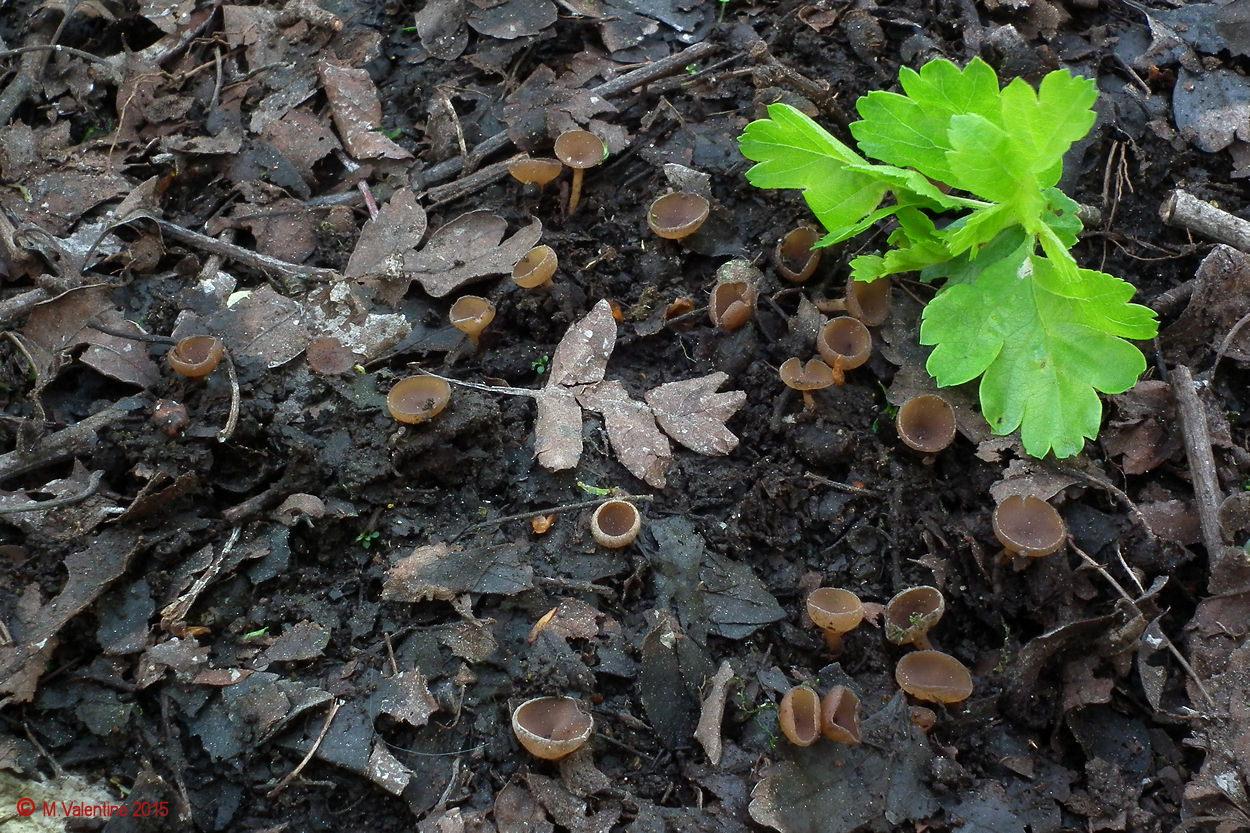
May 27, 2015 at 10:12 pm #34432Lots in the Stones but we found none at Treswell Wood May 28, 2015 at 6:54 am #34433Spotted yesterday in Carmarthenshire by Sam Bosanquet. May 28, 2015 at 1:14 pm #34434From Anston Stones Wood: -
AuthorPosts




- You must be logged in to reply to this topic.