
Erythricium aurantiacum on Physcia tenella
- This topic is empty.
-
AuthorPosts
-
September 20, 2022 at 3:51 pm #32403
This looks like Erythricium aurantiacum feeding on Physcia tenella but not seen it looking like this before as it is usually more spherical in shape. Also there does not appear to be significant bleaching on the host lichen. Is this a variant. Any forum thoughts would be appreciated. September 25, 2022 at 9:44 pm #44912This is potentially the basidioma of Erythricium aurantiacum, which is described as “floccose” (i.e covered in woolly tufts). There is a picture in Lichenicolous Basidiomycetes by Paul Diederich https://www.mnhn.lu/science/flora-of-lichenicolous-fungi/?lang=en ” class=”bbcode_url”> https://www.mnhn.lu/science/flora-of-lichenicolous-fungi/?lang=en I have just collected something a bit similar on
Physcia adscendens/tenella, but this is certainly not Erythricium aurantiacum. 
[attachment=2]2022-09-25-01.jpg[/attachment]
ThePhysciathallus with the pale orange infection 
[attachment=1]2022-09-25-02.jpg[/attachment]
Close view, the fuss of basidia? visible on the edge of the thallus
[attachment=0]2022-09-25-03.jpg[/attachment]
Microscope view of basidia? supporting a single spherical basidiospore? 10 – 13µm diameter. Or possibly these are the conidia of an asco.I have no idea what this is.
Neil
October 24, 2022 at 8:35 pm #44913I’ve found areas of the basidima of Erythricum aurantiacum without associated bulbils before. In the case that I saw, the bulbils were on top of a decaying thallus and the basidia were under the thallus where the air would have remained more moist. Microscopy is needed to confirm. Could your sample be a hyphomycete, Neil?
November 2, 2022 at 8:19 pm #44914Fay Quote:Could your sample be a hyphomycete, Neil?
For all I know yes, being an ecologist and not a mycologist this is a bit beyond me!
Neil
November 13, 2022 at 11:25 am #44915I don’t know what it is but it’s very interesting! November 14, 2022 at 10:08 pm #44916Actually thanks to Vince Giavarini, I have a tentative identification on my odd material. He has seen Nectriopsis physciicolaassociated with this type of material, suggesting that this may be the anamorph (asexual sporing form producing conidia) of this fungus. Searching on the internet there is also a report for very similar material associated with another Nectriopsisspecies in South America, which was thought to be the anamorph of that species, but this was not confirmed with sequencing. (See figure 16 https://pfsyst.botany.pl/pdf-120091-48872?filename=Biodiversity%20assessment.pdf ” class=”bbcode_url”> https://pfsyst.botany.pl/pdf-120091-48872?filename=Biodiversity%20assessment.pdf Neil
December 14, 2024 at 7:45 am #44917Further to the above post, I have now found Nectriopsis physciicolaas the teleomorph (sexual stage) with wonderful hairy perithecia that collapse when dry and look like ulcerate disks, but inflate into recognisable perithecia when wet. I found this on Xanthoria parietinaon a blown Ash twig in my home 1km square, during storm Darragh, which provided a good source of fresh twigs and lichenicolous fungi. This storm brought my list for the home square to 188 taxa (12 to go!). Close to the perithecia was the same Acremonium like anamorph I reported above, supporting Vince’s observations that this is likely to be the anamorph of
Nectriopsis physciicolaPhotos:

[attachment=4]2024-12-07-01.JPG[/attachment]
Nectriopsis physciicolaon Xanthoria parietina, dry collapsed perithecia 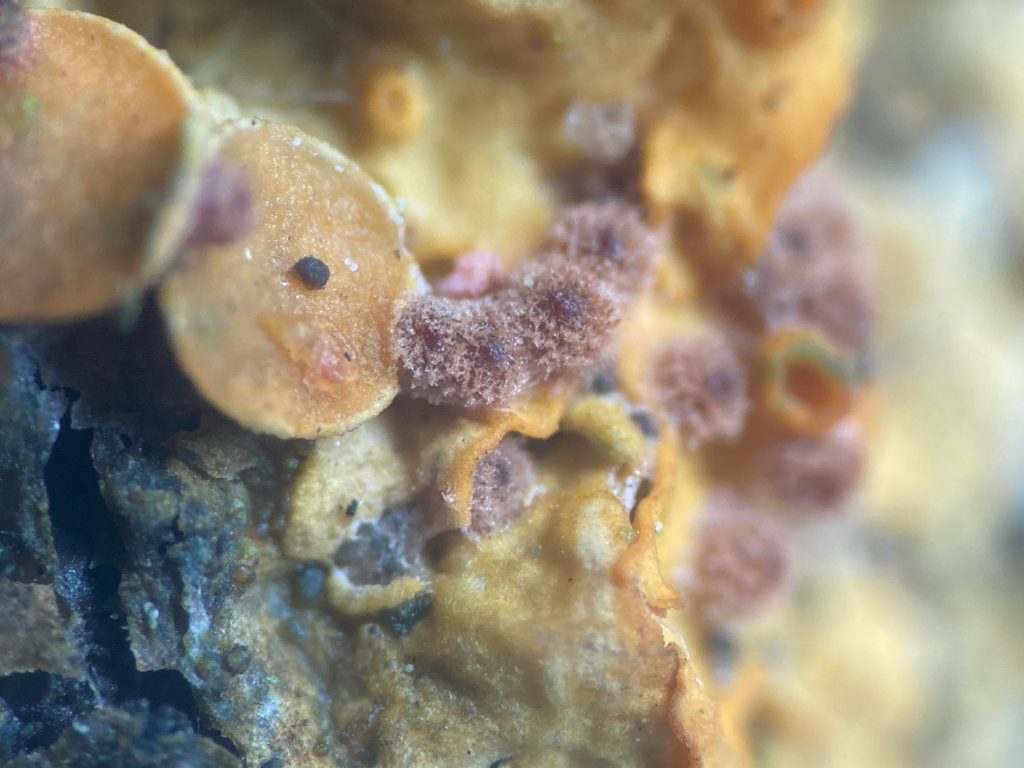
[attachment=3]2024-12-07-08.JPG[/attachment]
Nectriopsis physciicolaon Xanthoria parietina, wet inflated perithecia 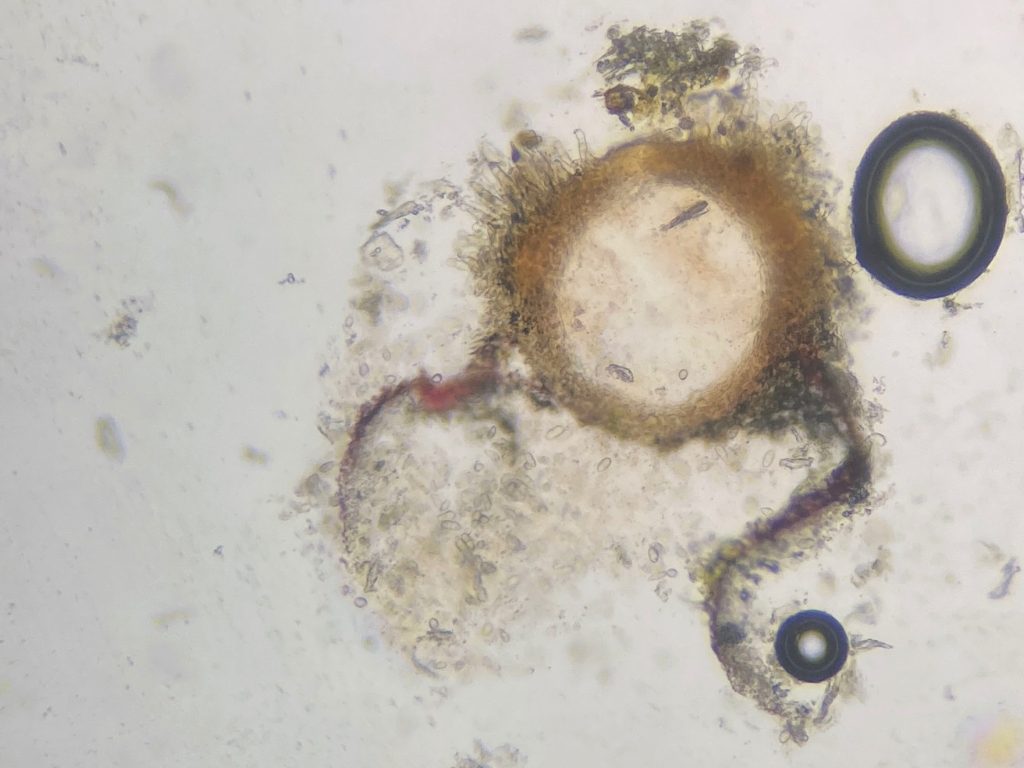
[attachment=2]2024-12-07-05.JPG[/attachment]
Nectriopsis physciicola, perithecia cross section 
[attachment=1]2024-12-07-07.JPG[/attachment]
Nectriopsis physciicola, spores 
[attachment=0]2024-12-07-10.JPG[/attachment]
Nectriopsis physciicolaassocaiated acremonium like anamorph More pictures at
https://britishlichensociety.org.uk/resources/species-accounts/nectriopsis-physciicola ” class=”bbcode_url”> https://britishlichensociety.org.uk/resources/species-accounts/nectriopsis-physciicola Neil
-
AuthorPosts


- You must be logged in to reply to this topic.