
Enigmatic lichen from Denmark
- This topic is empty.
-
AuthorPosts
-
March 3, 2021 at 5:54 pm #32047
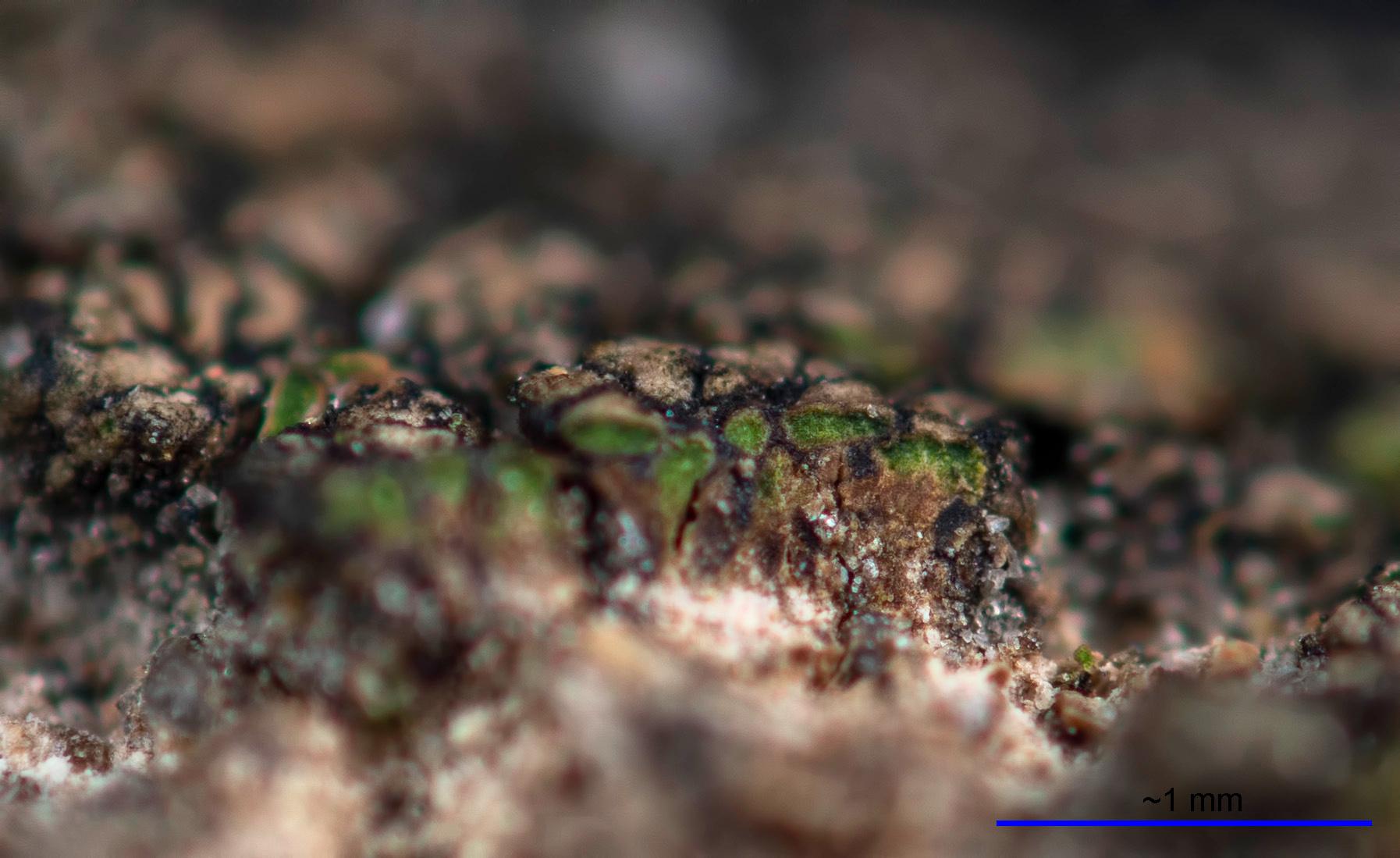
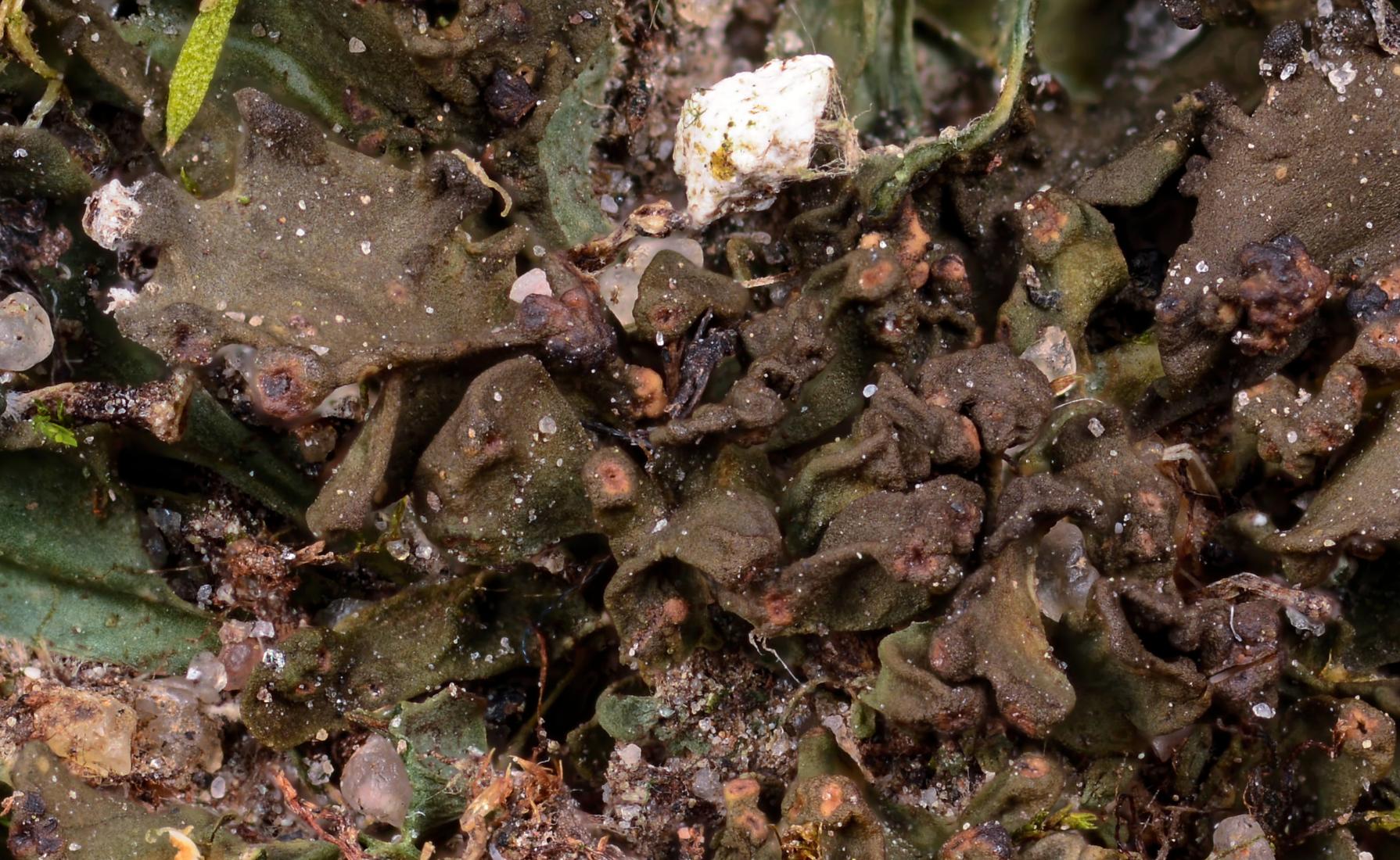
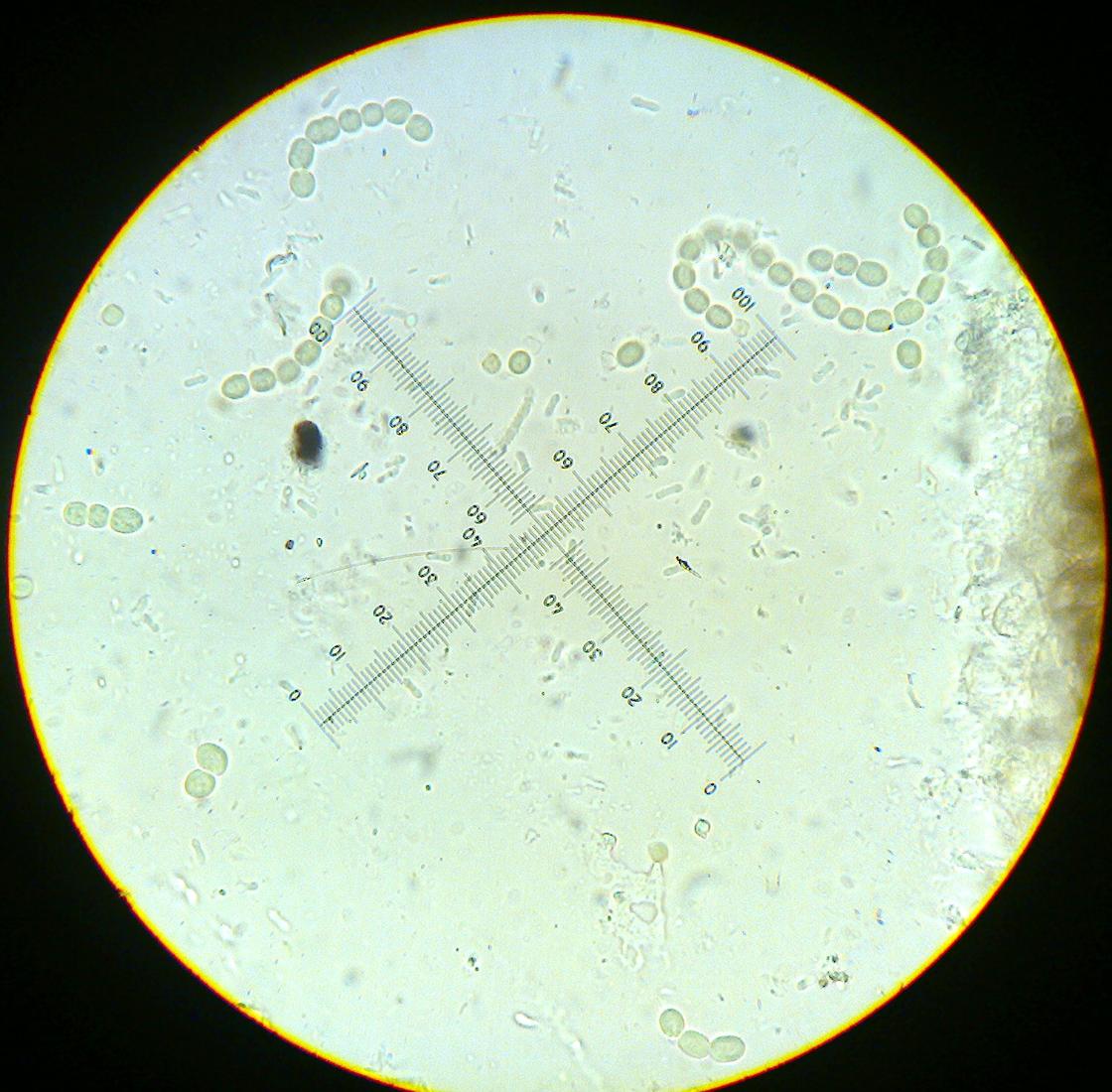
This specimen was found today on mortar in Aarhus, Denmark. I thought it might be something close to Catapyrenium(or other Verrucariaceae) in the field, but back home it defies identification despite the quite characteristic areolate almost subsquamulose habit. There are seemingly no reproductive structures other than pale brown pycnidia containing quite irregular conidia. The black parts of the thallus is apparently colonies of Gloeocapsaand not a hypothallus as I first though – although it may turn out to be both. I have examined about 15 sections of the thallus under the microscope and I have not been able to find anything that points me in the direction of an identification. There is a thin upper cortex with no visible internal structure (it just presents as a hyaline covering to the thallus) and thallus is K- and C- (possibly weakly yellow). The thallus is more grey than it appears on the photographs, although still with a brownish tint. Any and all ideas on where to go from here are more than welcome!
– Jonas
March 3, 2021 at 10:42 pm #44042As soon as I glanced at your overview photos I thought the pattern of pale grey areoles looked familiar and my thoughts went straight to Verrucaria ochrostoma. This was formerly considered a very rare species in Britain but it is now accepted that it is actually a common colonist of calcareous substrata, including mortar and concrete. The nature of the cortex in V. ochrostoma, with a distinct epinecral layer, is much as you have described. However, I have never seen pycnidia on any of the specimens of V. ochrostoma that I have examined. I wonder whether the pycnidia belong to something else, perhaps even to a lichenicolous fungus? In the close up from your overview, I can see a couple of small black structures on the edge of the little cluster of algal units making up the main areole (upper left) and the top of a larger brownish structure (above and right of centre). I wonder if the smaller black structures are the pycnidia that you have found and that you haven’t properly investigated what I think might be the perithecia belonging to V. ochrostoma. 
[attachment=1]Screenshot 2021-03-03 at 10.21.29 PM.png[/attachment]
Perhaps we have an arrangement as in my drawing but with some unknown pycnidia on the edges of some of the areoles?
[attachment=0]Verrucaria ochrostoma1.jpg[/attachment]
Here is a link to more information and images ofV. ochrostoma: http://fungi.myspecies.info/taxonomy/term/7172/media I offer this as merely a suggestion of something to investigate.
March 4, 2021 at 1:08 am #44043Hi again, Mark I like your suggestion, but all the black globular structures I have examined have been what I think is colonies of
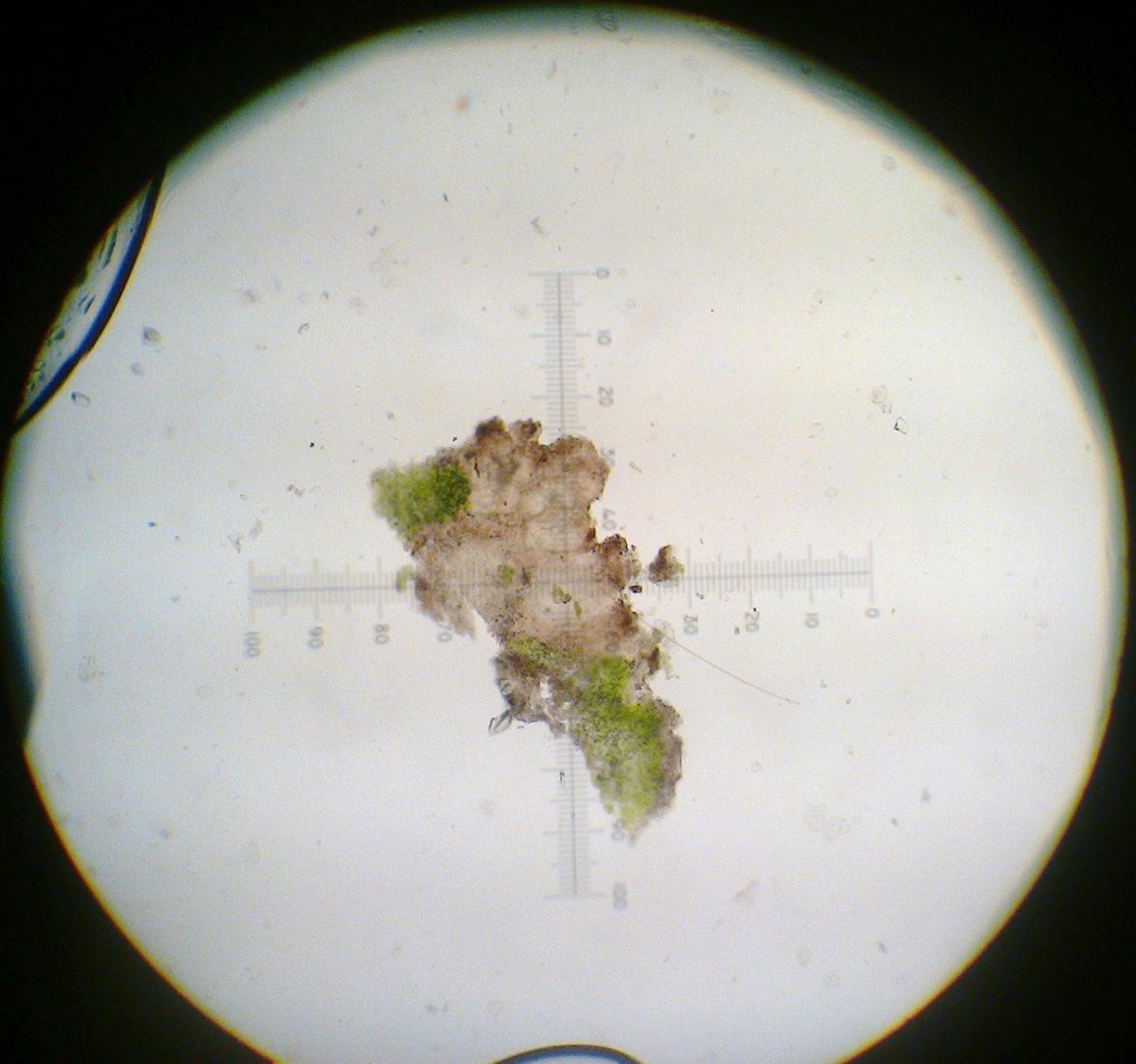
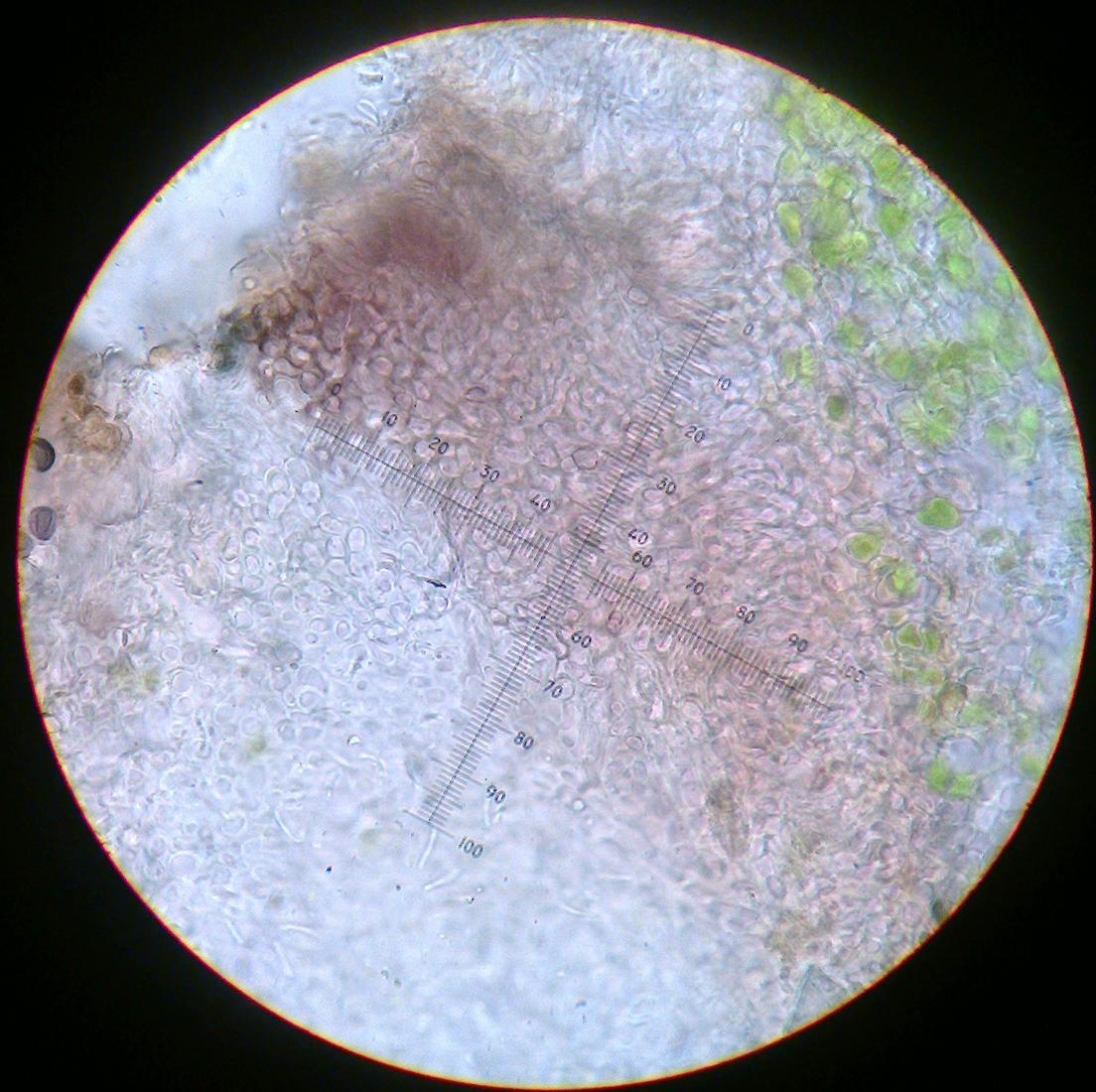
Gloeocapsa. The pycnidia are red-brown and immersed in the squamules/areoles. I attach a section through the area you highlighted – as far as I can see it is a cluster of pycnidia. You may be right that the pycnidia are from a lichenicolous fungus – I will attempt to key them as such tomorrow 

[attachment=1]Billede1924.jpg[/attachment] 
[attachment=3]Billede1921.jpg[/attachment] 
[attachment=0]Billede1926.jpg[/attachment] 
[attachment=2]Billede1923.jpg[/attachment] 
[attachment=4]Billede1919.jpg[/attachment] March 4, 2021 at 10:12 am #44044So we are left with various possibilities: 1. my suggestion of
V. ochrostomais incorrect. 2. it is
V. ochrostomaand the pycnidia belong to a lichenicolous fungus. 3. it is
V. ochrostomaand the pycnidia belong to the lichen. I slightly favour the third possibility at the moment, partly because the pycnidia are usually positioned where I would expect the perithecia of
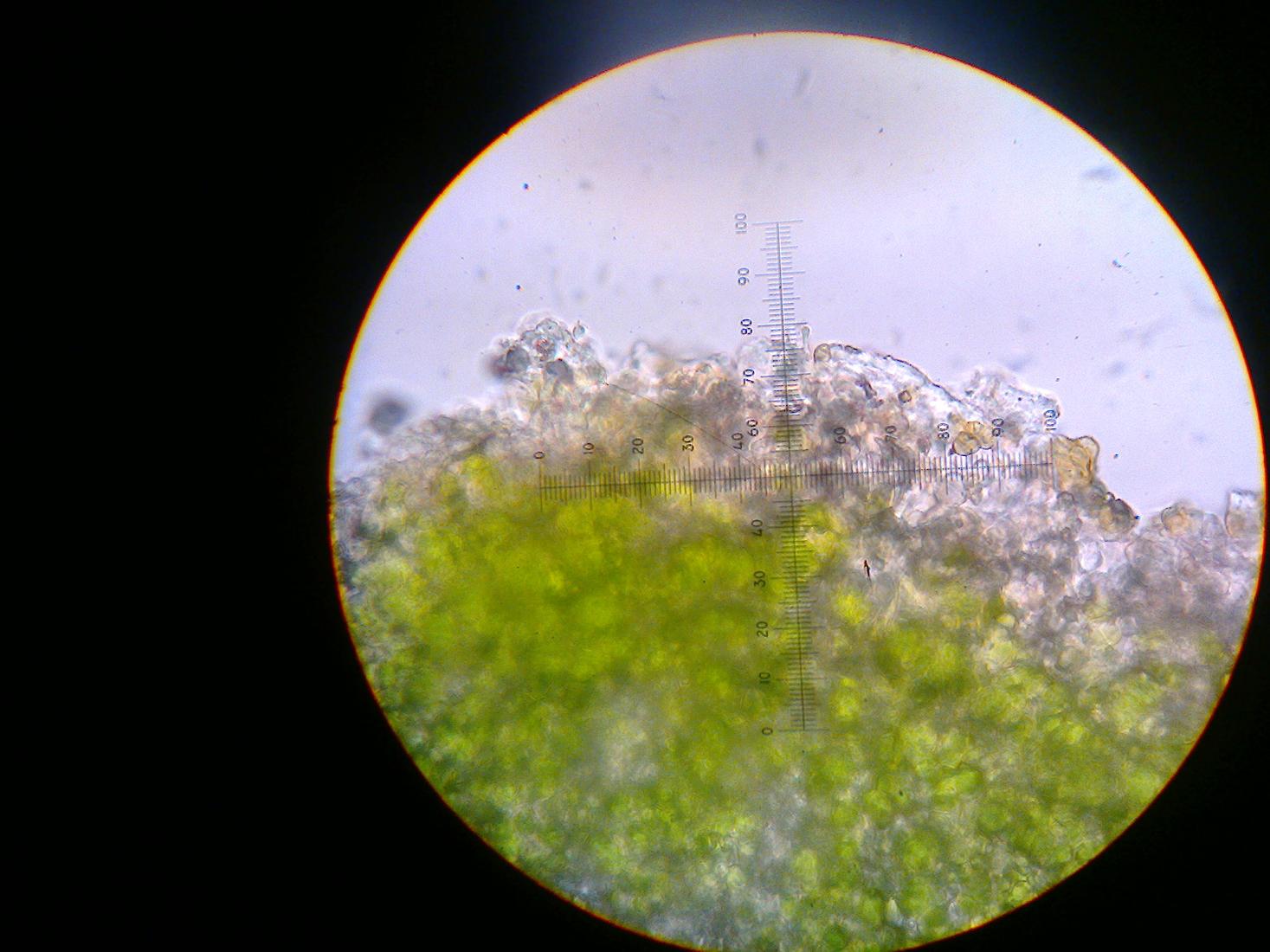
V. ochrostomawould normally be (surrounded by the little algal units). Although I have never seen pycnidia in V. ochrostoma, and they are not mentioned in the literature, that doesn’t mean that they definitely don’t exist. The 2009 ‘Flora’ tells us that the conidia of the rather similar V. viridulaare “straight to slightly curved, 7-10 x c. 1 um.” Unfortunately it can be frustratingly difficult to tell whether pycnidia belong to a lichen or whether they are a lichenicolous fungus. March 6, 2021 at 2:45 pm #44045If it is indeed V. ochrostoma, it would be the first record from Denmark, and I don’t think this sterile specimen is sufficient to document that. I do, however, think that the resemblance is quite striking when I look at photos and descriptions of V. ochrostoma, so I would tend to gravitate towards your option 2 or 3. I have visitied the location again hoping to find a better developed thallus, but so far without luck. It is quite nearby my home, so I will pop by there from time to time and update here if and when I find something conclusive. I did not mention this before, but after cutting some sections, I can see that the thallus is rather thick and thought it would be worth documenting aswell:

[attachment=2]cf. Verrucaria ochrostoma 1-1.jpg[/attachment] I recently spent more time than I would like to admit in trying to identify a lichenicolous species on
Enchylium cf. tenax, just to realize that it was in fact the “host’s” own pycnidia. I had never seen any Collemataceaewith pycnidia, so I did not even consider that possibility… The conidia are however quite characteristic (almost dumbbell shaped) and fit well with the reported conidia from E. tenax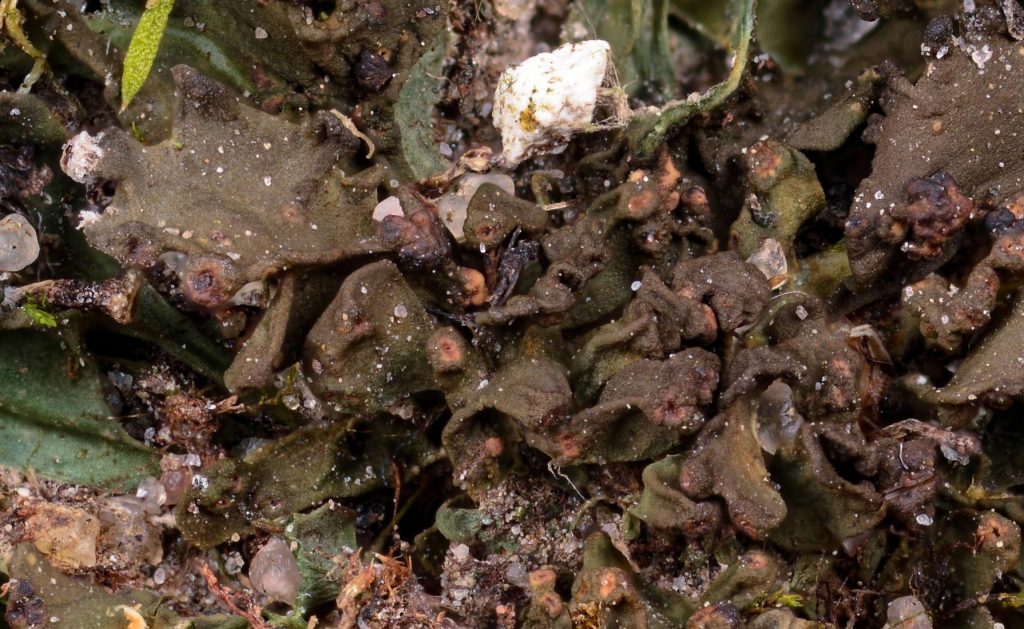
[attachment=3]cf. Enchylium tenax 2-1_01.jpg[/attachment] 
[attachment=0]Billede1890_01.jpg[/attachment] 
[attachment=1]Billede1886_01.jpg[/attachment] Lastly, I would like to add that even though no solid ID may come of it, I much appreciate you taking the time to answer my queries – thank you for that.
– Jonas
March 7, 2021 at 11:19 am #44046In Eastern England we have many buildings with sloping limestone windowsills. Many are 19th C. and include church and municipal buildings. These are often dominated by Verrucaria ochrostoma. If you have similar buildings in Denmark it might be worth keeping this in mind. 
[attachment=1]Verrucaria ochrostoma5.jpg[/attachment] V. ochrostomaalso turns up commonly on sloping cement on walls, for example the little slopes often found towards the tops of modern suburban walls. A wall such as the one below has a suitable little sloping fillet of cement below the topmost black bricks. 
[attachment=0]Screenshot 2021-03-07 at 11.05.58 AM.png[/attachment] V. ochrostomahas been a remarkably overlooked lichen. When I hosted a BLS meeting in 2012 I pointed out good material to the great and good of the lichen community and nobody present could name it. In the end, on a strong hunch, I made a trip to the Natural History Museum in London to examine Borrer’s 19th C. type specimen and this reassured me that this common colonist which I was finding regularly really is V.ochrostoma. I also noticed that the tops of the low walls outside the museum, where visitors queue to get in, were dominated by V.ochrostomawhere it had sat completely unnoticed. I went to Scotland a few years ago and within a very short time I was able to find first Scottish records for both V. ochrostomaand V. obfuscans. Last year I confirmed the first record of the latter for the Netherlands from a few ‘crumbs’ scraped from a tomb. I would be surprised if you don’t have plenty of occurrences of both species in Denmark. March 7, 2021 at 11:26 am #44047It is not at all easy in some cases to know whether one is looking at a lichenicolous fungus or a structure belonging to the lichen fungus. A classic example is of course Normandina pulchella. From LGBI2: “The perithecia were for a century rightly believed to belong to the thallus, until some authors suggested that the thallus might be a Basidiomycete and the perithecia a lichenicolous fungus. However, careful morphological observations and phylogenetic work have proved the original opinion to be right”. I have been sent several specimens of
Hypogymnia physodes, the collectors assuming that its conspicuous pycnidia belonged to a lichenicolous fungus. April 19, 2021 at 11:52 am #44048The plot thickens… I was asked in the facebook-group “Lichens Connecting People” if I was certain that there was no C+ reaction, so I redid all the chemistry (C, K and P) and to my surprise I found pretty localized K+ wine-red reactions. Not all squamules reacted in this way and I have not been able to pinpoint exactly what it is, that’s reacting even under the microscope.
The pigment that is formed reacts K/UV+ dullish orange.
– Jonas
-
AuthorPosts






- You must be logged in to reply to this topic.