
Didymocyrtis cladoniicola on Punctelia
- This topic is empty.
-
AuthorPosts
-
February 4, 2026 at 4:13 pm #33143
Dorset on Punctelia subrudecta s. lat. A pinkish necrotic patch with small black pycnidia, the conidia hyaline, both ends with small guttules, c4-6 x 2-2.5 µm. Using Ertz et al (2105) Fungal Diversity 74 it keys to Didymocyrtis cladoniicola but is it possible for anyone to confirm or correct this?
https://www.researchgate.net/publication/283945855_Phylogenetic_insights_resolve_Dacampiaceae_Pleosporales_as_polyphyletic_Didymocyrtis_Pleosporales_Phaeosphaeriaceae_with_Phoma-like_anamorphs_resurrected_and_segregated_from_Polycoccum_Trypetheliales_ ” class=”bbcode_url”> https://www.researchgate.net/publication/283945855_Phylogenetic_insights_resolve_Dacampiaceae_Pleosporales_as_polyphyletic_Didymocyrtis_Pleosporales_Phaeosphaeriaceae_with_Phoma-like_anamorphs_resurrected_and_segregated_from_Polycoccum_Trypetheliales_ 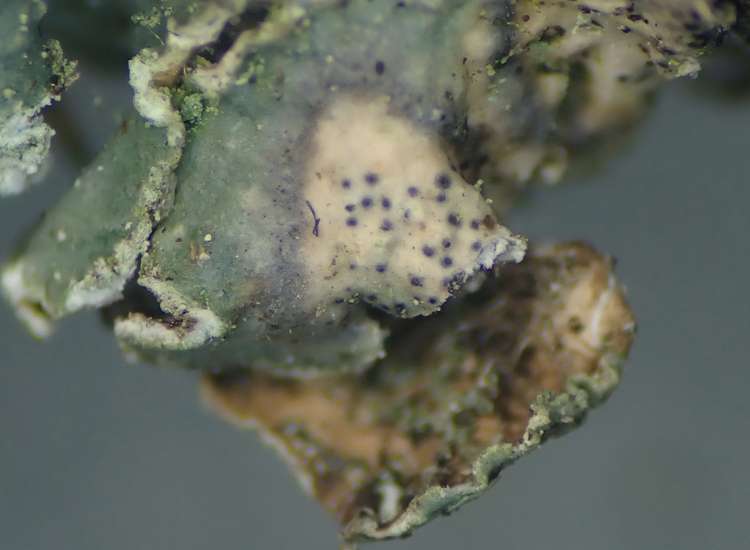
[attachment=4]z Didymocyrtis cladoniicola Q 260120 042.jpg[/attachment] 
[attachment=3]z Didymocyrtis cladoniicola Q 260120-1.jpg[/attachment] 
[attachment=2]z Didymocyrtis cladoniicola Q 260120-2.jpg[/attachment] 
[attachment=1]z Didymocyrtis cladoniicola Q 260120-3.jpg[/attachment] 
[attachment=0]z Didymocyrtis cladoniicola Q 260120-4.jpg[/attachment] February 10, 2026 at 11:29 am #46860I emailed the details and images to Paul Diederich and his reply is below:
Quote:From the anatomy of the pycnidial wall, I can confirm that it is a Didymocyrtis, and not Briancoppinsia, which is also growing on parmelioid hosts.
As D. cladoniicola and C. foliaceiphila are both known with certainty from hosts that are not related with Cladonia, e.g., Parmelia or Ramalina, confirmed by DNA sequences, an occurrence on Punctelia does not represent any problem.
Conidia of D. cladoniicola are (3.8–)4.7–5.9(–7.3) × (2.0–)2.4–3.0(–3.5) µm, l/b (1.4–)1.7–2.2(–2.
 , while those of D. foliaceiphila are (5.0–)5.8–7.1(–7.5) × (2.0–)2.2–2.7(–3.0) μm, l/b ratio (2.0–)2.4–3.0(–3.5)
4×6 agrees with cladoniicola, while 2-2.5 is more close to foliaceiphila. In my opinion, you should measure a larger number and also calculate the lenght/width ratio statistically, as that character may be the best to distinguish both.
Nothing remained of the original specimen so it will have to remain as Didymocyrtis sp. but I was hoping someone could explain how to calculate the lenght/width ratio statistically?
-
AuthorPosts

- You must be logged in to reply to this topic.