
Dark gill edged Entoloma
Forums › Forums › Fungi ID requests (post here if you aren’t sure what type of fungus you’ve found) › Dark gill edged Entoloma
- This topic is empty.
-
AuthorPosts
-
September 7, 2015 at 9:17 pm #29714
I often find E chalybaeum with its’ lovely colours and blue edged gills but I found this one today in a disused chalk quarry. No sign of blue on the cap or stem just a dark brown edge to the gills

[attachment=3]IMG_8857a.jpg[/attachment] 
[attachment=2]IMG_8858a.jpg[/attachment] 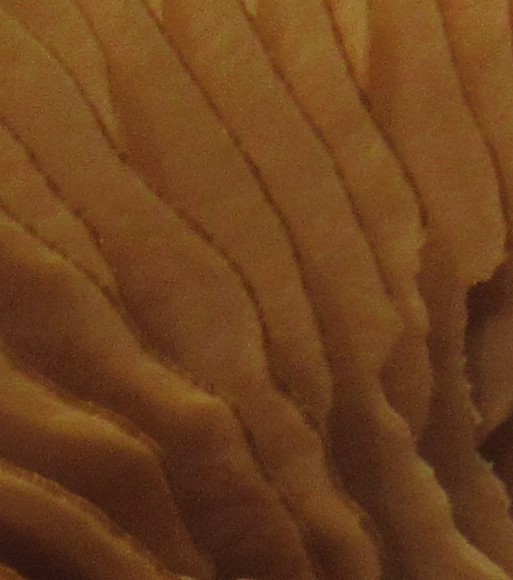
[attachment=1]IMG_8858 (2).JPG[/attachment]
With the swollen cheilocystidia
[attachment=0]cystidia.jpg[/attachment]
it keys out to Entoloma carneogrisium and the cap surface certainly looks a good fit for the photos in FOS but the gills are not the pink I would have expected and the gill edges are certainly not blue.Can anyone suggest anything else it might be?
Thanks
Mal
September 7, 2015 at 9:50 pm #36209Hi Mal, Carneogriseumkeys out in the section with blue tinges (using FE5 & 5a). Your species I believe is in the section with brown fruitbodies. There are about 9 species which have a brown (not blue-black) gill edge: I made several collections like it on Sunday. I think you have
E. longistriatum: Noordeloos recognises 3 var’s. longistriatum, sarcitulumand microsporum– so it’s pretty variable! Colours can be very variable from yellow-brown to more grey brown but all are translucently striate. The gill edge can be brown (or not!) and can be fertile, heterogenous or sterile!! The only likely alternative I feel is E. turcibut this has a cap which is non-striateand the “gills and stipe base turn slowly red when bruised”. I think if you stick it in a pot of water and let it hydrate, you will find the cap becomes translucently striate, often almost to the centre. It seems fairly common on unimproved grassland. September 7, 2015 at 11:06 pm #36210Thanks Roy, that seems a much better suggestion. There is no sign of red where handled so E longistriatumit is. Mal
September 19, 2015 at 11:07 am #36211Here are images of the collections that I referred to I my post of 7th Sept. Having given them these names, I’m not always convinced by the ‘reddening’ aspect of E. turci! Both lots were photographed after the stems were in jars of water overnight. September 22, 2015 at 10:30 pm #36212Hello, I think the scaly caps are quite untypical for E. longistriatum.
The reddening in E. turci is not a constant feature, so not a good character, to my experience.
Putting a dehydrated fungus in a water pot an let it hydrate again often doesn’t result in getting watersoaked caps again as if they were fresh. In most cases the caps once dehydrated don’t get their original characteristic back.
best regards,
Andreas
October 2, 2015 at 9:45 pm #36213Hello Andreas, I agree that re-wetting dried caps in this way doesn’t always bring you back to what a naturally hygrophanous cap would look like.
Also the specimens had been kept in a fridge for a week. Nevertheless, the smaller of the pale specimens was translucently striate to half way (although this doesn’t show up well in my ‘average’ images) and the darker specimens were not at all striate.
I am no expert in Leptonia’s but they seem very variable with age of fruitbody and older specimens of some species I guess may become more scally? Image No. 277a in Fungi Europaei 5A shows
Entoloma longistriatum var. longistriatumwith fairly scally caps. October 3, 2015 at 6:24 am #36214Hello Roy, you are certainly right, that somewhat scaly caps may occure in E. longistriatum. I have never seen it so distictly scaly as in your foto. As I’m far from an Entoloma expert, I don’t dare to say HOW scaly they are allowed to be, especially when the fruitbodies are in the fridge for one week already. So it may well represent E. longistriatum.
best regards,
Andreas
-
AuthorPosts


- You must be logged in to reply to this topic.