
Cladonia sp
- This topic is empty.
-
AuthorPosts
-
December 3, 2023 at 5:48 pm #32736
Anonymous
I found this Cladoniataxon on a dead trunk of Pinus. I’m considering a Cladonia ramulosa morph(forma cladomorphaor forma phyllophora) but the yellow-orange K+ and yellow KC+ reaction poses a problem for me. Do you have any guidance to give me? Thanks in advance. AG
December 4, 2023 at 7:35 am #45813Gerrault How yellow is the reaction? I looks quite brownish to me. Potentially the K+ brownish reaction to fumarprotocetraric acid; this is often weak and is clearest when there is a lot of fumarprotocetraric acid in the lichen. As it is inconsistent it tends not to be mentioned in descriptions, although American
Cladonialiterature does mention it more. We should have added a note on this reaction in the Cladoniaceae volume of the LBGI, but I forgot. Neil
December 4, 2023 at 10:29 am #45814Is it time to have another look at the “what is that colour” question? It came up in the post about K+ red Ramalinas too. Perceptions vary widely and not everyone has access to the extremely expensive Munsell colour charts. Put “colour chart” into the search on this website and there are a few hits, including one which implies to me that RBG Edinburgh produced a cheapish one for fungal spore prints, but I don’t think it is available any more. Someone suggested trying Dulux paint colour charts as they are widely available, standard and free. Maybe a colour chart distributed at least to BLS members, and maybe including fungus colours could be thought of. And yeah I know they change colour when they are wet, shaded, etc. Nightmare! Juliet
December 4, 2023 at 3:41 pm #45815Glos lichens wrote:. . . RBG Edinburgh produced a cheapish one for fungal spore prints, but I don’t think it is available any more. . .
Hi,
Just browsing the site and happened to spot your comment.
The spore colour chart you mention, (originally published in 1969), is actually still in print. – Available from several outlets (NHBS, Summerfield Books, etc.).
The full title of the chart is: – “Royal Botanic Garden Edinburgh – Flora of British Fungi – Colour Identification Chart”.
Price £2.50 plus postage.
Regards,
Mike.
December 7, 2023 at 11:34 am #45816I am not going to advocate for or against the adoption of a standard colour chart in British lichenology but I have sometimes used the RAL list of colours, readily available online, in some of my discussions and descriptions. Nor am I suggesting that the RAL list would necessarily be the best to use. I am just endorsing the suggestion that the description of colours in lichenology has sometimes seemed inadequate. Take, for example, Protoparmelia oleagina. The LGBI3 description of it is little changed from that given in the 1992 Flora and gives the impression that its thallus is a shade of brown. 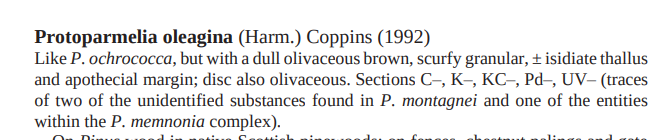
[attachment=0]Screenshot 2023-12-07 11.01.52 AM.png[/attachment] Every specimen I have examined (including herbarium specimens) are, to my perception, a shade of green. The following is from a twitter thread in which I discuss the subtleties of P. oleagina.
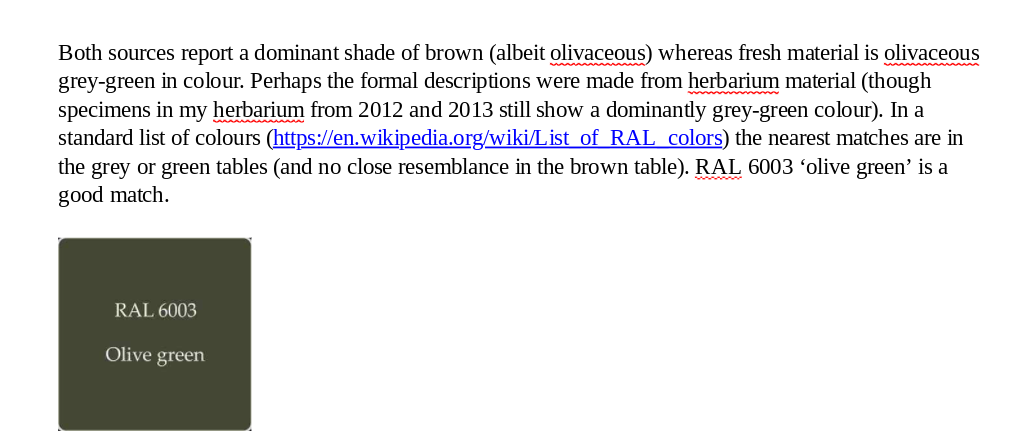
[attachment=1]Eqher-vW4AM2OSi.png[/attachment] Here is a link to the twitter thread (which includes the ‘K+ oily’ reaction, my own description of the thallus and notes on etymology and ecology of this interesting species).
https://twitter.com/obfuscans3/status/1344427288092438529 Here is a link to the List of RAL colours that I have used.
December 7, 2023 at 12:05 pm #45817The colour imparted to many lichen species by the presence of usnic acid is usually described as ‘yellow-green’ without any qualification. Until we get our eye in for this subtlety, ‘yellow-green’ suggests a much yellower and brighter shade than is actually the case. Take for example Lecanora orosthea, described as yellow-green, but appearing to beginners as a pale grey-green with the merest hint of yellow. 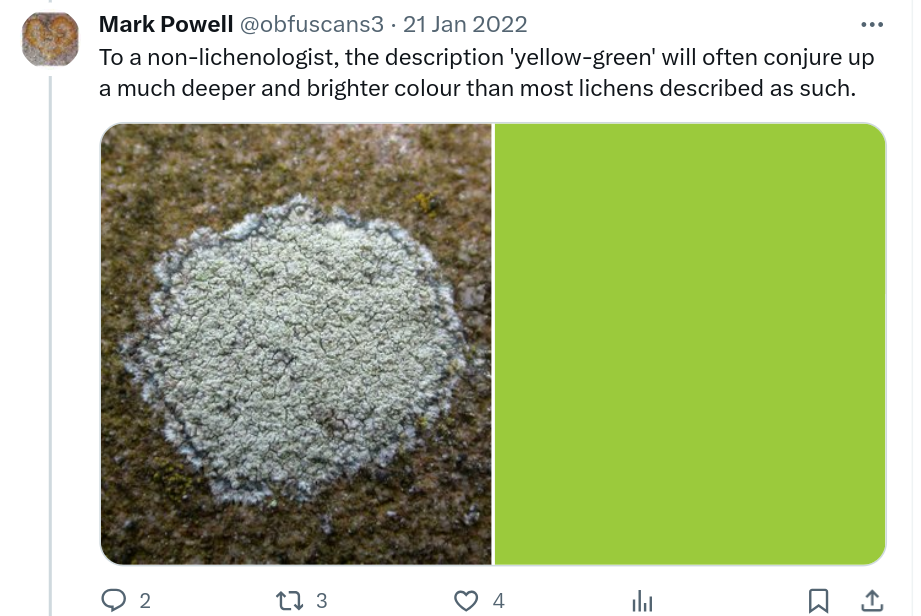
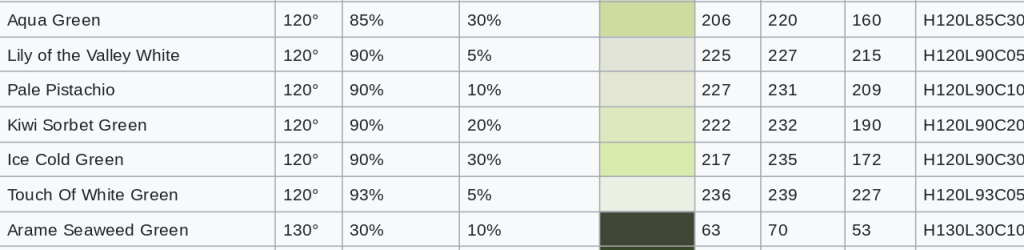
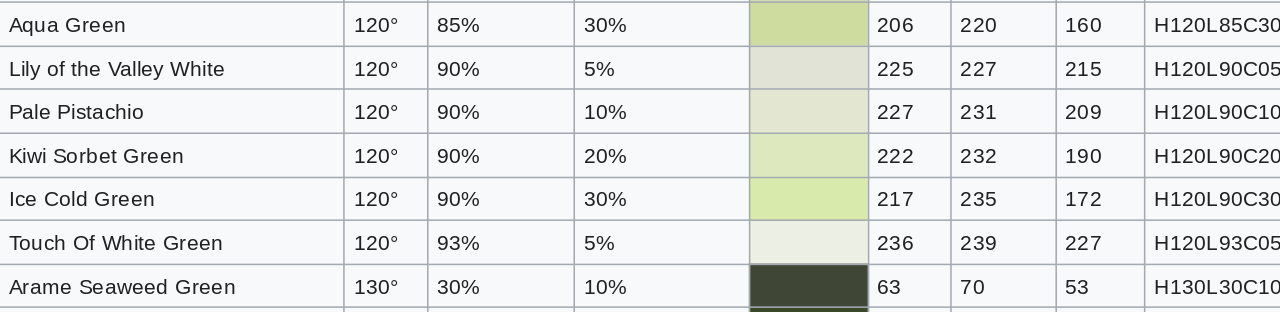
[attachment=2]Screenshot 2023-12-07 11.35.51 AM.png[/attachment] Perhaps L. orosthea is close to ‘Kiwi Sorbet Green’ on the RAL list?
[attachment=1]Screenshot 2023-12-07 11.47.31 AM.png[/attachment] Whatever colour L. orosthea is, it is one of the dominant species on Stonehenge, giving the uprights a pastel shade.

[attachment=0]Screenshot 2023-12-07 12.00.22 PM.png[/attachment] Twitter thread about Lecanora orosthea:
December 7, 2023 at 9:04 pm #45818Mark I agree, usnic acid colours are a bit difficult to describe in words. Pale grey-green with the merest hint of yellow is resaonable!
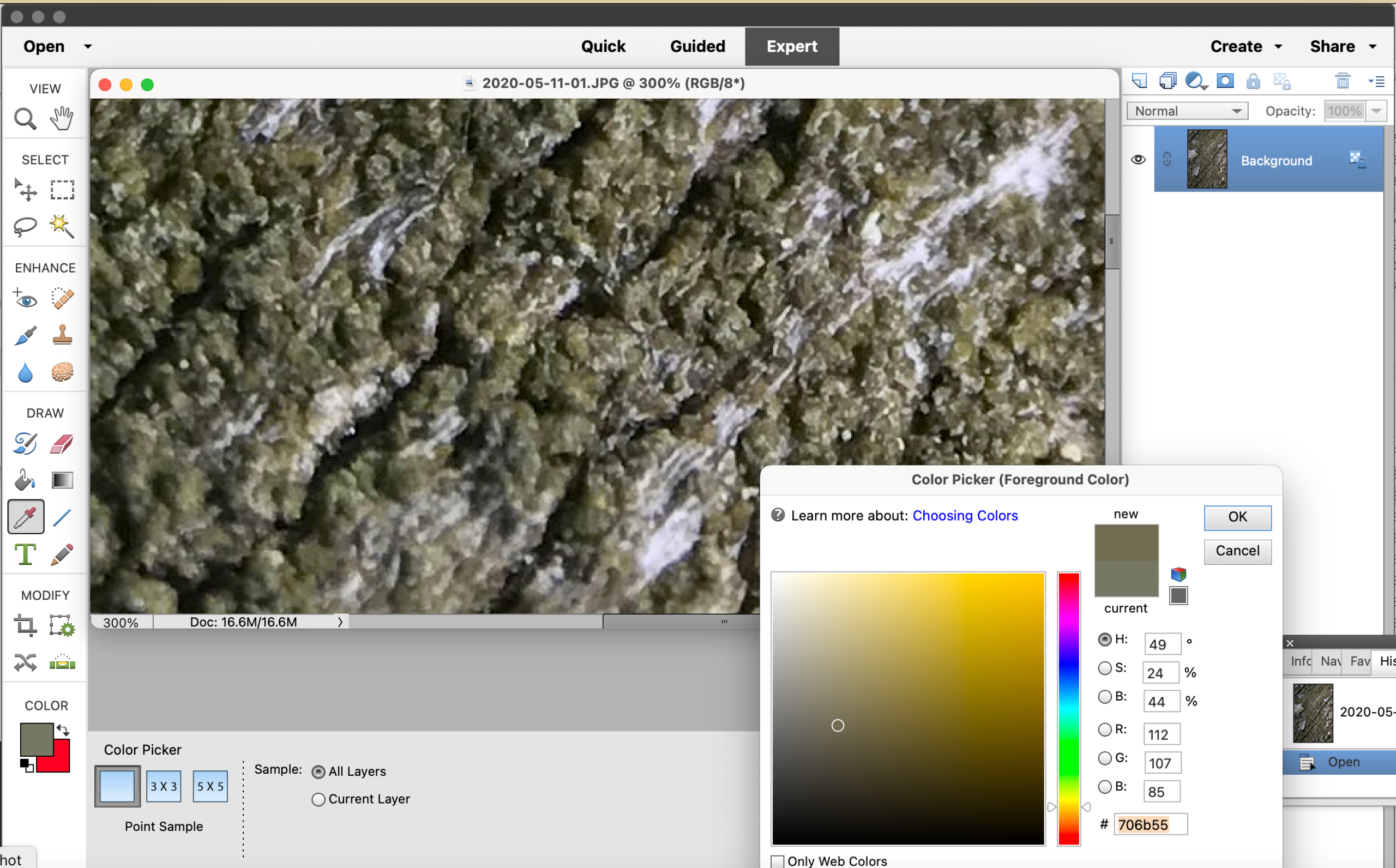
Using a colour picker in Photoshop Elements I got a Color Hex of #706b55 for an avaerage section of a Protoparmelia oleagina photograph, for what it is worth

[attachment=0]Screenshot 2023-12-07 at 20.46.40.png[/attachment] Neil
January 29, 2024 at 6:46 pm #45819Neil Sanderson wrote:
GerraultHow yellow is the reaction? I looks quite brownish to me. Potentially the K+ brownish reaction to fumarprotocetraric acid; this is often weak and is clearest when there is a lot of fumarprotocetraric acid in the lichen. As it is inconsistent it tends not to be mentioned in descriptions, although American
Cladonialiterature does mention it more. We should have added a note on this reaction in the Cladoniaceae volume of the LBGI, but I forgot. Neil
Apropos of Neil’s comment above about a K+ brownish reaction to fumarprotocetraric acid, I believe I may have observed it on a
Cladonia furcataspecimen that I collected this summer in Scotland (VC101 Kintyre : NR77 Ormsary : August 2023 : In pocket of humus on siliceous rock). The first photo below shows a Pd-test with a strong red reaction as expected. The second shows a K-test presumably with Neil’s weak brown reaction. Many thanks to Mark for pointing out to me the connection to the discussion in this thread. 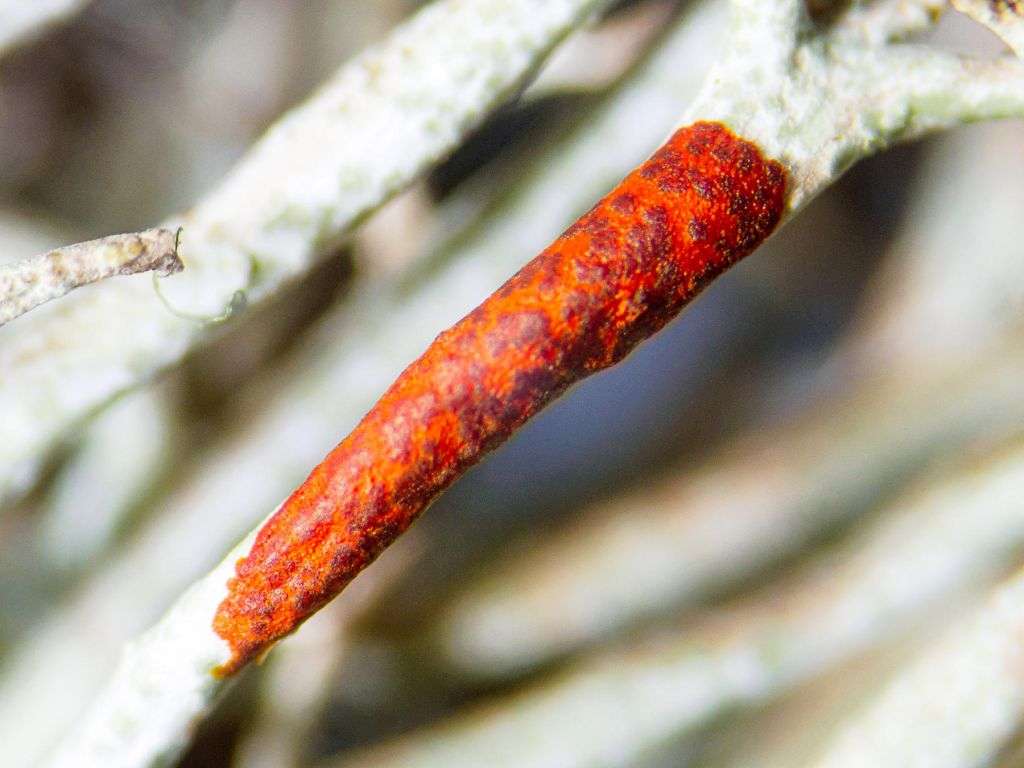
[attachment=1]20240121-P1211315.jpg[/attachment] February 8, 2024 at 10:49 pm #45820Following up further on the K+ brown reaction for fumarprotocetraric acid that Neil mentioned in this thread. In search of a more convincing result, I applied K to another spot on my specimen of Cladonia furcataabove. Rewarded with a clear K+ brown reaction, I applied Pd directly nearby. The strong Pd+ red demonstrates the presence of fumarprotocetraric acid, as expected. And the lack of any K/UV+ yellow flurorescence on the K-spot suggests fairly unmistakeably that the K+ brown is due to fumarprotocetraric acid, and not by strange chance to any trace of atranorin, which C. furcatacan sometimes contain. 
[attachment=3]20240204-P2040014.jpg[/attachment] 
[attachment=2]20240204-P2040016.jpg[/attachment] 
[attachment=1]20240204-P2040017.jpg[/attachment] An interesting note: where Pd overlapped K, the brown reaction became yellow. I wonder what Pd+ yellow compound results from the decomposition of fumarprotocetraric acid in K?
Another interesting note: a Google search on the K+ brown reaction for fumarprotocetraric acid turned up this 1935 article by American lichenologist RH Torrey entitled ‘Paraphenylenediamine: A new colour test for lichens’:
https://www.jstor.org/stable/40597010https://www.jstor.org/stable/40597010” class=”bbcode_url”> It appears from Torrey’s article that, until Pd came along, some lichenologists relied on the K+ brown reaction for fumarprotocetraric acid to help separate
Cladoniaspecies. Neil noted above that the reaction is still mentioned in North American Cladonialiterature. And the table of colour reactions in IM Brodo’s 2001 North American flora lists fumarprotocetraric acid as ‘K+ brownish’. 
[attachment=0]Screenshot 2024-02-08 at 22.43.30.png[/attachment] Torrey suggests that the K+ brown reaction is also detailed in what he calls Annie Lorrain Smith’s ‘Manual of British Lichens’. That’s not a title of Smith’s of which I’m aware. So far as I know, Smith published a field guide entitled
A Handbook of the British Lichens(1921), a flora in two volumes entitled A Monograph of the British Lichens(1911 and 1918), and a treatise entitled simply Lichens(1921). In none of those works by Smith could I find any reference to K+ brown for fumarprotocetraric acid. She mentions only K+ yellow for atranorin in her descriptions of
Cladoniaspecies (unless I’m missing something). I also couldn’t find it in the 1913 beginner’s flora by Gustav Lindau that Torrey calls ‘Die Flechten für Anfänger’, though the electronic copy I found online was hard to navigate. (Apparently, the proper title is Kryptogammenflora für Anfänger, Band 3: Die Flechten.) That isn’t to say the K+ brown reaction isn’t found in any British work: it’s mentioned in in Orange, Smith & James’s 2010 monograph
Microchemical Methods(p 12), for example. I also found it mentioned alongside Pd+ red as a diagnostic for Usnea antarcticain this 1964 flora of Antarctic lichens published by the British Antarctic Survey: https://core.ac.uk/download/pdf/33451352.pdfhttps://core.ac.uk/download/pdf/33451352.pdf” class=”bbcode_url”> U. antarcticain some online descriptions from Australia and New Zealand that I found in my Google search.) But anyway: assuming that there isn’t a ‘Manual of British Lichens’ by Annie Lorrain Smith of which I’m unaware, the K+ brown reaction for fumarprotocetraric acid on which Torrey and other (presumably mainly North American) lichenologists relied doesn’t seem to have been much used by British lichenologists before being obviated by the more effective Pd+ red.
February 10, 2024 at 4:49 pm #45821The problem is that the colour observed on the thallus after the action of a reagent is the result of all the colored chemical reactions of the substances contained in this thallus and not the colour of a single lichenic substance (in practice we only have the colour of the dominant substance). Alain
February 10, 2024 at 9:32 pm #45822Thanks, Alain — that’s an important point. But I think in this particular case we can be fairly confident that the K+ brown reaction that I’ve observed in my C. furcataspecimen is due to fumarprotocetraric acid, for the following reasons: [list]- My specimen certainly contains fumarprotocetraric acid, as the Pd+ red reactions show.
[/list] - We know from current and historical North American sources that K+ brown is indicative of high levels of fumarprotocetraric acid.
[list][/list] - My specimen appears to contain no atranorin, or at least any amount detectable with the standard K-test.
[list][/list] - K+ brown would be an unusual reaction for atranorin, even in the presence of fumarprotocetraric acid.
[list][/list] - It’s highly likely that my specimen, collected in Scotland, would be one of only two chemotypes: with fumarprotocetraric acid only, or with fumarprotocetraric acid and atranorin —
i.e.Chemos I and IV following the very helpful typology on your Lichens Marins website (for other readers, the relevant webpage is: http://www.lichensmaritimes.org/index.php?task=fiche&lichen=190&lang=en ” class=”bbcode_url”> http://www.lichensmaritimes.org/index.php?task=fiche&lichen=190&lang=en
[list][/list] - Again, following your chemotypology, the other possible major lichen substances would be bourgeanic acid, psoromic acid and conpsoromic acid.
[list][/list] - But as you note on your website, chemotypes containing psoromic/conpsoromic acid (Chemos III, V and VI) are Continental, and chemotypes containing bourgeanic acid (Chemos II and VII) are rare (and I might add they’re not mentioned in the British flora).
[list][/list] - As you also note, bourgeanic acid doesn’t give a colour reaction with K, and psoromic/conpsoromic acid gives a Pd+ yellow and not Pd+ red reaction (in the absence of fumarprotocetraric acid).
[list][/list] I certainly agree we must certainly interpret any new colour spot-test reactions carefully — though given North American practice, K+ brown for fumarprotocetraric acid isn’t really a new spot-test. And in this case it seems hard not to conclude that my Scottish
C. furcataspecimen is Chemo I, with fumarprotocetraric acid the only lichen substance detectable by colour spot-tests (Pd+ red most effectively, but also K+ brown). -
AuthorPosts




- You must be logged in to reply to this topic.