
Belonia nidarosiensis Apothecia query
- This topic is empty.
-
AuthorPosts
-
May 3, 2022 at 11:50 am #32347
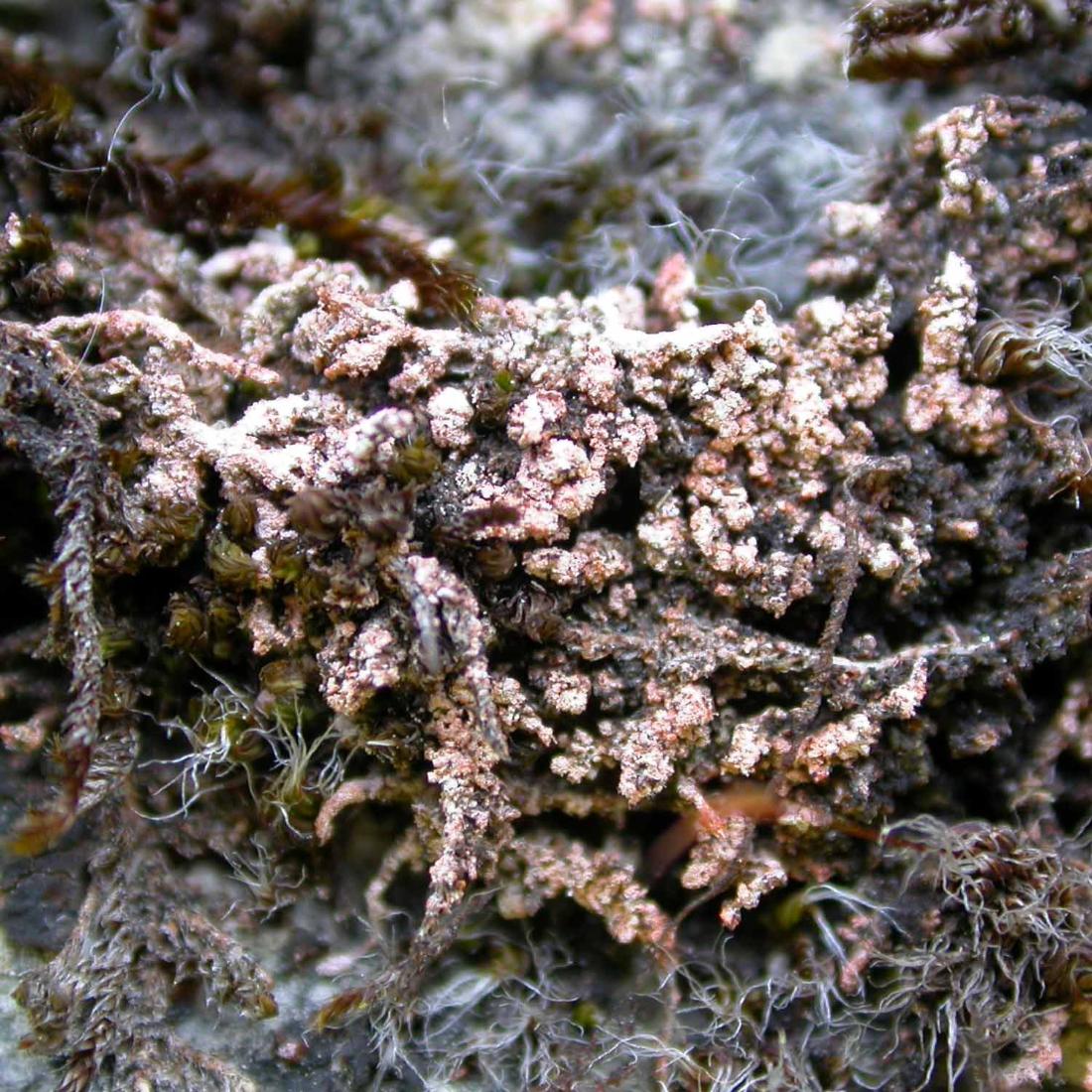
Came across B.nidarosiensis in a churchyard I had not visited before. The close up photograph taken with the digital microscope does shows some scattered Apothecia but reading Dobsons the description is not an exact fit but does say they are rare. The question is – are these B.nidarosiensis Apothecia or another Crustose lichen being overgrown by B.nidarosiensis. My own view is the former but so far I could not find any other online photographs showing the Apothecia to confirm and be certain. Any expert views much appreciated as always. May 3, 2022 at 12:59 pm #44783Well Beloniais supposed to have perithecia not disks, which are essentially Gyalectaapothecia with the margin curled over to leave a pore, which is not what these look like. 
[attachment=0]urn-cambridge.org-id-binary-20191017153956333-0717-S0024282919000240-S0024282919000240_fig4g.jpeg[/attachment]
The top left [not right: dyslexia strikes] photo isBelonia russulafrom https://www.cambridge.org/core/journals/lichenologist/article/gone-with-the-wind-sequencing-its-type-species-supports-inclusion-of-cryptolechia-in-gyalecta-ostropales-gyalectaceae/889C4400FD8699D62D05F53AD71C6DDF ” class=”bbcode_url”> https://www.cambridge.org/core/journals/lichenologist/article/gone-with-the-wind-sequencing-its-type-species-supports-inclusion-of-cryptolechia-in-gyalecta-ostropales-gyalectaceae/889C4400FD8699D62D05F53AD71C6DDF Not having seen
B. nidarosiensisperithecia, not sure but does not look like what I would expect. Neil
May 3, 2022 at 1:36 pm #44784I agree with Neil in very much doubting that the discoid apothecia belong to Belonia. They look more like the apothecia of a Bacidia species. Despite the hundreds of churchyards that I have recorded, and the numerous colonies of B. nidarosiensis, I have never seen it fruiting. I have to say that I am rather dubious about many records of B. nidarosiensis (I think the name is often applied to various orange or pink crusts, including free-living crusts of Trentepohlia alga). 
[attachment=1]Dw3w7_YX0AAy1cP.jpeg[/attachment]
The sort of crust shown above is very common on shaded vertical stonework and I interpret this as a non-lichenised Trentepohlia crust, the pinkish pruinose appearance due to crystallisation of calcite on the algae (presumably due to repeated wetting and drying).
[attachment=0]Dw048i4WoAEbnZU.jpeg[/attachment]
The pale pastel pink crust (overgrowing moss in this case) above is the sort of material that I record as B. nidarosiensis.The images on the lichensmaritimes site look convincing (in almost every case) for B. nidarosiensis in my opinion.
http://www.lichensmaritimes.org/index.php?task=fiche&lichen=319&lang=en Back to the original query, and I think the most likely explanation is that we have a crustose lichen with disc-like apothecia (perhaps a Bacidia species) and that, growing in a shaded situation, the thallus has been much overgrown (perhaps even invaded) by Trentepohlia. I can’t prove this to be the case but it is my strong suspicion. It is the sort of query where I wish I could cut a section as that would almost certainly resolve the matter.
May 3, 2022 at 1:50 pm #44785Could it be a Lecanactis/Lecanographa? – Alan May 3, 2022 at 3:21 pm #44786Agh not it is the top left picture not top right in my post! May 4, 2022 at 9:22 am #44787Chaps many thanks for the clarification and am now in a much better position to recognise this lichen in the future. -
AuthorPosts



- You must be logged in to reply to this topic.