
Athallia (Caloplaca) pyracea?
- This topic is empty.
-
AuthorPosts
-
December 10, 2025 at 1:43 pm #33127
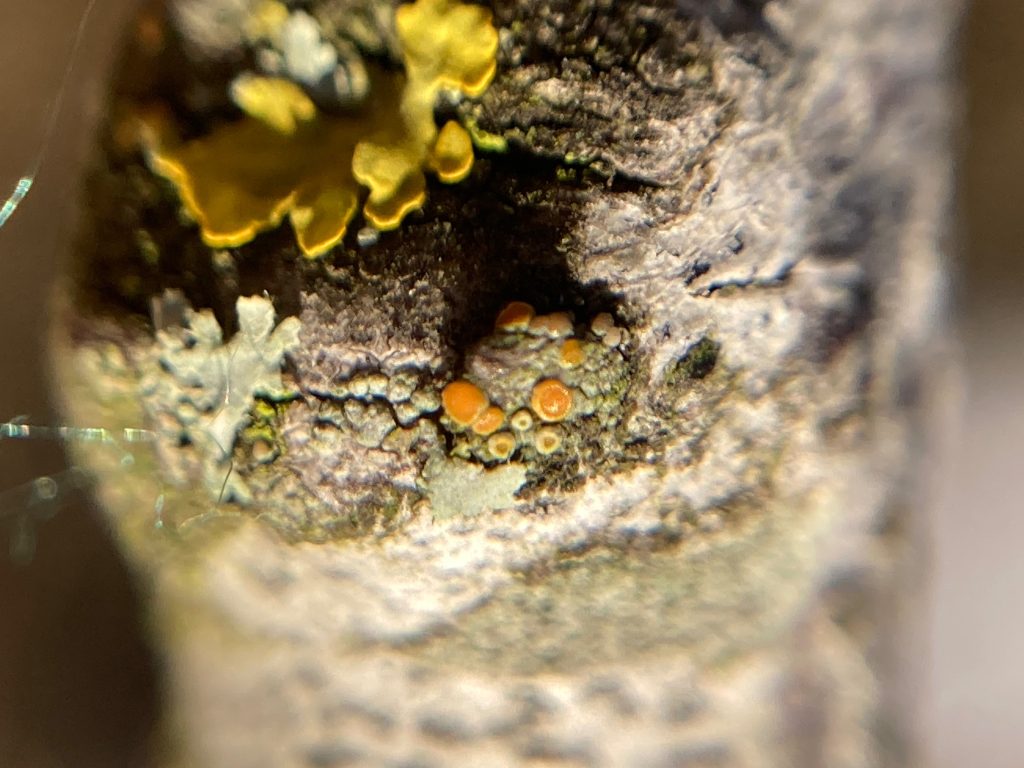
[attachment=2]IMG_2418.jpeg[/attachment] Think this would be a new record for Warwickshire. The spores are about 15 x 8 um, with septa about half the spore length.
[attachment=6]2EE99662-8398-479A-B3C9-E668395C71BF_4_5005_c.jpeg[/attachment] 
[attachment=1]IMG_2494.jpeg[/attachment]
Found on cherry twigs on a fallen tree in woodland around an ex-quarry, mostly as scattered apothecia with barely any thallus, and only noticeable with a lens. We did then find a few slightly larger patches visible by eye.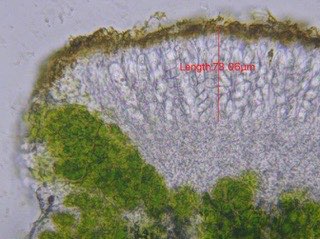
[attachment=4]image.jpeg[/attachment] 
[attachment=3]IMG_2432.jpeg[/attachment]
I’d been looking out for it for some time after seeing photos of it online but haven’t found it before despite checking lots of twigs. The mature apothecia looked distinctly different to Caloplaca cerinella, which is pretty common on twigs here.In the field, we looked in Dobson, and the only similar species seemed to be Caloplace luteoalba (but wasn’t quite right and the spores don’t match) or Caloplaca holocarpa (Athallia pyracea has apparently been split from that). A search on this forum for Caloplaca species came up with earlier posts about Athallia pyracea in Gloucestershire (Juliet) and Cumbria (Pete). Checking in LGBI3 (and Italic) and the BLS page it seems to be a good match.
Trying to key it out was tricky because of the minimal thallus, as it wasn’t clear what was associated with the apothecia. I’ve just tried again, now I think I know what it is. To get to Athallia pyracea seems to require ‘thalline margin absent’ (couplet 59) so now there’s a seed of doubt. Though in the Athallia key further on, is says ‘usually with a thin thalline margin’. The young apothecia have a distinct thalline margin, but it’s less (or not) obvious in the more mature ones, as the proper margin expands.
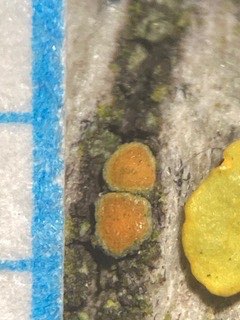
[attachment=5]IMG_2488.jpeg[/attachment] 
[attachment=7]IMG_2797.jpeg[/attachment] [attachment=8]image.jpeg[/attachment] 
[attachment=0]IMG_2491.jpeg[/attachment]
I tried to find information about pH of Wild Cherry bark (to compare with Aspen that is mentioned as host bark) but couldn’t find anything useful. Though it seems to crop up on various other trees too.Interesting that it shows as widespread across Europe (including Scandinavia) on GBIF.
https://www.gbif.org/species/7937066 Di N with Stephanie G and Sheila S
December 10, 2025 at 7:06 pm #46799Your lichen looks fine for Athallia pyracea to me. I think you have found a slight problem with couplet 59 in LGBI3 because, as you suggest, the apothecia of A. pyracea do have have a thalline margin and it is this feature which helps to distinguish it from species such as corticolous A. holocarpa. I suppose the key was trying to separate those species such as Caloplaca cerina which have a thick and persistent thalline margin and the wording didn’t quite take into account that A. pyracea also has a thalline margin, albeit a less conspicous one. 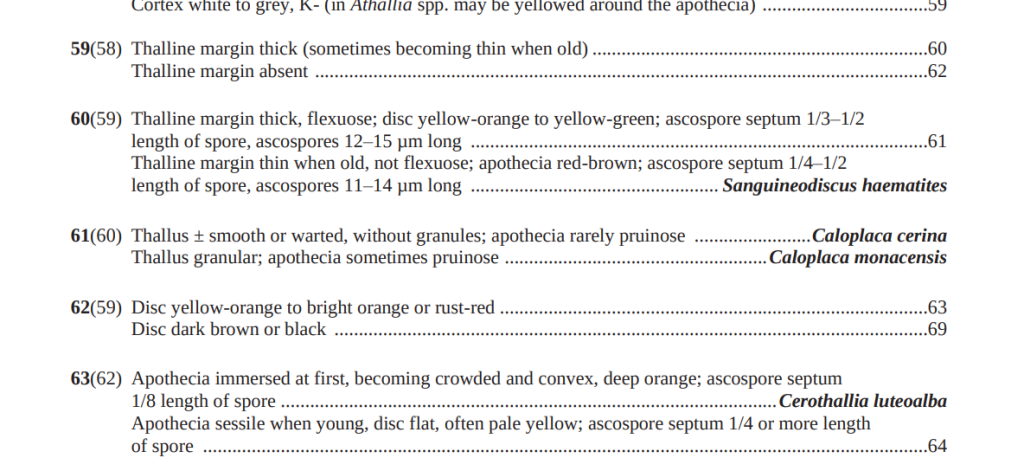
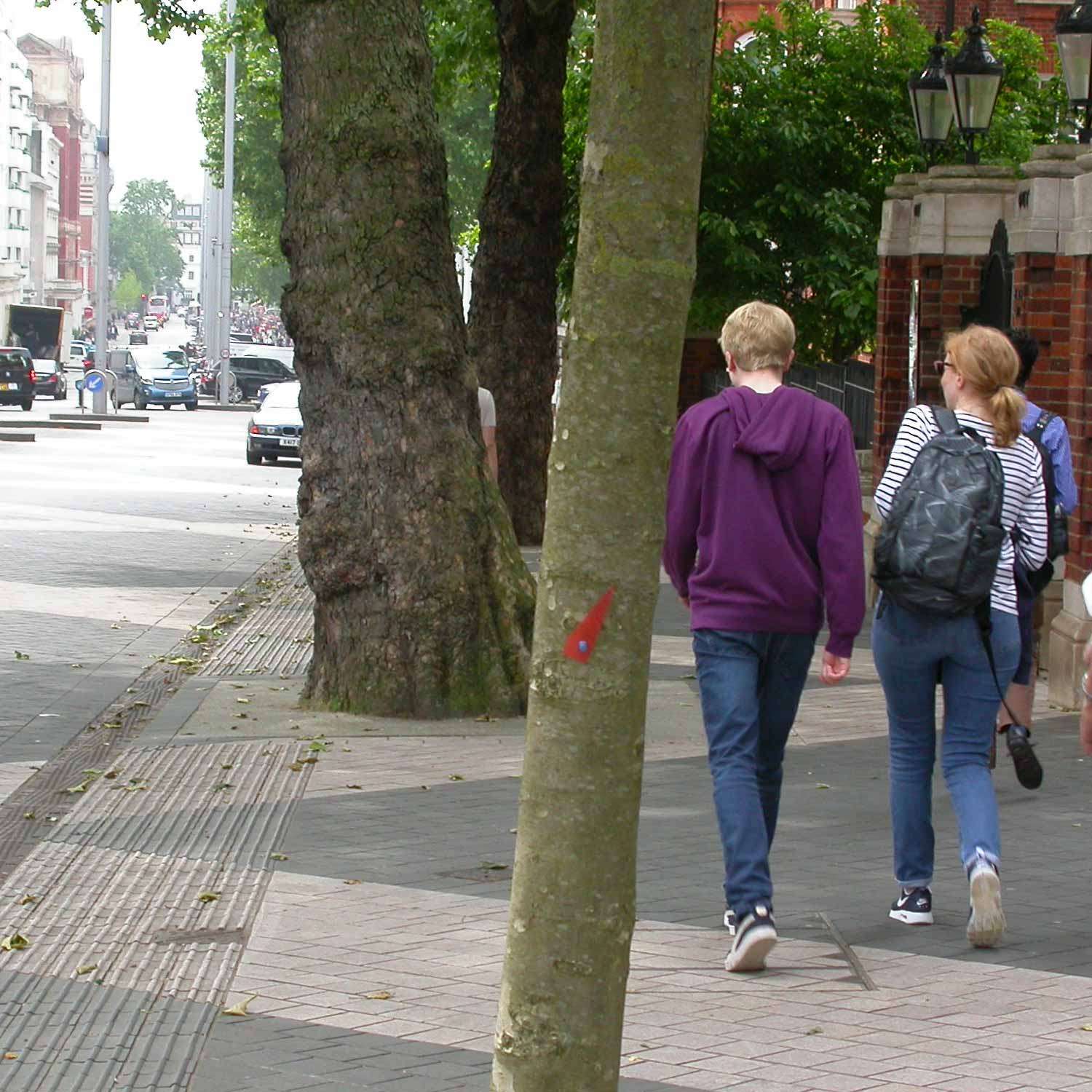
[attachment=3]Screenshot 2025-12-10 6.47.49 PM.png[/attachment] I find A. pyracea to be fairly common now on large twigs of Populus species, especially P. tremula in the wild and P. alba in parks and cemeteries. It is much less common in my experience on other species of tree but your finding of it on cherry doesn’t worry me too much because it does crop up in surprising places and on surprising hosts. The red marker on this young London Plane tree points to a colony of A. pyracea in Exhibition Road in London.

[attachment=2]pyracea exhib.jpeg[/attachment] As you have described, the thalline margin of A. pyracea tend to be conspicuous on young apothecia but then become rather excluded as the apothecia mature. I tend to identify A. pyracea on sight now that I am familiar with it. If I found something in this group of holocarpa type things on a damaged tree trunk I might allow myself to get excited by the prospect of C. luteoalba and look for the somewhat distinctive spores that species is supposed to have but so far I haven’t come across C. luteoalba. When growing on young bark, especially twigs and small branches, I don’t often bother looking at the spores because there is not much diagnostic to distinguish between A. pyracea and A. holocarpa. More important seem to be the larger apothecia of A. pyracea with a thalline margin (visible at least on young apothecia).
Here are some images of specimens which I have named A. pyracea.

[attachment=1]pyracea1.jpeg[/attachment] 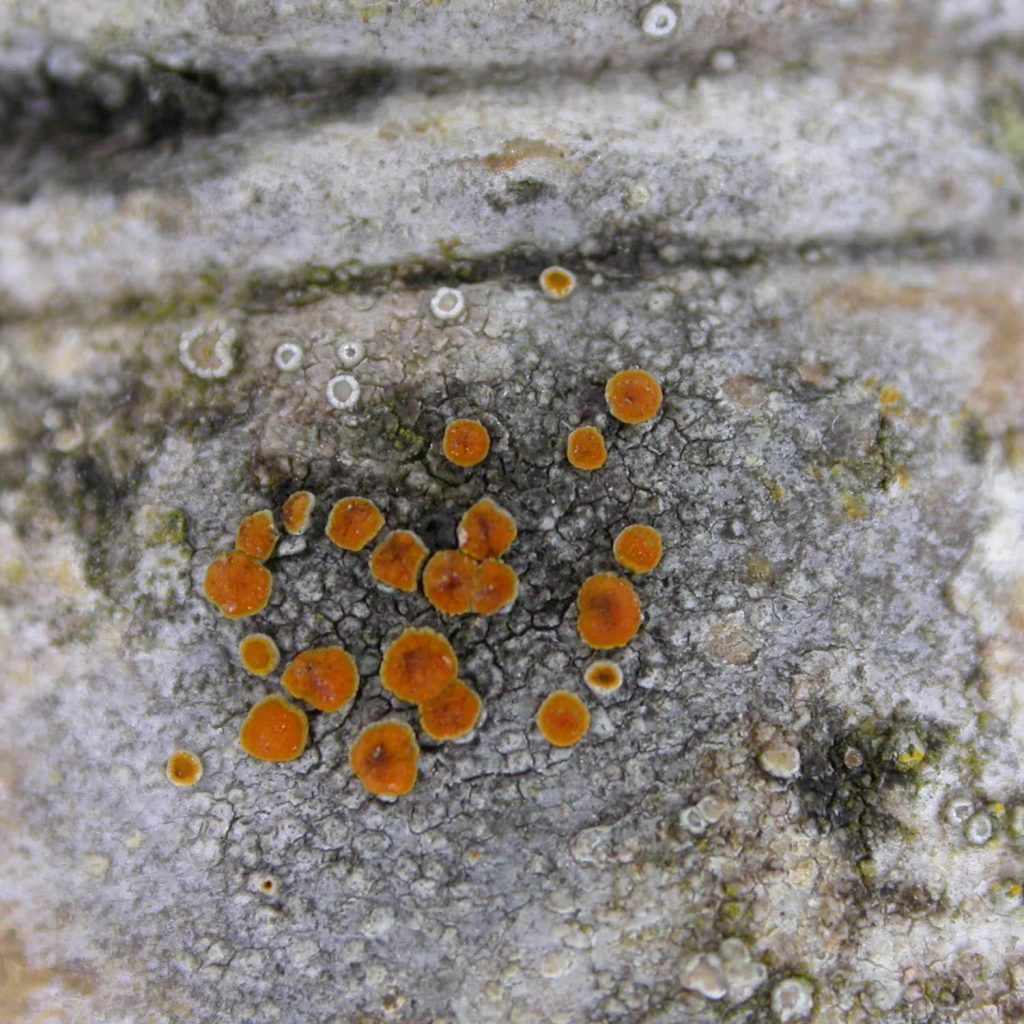
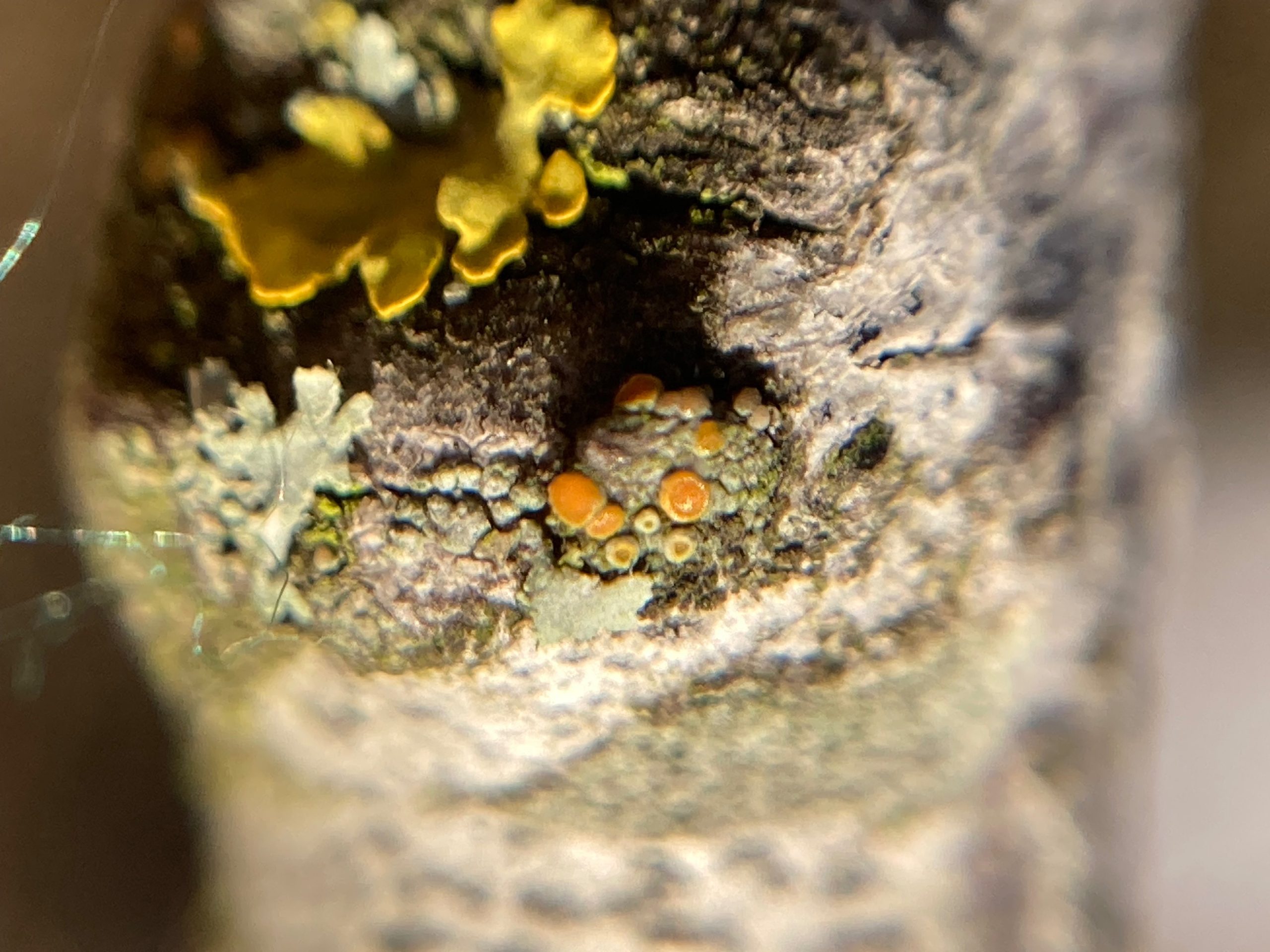
[attachment=0]pyracea2.jpeg[/attachment] December 11, 2025 at 12:24 pm #46800Thanks again. The only pointer against it really is that the largest apothecium we found was only 0.55 mm. Most were O.3 to 0.5 (of about 50 apothecia). Seems best to record it as A. pyracea for now though, with a note in the comment section about the apothecial size. December 13, 2025 at 7:15 pm #46801What do you think of this, picked up on small dead Fraxinus branch near Cirencester earlier this week? There is a good scatter of the Caloplaca “cerina” (yellow-disked broad-margined boiled eggs) fruit at various points along the branch, but also this little group, apparently with “cerina” to the right and startling orange, narrow-margined “pyracea” fruit in the middle. The smaller greener-yellow fruit to the left might be cerinella. I am loathe to section it as it is such an attractive specimen for the juxtaposition, though I’d be prepared to do so if it could usefully demonstrate anything – a pyracea look-alike, maybe? Any thoughts please?
Juliet
December 14, 2025 at 12:01 pm #46802I think your attractive collection of ‘Caloplaca’ species are just as you suggested based on appearance and what is likely. So we have what looks to me like cerinella to the left, pyracea in the middle and ‘cerina’ to the right. I am not experienced with the cerina group so I won’t comment further on that one (C. ‘cerina’ is rare or absent still in my region). A. cerinella has, at least, something distinctive and diagnostic microscopically (12- to 16-spored asci) which is more than can be said for many ‘Caloplaca’ species. I am not suggesting you spoil your specimen as cerinella is now frequent, especially on Sambucus and Fraxinus twigs, but it is easy to confirm if necessary. As for the suspected A. pyracea, I think I can see some hint of grey thalline margins on the young apothecia. If that is so then I think you can reasonably consider your lichen to be A. pyracea. Although LGBI3 suggests that A. holocarpa has a (poorly developed) grey thalline margin, I think this assertion is lifted from LGBI2 in which ‘C. holocarpa’ was treated as a group rather than a single taxon. In my studies, I find that the thalline margin of C. holocarpa s. str. is yellowish-orange and scarcely distinguishable from the similarly coloured proper margin. The description of C. holocarpa s. str. in Arup’s 2009 paper seems to align with my own careful observations on the margins of C. holocarpa s. str. The actual thallus of C. holocarpa s. str. is usually difficult to see because of the closed-packed apothecia but when apparent, it is seen to consist of tiny orange warts.
Here is one of the illustrations from Arup’s paper, C. holocarpa s. str. A and B, and C. pyracea F.
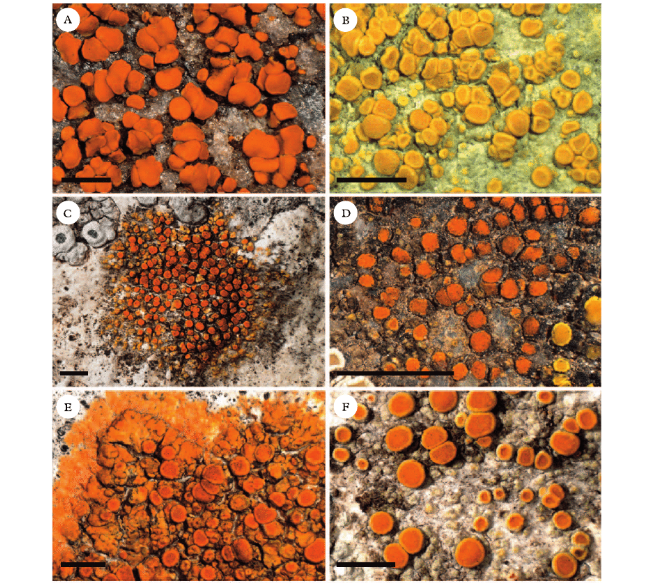
[attachment=1]Screenshot 2025-12-14 11.45.36 AM.png[/attachment]
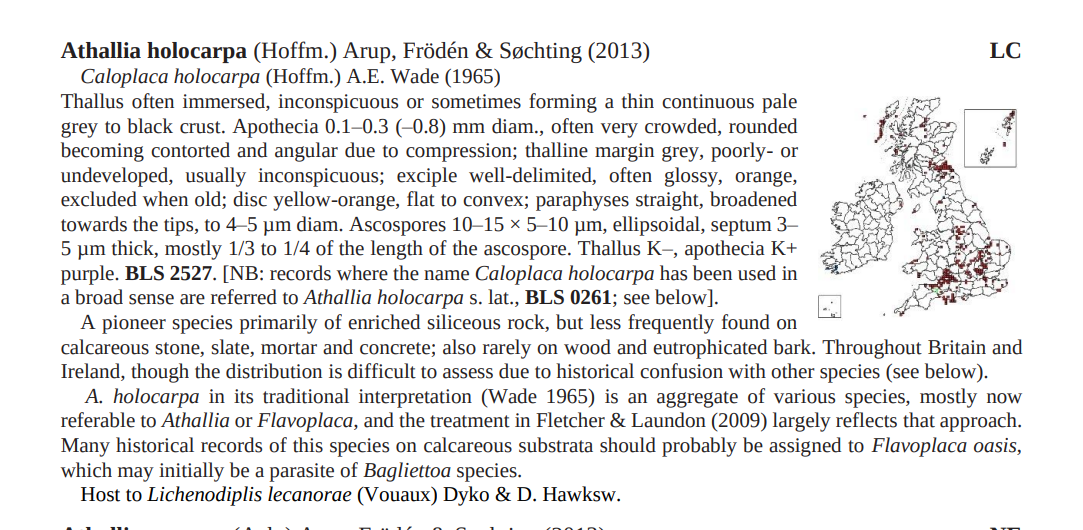
Here is the LGBI3 account of A. holocarpa and if I am right about the thalline margin of this taxon, then I think the suggestion here that it has a grey thalline margin may cause confusion. If anyone wants to find some A. holocarpa to study then these days it is probably easiest to find it on chemically treated fence rails where it often grows with Candelariella vitellina and Lecanora stenotropa.
[attachment=0]Screenshot 2025-12-14 11.27.46 AM.png[/attachment]
If one wants to find it on stone then it is more profitable to look at relatively recent gravestones rather than old ones and it is important to look for it on siliceous/acid stone (fine grained pure sandstone or ‘granite’) rather than on calcareous stone (on which C. oasis is common).Back to the A. pyracea and when I surveyed a site in Derbyshire some years ago, I found A. pyracea fairly frequently on smooth Fraxinus bark so ash trees are a likely host even though in my region it is much more commonly found on Populus. As so often in lichenology, it is very instructive once you have specimens of the various options side by side for examination.
-
AuthorPosts





- You must be logged in to reply to this topic.