
A Lecanora?
- This topic is empty.
-
AuthorPosts
-
February 3, 2021 at 4:56 pm #32009
I was inspired by the BLS zoom weekend to have a go at some of the crustose species on paving (used as wall-tops) in my Warwickshire garden. I’m a relative beginner, though have done a fair bit of microscope work on fungi. I know this probably isn’t a good place to start, but there is loads of it. I’ve been round and round in circles, looking at Lecanora albescens, Lecanora intricata, L polytropa and L symmicta (but not on wood). When dry (indoors) it goes white, but outside it is pretty damp and appears (like so many others) pale green.
The packed apothecia have a blocky, irregular edge that tend to stand proud of the substrate.
I couldn’t get any K reaction on apothecia or under the apothecia (applied to dry material with cocktail stick).
Happy to learn from my mistakes.
Added photo of brown spores from the spherical black blobs (c 0.15 mm across) found on top of the white lichen – asci c 65um long, spores 15-16um x 6 um, dark brown, tri-septate.
February 3, 2021 at 5:37 pm #43951You haven’t started with the easiest type of lichen by any means but since it is growing in your garden it is understandable and sensible that you will be curious to study it. I am almost certain that this is Lecanora albescens. The trouble is that this belongs to a group of lichens which are particularly difficult to study, the Lecanora dispersagroup (recently transferred to the separate genus Myriolecis). In addition, I think there are more than one taxon which get lumped by lichenologists and recorded as L. albescens. 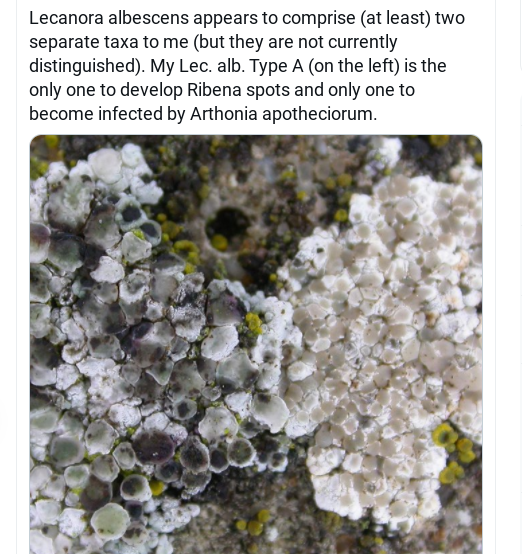
[attachment=0]Screenshot 2021-02-03 at 5.16.30 PM.png[/attachment] I first started to seriously suspect that at least two taxa were involved when I studied them on the long, even concrete walls of Grafham Water near Huntingdon. However, in most situations it is much more difficult to distinguish them and there may be more than two taxa for all I know. If my Types A and Types B mean anything at all, I would suggest that you have Type B with very little thallus, brown discs (when dry) and thalline margins not or little raised above the discs.
https://twitter.com/obfuscans3/status/1062756711876964352 In your first micrograph you note the presence of brown-walled hyphae. These belong to a lichenicolous fungus, presumably a dematiaceous hyphomycete and this sort of thing often turns out to be
Intralichen christiansenii. However, I tend to be wary of naming such things and can’t identify yours, just giving a suggestion of the sort of thing it is likely to be. http://www.dorsetnature.co.uk/pages-lichen/lch-454.html I’m afraid that the other micrographs don’t provide much information to help. This is not your fault, it is just that this group of lichens have few easy characters and often critical work involves noting the solubility of granules in various mountants. I would record this as
Lecanora albescensand move on to something a bit easier! You mention
L. intricata, L. polytropaand L. symmicta. All of those contain usnic acid which gives the lichens a subtle dull yellowish green colour, something that you will get your eye in for once you have studied such species. February 3, 2021 at 5:53 pm #43952Thank you (I deleted the first photo as I found a better example of the brown spores). I hadn’t expected such a speedy response. That is all really helpful and encouraging. I had read and re-read your twitter thread about L albescens variations – it helped a lot.
February 3, 2021 at 7:05 pm #43953The new micrographs of the interior of the black dots do not belong to a dematiaceous hyphomycete! (I think the original micrograph now removed did show a fungus with brown walled vegetative hyphae). The one shown now is a different type of lichenicolous fungus with brown, septate (perhaps submuriform) ascospores in asci. This looks interesting. I don’t know its identity offhand but hopefully we can work it out. The only thing with similar spores that I have had in Lecanora dispersaagg. is Diplotomma parasiticumbut that would have brown tipped paraphyses and brown hypothecium. February 3, 2021 at 7:16 pm #43954The draft keys to lichenicolous fungi that most people use when attempting to identify them is available online: http://www.ascofrance.fr/uploads/forum_file/LichenKeys2010-0001.pdf I am offering this in case you want to have a go but the keys are not for the faint-hearted and it has to be realised that there are many lichenicolous fungi which do not appear in the keys (they have either been described since 2010 or are as yet undescribed).
February 3, 2021 at 9:39 pm #43955Thank you again. I did have a look, but I need lots more practise with sectioning bigger things. Just for curiosity, I tried taking a photo with incident light at x100. I wasn’t able to get a better section than the squash before. What appeared to be black spheres at x20 are actually elongated, about 100um wide and 200 um long.
Maybe one day I’ll look again when I’ve learnt a bit more. Thank you.
-
AuthorPosts


- You must be logged in to reply to this topic.