
Forum Replies Created
-
AuthorPosts
-
Hi Bob,
My initial thoughts were along the lines of Postia ptychogaster – but the underside with teeth doesn’t look right.
You mention apparent elements of blueing, so I suppose it could be a somewhat atypical very lightly “blued” example of one of the blueing brackets (Postia caesia or Postia subcaesia).
I can’t think of anything else that might fit – but maybe someone with more experience on these sorts might add a better suggestion.
Regards,
Mike
November 2, 2026 at 2:09 pm in reply to: Fungus Of The Day (One identified fungus only please, with species name in attachment comment and in post) #70980Calocera viscosa – Yellow Stagshorn.
Seen in typical Spruce plantation habitat, in Gisburn Forest, Lancashire.
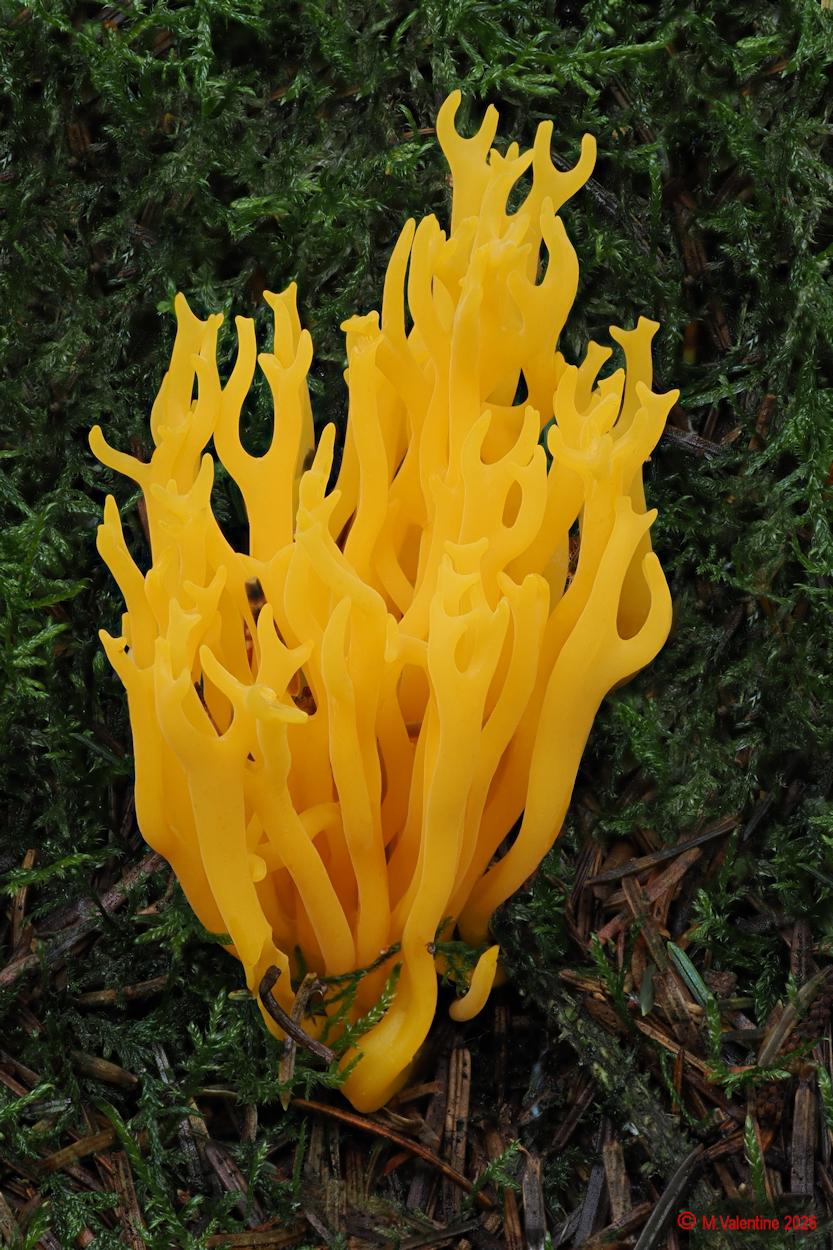
Regards,
Mike.
October 31, 2026 at 1:24 pm in reply to: Fungus Of The Day (One identified fungus only please, with species name in attachment comment and in post) #70977Mycena epipterygia – Yellowleg Bonnet
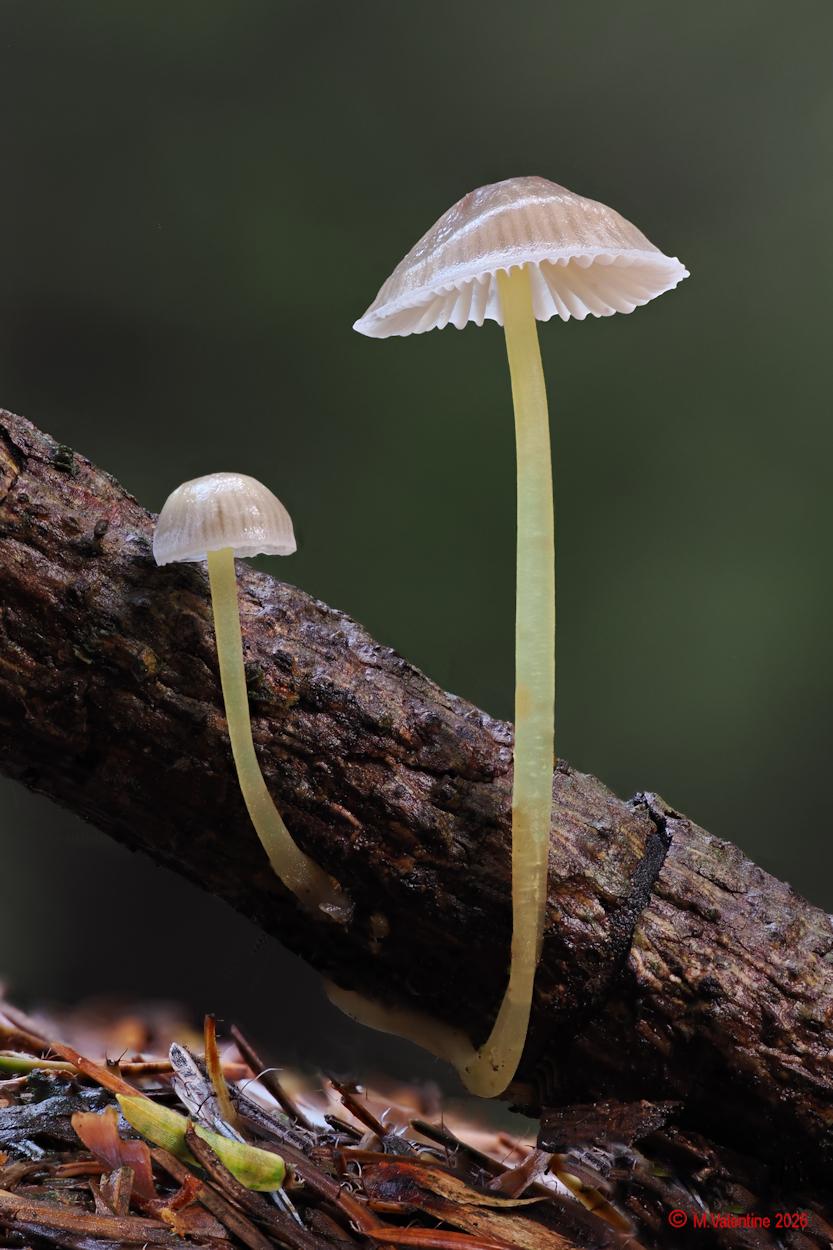
Note the translucent peel-able pellicle on the cap – a good “in-the-field indentifier” for this species.
Regards,
Mike.
You may be aware that the website has recently been completely rebuilt in order to hopefully prevent increasing numbers of attempted spam posts.
Unfortunately, a few teething problems arose which resulted in some registered users receiving unwanted email messages. (Hopefully those problems have now been solved).
If you log in and click on your user name below your profile image (which is currently just the default template image as no photo has been provided) you will see your member profile with links for the topics and replies you previously created. Clicking on those links will show all the individual topics / replies.
Your profile indicates that you have been registered for over 11 years, and have created 7 topics and 57 replies.
eg: –

Regards,
Mike.
Hi, and welcome to the UK Fungi website. Not
Hydnellum peckii, as that one grows in coniferous forest soils, always associated with Pine trees. (In the UK, its distribution is confined to the Scottish Highlands). If the tree was definitely Willow, this will more than likely be a freshly emerged fruitbody of “Willow Bracket” –
Phellinus igniarius. The species does also appear on other deciduous trees, and is not particularly common in the UK.
As the fruitbody matures, it will grow much larger, becoming very “woody” and “hoof” shaped with a grey cap, and probably cracking with age.
Regards,
Mike.
Hi, My best guess would be
Nectria pseudopeziza. Grows generally on dead deciduous wood (but also appears on dead herbaceous stems), and in the UK is predominantly a winter-spring species.
Size of individual perithecia to approx. 0.35mm diameter.
Asci 8-spored, spore size 25-45µ, spores becoming 2 to 8 septate.
Regards,
Mike.
Hi, Yes, that’s fine for
Morchella esculenta. I’m not sure where “Yellow Morel” would be the common name, but for quite a few years in the UK,
Morchella esculentawas known as the “Common Morel”. However, its current “accepted” (British Mycological Society) English/Common name is simply “Morel”.
Habitat of chalky soil with deciduous trees is quite typical for the species.
Regards,
Mike.
I don’t mind whatever “theme” is depicted on such things as British commemorative stamps, but on our banknotes, (and on definitive stamps), I believe that we should always retain the principle of depicting the Monarch, and (on the reverse of banknotes), notable people from the proud heritage of our nation. – I can’t help but think that this change is more about the downplaying of British history than the stated “opportunity to celebrate another important aspect of the nation”. Notable British people are just that – Well known and British. – I can think of several wildlife species (across animals, plants, fungi, or whatever) that are uniquely endemic to the UK, but all of them are so rare and localised in their distribution as to be very unlikely to be chosen for national banknote depiction, and all of them would more than likely be unknown to the vast majority of the population.
I get the feeling we will end up with Red Squirrels & Robins etc. – Very nice and universally loved species without doubt – but they aren’t uniquely British species!
Regards,
Mike.
March 5, 2026 at 3:11 pm in reply to: Fungus Of The Day (One identified fungus only please, with species name in attachment comment and in post) #34236Sarcoscypha austriaca– Scarlet Elfcup – with orange variant. Slightly later visiting the site this year, (I normally get there by early February), but for the fourteenth consecutive year, the orange variant of
Sarcoscypha austriacahas appeared there. (A small mixed woodland, predominantly Birch, in North West England).
As usual, many hundreds of normal red fruitbodies being seen all over the entire site, with the orange variants still only seen (amongst red ones) in one very small localised area.
The fruitbodies were quite dry and somewhat past their best, but I thought they still made quite a nice photo growing on fallen Birch branches amongst the Snowdrops.
Over the years, microscopy has been carried out, (by myself), on both the red and the orange fruitbodies from this exact location.
Additionally, samples of both red and orange variants were sent to Kew, (several years back now), where Dr Paul Cannon confirmed the orange ones as a variant of S. austriaca.
.

[attachment=0]Sarcoscypha austriaca – Scarlet Elf Cup (With Orange Variety).jpg[/attachment]
.Regards,
Mike.
Hello, and welcome to the UK Fungi website. Unfortunately, the links to your photos have had to be removed as the website rules don’t allow links to externally hosted images, for the reasons stated in the “”HOW TO” Guide to Uploading & Posting Images (Information)” topic
https://www.fungi.org.uk/viewtopic.php?t=1 and copied here below: –NB: All forum images MUST be uploaded directly to this site.UK Fungi does not accept links to images hosted on other sites. (Flickr, etc. etc.)
This is to ensure that the images remain associated with the relevant posts, (Images hosted elsewhere can sometimes be inadvertently deleted, thus potentially rendering the particular topic on UK Fungi useless), and also, so that images cannot subsequently be exchanged for alternative/inappropriate images.
If you upload any relevant images directly to the UK Fungi website as per instructions provided on that topic, I’m sure that members will try to provide whatever help they can towards your request for identifications.
Regards,
Mike.
Hi, I’ve posted several times (in English) on AscoFrance when I’ve been stumped by an asco find, and have always received nothing but genuine interest and typical friendly mycological fellowship in what’s been posted – And they’ve always come up trumps with answers to my queries!
Several other UK Fungi members, including the late Chris Yeates (professional mycologist and Yorkshire Recorder), a much missed “myco friend” who was a longstanding member and frequent contributor to the UK Fungi website also regularly contributed to AscoFrance using English language.
So I don’t think you need to have any concerns over posting in English. I’m more than certain that any of your asco queries will be warmly welcomed and will receive whatever help they can provide.
Best regards,
Mike.
This could be something of much interest! – And I too am completely stumped by it! As Paul says, it looks as though it should be an easy ID – But I’ve never seen anything like it, and, having trawled through my asco books, can find nothing similar.
I was just about to post, suggesting that of UK Fungi’s registered members, Paul would be the most likely person to be able to ID it.
But with Paul having no clue either, I would definitely agree with his suggestion to upload your pics and description to AscoFrance (
http://www.ascofrance.com/ ).NB: the AscoFrance website defaults to French language, but if you click on the small Union Flag icon on the homepage, the entire site’s text is translated to English.
It is a marvellous (probably the best available) online resource for anything “ascomycete”, and I’d be surprised if no one on there could come up with a positive ID.
I do hope that you can utilise AscoFrance, and please do let us know back here on UK Fungi if you get whatever this is identified. – Best of luck with it!
Regards,
Mike.
October 27, 2025 at 4:36 pm in reply to: Fungus Of The Day (One identified fungus only please, with species name in attachment comment and in post) #34232Tricholoma imbricatum– Matt Knight Found under Pine, in a peripheral wooded area of a west Lancashire cemetery.
.

[attachment=0]Tricholoma imbricatum – Matt Knight.jpg[/attachment]
.Regards,
Mike.
Hi, It’s often the way with fungi, mushrooms of most species can be quite variable in appearance (both throughout an individual fruitbody’s lifespan and in general), and it is not often (apart from a few very obvious species) that photos we see in books look exactly the same as what we find out in the field. (Which is why most reputable authorities advise against using photo apps as any sort of definitive identification method).
Clitocybe nebularisis a saprobe, meaning that it gets its nutrients from dead or decaying organic matter. So yes, it will be feeding on the woodchip mulch (along with any fallen twigs or leaf litter from the apple tree) but it won’t pose any threat to any healthy trees or plants.
Regards,
Mike.
Hi, and welcome to the UK Fungi website. I’d say that these look very much like
Clitocybe nebularis– Clouded Agaric/Clouded Funnel. Regards,
Mike.
-
AuthorPosts


