- This topic is empty.
-
AuthorPosts
-
May 7, 2023 at 9:00 pm #32608
Much to my surprise I have found another Cladoniaspecies in the New Forest! I was trying out a new macrolens that attached to my iPhone (it is very good) on a new colony of Cladonia firmain the centre of a little used track: 
[attachment=3]2023-05-07-11.jpg[/attachment]
Cladonia firmawith Cladonia strepsilisand odd lichen to left This was growing with
Cladonia strepsilisand Pycnothelia papillariaand a small sterile olive-brown lichen. The latter looked a bit like Cladonia pulvinatahttps://britishlichensociety.org.uk/resources/species-accounts/cladonia-pulvinata ” class=”bbcode_url”> https://britishlichensociety.org.uk/resources/species-accounts/cladonia-pulvinata Cladonia pulvinatahas very strongly tomentose white undersides and pruina on the squamule tips. This lichen also appeared to be parasitised by what looked like Abrothallusapothecia. Then it clicked: these were the highly characteristic pycnidia of Cladonia brevis; large black and constricted at the base https://fungi.myspecies.info/all-fungi/cladonia-brevishttps://fungi.myspecies.info/all-fungi/cladonia-brevis” class=”bbcode_url”> 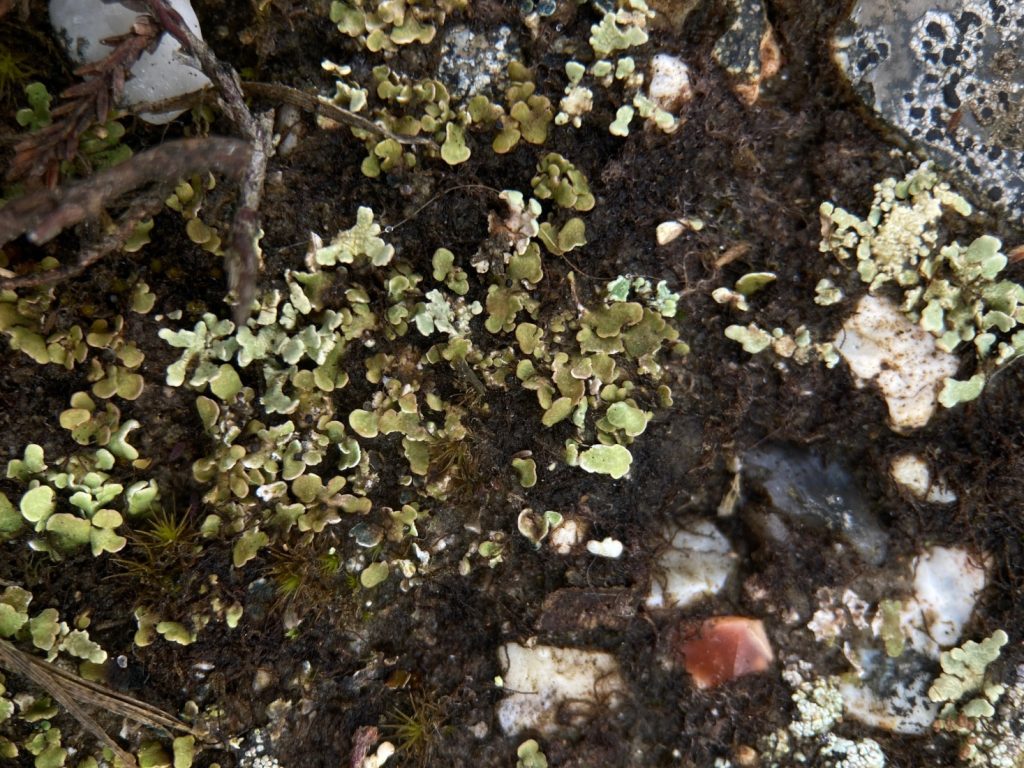
[attachment=2]2023-05-07-14.JPG[/attachment]
Cladonia brevis(olive-brown) with Cladonia strepsilis(pale). One squamule of Cladonia brevis is dark green indicating infection by Arthrorhaphis aeruginosa. 
[attachment=1]2023-05-07-13.jpg[/attachment]
Cladonia breviswith pycnidia in field 
[attachment=0]2023-05-07-17.JPG[/attachment]
Cladonia breviswith pycnidia, stereoscope This is a great find, only the second British record and the first English one. It was first found by the late Alan Orange on mine waste in Wales. One to look out for in open disturbed and poorly vegetated sites.
Neil
October 22, 2023 at 4:15 pm #45441Thank you for the photos, Neil. Thats a very interesting finding. Congrats I also was lucky to find
Cladonia brevisabout two years ago and since learned how to identify that species with some confidence. C. breviswas recently recorded in ten different locations in the federal state of Brandenburg in the northeast of Germany. It was first recorded by Harrie Sipman a couple of years ago in a disturbed site on eolian sand in the southeast of Brandenburg. I am accountable for more recent records. C. brevisseems to be a very early colonizer on silt rich sandy substrates soon to be replaced by more competitive terriculous lichen species or mosses. It was found colonizing compacted loamy sand in a heath grazed by cattle, on heaphs of earth, forest paths and aisles, as well as in sites disturbed by heavy vehicles on dunes and eolian sand. Frequent lichen accompaniants are definitely Pycnothelia papillariaand C. cervicornis ssp. cervicornis. Also C. strepsilis, C. coccifera, C. subulataand Placynthiella species. Polytrichum piliferumist the most frequent moss species. Among higher plants Corynephorus canescens, Spergula morissonii, Calluna vulgarisand Teesdalia nudicaulisare the ones to name. Those always have only very little cover ratio. As you wrote, blackish globose (or mug-shaped) pycnidia constricted at the base are typical of that species. It can be distiguished from other species with small rounded squamules, mostly lacking podetia but having dark coloured globose pycnidia, by using the fast and strong yellow P reaction (vs. Red for
C. peziziformisand – for C. cariosa) or checking with K (- in C. brevis) against C. polycarpoides, which reacts yellow to red. C. cervicornis ssp. cervicornis ismorphologically and ecologically quite similar, but lacks pycnidia and reacts P+ red. C. ramulosacan be similar to C. brevis, but has mostly lime green coloured small squamules that do react P+ red. With some luck one is able to find fertile colonies, bearing numerous podetia up to 1,5 cm high but mostly much smaller. I am going to attach some pictures.
Hendrik
October 23, 2023 at 10:52 am #45442Hendrik Thanks for that, very interesting, which a good deal of overlap in the associated lichens but much less so with the vascular plants, not surprisingly. Nice to see the podetia; would it be OK to put these up on the BLS website?
Neil
October 23, 2023 at 1:54 pm #45443Neil, feel free to use them for the BLS website. I already appreciated very much the informative
Cladoniaspecies profiles and would be happy to see my C. brevispictures there. Maybe you can send me an E-mail address to where I can send you the uncompressed pictures and information on the localities. Hendrik
-
AuthorPosts


- You must be logged in to reply to this topic.