Forums › Forums › Fungi ID requests (post here if you aren’t sure what type of fungus you’ve found) › Very glutinous cap
- This topic is empty.
-
AuthorPosts
-
January 7, 2016 at 7:50 pm #30056
Found this amongst a pile of woodchip in a broadleaf woodland. very sticky cap. Any help with i.d. appreciated. Details below: 1. Cap : 35mm across. Tan, lighter at the margin,very glutinous, jelly like covering. A few fine flecks on the surface.
2. Stipe : Concolorous, but lighter towards the cap. 40mm x 9mm, floccose, no ring present, slightly twisted towards the base, fibrose.
3. Gills : Tan, crowded, adnexed.
4. Smell : none.
5. Spore print : Rusty orange.
6. Spores : Negative in Melzers. elipsioid. 6.9 Microns x 4.3 microns.
January 7, 2016 at 7:58 pm #37828Hello, definitely a Pholiota species, but can’t say which one without having literature at hand.
best regards,
Andreas
January 7, 2016 at 9:00 pm #37829Thank you for the quick response Andreas. I will endeavour to find which one it is now I know the genus. All the best,
Michael.
January 7, 2016 at 10:09 pm #37830Hi Michael The ‘burnt’ woodchip would perhaps suggest Pholiota highlandensis
Best wishes – John
January 7, 2016 at 11:14 pm #37831Thanks John, not sure if the woodchip was burnt though, if I’m passing I’ll take another look. Sometimes it’s so easy to miss the obvious signs. I kept a spare sample for further diagnosis so will see whats revealed. All the best,
Mike.
January 8, 2016 at 2:18 am #37832Hi Mike this is what I would call
Pholiota lubrica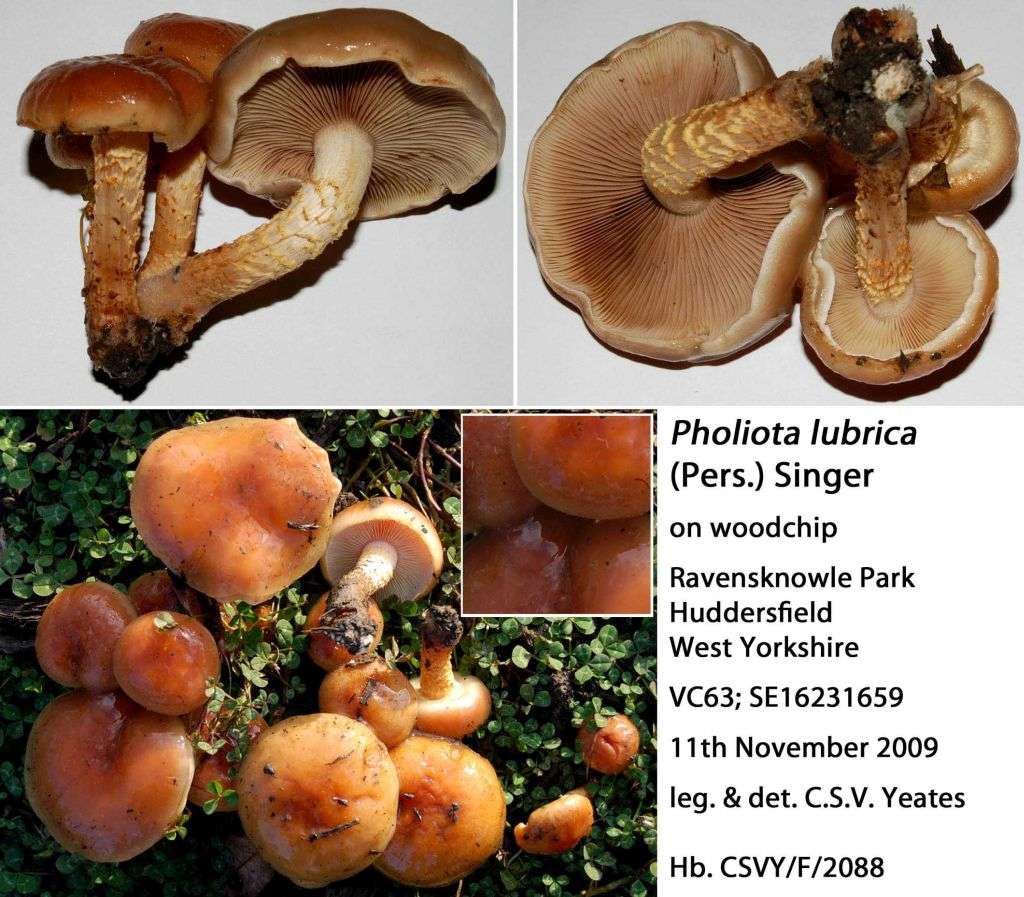
[attachment=0]Pholiota lubrica.jpg[/attachment] (which – I seem to remember – Andreas suspects may be conspecific withPh. lenta; the only differences are in cap colour and subtleties of spore shape – see Funga Nordica). The above is – to the best of my knowledge – the only Yorkshire record; it appeared on a patch of chipped wood on a bare patch of park grassland colonised by
Trifoliumspp. It’s only because it was close to my place of work it was spotted at all. The area soon totally grassed over and the fungus has not appeared since. Not many GB records – the opportunism of these wood-chip fungi never ceases to amaze me . . . cheers
Chris
January 8, 2016 at 10:29 am #37833Hi Chris, It looks very similar indeed. I was looking through F.N. last night and glad that I took another sample tp I.d. will take a good look at the weekend. Thanks for the advice, you’ve all been very helpful. Thats what I really like about this group.Very convivial.. Mike.
January 8, 2016 at 2:58 pm #37834I think this was at Withybush Woods, wasn’t it? I think it is the same as January 8, 2016 at 8:44 pm #37835Hi Adam, We’re they on the left hand side of the path about 50-100m from the car park . Actually I remember there was a path either side of the woodchip? January 8, 2016 at 10:38 pm #37836They were on the right, but same area, yes. If you read the post, you can see that both P.lubrica and P.highlandensis were suggested. January 8, 2016 at 10:54 pm #37837Fair play.Did you find out which one it is and was it a first county record? January 8, 2016 at 11:10 pm #37838According to Funga Nordica, the split is on whether the spores are phaseoliform in side view (lenta, lubrica or elegans) or ellispoid to ovoid in side view (highlandensis, spumosa or mixta) – although highlandensis is usually found on burnt ground, it also occurs elsewhere ..”rarely recorded also in open places without visible burnt material” Perhaps if you post a several spore photos with a good selection of spores, someone could comment on the spore shape.
January 8, 2016 at 11:41 pm #37839Hello, in my opinion thisis not Ph. highlandensis, but I can’T explain why, just a “feeling”. Ph. spumosa or mixta are out, because they are not that glutinous and occur in conifer forests. For Ph. lenta the colour doesn’t fit and Ph. elegans is a species from pine truncs as far as I remember (don’t have books at hand). So this leaves Ph. lubrica, what Chris already suggested. He cited me as being the opinion that lubrica and lenta is the same. This is not the whole truth. I can’t find other differences than the colour and may be slight differences in spores, but the macroscopy of lenta and lubrica is nevertheless quite different and I have never seen intermediate forms. So I believe in two taxa, on which rank it be.
best regards,
Andreas
January 9, 2016 at 9:28 am #37840Those two have almost identical descriptions in Funga Nordica, and as far as I can see, are only different in macro characters, with lubrica having a more vivid coloured cap P.lenta:- “Cap at first whitish, but with age and especially at the centre pale beige brown”
P.lubrica: “Cap predominantly reddish brown, especially at centre, paler at margin”
Going by this, I saw some quite young fruitbodies and they were always a rich reddish-brown colour, never whitish, so I would say this matches P.lubrica better.
-
AuthorPosts


- You must be logged in to reply to this topic.