Forums › Forums › Fungi ID requests (post here if you aren’t sure what type of fungus you’ve found) › Small creamy Russula
- This topic is empty.
-
AuthorPosts
-
July 29, 2015 at 12:51 pm #29584
Cap diameter 3cm. Taste hot. Cuticle peels 1/2 Ruined spore print, trying to make another.
Found among some saplings (oak, birch, beech) – about 20 ft from a mature spruce, so take your pick

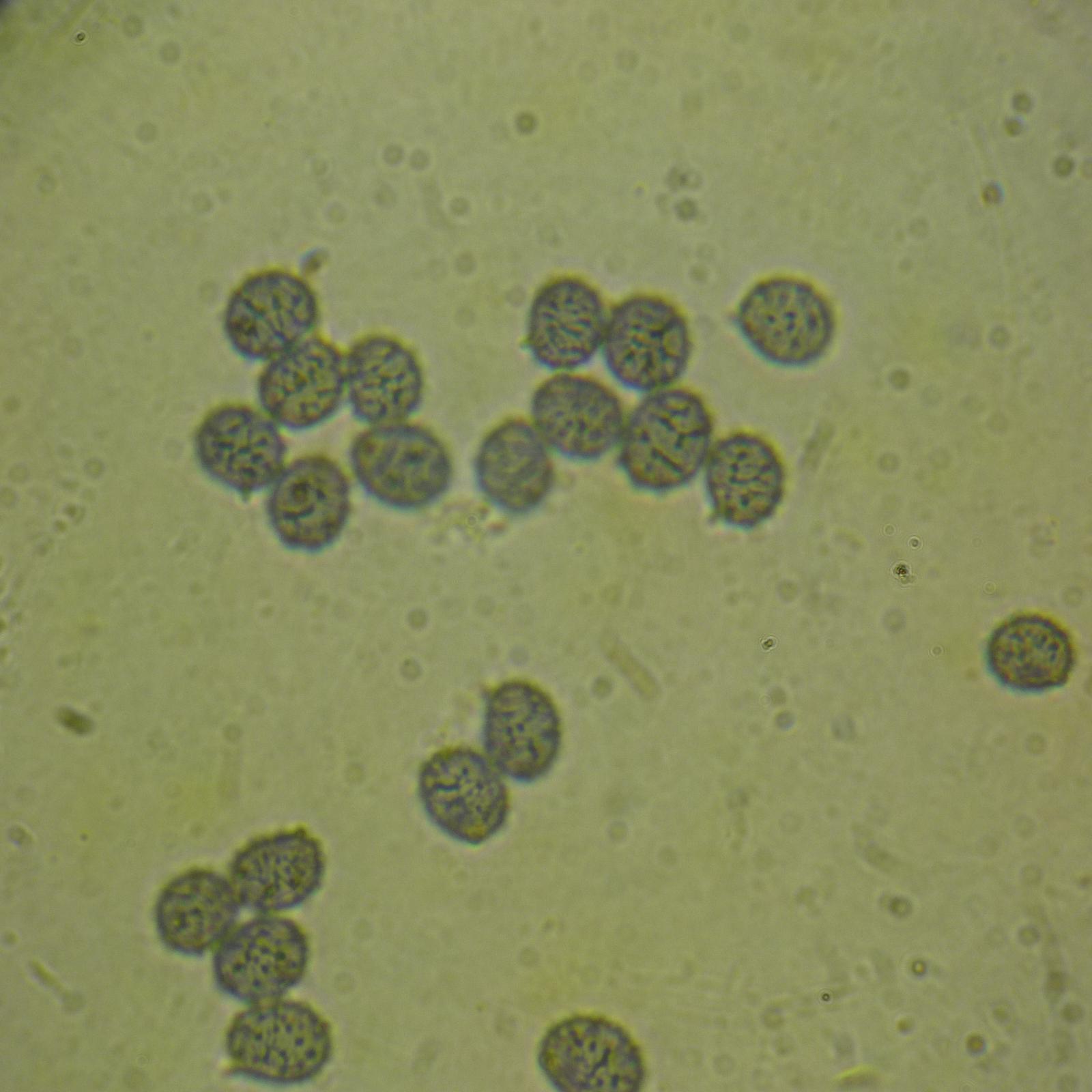
Cap cuticle – appears to me to contain both dermatocystidia (1-2 septate) and fuchsinophile hyphae.
Spores are 8-10 x 6-8 (average 9.46 x 7.69µm) with some connectives.

[attachment=3]P1100777.JPG[/attachment] 
[attachment=2]P1100778.JPG[/attachment] 
[attachment=1]P1100801.JPG[/attachment] 
[attachment=0]P1100804.JPG[/attachment] July 29, 2015 at 2:34 pm #35494No expert on Russula but: how far did cap cuticle peel, taste of gills, any colour change on cuticle with ferrous sulphate solution? I found 1/2 Russula at Kenfig Pool NNR and struggling to get to species! July 29, 2015 at 2:54 pm #35495I think this could easily be Russula betularum. The habitat, macro & micro characteristics all look ok, and the colour on the caps of
R.betularumoften tends to fade to near-white after being rained on. (On my screen, there still appears to be a hint of the normal pinkish colour on the cap of your find). Regards,
Mike.
July 29, 2015 at 4:15 pm #35496marksteer wrote:No expert on Russula but: how far did cap cuticle peel, taste of gills, any colour change on cuticle with ferrous sulphate solution? I found 1/2 Russula at Kenfig Pool NNR and struggling to get to species!
If you read my post again, you’ll see where I said it was hot and peeled 1/2

I haven’t tested with ferrous sulphate (need to make a new batch, last years is now Ferric Sulphate
 July 29, 2015 at 4:21 pm #35497Lancashire Lad wrote:
I think this could easily be
Russula betularum. The habitat, macro & micro characteristics all look ok, and the colour on the caps of
R.betularumoften tends to fade to near-white after being rained on. (On my screen, there still appears to be a hint of the normal pinkish colour on the cap of your find). Regards,
Mike.
I reckon you’ve nailed it, Mike. These look similar and were about 100m away. Also, these did smell of coconut.
July 29, 2015 at 6:19 pm #35498Sorry Adam I must pay more attention! This may well be what I found yesterday but smell faint mushroom and cuticle only peeled about a quarter. Glad I didn’t swallow gills (mild hot) as poisonous! July 29, 2015 at 8:17 pm #35499marksteer wrote:Sorry Adam I must pay more attention! This may well be what I found yesterday but smell faint mushroom and cuticle only peeled about a quarter. Glad I didn’t swallow gills (mild hot) as poisonous!
Relax, there are no deadly Russulas. I don’t think there have been any fatalities from eating Russulas. Emetica stems from the latin for vomiting. That’s the likely result if you ate a lot of it (like more than one cap)
July 29, 2015 at 8:32 pm #35500Field guides may go over the top with ‘poisonous’ (I think rightly so) but I am very careful – short tasting, spitting out then washing mouth! July 29, 2015 at 8:50 pm #35501I used to be a microbiology lab technician. I remember having to label every pot of chemicals in our stores for COSHH, including cyanide, arsenic, some anti-eukaryot antibiotics (nasty stuff much more toxic than cyanide) along with stuff like ferrous sulphate, sodium chloride etc! We had a big chemical hazard book. Everything was poisonous, corrosive, or irritant! The entry for H2O read like this. “Harmful in large quantities. If ingested, immediately wash out with plenty of water and seek medical attention.” It’s called covering your a*** I am a bit nervous when keys call for tasting Cortinariius, Inocybe or other genera with deadly species. With Boletes, Russulas and Lactarius, you really don’t have to worry about chewing a bit and spitting it out. They say you can even do that with Death Cap (the lethal dose is around 30g) but I wouldn’t …
July 29, 2015 at 8:56 pm #35502Have you seen this one: http://www.dhmo.org/facts.html I trained as an industrial chemist many years ago just before H&S at Work Act 1974 – oh what we used to do in the lab then! I’m surprised I am still alive based on current legislation!
July 29, 2015 at 10:03 pm #35503Love it! I remember the fume cabinet at school had a bottle of benzene. When was in college, I bought big bottles (2.5L?) of concentrated sulphuric, nitric and hydrochloric acids from a local chemist to experiment with in the kitchen. I filled a friend’s kitchen with brown noxious fumes… fun times!
July 29, 2015 at 10:20 pm #35504Benzene – good solvent to clean out the gunge from glass flasks when organic chemistry experiments went wrong (heated over Bunsen burner!) A bit off topic from Russulas!
-
AuthorPosts




- You must be logged in to reply to this topic.