- This topic is empty.
-
AuthorPosts
-
September 4, 2024 at 7:40 pm #32866
Back in December, I collected some Pseudevernia furfuraceafrom juniper very near High Force, NY82/VC65. The cortex reacted K+ yellow, and the medulla C- and KC+ pale red. Photos are available on my X/Twitter feed if anyone is interested to view them — https://x.com/specanatura/status/1741057351287759056https://x.com/specanatura/status/1741057351287759056” class=”bbcode_url”> On that basis, I recorded it as
P. furfuraceavar. furfuracea, following Dobson (2018, p. 385): Quote:Cortex: K+ yellow. Medulla: C-, KC+ rose-red [var.
furfuracea]. Cortex: K+ yellow. Medulla: C+ rose-red, KC+ red [var.
ceratea]. However, while recently consulting the LGBI3 volume on the Parmeliaceae for other reasons, I happened to notice that the
P. furfuraceachemotypes are defined differently there, particularly with respect to the KC-reaction in the medulla of P. furfuraceavar. furfuracea: Quote:Cortex: K+ yellow (atranorin); medulla C-, K-, KC-, Pd-, UV- (physodic acid).
…
Pseudevernia furfuraceavar. ceratea(Ach.) D. Hawksw. (1969) BLS 1193is morphologically identical to var.
furfuraceabut differs in the C+ red reaction (olivetoric acid) of the medulla… The wording in both LGBI1 and LGBI2 is nearly identical as well.
Cross-checking with mainland European flora, I find that Wirth isn’t too much help, except perhaps by implication that the KC-test isn’t significant for identifying chemotype:
Quote:…two chemical races: Olivetoric acid, medulla C+ red: var.
ceratea(Ach.) D. Hawksw.: Physodic acid (C-); var. furfuraceaBut ITALIC 7.0 is explicitly clear that the KC-reaction differs between chemotypes, going even further than LGBI in distinguishing them.
Quote:[
P. furfuraceavar. furfuracea]: Spot tests: cortex K+ yellow, C-, KC-, P-; medulla K-, C-, KC-, P-, UV-. Chemistry: cortex with atranorin and chloroatranorin, medulla with physodic acid. [
P. furfuraceavar. ceratea]: Spot tests: cortex K+ yellow, C-, KC-, P-; medulla K-, C+ red, KC+ red, P-, UV-. Chemistry: cortex with atranorin and chloroatranorin, medulla with olivetoric acid. Contrariwise, on the Lichens Marins website, it’s suggested in accord with Dobson that
P. furfuraceavar. furfuraceacan at least sometimes have a KC+ red medulla: Quote:Pseudevernia furfuracea var. furfuracea: cortex: K+ yellow, medulla: C-, KC+ very pale red or KC-, Pd-.
…Pseudevernia furfuracea var. ceratea (Ach.) D. Hawksw.: cortex: K+ yellow, medulla: C+ bright pink, KC+ red, Pd-.
Can anyone shed any light on this? It seems we can identify two positions:
[list=]- Dobson/Lichens Marins/Wirth — the medulla of
P. furfuraceavar. furfuraceais at least sometimes KC+ red, if always C-, and so perhaps the KC-test can’t be wholly relied on to help discriminate between the chemotypes [/list] [list=]- LGBI/ITALIC 7.0 — the medulla of
P. furfuraceavar. furfuraceais always both C- and KC-, and either test discriminates between the chemotypes [/list] One explanation might be that the C+ red reaction of
P. furfuraceavar. cerateais fleeting or difficult to discern, which gives the erroneous impression that P. furfuraceavar. furfuraceacan be KC+ red, and leads to misidentifications. In that case, LGBI/ITALIC 7.0 is the correct position. Another explanation might be that
P. furfuraceavar. furfuraceaat least sometimes contains enough olivetoric acid in the medulla to give a KC+ pale red reaction, but not enough to give a C+ red reaction. In that case, Dobson/Lichens Marins/Wirth is the correct position — but I wouldn’t know if that’s even chemically plausible. Yet a third explanation might be that there is an intermediate chemotype that deserves to be separated from the other two as its own variant. In that case, neither position is wholly correct.
I’d have myself concluded that there was perhaps a misprint in Dobson if Lichens Marins didn’t agree with him, and if I hadn’t myself seemed to have come across a
P. furfuraceaspecimen whose medulla was simultaneously C- and KC+ red! September 5, 2024 at 2:17 pm #46177No answers, but I have also found several examples of Pseudevernia furfuracea with the same C- and KC pale pink (not red) reaction, and been confused by the texts. I thought from Dobson they were var. furfuracea, but cross-checking in LGBI2 and 3 made me doubtful (I don’t think I’d seen the Italic website then). I’ve just re-tested two samples, several times, one from Warwickshire annd the other from Dolgellau, Wales. The C is definitely -ve (not fleetingly pink). (One sample had one odd spot that was pinkish before and after adding the C, but that was not typical.)
Also just looked at afl.lichenologie, which has var. furfuracea as KC-, C-, and var. ceratea as C+ (but no mention of KC).
I haven’t yet submitted any Pseudevernia records as I wasn’t sure which var. to call them (though my inclination is for var. furfuracea, as the C reaction is so decidedly negative). I’ve just noticed that I could use s. lat. though.
LGBI says var. ceratea is the commoner chemotype, albeit ‘particularly abundant in the north’.
Perhaps var. ceratea has a much stronger, redder reaction with KC? I haven’t yet found one with a C+ medulla.
Incidentally, there are no post 1960 records of P. furfuracea in Warwickshire, but I’ve found it in three different sites recently.
September 5, 2024 at 3:36 pm #46178Many thanks for that very helpful reply, Di. It’s good to know that others have shared my experience with C- but KC+ red P. furfuracea, and what’s more that I didn’t simply mistake a fleeting or weak C-reaction for a negative! I collected my specimen while on holiday in the North Pennines, and as it’s pretty uncommon in East Anglia, it would be difficult for me to investigate further. It does seem to make sense to consider such specimens as
P. furfuraceavar. furfuracea, because as you say the C-test is decidely negative. As mentioned, I recorded my specimen back in December as P. furfuraceavar. furfuraceafollowing Dobson, and I’m happy to leave it there for now for the same reason. But that’s to say that the KC-test isn’t diagnostic, but the C-test is. I’m wary of completely committing to this Dobson/Lichens Marins/Wirth position without understanding why the LGBI/ITALIC 7.0 (and as you found also AFL Lichenologie) species descriptions differ!
I’m also wary of using the BLS number for
P. furfuraceasens. lat. to record these specimens, unless e.g.Paul Cannon specifically directs it. My worry is that it’s possible that number was used at a time when P. furfuraceahadn’t yet been distinguished from other species, and the data tagged with it is classed as unreliable. But maybe not — I don’t know myself what the history of that BLS number might be. If you find more of this C- but KC+ red
P. furfuraceain Warwickshire, I’d be keen to hear about it! September 5, 2024 at 5:10 pm #46179I can’t add much to the debate, other than questioning the evolutionary significance of the distinction between the two varieties. I have been accused of being allergic to varieties… It seems that physodic and olivetoric acids (the two chemical culprits) are generated using the same gene cluster (see
https://www.mdpi.com/2218-273X/11/10/1445https://www.mdpi.com/2218-273X/11/10/1445” class=”bbcode_url”> Regarding recording,
Pseudevernia furfuraceas. lat. (BLS 1192) can still be used, and indeed should be preferred in circumstances where there is doubt as to which of the varieties is present. You can add details of the chemical reactions to the notes field, which will guide others in the future when we have more data. Best wishes
Paul
September 6, 2024 at 9:09 am #46180Many thanks, Paul — that’s really helpful to know. I’ve wondered about the status of varieties before — e.g. the
ciliataand tenuisvarieties of Cladonia ciliata, which also seem to have to do with chemistry, or the the furcataand subrangiformisvarieties of C. furcata, which seem to have to do with morphology. Are these (and perhaps others) also similarly epigenetic distinctions, or ‘environmental morphs’ as I’ve sometimes seen them called? I’ve wondered about this because so many other lichens are highly variable both chemically and morphologically — some of the Ramalina species come to mind — yet we don’t record separate varieties of them.
Are varieties a bit of a holdover from pre-molecular days, when lichenologists were making fine distinctions according to morphology, and (somewhat later) according to chemistry? Can we ‘field lichenologists’ assume that, if varietal names still remain current in the BLS Taxon Dictionary, that there’s some real phylogenetic distinction to be made, or at least that the jury is still out?
Coming back to
P. furfuracea— thanks for the advice to use BLS 1192 when in doubt about variety. I’ll need to contact Janet to update my past record to that number, and to ensure that both the C- and KC+ red results are recorded in the notes. September 6, 2024 at 3:11 pm #46181Thank you, Paul, for that link, which led down several rather deep but interesting rabbit holes. Apologies that this is probably not especially helpful. I agree that subspecies, varieties, etc often mean more time spent on details that tend to end up being inconclusive (with higher plants anyway), and/or not really useful. Nevertheless, I followed this up, as it was puzzling me. One of the references in the link led indirectly to: “Pseudevernia furfuracea (L.)Zopf and its chemical races in the British Isles” by Hawksworth and Chapman in The Lichenologist, Vol 5, Issue 1-2 , October 1971, which gives the chemical reactions as stated in Dobson, that is, var. furfuracea being C- and KC rose-red. (It also refers to “the joint occurrence of these acids in a single specimen of this species” implying that most only had either physodic or olivetoric acid, which would mean that the KC rose-red was a reaction to physodic acid, rather than a faint olivetoric acid reaction.)

[attachment=2]Screenshot 2024-09-06 at 13.58.57.png[/attachment] In Orange’s ‘Microchemical Methods for the Identification of Lichens’ there is a reference to Hypogymnia physodes containing physodic acid. In LGBI it states that H. physodes also gives C- and KC red reactions (but it does also has other lichen acids). I tested a sample of H physodes, and it only gave a rather faint pink KC reaction.
An online search for “physodic acid KC” turned up a website about Hypogymnia species of North America:
“KC Test: Physodic acid is a very common substance in Hypogymnia that produces a KC+ orange, pinkish, or red color.”

[attachment=1]Screenshot 2024-09-06 at 14.58.31.png[/attachment] Wikipedia (admittedly not always a reliable source, but the bit about why it produces a colour was interesting) also says that physodic acid gives KC+ red. The linked reference (15) is Ahmadjian, Vernon; Hale, Mason E. (1973). The Lichens. New York: Academic Press.

[attachment=0]Screenshot 2024-09-06 at 15.23.38.png[/attachment]
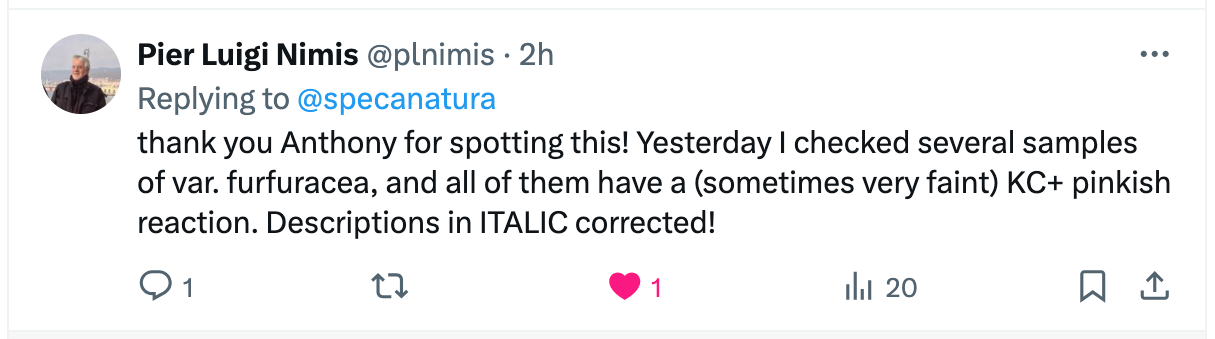
Could the references to var. furfuracea being KC- possibly be an error that has been copied across to other places?September 6, 2024 at 3:35 pm #46182Excellent stuff, Di! I’d seen that Hawksworth and Chapman paper on P. furfuraceabefore, but I’d completely forgotten it. The further references that you’ve dug up on a KC+ reaction to physodic acid makes me more confident to leave my record as P. furfuraceavar. furfuracea. It also adds to the question of whether it’s valuable to revisit the species description for
P. furfuraceain LGBI3, if not to correct then perhaps at least to qualify the spot-test results listed there. Also the description in ITALIC 7.0 — perhaps I’ll send a message to Pier-Luigi to ask for his views. Of course, this is all compatible with Paul’s point that the production of physodic or olivetoric acid in
P. furfuraceaisn’t phylogenetically significant. So his implied question remains over whether we should be recording these varieties separately in the first place. That said, insofar as the various BLS numbers are all there to use, your finds certainly help to clarify the way forward for us in the field!
September 7, 2024 at 3:57 pm #46183As promised above, I was in touch with Pier-Luigi for his views. He tested some samples of P. furfuraceavar. furfuracea, and he also found a (sometimes very faint) KC+ pinkish reaction in the medulla. He’s now updated the species description in ITALIC 7.0 to reflect our shared observations — https://italic.units.it/index.php?procedure=taxonpage&num=1907 ” class=”bbcode_url”> https://italic.units.it/index.php?procedure=taxonpage&num=1907 
[attachment=0]Screenshot 2024-09-07 at 17.10.59.png[/attachment] Pier-Luigi hasn’t yet expressed a view on the phylogenetic validity of these varieties, in light of Paul’s comments above. I’ve asked him directly, and if he responds, I’ll report back.
September 7, 2024 at 6:26 pm #46184Pier-Luigi did reply to the specific question about the value of differentiating between the two varieties of P. furfuracea. He agrees that they’re just chemical strains, and he suggests that the rank of forma(lower in the taxonomic tree than varietas, and indicating more minor differences) might be better in this case. At the same time, he favours retaining the two varieties because he thinks that evidence suggests that there are important ecological/distributional differences between them. As you pointed out, Di, LGBI3 also agrees that
P. furfuraceavar. cerateaappears more common in the UK, and particularly more abundant in the north. Not sure if there’s an explanation why, but without recording varieties, the data wouldn’t exist to support one. And more generally, Pier-Luigi takes the view that ‘taxonomists should provide names not only for taxonomists’, and that infraspecific epithets such as
varietasand formaare a good way to capture information such as ecology, distribution, etc. I take it that he’s reminding us that taxonomy isn’t wholly the same as phylogeny, at least below the level of species. Screenshots of his thread:

[attachment=3]Screenshot 2024-09-07 at 19.24.04.png[/attachment] 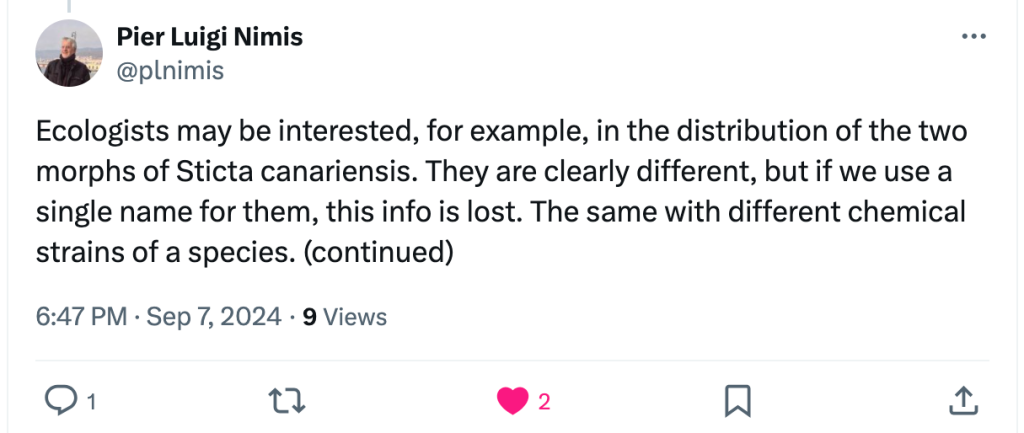
[attachment=2]Screenshot 2024-09-07 at 19.24.16.png[/attachment] 
[attachment=1]Screenshot 2024-09-07 at 19.24.30.png[/attachment] 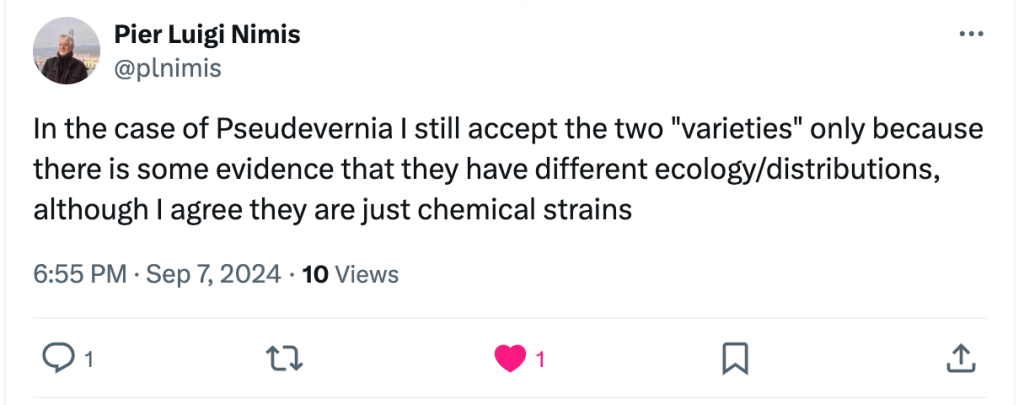
[attachment=0]Screenshot 2024-09-07 at 19.25.01.png[/attachment] September 10, 2024 at 4:16 pm #46185Anonymous
About chemical spot tests. The colored chemical reactions performed directly on lichens cannot alone characterize a lichen because they are not a complete chemical analysis (like a chromatography where the lichen compounds are separated before reacting with chemical agents to give a characteristic coloration) because they are performed on a mixture of chemical compounds and the coloration obtained is that of the mixture of the different colorations of each of the compounds taken individually. It is the chemical compound that has the highest concentration that contributes the most to the final coloration… so the interpretation can be difficult and the colorations obtained must be considered as a simple orientation.
On the other hand, current studies seem to show that the synthesis of the lichen compounds responsible for these colorations is not only the result of the action of the lichen genes, but that it also depends on the microbiome and environmental factors. So the colored reactions cannot alone characterize a lichen, it is just additional information (but sometimes very useful).
In the case of reaction C with sodium hypochlorite I have a few remarks to make:
_ The C solution used is generally made with bleach, which is not a pure chemistry laboratory solution but an industrial solution that contains NaOH (1-2%) and sodium chloride but also additives and dyes so it can give unexpected colors…
_ The pink or red coloring is very often fleeting and can go unnoticed. (It is often so fleeting that it is difficult to photograph). As for a C+ reaction, its interpretation is generally easy, we are indeed in the presence of the lichen substance sought (except in the rare cases where another substance has reacted in the same way!).
In the case of a C- reaction, the interpretation is more difficult and it is advisable to be careful because it is legitimate to ask questions:
_ Absence of the lichen substance sought?
_ Handling errors: corrupted C solution, temperature too cold or too hot, non-compliant pH, absence of ions necessary for the color reaction (Ca++, Mg++, etc.)…
That said, regarding
Pseudevernie furfuracea, the KC reaction is often inapplicable in practice in the field because a possible pink or red coloration is masked by the very strong yellow coloration by K (and it is very difficult to differentiate a golden yellow from a pale orange (yellow + pink)! I think that we should “forget” this reaction in this specific case. Furthermore, I think that making two varieties
cerateaand furfuraceaonly on chemical characteristics that are difficult to highlight in the field as part of an inventory is excessive, two chemoforms would be sufficient, but it is not impossible that these two varieties exist, it would be very interesting to do more complete studies to properly pose the problem and to perhaps look for other characteristics that can be used in the field (In France ceratea is more frequent in the mountains). Attached are some photographs to illustrate the discussion.
AG
PS. I noticed that in the case of the Pd reaction with var. ceratea it is Pd+ yellow, have you noticed the same phenomenon?
September 10, 2024 at 4:30 pm #46186Commentary on the photographs: 1. var. ceratea saxicolous forma
2. var ceratea corticolous forma Mountains
3. var. ceratea lignicolous forma
4. var. furfuracea corticolous forma Corsica
- Dobson/Lichens Marins/Wirth — the medulla of
-
AuthorPosts




- You must be logged in to reply to this topic.