- This topic is empty.
-
AuthorPosts
-
November 2, 2022 at 9:00 pm #32474
In Spribille et al (2011) https://www.researchgate.net/publication/50891044https://www.researchgate.net/publication/50891044” class=”bbcode_url”> Mycoblastus sanguinariuscollections across the world were sequenced including a single specimen from Scotland (Loch an Eilein, Cairngorms). This study found two semi-cryptic clades one equivalent to Mycoblastus sanguinariuss. str. including the eastern Scottish specimen. The other included the Tasmania M. sanguinarioidesbut also north hemisphere material from north western and north eastern North America and eastern Russia but not Europe. Spribille et al did find one morphological character that distinguished
Mycoblastus sanguinariuss. str. from M. sanguinarioides: the hymenium of the latter had crystals visible in polarised light, while these are totally lacking from Mycoblastus sanguinariuss. str. I have been meaning to collect
Mycoblastus sanguinariusmaterial when in the uplands to have look myself, but keep forgetting. Finally I remembered when doing a contract lichen survey of Coed Cymerau, Ffestiniog, North Wales, a lichen rich ravine. Astonishingly this specimen proved to have hymenial crystals, so may be M. sanguinarioides, new to Europe. 
[attachment=1]2022-10-18-27.jpg[/attachment]
M. sanguinarioides? in normal light 
[attachment=0]2022-10-18-26.jpg[/attachment]
M. sanguinarioides? in polarised light, showing the hymenial crystals. This will need to be checked by sequencing (but my specimen is scrappy I was just expecting
Mycoblastus sanguinariuss. str.!), but looks promising. It would be useful if others in the uplands could check fresh specimens from other areas and seen what they get, or alternatively have a look at older herbarium specimens. All the best
Neil
November 4, 2022 at 3:54 pm #45102OK, we now have conformation from Tony Spribille from the pictures that this is Mycoblastus sanguinarioides, new to Britain. It is not new to Europe after all, it had been found in humid lichen rich ravines in Sweden and Finland since the original paper see https://mycokeys.pensoft.net/article/13375/https://mycokeys.pensoft.net/article/13375/” class=”bbcode_url”> So hypotheses for those out in
Mycoblastus sanguinariusland to test: is the bulk of material is ordinary habitats Mycoblastus sanguinariuss. str. and secondly is Mycoblastus sanguinarioidesa species of lichen rich humid habitats? There are some visual hints for
Mycoblastus sanguinarioides, well developed Mycoblastus sanguinarioideshas flat apothecia surrounded by a thin ring of whitish thalline tissue, while apothecia Mycoblastus sanguinariuss. str. have a distinctly convex disk and a constricted base. My specimen is not that well developed, but the apothecia do not have a constricted base. 
[attachment=1]2022-10-18-28.jpg[/attachment] 
[attachment=0]2022-10-18-29.jpg[/attachment]
Mycoblastus sanguinarioidesspecimen Neil
December 18, 2022 at 9:04 pm #45103An up date on Mycoblastus sanguinarioides. Dave Lamacraft has found some in one of the high altitude woods in Dartmoor, so that is new to England and, as with the Welsh record, it was found in a lichen rich upland rainforest. 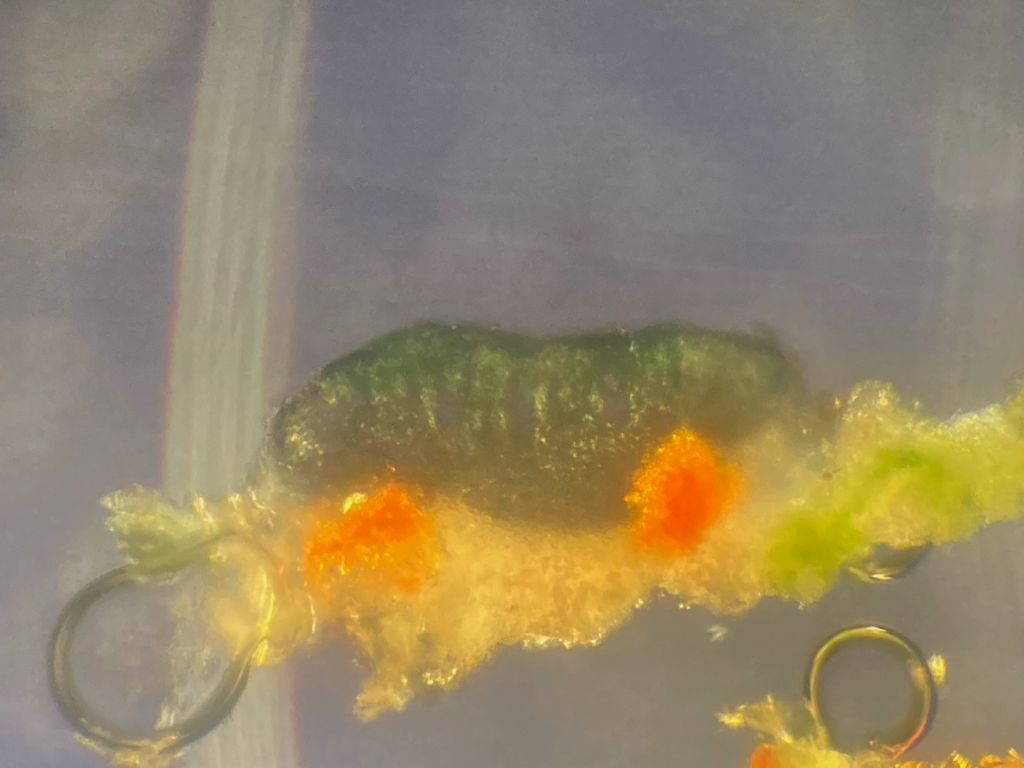
[attachment=0]image0 copy.png[/attachment]
A cross section in polarising light, with the crystals in the hymenium (the shinny granules) along with a similarly limited amount of red pigment as seen in the Welsh specimen (Dave’s picture).A great find: I would welcome any more specimens of either
Mycoblastus sanguinarioidesor Mycoblastus sanguinariusfrom anywhere. Neil
February 16, 2023 at 9:16 pm #45104I’ve been looking at Mycoblastus sanguinariussamples when I’ve found it over the last couple of months- and not seen any shining in polarised light. Until this one (appalling picture sorry) from Borrowdale yesterday where there appears to be a line of shining “crystals”. Is this worth investigating further do you think? ( There’s lots of red pigment at the base and apothecia appear to be convex as usual.) 
[attachment=0]P2160433.JPG[/attachment] February 17, 2023 at 10:43 pm #45105Pete That looks OK for
Mycoblastus sanguinarioides, the original paper states that it is a clear cut difference: Quote:However, systematic examination of apothecial cross-sections revealed that, withoutexception, all individuals of Clade I [
Mycoblastus sanguinarioides] possessed microscopic birefringent crystals in the apothecial hymenium (Figs. 2C) which were always lacking in individuals of Clade II [ Mycoblastus sanguinarius] The other features overlap, so only point to the potential identity. The final conformation would be the squence the specimen. I tried getting an ITS sequence from a
Mycoblastus sanguinarioidesspecimen from Wistmans Wood at the DNA workshop last weekend, but the result either failed or needs further amplification (which will be tried). It will be some months before I get the time to master this myself! I am also very interested in findings of the presumably commoner
Mycoblastus sanguinarius, especially habitat, so please pass these on too. Intersting that the Mycoblastus sanguinarioides, was, I assume as from Borrowdale, from a rich area. Neil
February 18, 2023 at 2:01 pm #45106Thanks for this- interesting. It’s from a very good bit of humid and lichen-rich habitat at Surprise View. Though not a ravine.
Shall I stick this one in the post to you, and include details of the M sanguinarius I’ve checked too?
February 18, 2023 at 2:12 pm #45107Yes please including the Mycoblastus sanguinariusdetails (and a Mycoblastus sanguinariusspecimen would be nice if you have one handy). Neil March 1, 2023 at 8:19 pm #45108Hi. I took a couple of samples of Mycoblastus from our trip in the last week to Knapdale area of Argyll: two separate places. Both samples look more like M. sanguinarius s. str. as they are pretty convex and probably no crystals.
I’ll bring the samples to Edinburgh and hand them over…
Sample A:
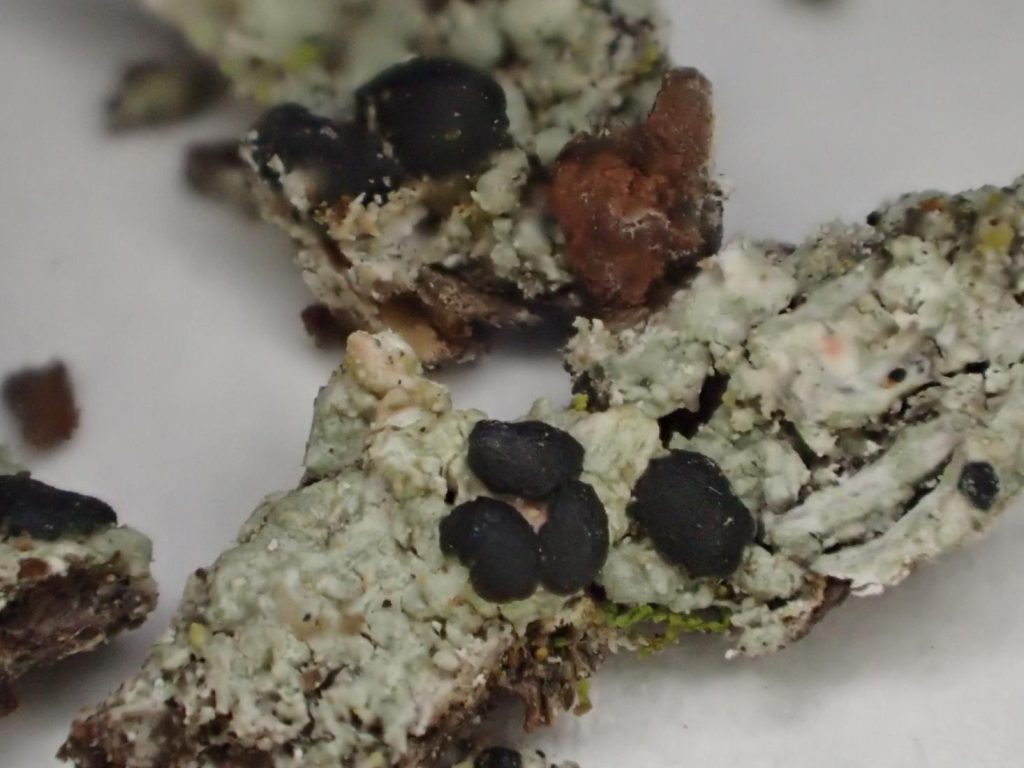
[attachment=5]P3010187.JPG[/attachment] 
[attachment=4]P3010180 H2O.JPG[/attachment] 
[attachment=3]P3010181 Polarised.JPG[/attachment] Sample B:

[attachment=2]P3010185.JPG[/attachment] 
[attachment=1]P3010174 H2O.JPG[/attachment] 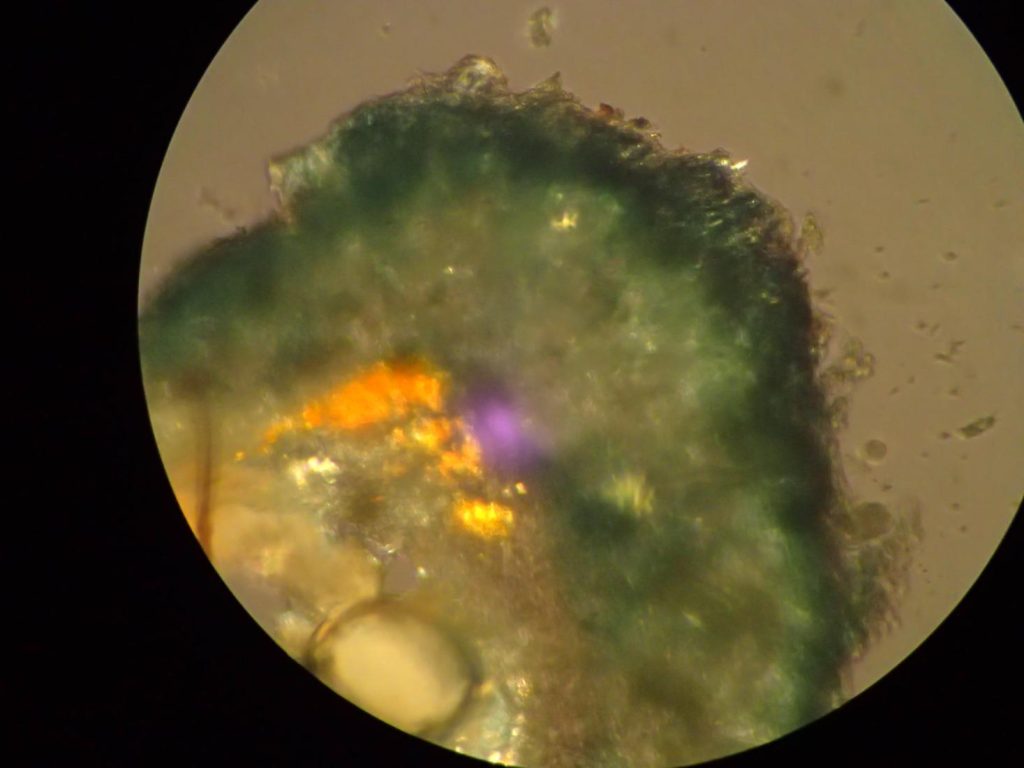
[attachment=0]P3010175 Polarised.JPG[/attachment] March 2, 2023 at 10:46 pm #45109OK, the polarised photos look like there may be crystals. (The other characters are indicative NOT decisive) The crystals are soluble in K, so if you are unsure add K and see what happens. The hymenium goes completely dark as the K dissolves the crystals. Anyway I can have a look. See you at the AGM. Neil
-
AuthorPosts


- You must be logged in to reply to this topic.