- This topic is empty.
-
AuthorPosts
-
January 5, 2026 at 9:24 am #33135
Hi, I found this lichen growing on flint on the south wall of a church. After much research, it seems to match up with Pachnolepia pruinata with an extremely thin thallus, although thalli are always thin on flint. I wanted to see if anybody had any thoughts on this as it seems an unusual substrate for the lichen, or could it be something else. If I use the key to Arthonia and follow the couplet for ‘on rock’ I get to Sparria endlicheri, which can’t be right.
The lichen’s attributes are as follows and photos are below:
Photobiont – trentopohlia
Thallus – light pink/white heavily pruinose, very thin, C+ red, K-, UV-
Apothecia – very heavily pruinose, irregular shaped, light pink/brown disc with a white margin, very thin
Epithecium – dark brown changing to grey in KOH
Hymenium – colourless
Hypothecium – light brown
Spores – 8 per ascus, the maximum septa I found was four, but there were asci found that contained eight with just 1 septa, or eight with just 2 septa etc. The 4 septate spores where 15-17.5 X 5-7.5 micrometers
I should add this church is on the southern slope of the South Downs not far from the sea. There is woodland not far but it’s relatively new woodland and the churchyard, although 11th century, does not contain any ancient trees. I have previously found Pachnolepia pruinata on sandstone of an ancient church but that churchyard was surrounded by old woodland.
Any comments appreciated. Thank you
Sylvia
January 11, 2026 at 12:32 pm #46815Hello Sylvia I would think you have P. pruinata here despite the most unusual substrate. As you rightly say it’s unlikely to be Sparria endlicheri which is typically found in dry coastal underhangs. I should like to see your find included in NR&I in the next Bulletin to alert people to the possibility of its occurring on rock. I wonder if we have any saxicolous records on the database?
The Lichens marins website has some good images and although it’s late for Christmas now I loved this ‘Christmas decorations’ image …. Thank you Jacques Haine
Best wishes
maxine
January 11, 2026 at 2:48 pm #46816Pachnolepia pruinata, along with Cresponea premnea, occurs near the base of one of the large upright stones of Stonehenge. 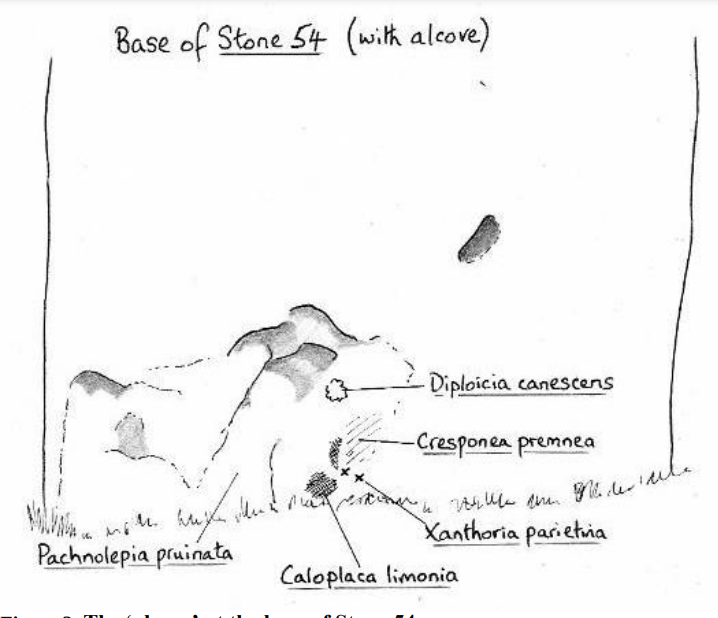
[attachment=0]stonehenge.png[/attachment] January 11, 2026 at 8:45 pm #46817Thanks Maxine and Mark, This is the second time I’ve found it, but the first time it was on sandstone and it looked just like it does on bark. Not the case for flint, where it will be very easily overlooked as the thallus was so thin and barely there, as well as being the same colour as flint. Perhaps Cresponea premnea will turn up next!
Thanks,
Sylvia
-
AuthorPosts


- You must be logged in to reply to this topic.