Forums › Forums › Rusts, Smuts, and Mildews › Mildew on Oxalis corniculata
- This topic is empty.
-
AuthorPosts
-
October 1, 2015 at 2:09 pm #29810
We’ve got a nasty invasion of Oxalis corniculatain the paving stones. Sat drinking coffee as is my wont on a pleasant afternoon I noticed one, and only one, plant was over-run with mildew. I am sure there will only be one species that infects O. corniculatabut I can’t seem to find which one. Closest I can get is Microsphaera russelliibut that is on a US website and host just stated as Sorrel (although it gives the scientific name Oxalis). Any help would be appreciated. October 1, 2015 at 7:24 pm #36592Hi Simon no need to double-check whether this was indeed the mildew or the rust
Puccinia oxalidisas that species only attacks the pink-flowered Oxalisspp. Yes it must be
Erysiphe russelli; not many British records (under-recorded no doubt as the few records are quite widely spread – http://www.fieldmycology.net/FRDBI/FRDBIrecord.asp?intGBNum=58884 ” class=”bbcode_url”> http://www.fieldmycology.net/FRDBI/FRDBIrecord.asp?intGBNum=58884 http://extension.umaine.edu/ipm/wp-content/uploads/sites/3/2013/06/200405248Image1.jpg ” class=”bbcode_url”> http://extension.umaine.edu/ipm/wp-content/uploads/sites/3/2013/06/200405248Image1.jpg Oidiumstage, forming only conidia, only later starting to “get sexual” as it were 😳 best wishes
Chris
October 2, 2015 at 6:33 am #36593Thanks Chris. It definitely wasn’t a rust, I can get that far most of the time. It has been moved to Erysiphenow has it? It now seems a good bet as all the genera seem to have been lumped in it. I might start labelling my requests as “ Erysipheon…” This fungal taxonomy seems to be in constant flux. I thought part of the idea of binomials was that they were fixed! On a more serious note, I couldn’t see chasmothecia but I only had a quick squizz through a hand lens. When the plant is growing outside your back door, it seems less relevant to make sure you pick a representative sample.I shall check it out again a couple of times over the next week or two.
October 2, 2015 at 5:25 pm #36594Simon Horsnall wrote:. . . .It has been moved to
Erysiphenow has it? It now seems a good bet as all the genera seem to have been lumped in it. I might start labelling my requests as “ Erysipheon…” This fungal taxonomy seems to be in constant flux. I thought part of the idea of binomials was that they were fixed! . . . .
Unless a priorspecificepithet for a taxon is discovered that will be transferred to a new / different genus (providing the name is not pre-occupied). The genericposition is in effect an opinion – although of course the opinions of those specialising in a group are likely to carry the most weight. The separation of
Microsphaerafrom Erysipheand of Sphaerothecafrom Podosphaerawas based to a large degree on the appendages of the chasmothecia. These are now considered not to be particularly useful and molecular studies, plus characters of the anamorphs have caused the reorganisation, which has probably stabilised the order. As with many groups of organisms taxonomy was originally Europe-based, in fact often northern Europe-based – when one looks at the picture worldwide a range of intermediates between previously separated genera may well appear. These are the genera currently recognised among the powdery mildews:
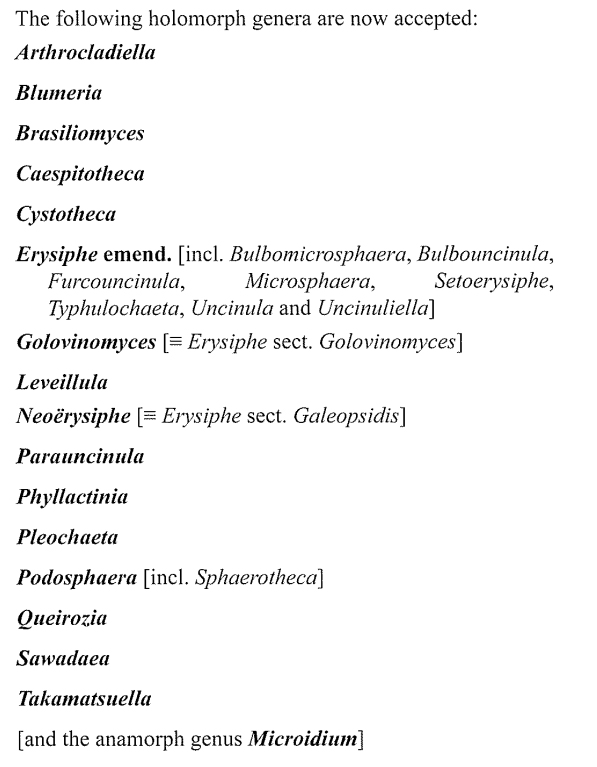
[attachment=0]Braun-1.jpg[/attachment]
taken from Uwe Braun’s monumental (707 pages!)Taxonomic Manual of the Erysiphales(2012). best wishes
Chris
-
AuthorPosts


- You must be logged in to reply to this topic.