Forums › Forums › Rusts, Smuts, and Mildews › Melampsora populnea – or something else?
- This topic is empty.
-
AuthorPosts
-
August 10, 2015 at 5:33 pm #29621
Can this be anything other than Melampsora populnea? Found yesterday, growing on live leaves of
Populus alba– White Poplar. Henderson (2004), mentions only
Melampsora populneabeing associated with P.albain the UK. However, Wilson & Henderson (1966) state: –
Uredosori
hypophyllous, minute, 0-5 mm. diam., pulvinate, pulverulent, yellowish-orange; paraphyses distributed throughout the sorus, 40-60 x 8-23µm, clavoid or somewhat capitate, with wall 3-9/« thick; uredospores ovoid, broadly ellipsoid or obovoid, 15-25 x 11-18µm, wall 2-3µm thick with stout, rather distant spines about 2µm apart. and Termorshuizen & Swartz (2011) state: –
II
Hypophyllous, pulvinate, diam. 0.5 – 1mm, pulverulent, yellow-orange, paraphyses clavate to somewhat capitate at the apex 3-9µm thick. Spores 15-25 x11-18µm, wall 2-3µm thick, distantly echinulate.
I’m not too worried that my spore measurements include some that are larger than both books indicate, as I’ve had that occur with quite a few rusts, and I know that my scope’s measurement calibration is correct.
However, I am concerned that both books say that the uredosori are hypophyllous – whereas those on my samples are clearly
amphigenous, with the sori mainly evident on the upper “ Epiphyllous” surface. 
[attachment=2]Melampsora populnea Uredosori on Populus alba Leaves.jpg[/attachment] 
[attachment=1]Melampsora populnea Uredospores x400.jpg[/attachment] 
[attachment=0]Melampsora populnea Uredospores x400 measured.jpg[/attachment] Confirmation (or otherwise) would be much appreciated.
Regards,
Mike.
August 11, 2015 at 8:53 pm #35693Hi Mike examination of the uredinial paraphyses is critical with rusts on
Populusspp. As per (central images): 
[attachment=0]Melampsora populnea.jpg[/attachment]
cheersChris
August 11, 2015 at 9:00 pm #35694Chris Yeates wrote:Hi Mike
examination of the uredinial paraphyses is critical with rusts on
Populusspp. As per (central images): [attachment=0]Melampsora populnea.jpg[/attachment]
cheersChris
That’s unusual, Chris, you haven’t dated that montage.
August 11, 2015 at 10:48 pm #35695Chris Yeates wrote:Hi Mike
examination of the uredinial paraphyses is critical with rusts on
Populusspp. As per (central images) cheers
Chris
Hi Chris,I’ve attached my shots of the paraphyses – but my technique at getting these nicely oriented in suitably thin sections still leaves a lot to be desired.
😳 I’ve just looked on FRDBI and (on
Populus alba), there are: – 90 records for
M.populnea. 6 records for
M.allii-populina. 1 record for
M.larici-populina. Comparing my paraphyses with the descriptions/illustrations for the above three species in Wilson/Henderson, I can’t decide which would be the best fit!
Plus, as seems to be becoming the norm with W/H – the sizes of my examples would appear to be on the large side too.
Any suggestions?

[attachment=4]Melampsora paraphyses x400 (1).jpg[/attachment] 
[attachment=3]Melampsora paraphyses x400 (2).jpg[/attachment] 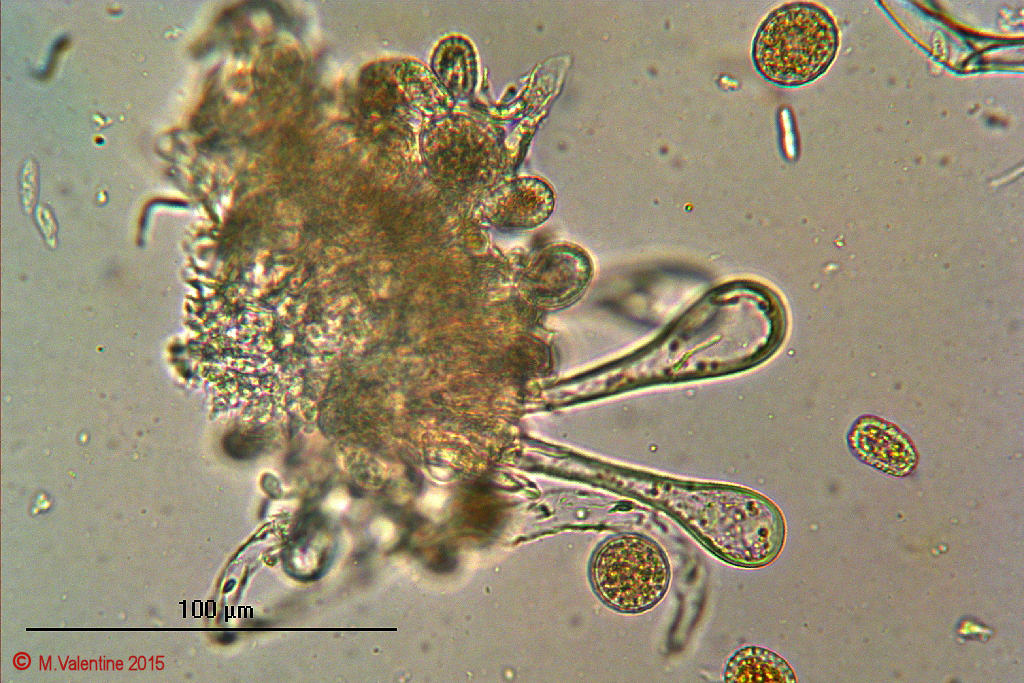
[attachment=2]Melampsora paraphyses x400 (3).jpg[/attachment] 
[attachment=1]Melampsora paraphyses x400 (4).jpg[/attachment] 
[attachment=0]Melampsora paraphyses x400 (5).jpg[/attachment] Regards,
Mike.
EDIT– Looking at the paraphyses again, I’m back to thinking this has to be M.populnea. (Even though non of the literature I’ve seen mentions the possibility of uredosori being amphigenous). Wilson & Henderson say: –
Paraphyses for
M.allii-populina“mostly capitate with thin stalks” 50-60 x 14-22µ, wall uniformly 2-3 thick”. Paraphyses for
M.larici-populina“clavate to capitate, 40-70 x 14-18µ, wall strongly thickened (up to 10µ) above”. Paraphyses for
M.populnea“distributed throughout the sorus, 40-60 x 8-23µ, clavoid or somewhat capitate, with wall 3-9µ thick. Termorshuizen & Swertz’s descriptions mostly mirror W/H word for word – but notably, in the description relating to
M.populneathey word their description: – “paraphyses clavate to somewhat capitate, at the apex3-9µ thick”. The paraphyses in my samples were mostly clavate. The walls on some of the paraphyses were thickened in the apical region within the 3-9µ range, and they were seen throughout the sori.
August 13, 2015 at 8:09 pm #35696Hi Mike looking at your images I would call this
M. allii-populina; based on the paraphyses’ wall thickness in proportion to the centre – compare that to the ones in my image where the walls are almost as thick as the central lumen. Have a look also at the micro-images at http://www.bioimages.org.uk/html/r162855.htmhttp://www.bioimages.org.uk/html/r162855.htm” class=”bbcode_url”> This paper is worth reading in this context:
http://max2.ese.u-psud.fr/bases/upresa/pages/gerard/pubs/book.pdf ” class=”bbcode_url”> http://max2.ese.u-psud.fr/bases/upresa/pages/gerard/pubs/book.pdf 8 specieseh? (Plus talk of hybrids . . . . . ) This has encouraged me to do a bit of collecting of rusts on poplars (which tend to be very frequent) and see what pattern emerges . . .
cheers
Chris
August 13, 2015 at 9:03 pm #35697Many thanks Chris. I think I need to gain a much better idea of where clavate starts to become capitate!
I was thinking that only four of the paraphyses (from amongst all five photos above) were sufficiently “round headed” to be classed as capitate – and had been thinking that by far the majority were clavate!
I do see that some of them have marked wall thickening towards their apices, but again there were sufficient (to my eye) that didn’t, to steer me away from
M. allii-populina. 
If
M. allii-populinais the most likely given the characteristics here, I’ll record it as that. With 90 records for
M. populnea, and only 6 for M. allii-populina, I was wary of not wanting to go for the scarcer of the two unless it was beyond reasonable doubt. – Possibly to the extent of subconsciously thinking myself away from that option altogether! I’ve downloaded the article to which you link and have just had a quick browse.
I think it will need a concerted reading session, (probably more than once), before its content might “sink-in”.
Once again, many thanks.
Regards,
Mike.
-
AuthorPosts


- You must be logged in to reply to this topic.