Forums › Forums › Fungi ID requests (post here if you aren’t sure what type of fungus you’ve found) › ID help appreciated please
- This topic is empty.
-
AuthorPosts
-
April 9, 2020 at 7:26 am #31635
Hello. I found this tiny black fungus (I think) on my daily exercise walk recently. It’s growing on an Ash branch, erupting through the bark. I brought a small sample home and managed to remove one of the black ‘things’ and squash it on a slide – think I can see fungal hyphae. They are very hard though and difficult to squash. I noticed a whitish pruina on some of the patches.
April 10, 2020 at 8:23 pm #42901Hi and welcome to UK fungi. I am assuming from your post that you have a microscope. This is one of the so-called “pyrenomycete” fungi, which tend to have tough carbonaceous fruitbodies and you can sacrifice many coverslips.
Ideally, with a stereo microscope, but if not, using a hand-lens, cut a fruitbody open, or break into one with a needle. If you see jelly-like contents then you have potentially identifiable material. However if – and this often the case – the fruitbodies are empty (hollow) then you will never get any further. With these fungi asci and spores are always the first step and if you don’t have those . . . . I always check in the field whether the material is viable.
Hope that helps
Chris
April 10, 2020 at 8:39 pm #42902Thanks Chris. Yes, I have microscopes so will give this a try and post pictures if I find anything useful. I was hoping it would be an straightforward one to you experts! April 12, 2020 at 9:59 am #42903I’ve had a go at this with the results below. I suspect that the 2nd photo is showing a lot of immature asci – is that right? There is one in the middle that looks a bit more developed but I still can’t see any spores. So I guess this one is for the compost bin! How do you check in the field whether you’ve got viable material?
April 14, 2020 at 6:04 pm #42904Hi Yes the bad news is that this is immature – but the good news is that it is not past maturity. I would agree that there appear to be one or two immature asci in the second photo; these appear to be bitunicate, which limits the possibilities a bit.
I would certainly not bin it at this stage, but would try to grow it on. Depending on how much material you have you could try some different methods:
Putting a sample on sand / soil or similar in a flowerpot in the shade outdoors (keeping it damp but not too wet).
Another technique is to keep a sample damp in a sealed small plastic jar or similar on some kitchen roll). This can be very effective in my experience, but you need to keep that container in the fridge, otherwise unwanted mould-type growths will start to overgrow it. Not nasty / dangerous moulds, just annoying hyphal growth.
Looking at the stage of development I wouldn’t bother looking again under the ‘scope for a couple of weeks. Btw you have clearly mastered the technique of getting a workable sample. If you can get out safely if you want to practise getting a decent result then collecting dead nettle stems from a damp area should provide good material of
Leptosphaeria acutasee: http://www.ascofrance.com/search_recolte/1491#http://www.ascofrance.com/search_recolte/1491#” class=”bbcode_url”> https://cdn.shopify.com/s/files/1/1746/0155/files/bottle_kilns_large.jpg?v=1506015977 ” class=”bbcode_url”> https://cdn.shopify.com/s/files/1/1746/0155/files/bottle_kilns_large.jpg?v=1506015977 I check in the field simply by cracking open one or two fruitbodies either with a thumbnail or swiss army knife and then looking through a x10 loupe. A good option would be to go to a beech wood. Check out the thicker fallen twigs and you should soon come across
Diatrype disciformis. If you look at this image you can see the blackish, tar-like, shining contents, in both horizontal and vertical sections, which means the collection is in good condition. In this species the individual “kilns” are grouped in these cushion- or crumpet-like stromata. 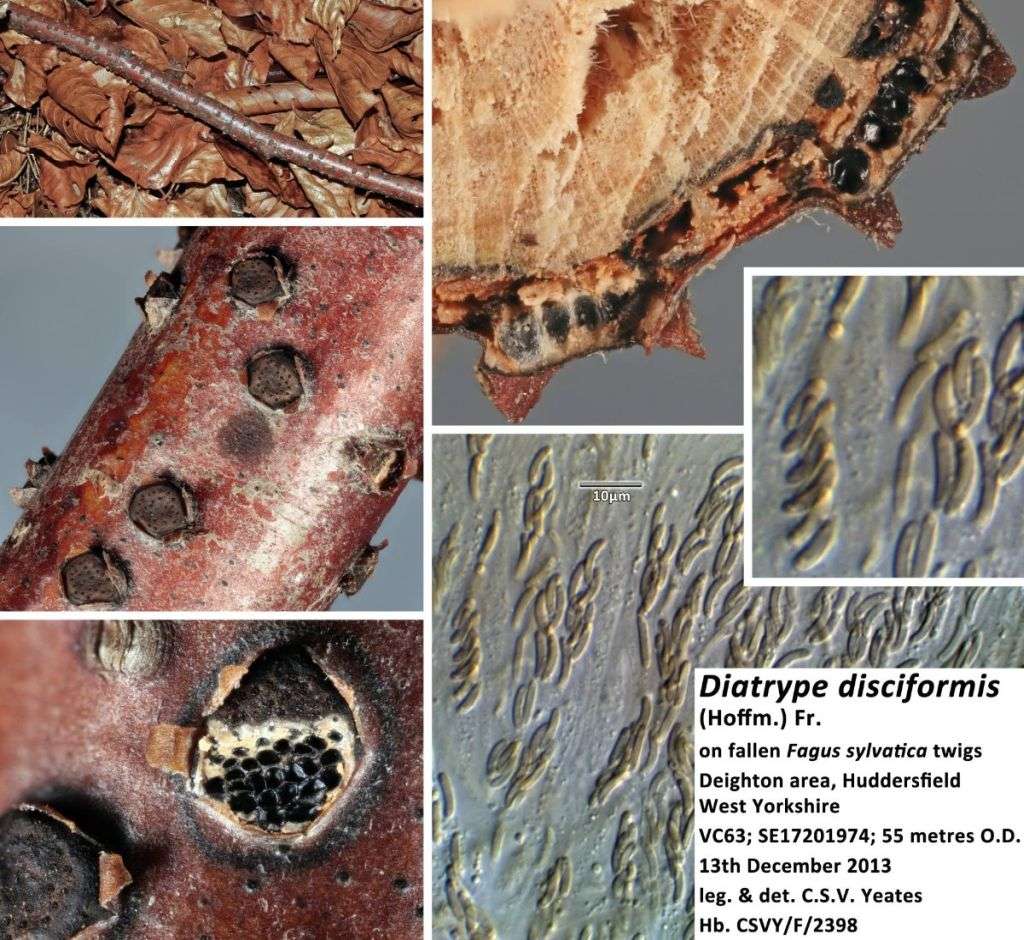
[attachment=0]Diatrype disciformis 0a.jpg[/attachment] Hope that helps
Chris
-
AuthorPosts


- You must be logged in to reply to this topic.