Forums › Forums › Fungi ID requests (post here if you aren’t sure what type of fungus you’ve found) › Entoloma elodes
- This topic is empty.
-
AuthorPosts
-
November 2, 2015 at 9:48 pm #29925
I believe this is Entoloma elodes, growing in a cemetery in Surrey: 
[attachment=1]_DSC4327 Entoloma elodes.jpg[/attachment] 
[attachment=0]_DSC4333 Entoloma elodes.jpg[/attachment] Spores in Melzer’s solution:

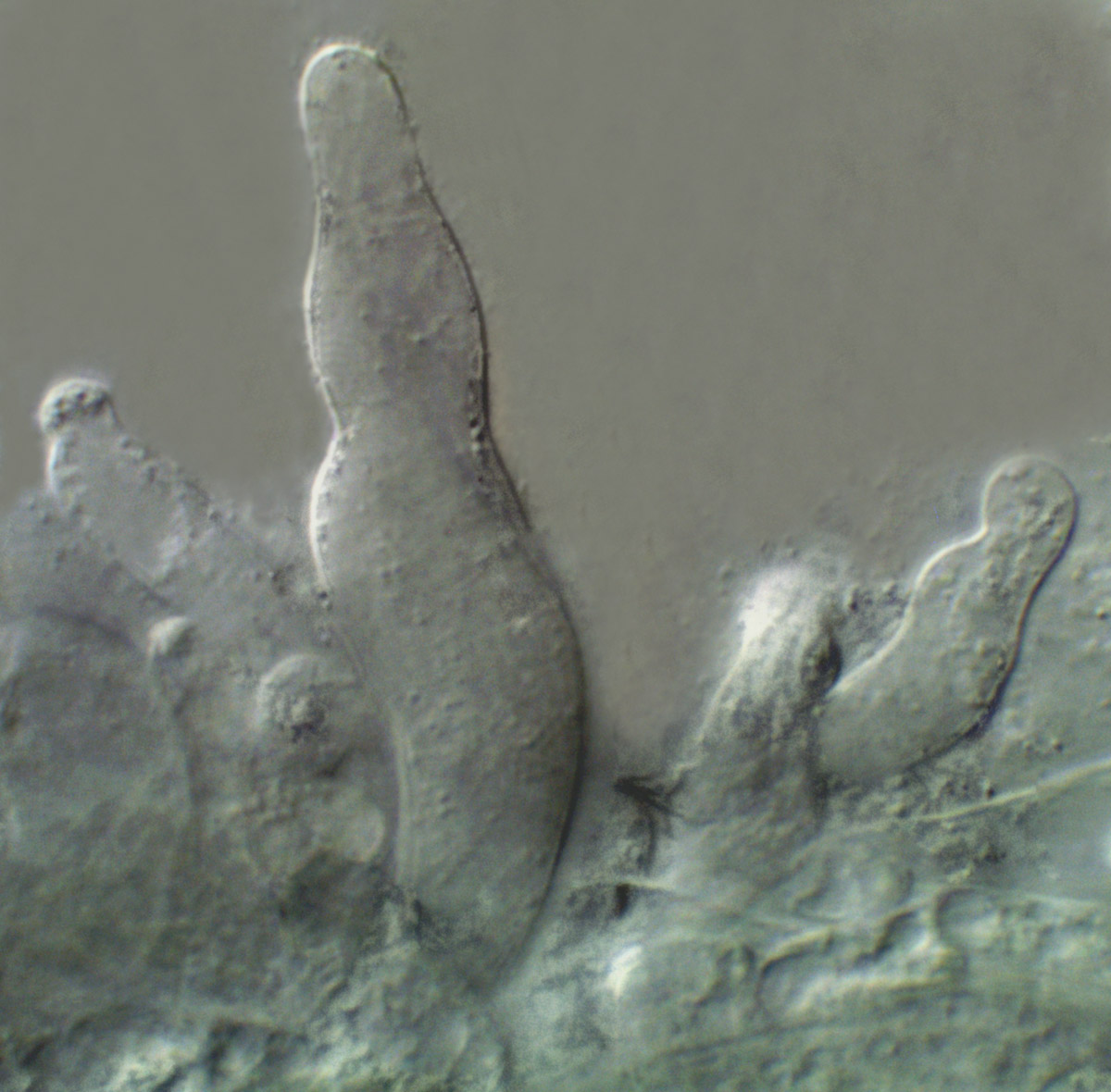
[attachment=3]Entoloma elodes spores in Melzers x100 composite.jpg[/attachment] Gill edge cystidia in Congo red:

[attachment=2]Entoloma elodes GEC Congo red x40 composite.jpg[/attachment] I have a slight concern as the specimen lacked a mealy smell and taste although I have a bug so perhaps an assistant nose was needed. The spore measurements came out a bit narrow, but after checking Fungi Europaei 5 it turns out that they should be measured with the apiculus in one corner of the imaginary enclosing rectangle, which is not what I did, so I’ll need to adjust my results. I originally thought this would key out to Entoloma porphyrophaeum, but most GEC are not capitate, and the fruiting bodies lacked lilac/purple tones, being grey brown. The slight blue tint at the base of the stem is an artifact of the photo (I blew the highlights, and they picked up colour from the blue sky). There were many specimens on a spongey mossy grassy plot in a cemetery, quite possibly peaty soil as the area around the town does have peaty soil.
November 2, 2015 at 10:08 pm #37204Hi Leif I was about to respond to this on a different thread – it appears to have moved. . . .
Entolomais a genus for which I would consider myself something of a tyro. I recently collected something very close to your fungus and I came to the conclusion that it was E. porphyrophaeum
Funga Nordica“cheilocystidia often with a moliniform neck and rounded capitulum” (or at least how I interpreted that feature). I ruled out E. elodesfor my collection as there was no evidence of the caps being hygrophanous; it was E. jubatumwhich is causing me confusion. 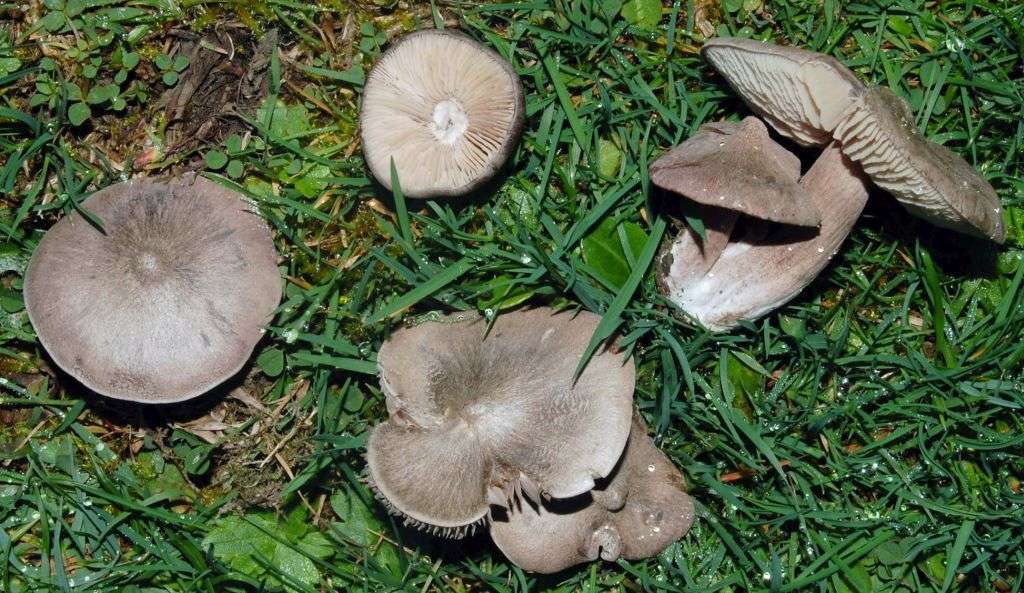
[attachment=5]Entoloma 01.jpg[/attachment] 
[attachment=4]Entoloma 09.jpg[/attachment] 
[attachment=3]Entoloma 12.jpg[/attachment] 
[attachment=2]Entoloma 13.jpg[/attachment] 
[attachment=1]Entoloma 14.jpg[/attachment] 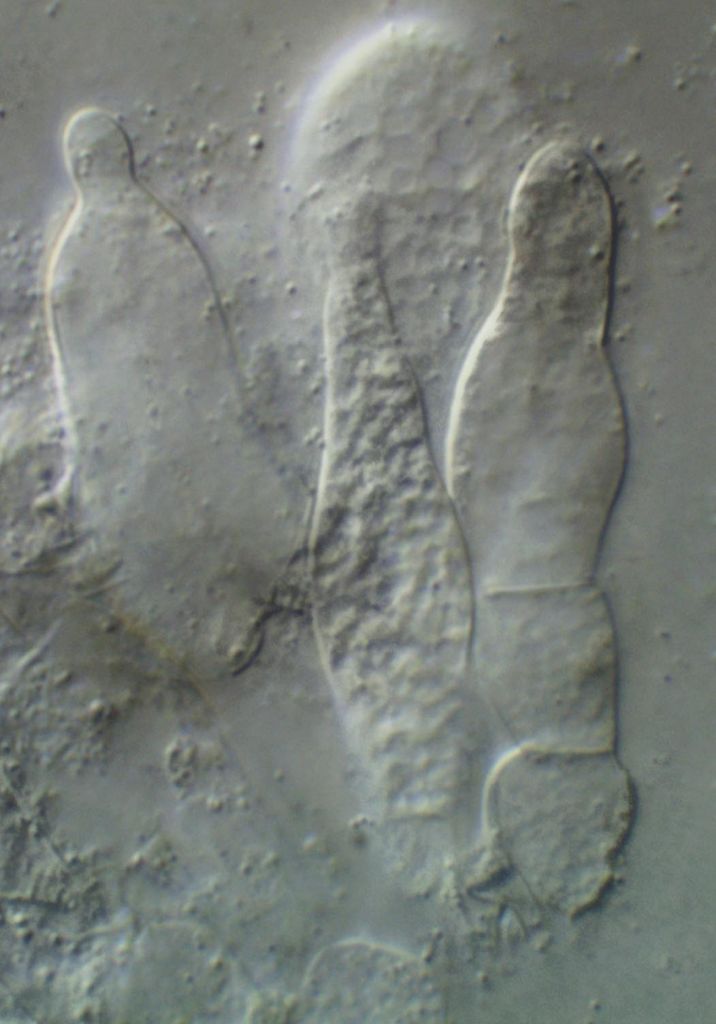
[attachment=0]Entoloma 15.jpg[/attachment]
I am certainly not claiming to be correct here – your post has been a timely one to piggy-back on
cheers
Chris
November 3, 2015 at 9:20 am #37205Leif wrote:I believe this is Entoloma elodes, growing in a cemetery in Surrey:
I have a slight concern as the specimen lacked a mealy smell and taste although I have a bug so perhaps an assistant nose was needed. The spore measurements came out a bit narrow, but after checking Fungi Europaei 5
it turns out that they should be measured with the apiculus in one corner of the imaginary enclosing rectangle,Hi Leif
I think the stylised drawing in
Fungi Europaei 5is fine for cruciform type spores but doesn’t really work for heterodiametrical spores. Take your spores 1 and 5: I would measure these from the base of the apiculus straight down the centre and then at 90 degrees across at the widest. Visually, your spores don’t look broad enough for E. elodes, based on my experience. E. elodesis not uncommon here and always found in very wet habitat, although I appreciate the books suggest dryer habitats as well. My images for this species are early and poor, I must do some more. Cheers, Chris
November 3, 2015 at 9:38 am #37206Hello Chris Sorry about the confusion, I developed some doubts, so thought I would pass it by others here first. Your microscopy results look very similar to mine, albeit yours are beautiful pictures, and mine aren’t. The fungi look very similar too.
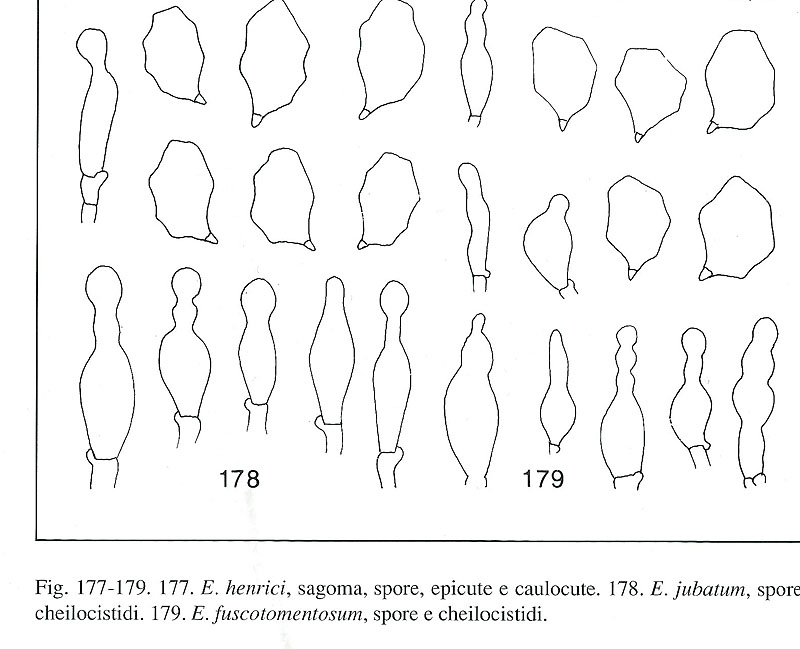
I used Fungi Europaei 5. Here are a couple of scans of some drawings:
[attachment=1]SCAN0001.JPG[/attachment] 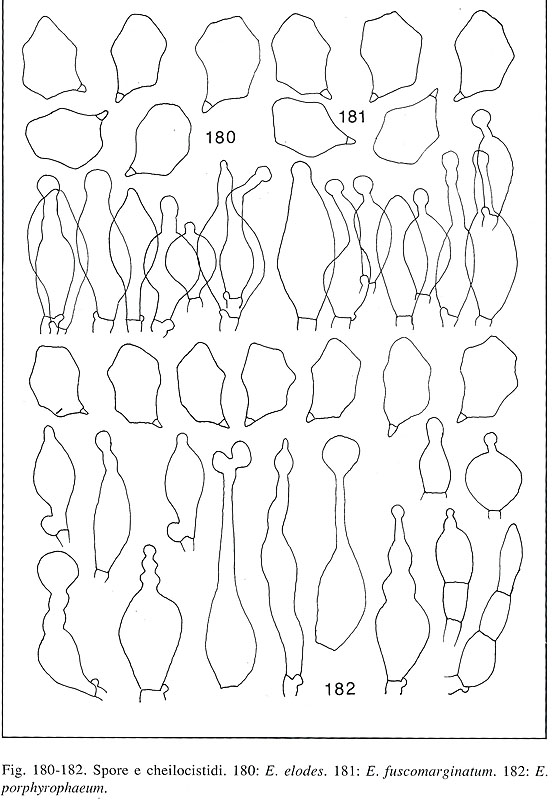
[attachment=0]SCAN0002.JPG[/attachment] (My understanding is that it is okay to post a few scans from a book for educational purposes as long as the excerpts are a tiny proportion of the book.)
The GEC do not match Entoloma porphyrophaeum whereas they do match E elodes. The colours do not match E porphyrophaeum as I saw no lilac or purple shades. Like you E jubatum was another I considered, but the GEC do not match as they should be predominately capitate.
The doubt I had is that Nordeloos says E elodes is hygrophanous when wet, I did not notice that, and I did not notice any smell either.
November 3, 2015 at 9:48 am #37207Chris Johnson wrote:
Hi LeifI think the stylised drawing in
Fungi Europaei 5is fine for cruciform type spores but doesn’t really work for heterodiametrical spores. Take your spores 1 and 5: I would measure these from the base of the apiculus straight down the centre and then at 90 degrees across at the widest. Visually, your spores don’t look broad enough for E. elodes, based on my experience. E. elodesis not uncommon here and always found in very wet habitat, although I appreciate the books suggest dryer habitats as well. My images for this species are early and poor, I must do some more. Cheers, Chris
Thanks Chris. I did notice that your spores were wider with a smaller Q. Do you always notice a mealy smell? And how does the cap change on drying, assuming you can remember?
November 3, 2015 at 10:23 am #37208Leif wrote:Thanks Chris. I did notice that your spores were wider with a smaller Q. Do you always notice a mealy smell? And how does the cap change on drying, assuming you can remember?
I don’t have a good sense of smell but when others have been with me it has been noticeable. I’ve never observed
E. elodesas hygrophanous when wet, but his comment ‘slightly pallescent on drying’ is good. Just reading Funga Nordica, it notes the habitat as in sphagnum and peat bogs, which is my experience.
Chris
November 3, 2015 at 10:59 am #37209Chris Johnson wrote:Leif wrote:
..hygrophanous when wetChris
This seems a strange thing to say when hygrophanous is a change of state. Isn’t it a bit like saying ice is thawing when it’s solid?
November 3, 2015 at 11:32 am #37210Thanks. I would say these were slightly pallescent on drying, and evenly so. FE5 quotes the habitat as in “peaty soil, and in living Sphagnum in bogs, or wet places in coniferous and deciduous forests; also in drier heaths on peaty soil with Calluna, Empetrum etc.” The ones I found were in a damp very mossy area of a grave yard, with lots of Hygrocybe nearby. Records outside Scotland in the FRDBI seem to have a more varied habitat, but may not be correctly IDed, or independently confirmed. November 3, 2015 at 11:38 am #37211adampembs wrote:Leif wrote:
..hygrophanous when wet
This seems a strange thing to say when hygrophanous is a change of state. Isn’t it a bit like saying ice is thawing when it’s solid?
The quote from FE5 is actually “hygrophanous when moist”. It does seem a little odd. I suspect he means that specimens do not appear hygrophanous, unless they start out moist. I would not say the ones I found were ‘moist’ as such.
November 3, 2015 at 12:15 pm #37212Chris Yeates wrote:Hi Leif
I was about to respond to this on a different thread – it appears to have moved. . . .
Entolomais a genus for which I would consider myself something of a tyro. I recently collected something very close to your fungus and I came to the conclusion that it was E. porphyrophaeumFunga Nordica“cheilocystidia often with a moliniform neck and rounded capitulum” (or at least how I interpreted that feature). I ruled out E. elodesfor my collection as there was no evidence of the caps being hygrophanous; it wasE. jubatumwhich is causing me confusion. I am certainly not claiming to be correct here – your post has been a timely one to piggy-back on
cheers
Chris
Hi Chris
You don’t say what was confusing you regarding
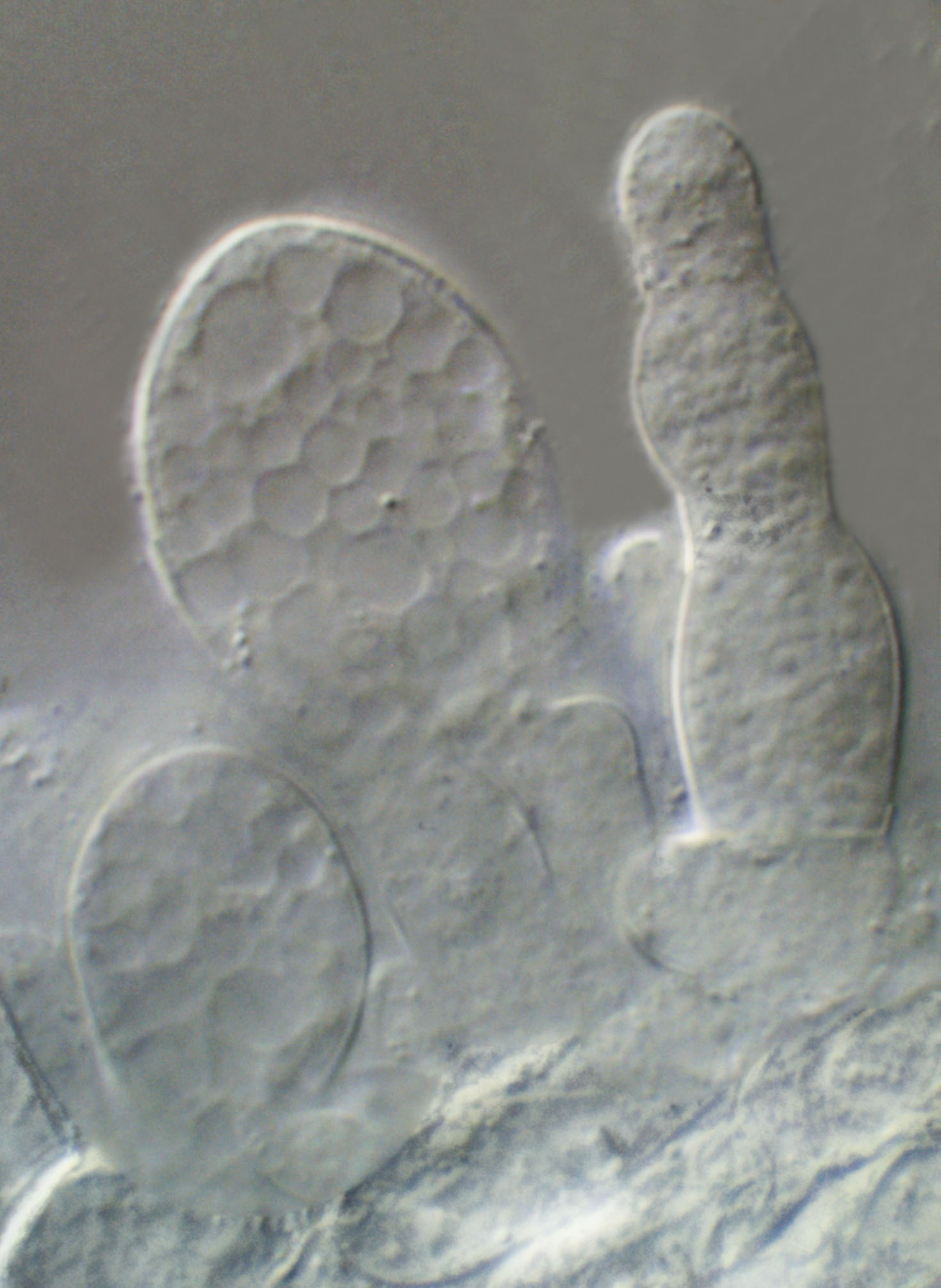
E. jubatumbut the main character I have found is the consistent cheilocystidia which are predominantly lecythiform (misspelt on my website 😯 ) with the occasional one with a swollen neck below the capitulum (not sure if a single swelling passes a moliniform?) Note the one in the image, left of centre, where the swelling is broader than the head. Other species in this group tend to have a greater range of cheilocystidia.Don’t know if this is any help.
Regards, Chris

[attachment=0]Entoloma-jubatum-06.jpg[/attachment] November 3, 2015 at 12:34 pm #37213Comparing them to my collection, the cheilocystidia in Nordeloos’ figures closest lead me to E. porphyophaeum– I note especially those with septa, which I saw in mine; though it has to be said it seems to me with this group cheilocystidia shape is very heterogeneous, even from the same gill. I hasten to add this comment is purely about
mycollection, Leif’s may well be different. As happens so often in mycology one needs to make several collections of certain species-groups in order to develop a picture of the range of variability / similarities – I’m certainly not there with Entolomasubg. Trichopilus. The situation is not helped by the fact that porphyry itself is not particularly purplish/lilaceous, but tends towards the reddish:
https://en.wikipedia.org/wiki/Porphyry_%28geology%29https://en.wikipedia.org/wiki/Porphyry_%28geology%29” class=”bbcode_url”> There are lots of images on the net, but I usually treat these with caution when dealing with critical species. Ones I think are reliable; knowing the originators, are:
http://www.bioimages.org.uk/html/r133745.htmhttp://www.bioimages.org.uk/html/r133745.htm” class=”bbcode_url”> http://www.asturnatura.com/fotografia/setas-hongos/entoloma-elodes-fr-p-kumm-2/13475.html ” class=”bbcode_url”> http://www.asturnatura.com/fotografia/setas-hongos/entoloma-elodes-fr-p-kumm-2/13475.html http://www.asturnatura.com/fotografia/setas-hongos/entoloma-porphyrophaeum-fr-p-karst-3/8339.html ” class=”bbcode_url”> http://www.asturnatura.com/fotografia/setas-hongos/entoloma-porphyrophaeum-fr-p-karst-3/8339.html By the way the epithet “helodes” or sometimes “elodes” comes from the Greek word “έλος” meaning a marsh or swamp – e.g. the st john’s wort
Hypericum elodesand the fungi Cortinarius helodes, Hebeloma helodes, Lactarius helodesetc. cheers
Chris
November 3, 2015 at 3:48 pm #37214Reading through again I noticed I had missed the presence of 2 and 4 spored basidia in the FE5 description of Entoloma porphyrophaeum, but only 4 spored for E elodes, whereas I have seen both two and four spored basidia in my specimen. That feature is not mentioned in FN despite a common author. Given Chris Y’s pointing out that the gill edge is heterogenous, as stated in the literature, (and my taking the FE5 drawings too literally) and Chris J’s reservations based on his collections, notably the narrow spores, and the habitat, I think the balance is that this is Entoloma porphyrophaeum, which is quite common in southern England, whereas E. elodes has one very old record from Surrey by ‘anon’ (a prolific collector) with presumably no voucher specimen. I will file this under Entoloma porphyrophaeum with a note that the ID was reached after discussions with Chris Y and Chris J and that it is unconfirmed. Future collections at the same site may reveal some violet specimens. Regarding colour, Kibby in his popular guide book (a popular guide but a knowledgeable author) says that strong violet tones are present when young, and disappear with age.
Thanks all for your comments.
By the way, Capsicum annuum, the chile pepper used in curry, is so named because it was thought to be annual, whereas it is perennial, and Capsicum chinense, a chile pepper favoured by Jamaicans, was so called because it was thought to originate from China, whereas it originates from Central or South America. Perhaps botanists are human too.
As a footnote, is anyone here yearning for the simplicity of the Inocybe genus?
😆 Never thought I would say that, but they do seem more clearcut.November 3, 2015 at 7:51 pm #37215Leif wrote:By the way, Capsicum annuum, the chile pepper used in curry, is so named because it was thought to be annual, whereas it is perennial, and Capsicum chinense, a chile pepper favoured by Jamaicans, was so called because it was thought to originate from China, whereas it originates from Central or South America. Perhaps botanists are human too.
The Black-headed Gull has the scientific nameChroicocephalus ridibundus“ridibundus” means “laughing” The Laughing Gull has the scientific name
Leucophaeus atricillaThe Mediterranean Gull has the scientific name
Ichthyaetus melanocephalus“melanocephalus” means “black-headed” (the Black-headed Gull has – of course 🙄 – abrownhead in breeding plumage . . . . ) Larus hyperboreusis the Glaucous Gull Larus glaucoidesis (naturally 🙄 – breed in Iceland)Ornithologists are definitely human
 November 3, 2015 at 10:22 pm #37216Leif wrote:
As a footnote, is anyone here yearning for the simplicity of the Inocybe genus?
😆 Never thought I would say that, but they do seem more clearcut.I am, having just given up on a Psathyrella. Anyone want to try to help ID it? Any fans of Psathyrella on the forum?
November 4, 2015 at 9:26 am #37217Not a fan exactly but you put it up and I’ll knock it down – always up for a challenge… Some Psathyrella come out nicely, others are a real pain. I mainly use Kits van Waveren and am trying to use Melzer’s online Key and descriptions (but not getting on too well with it). What’s Funga Nordica like on the Genus and who does it? There are rumours of a forthcoming volume in
Fungi Europaeiseries – definitely one I’ll purchase. -
AuthorPosts




- You must be logged in to reply to this topic.